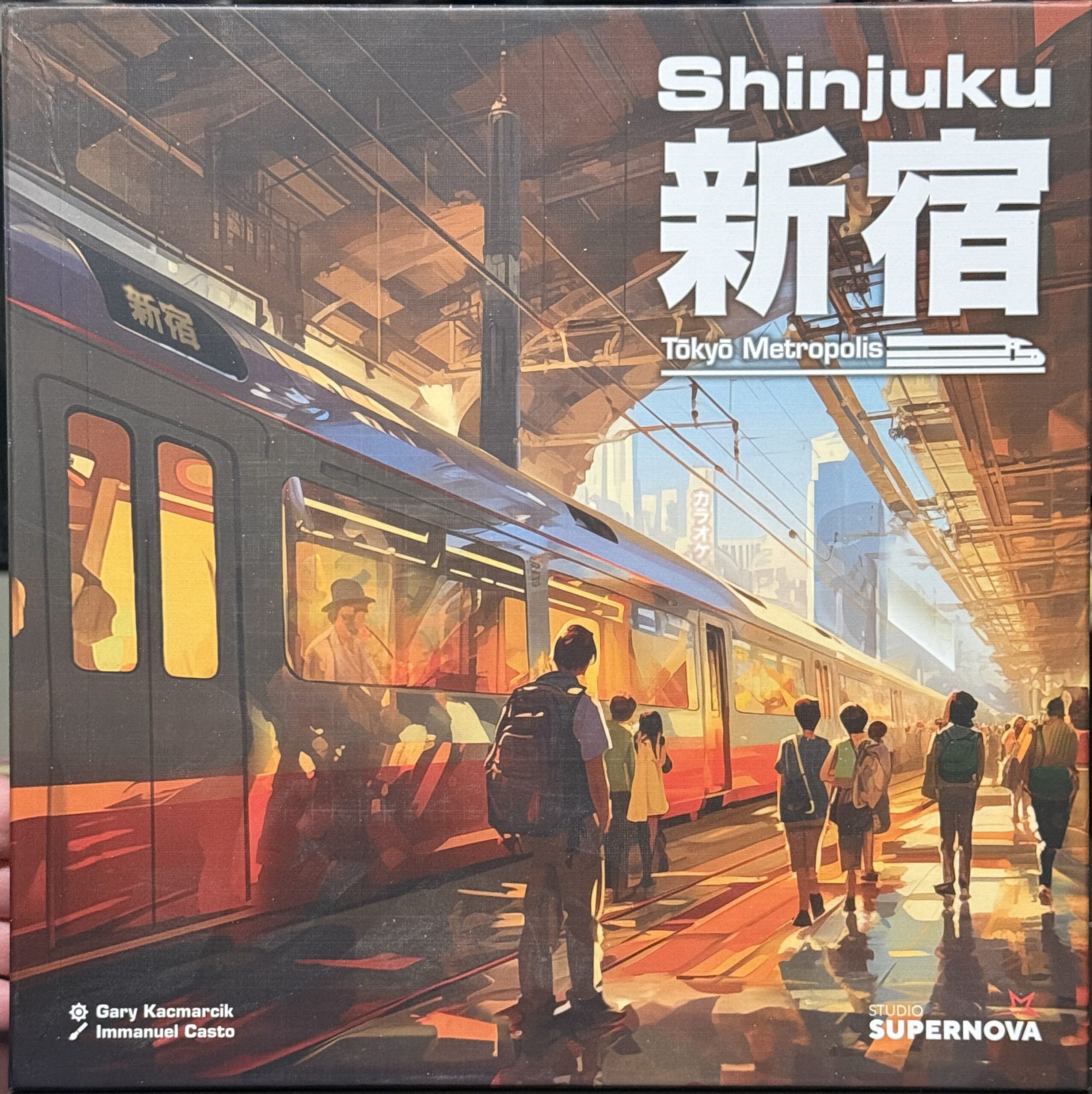
Last night John brought some unusual and hard-to-find games. I’ve linked to them as best I could.
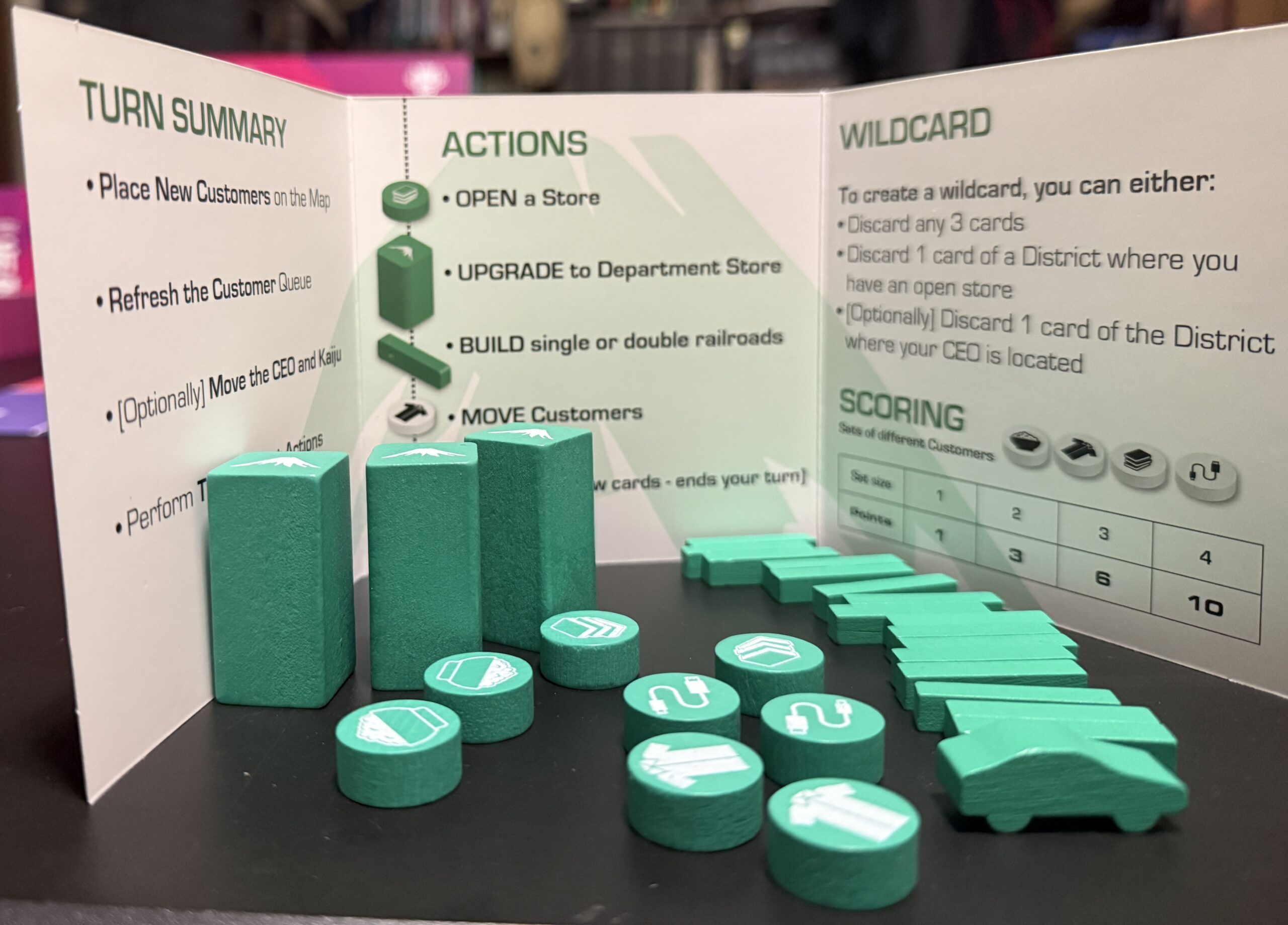
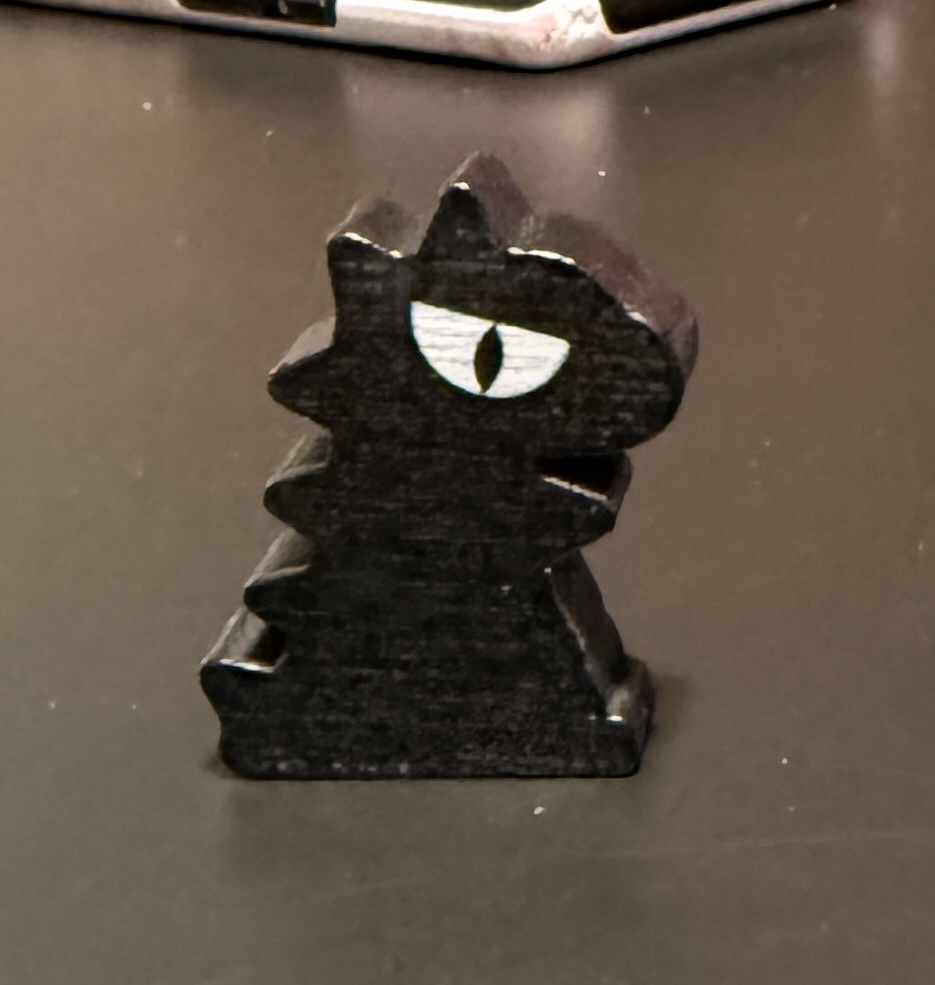
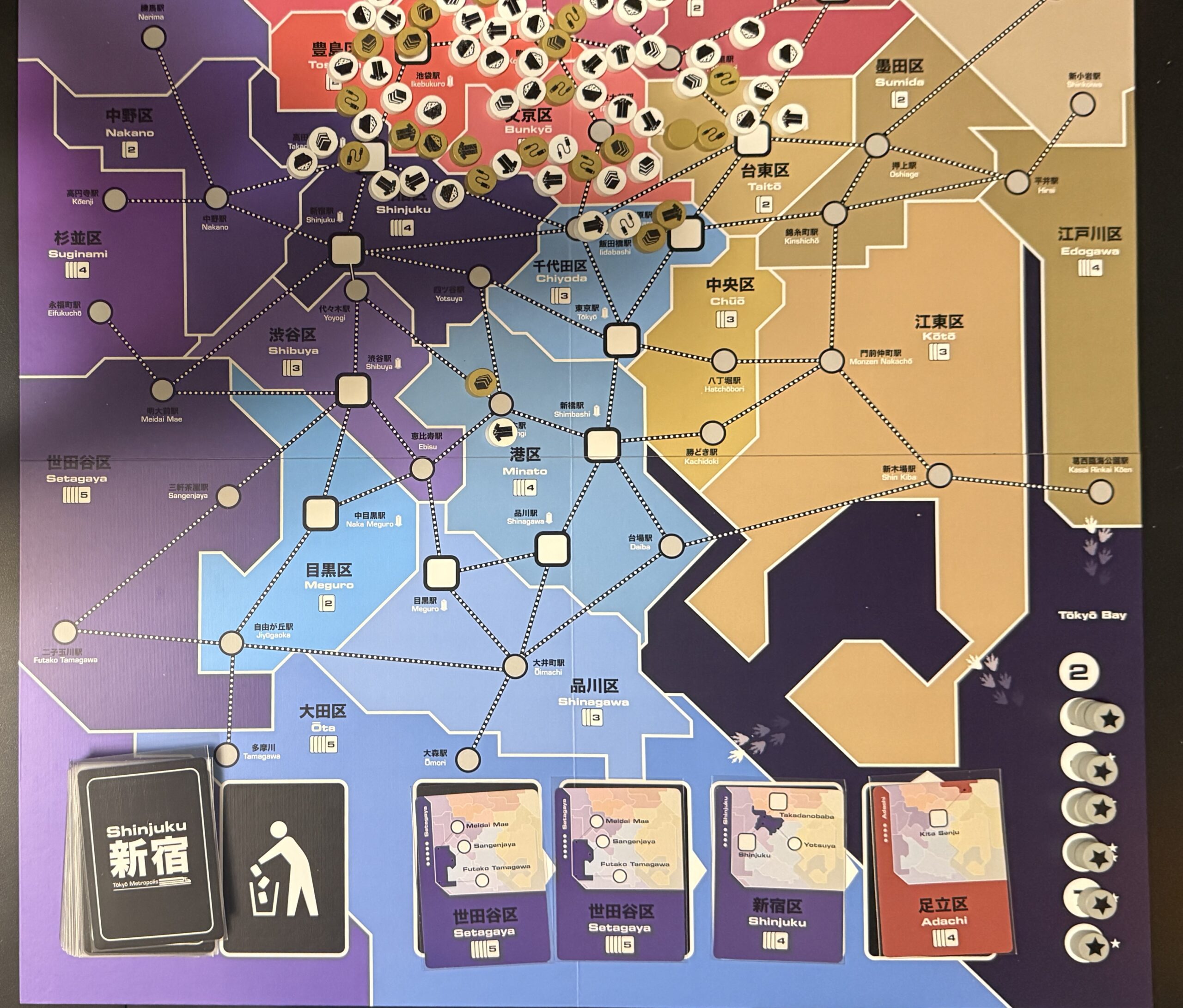
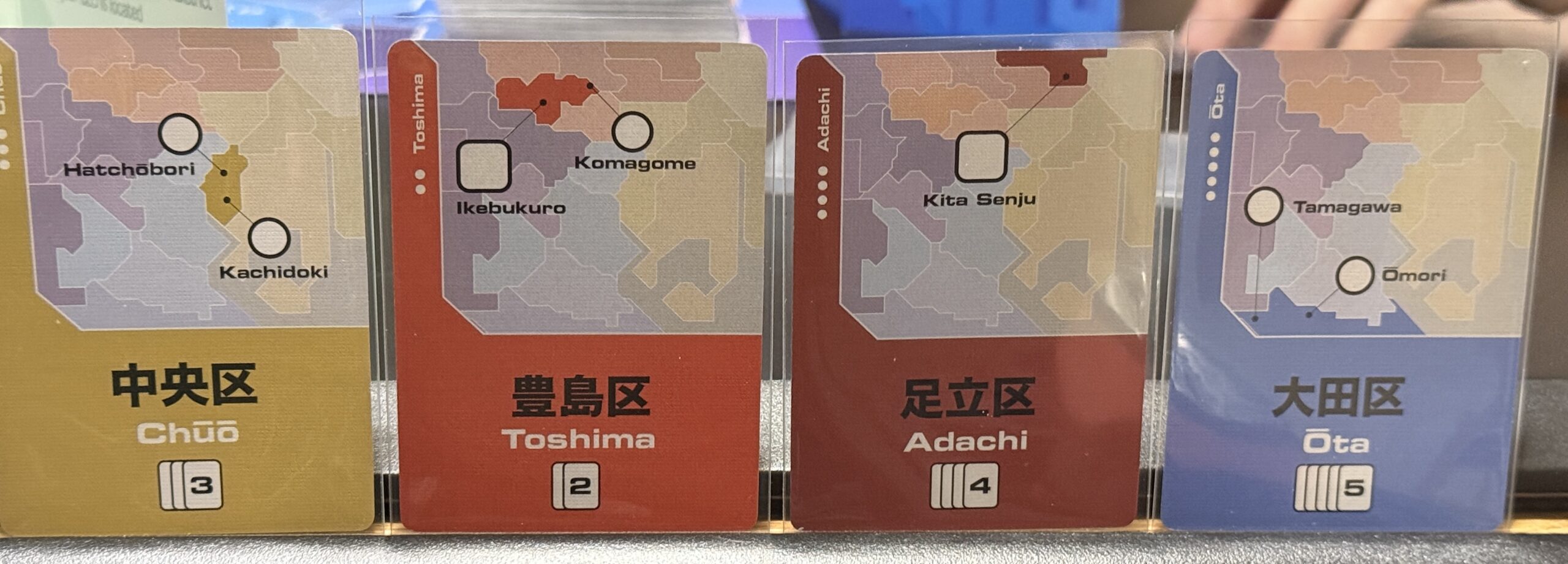
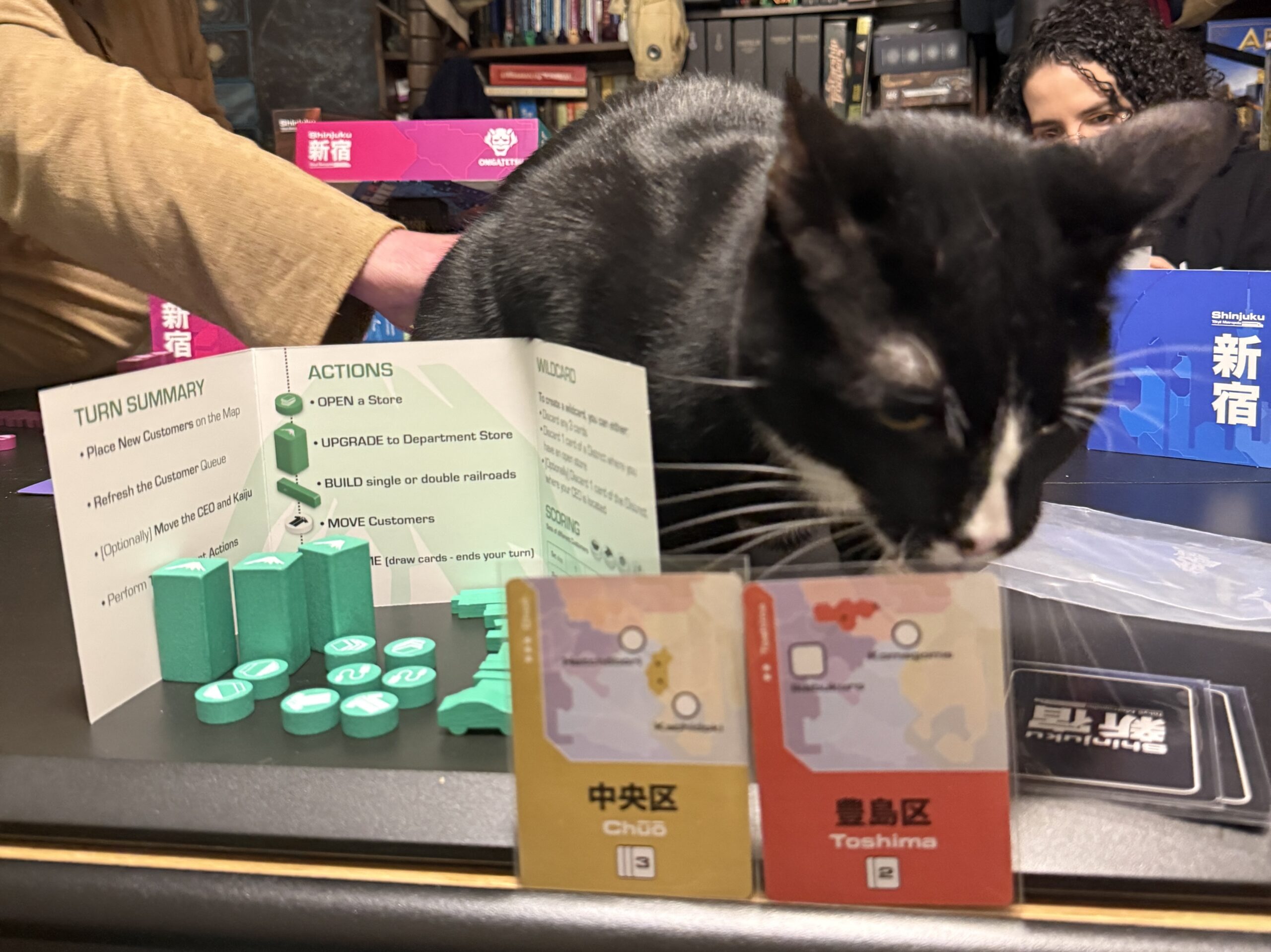
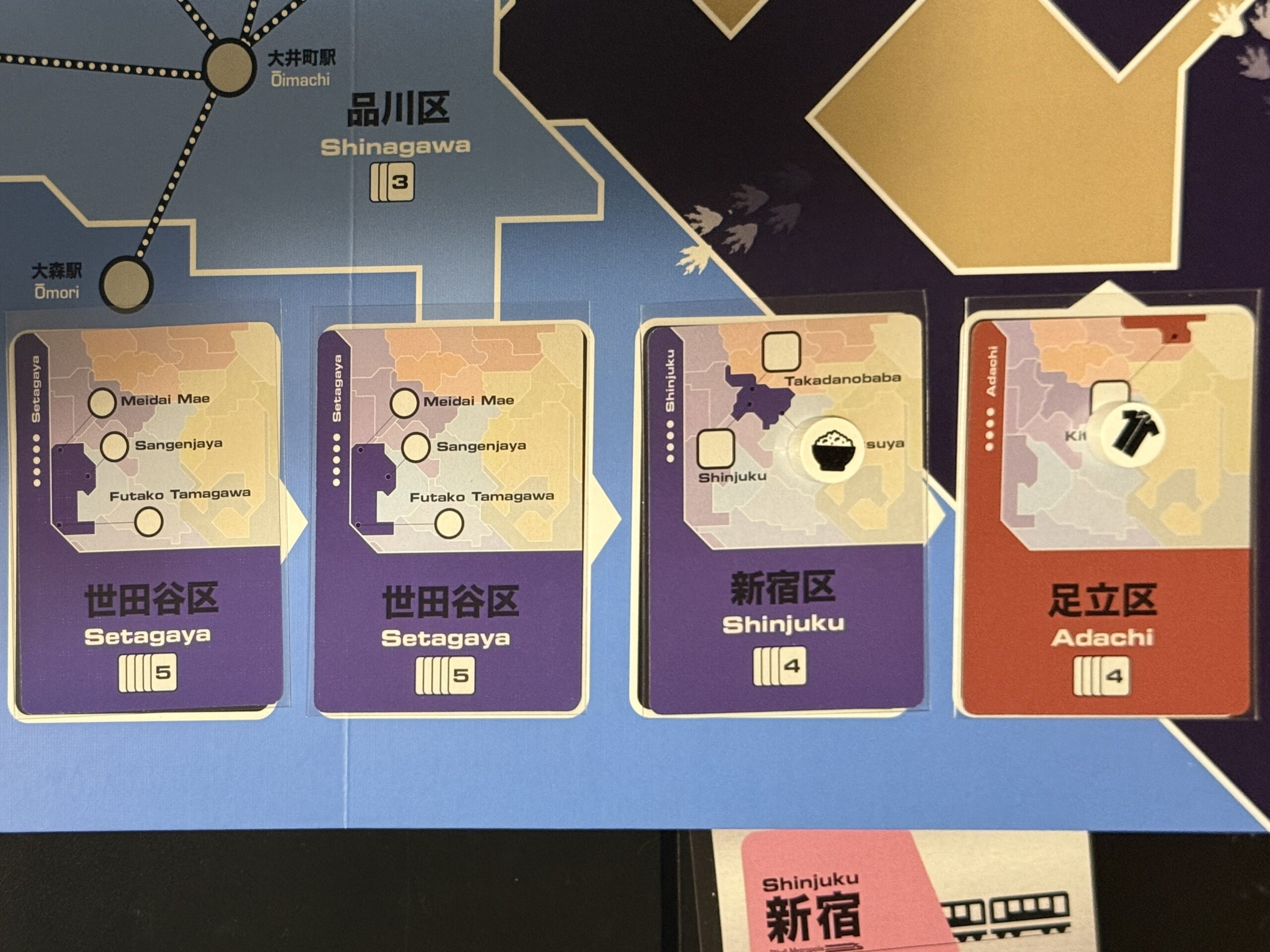
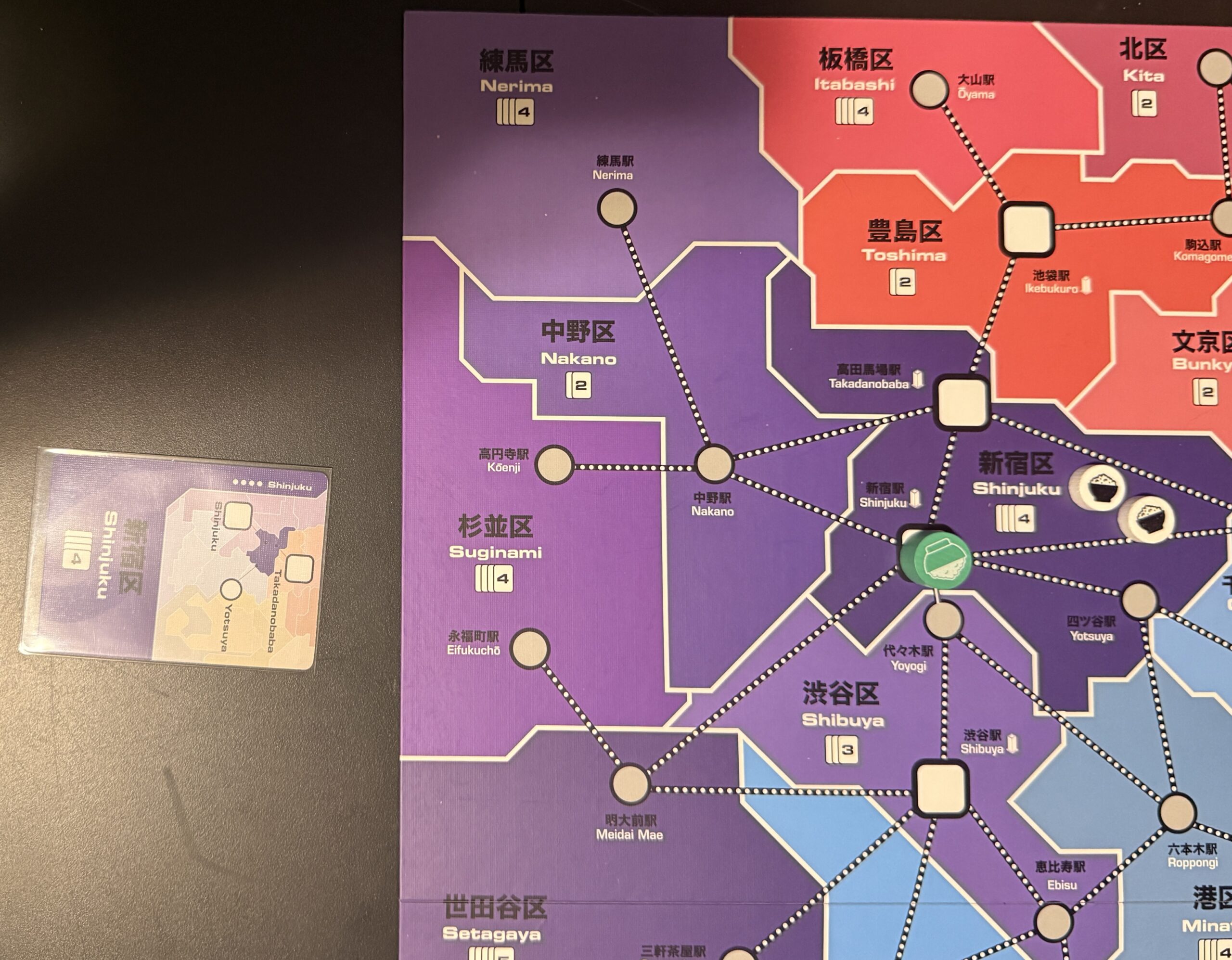
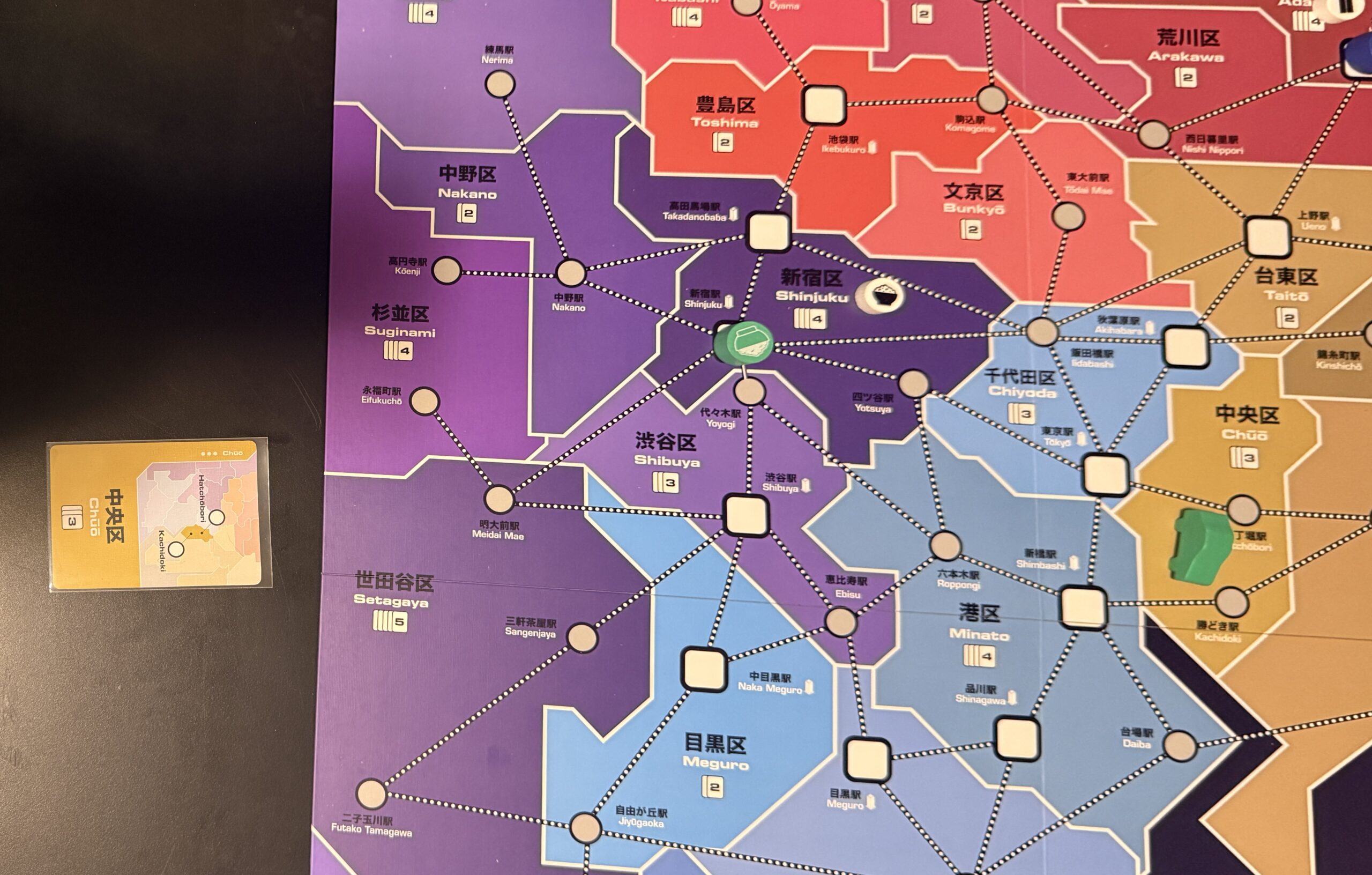
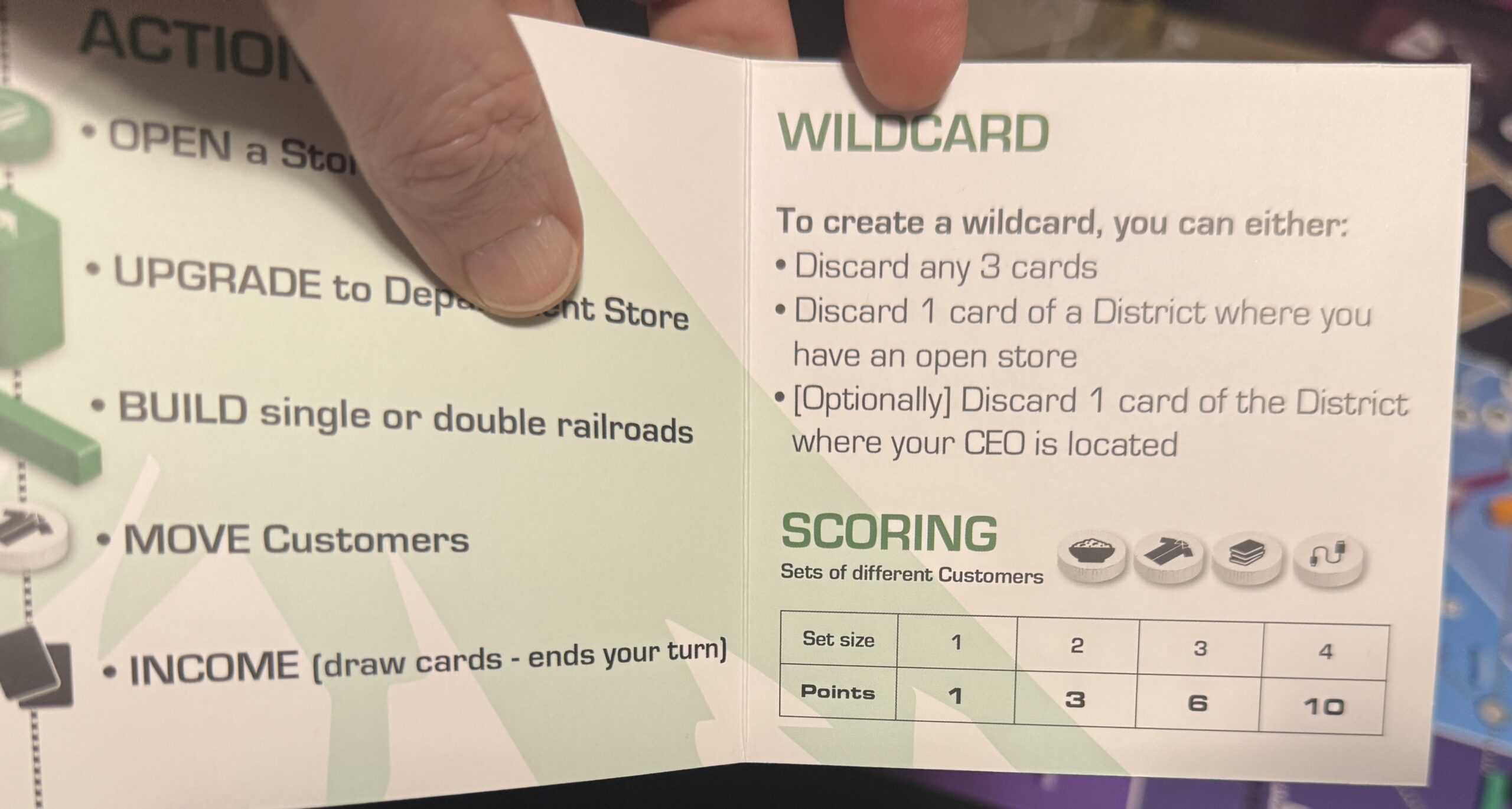
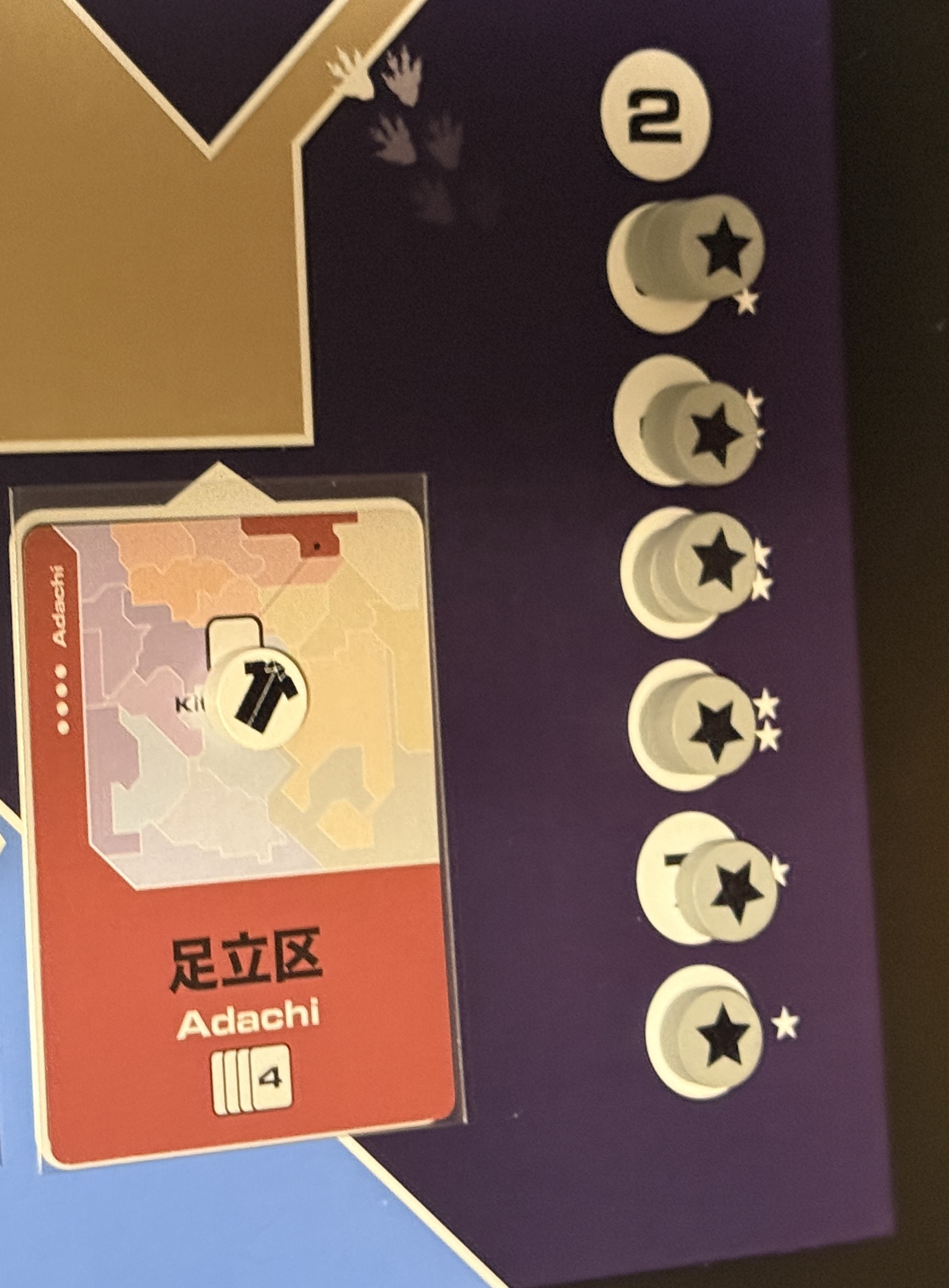
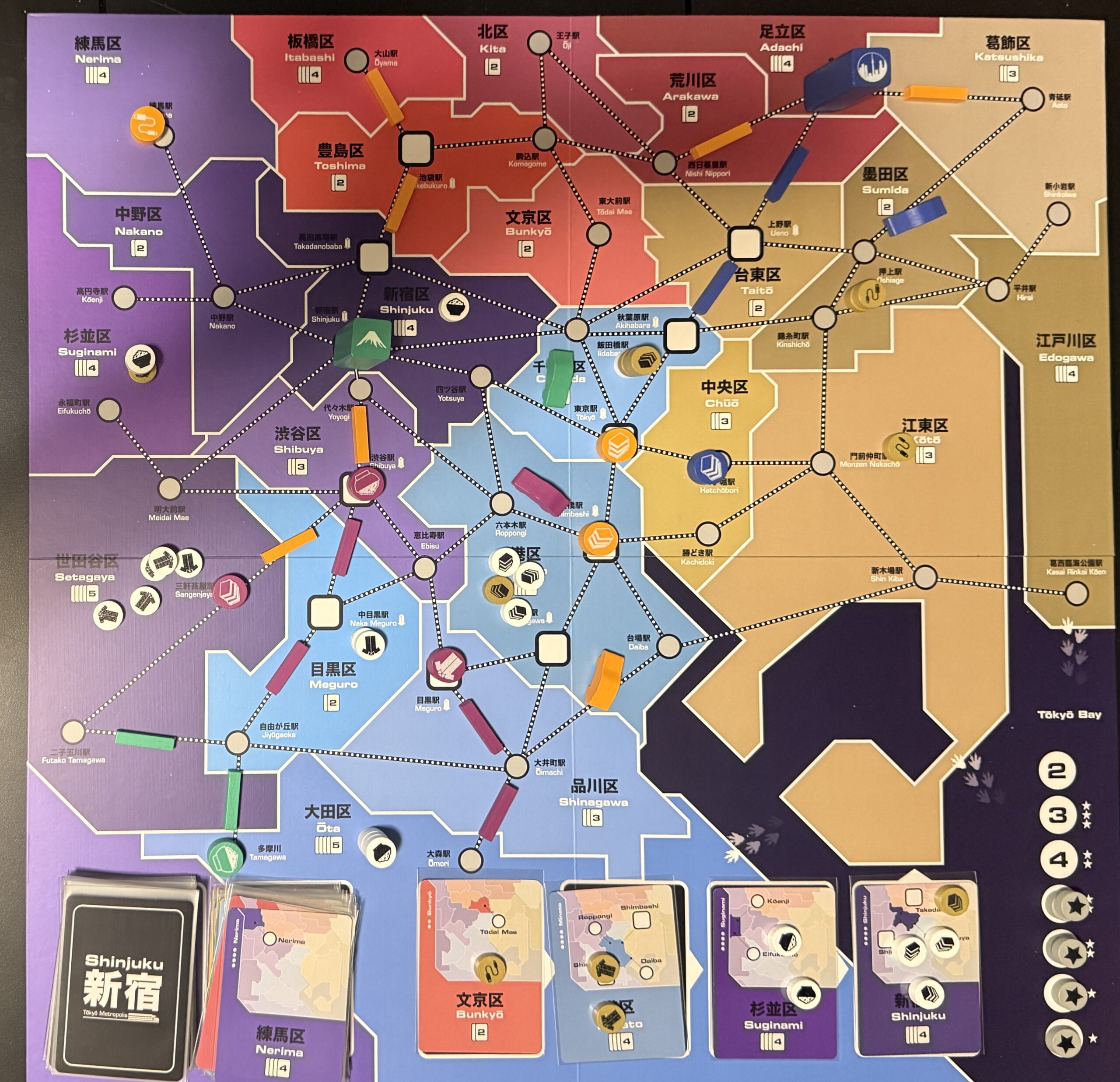
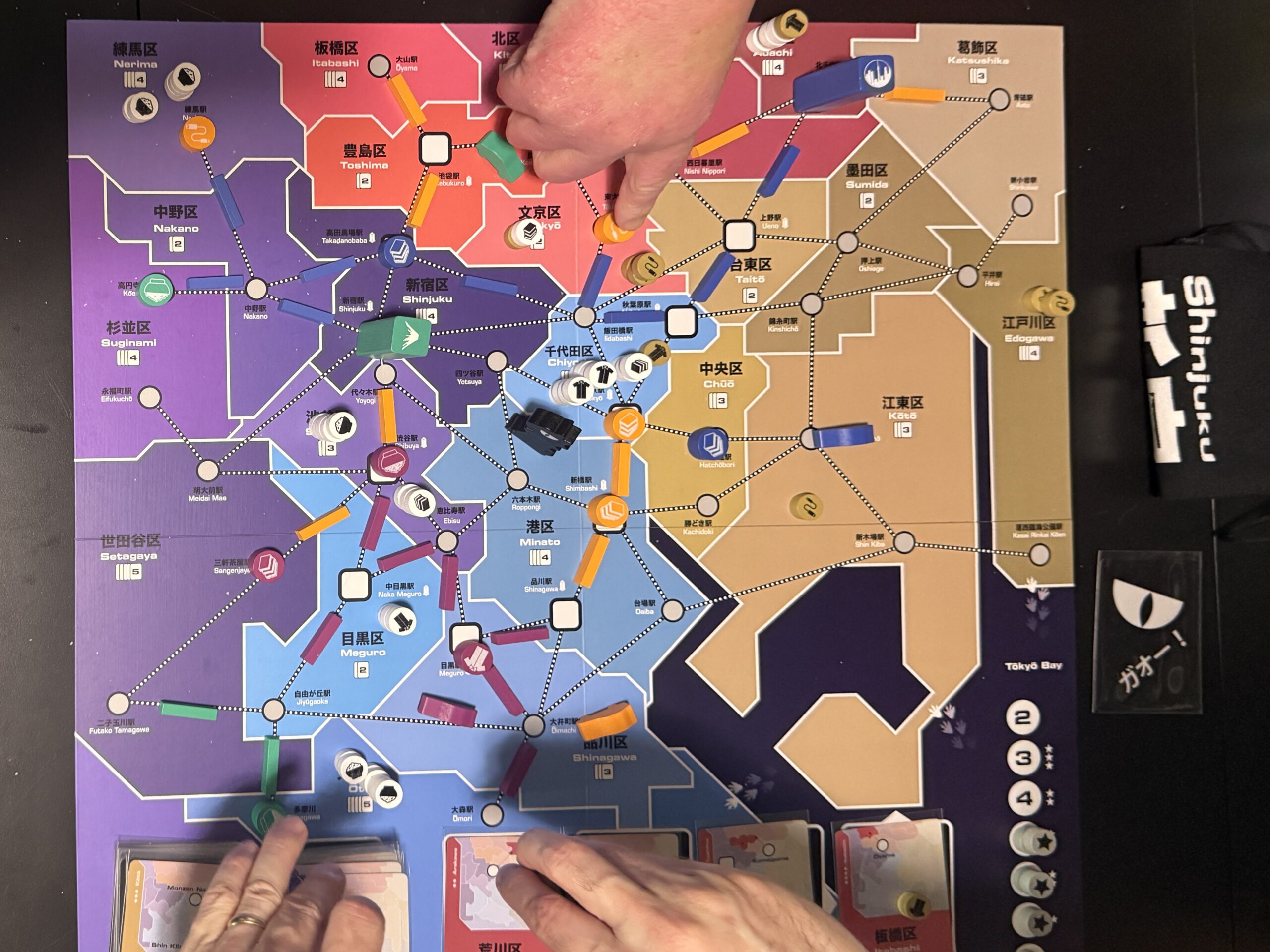
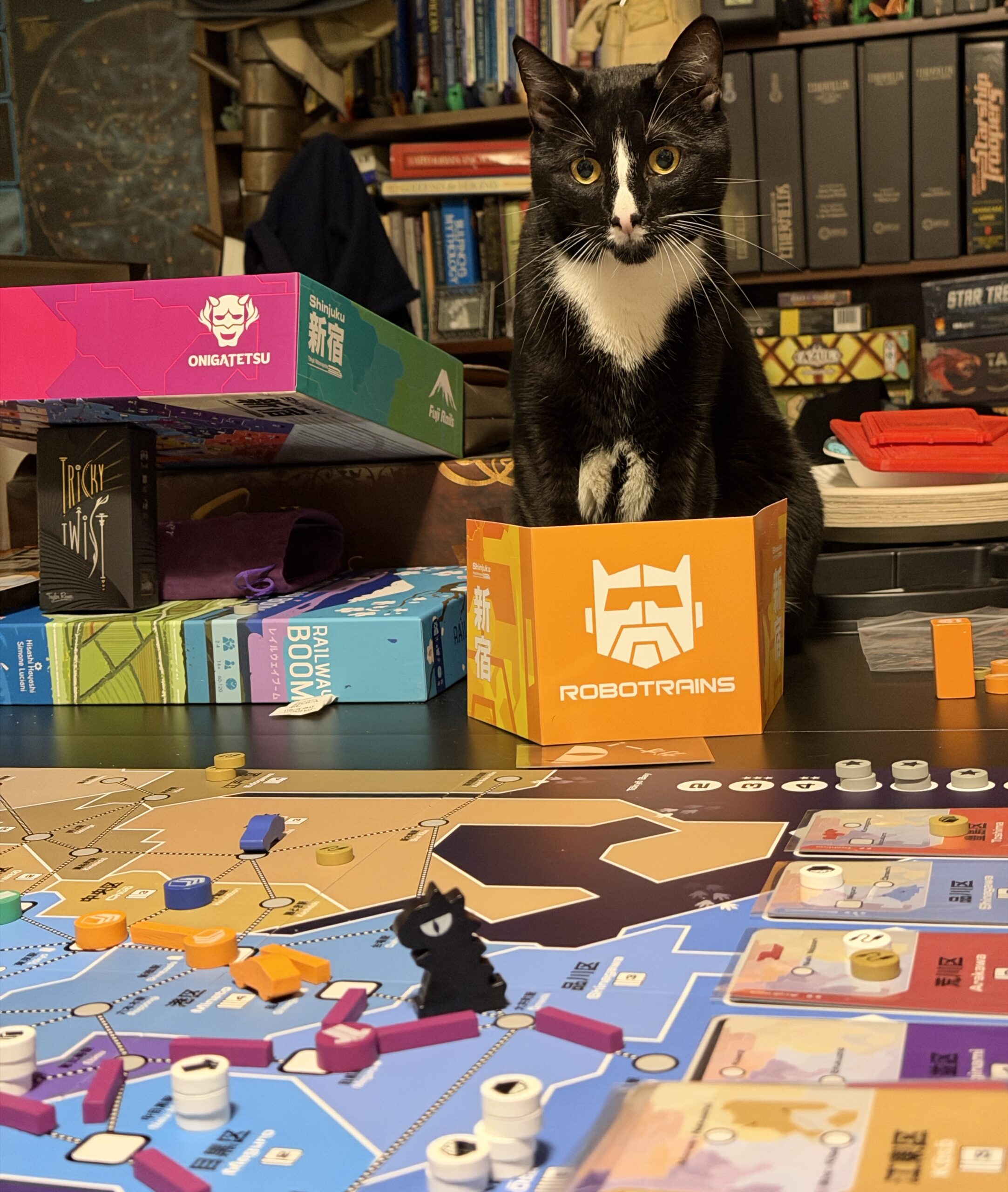
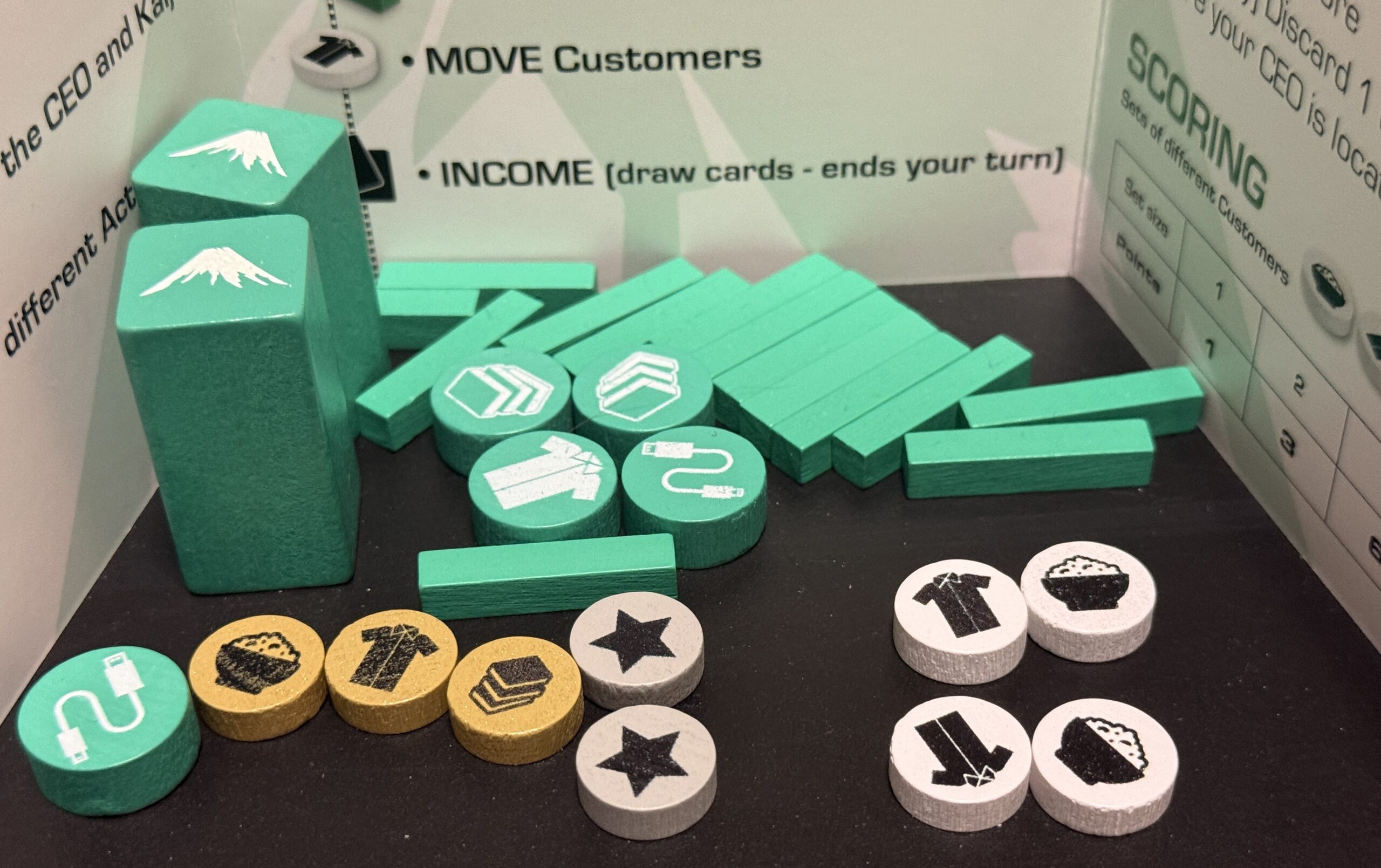
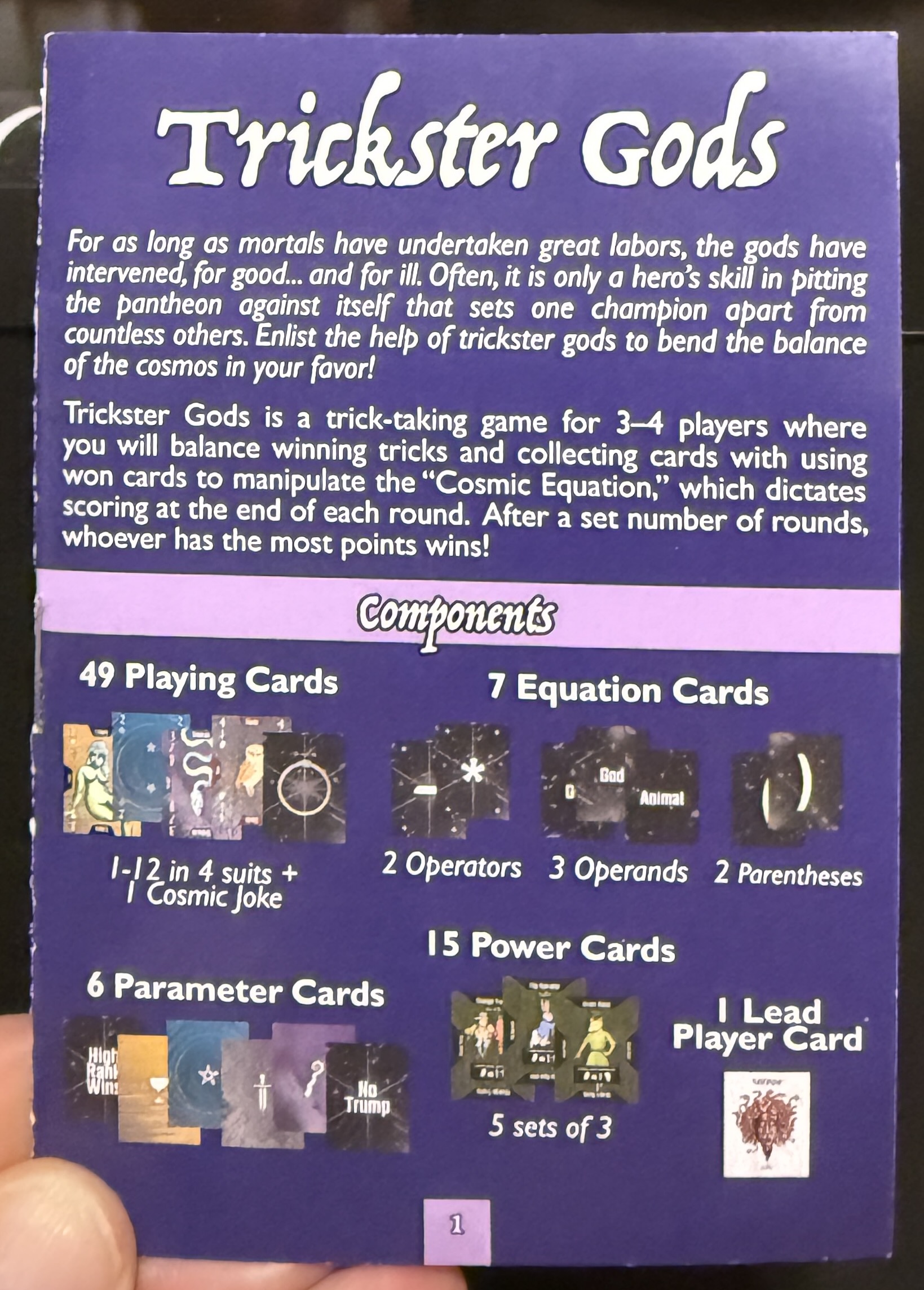
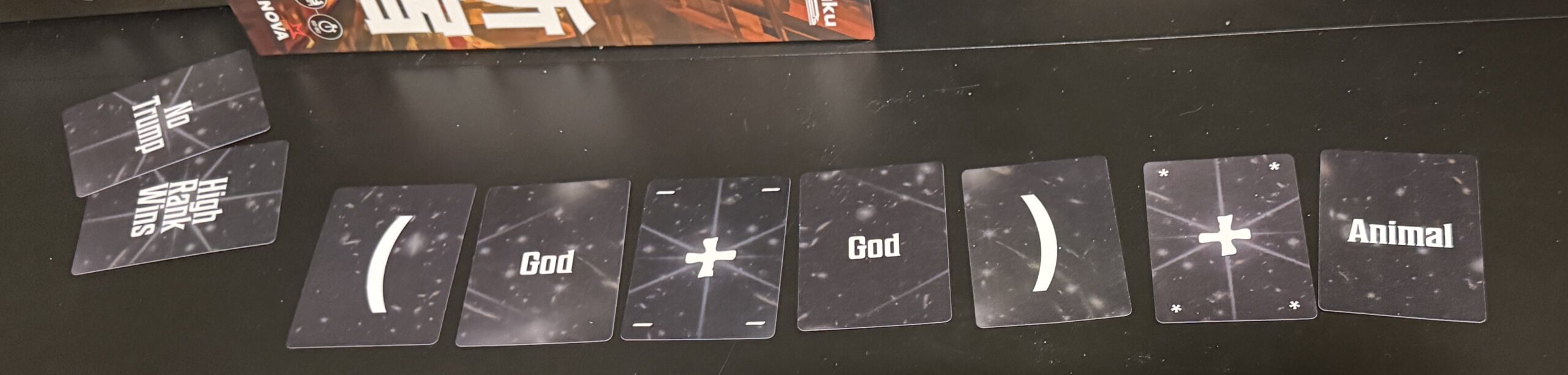
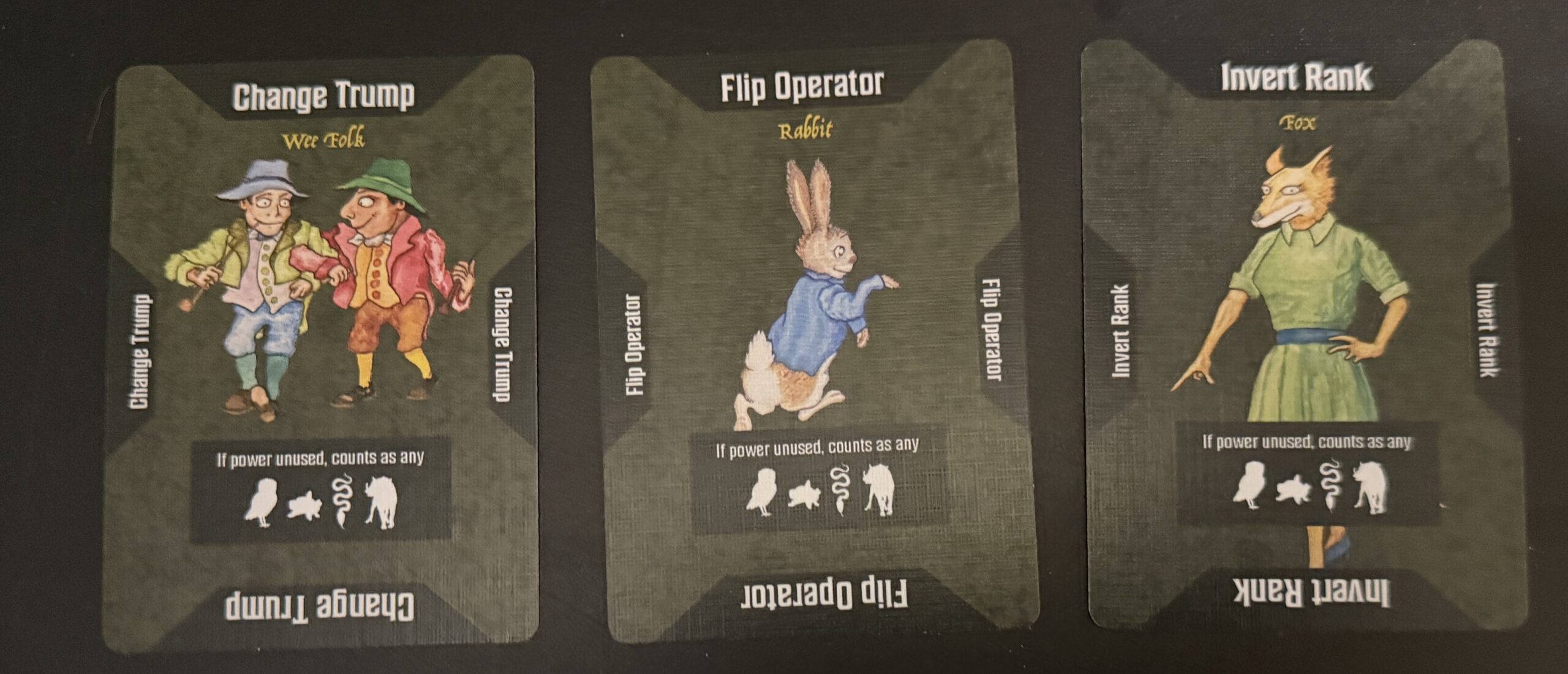
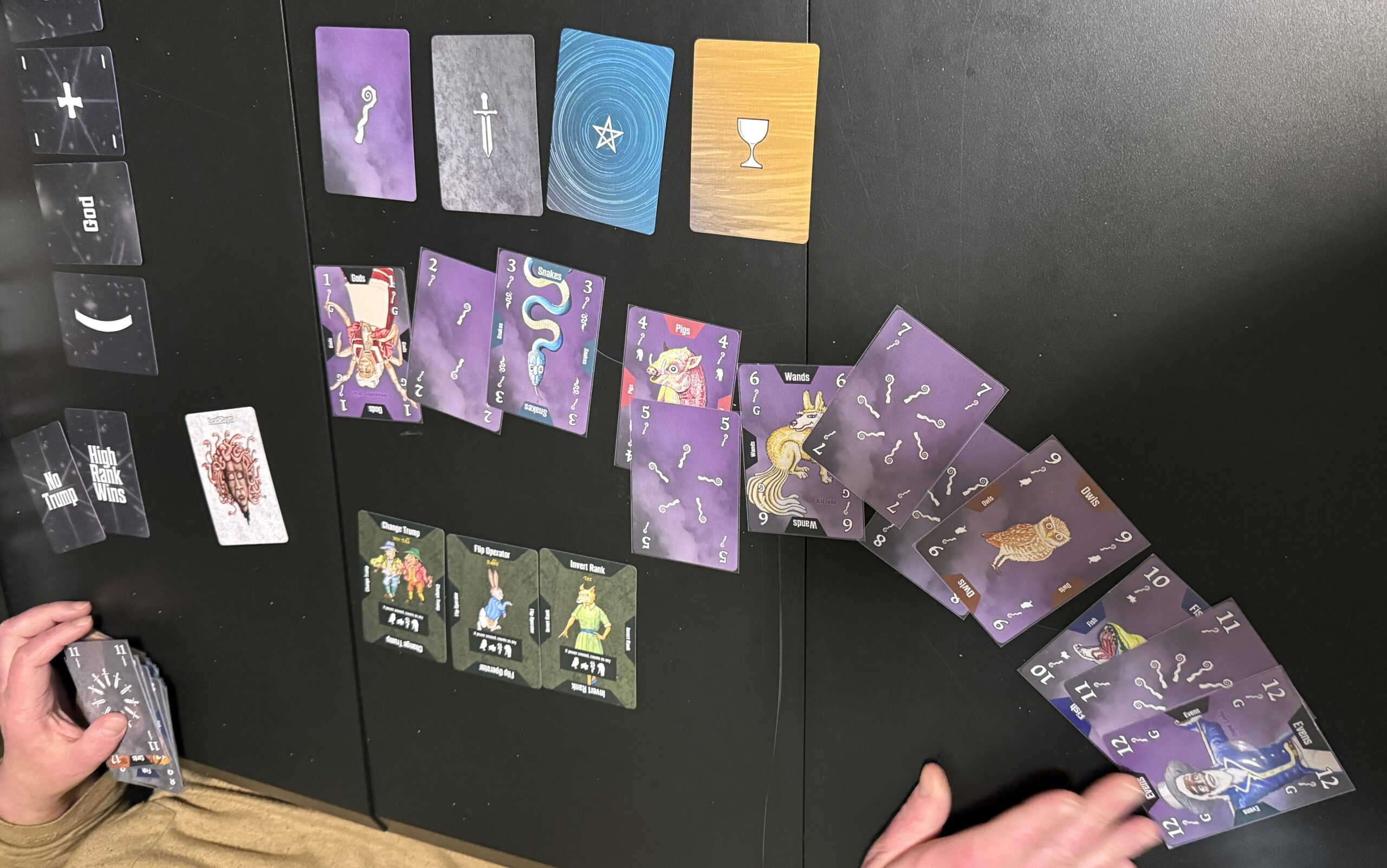
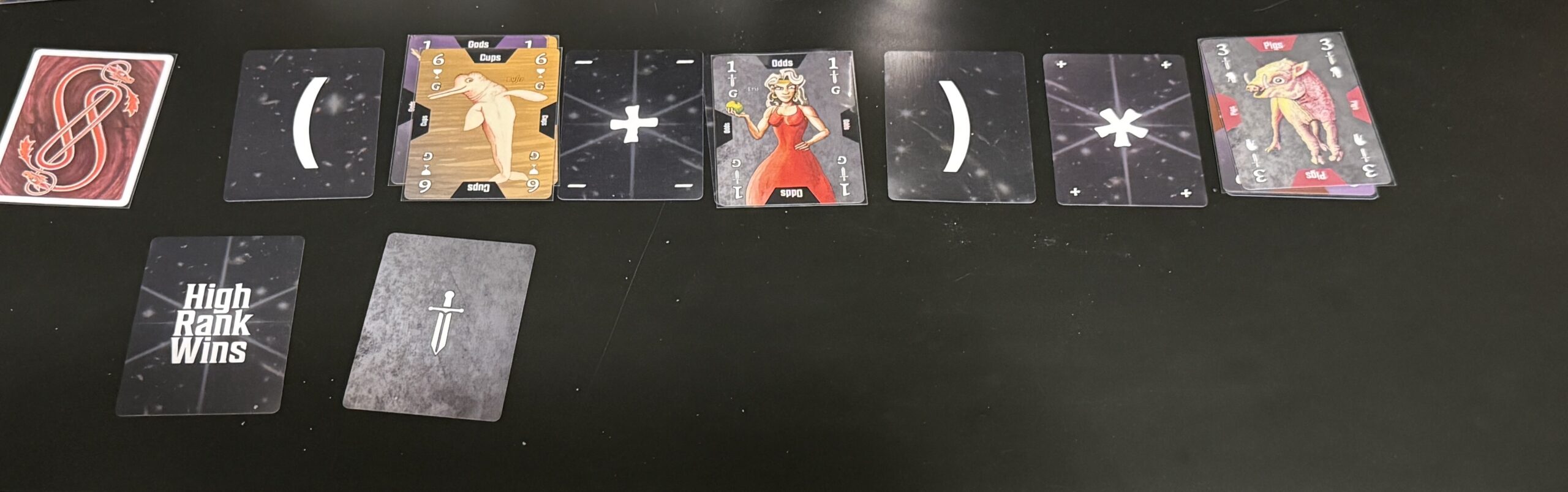
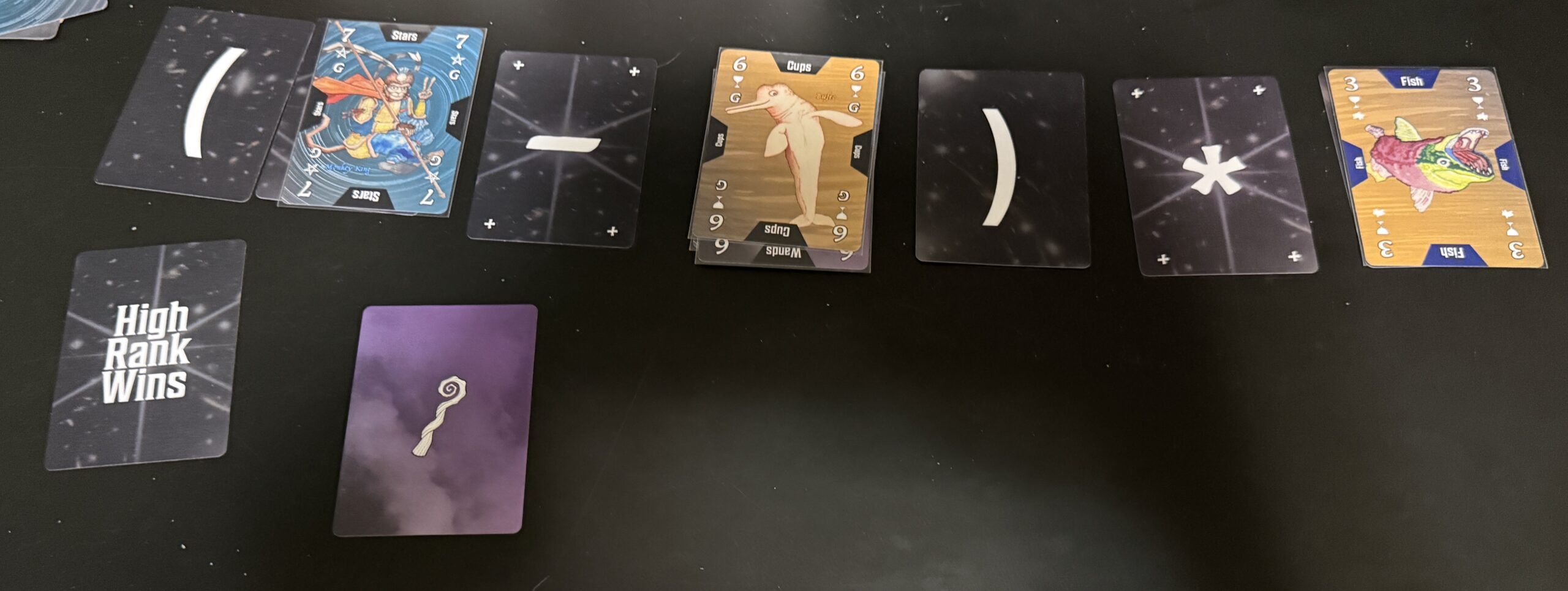
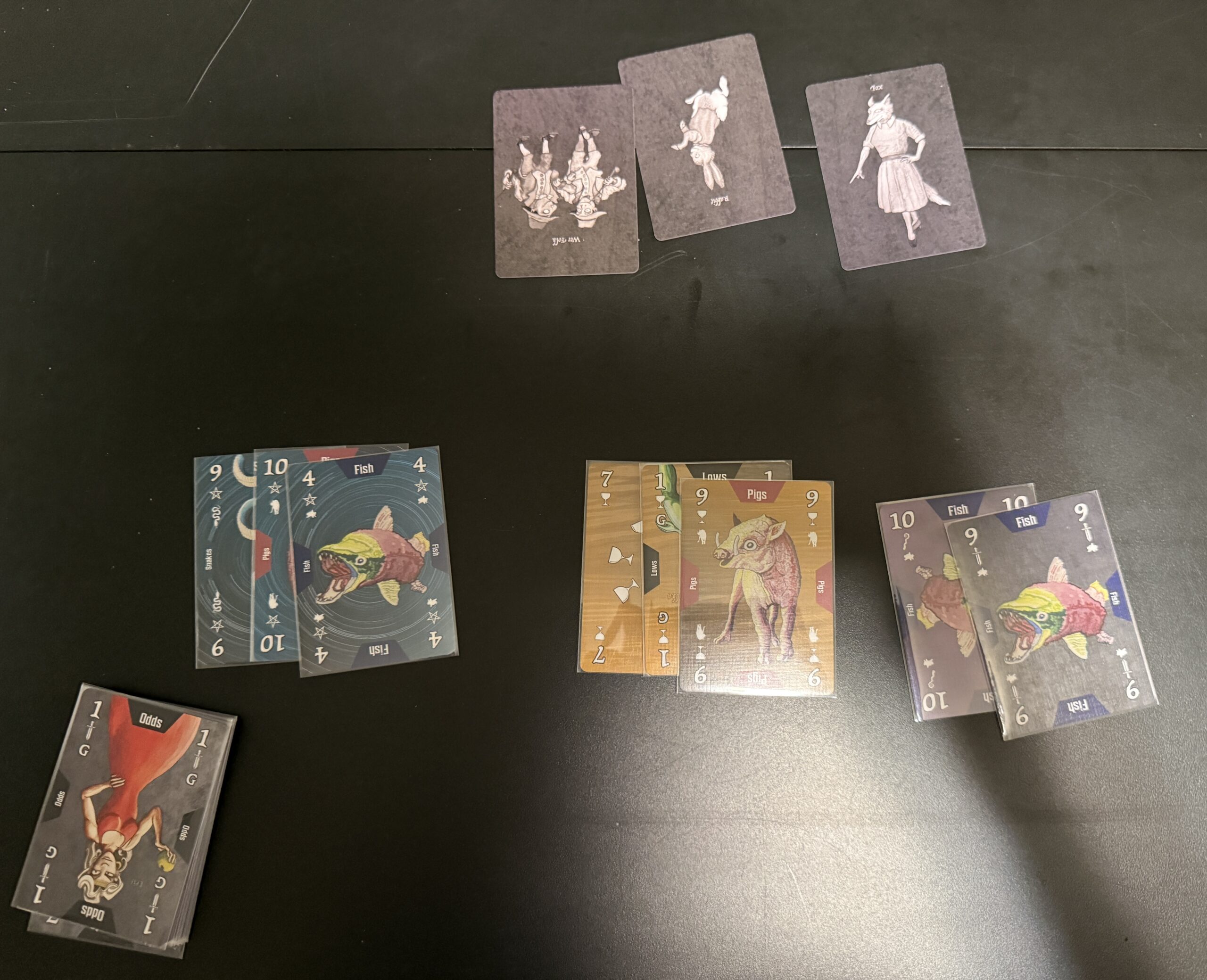
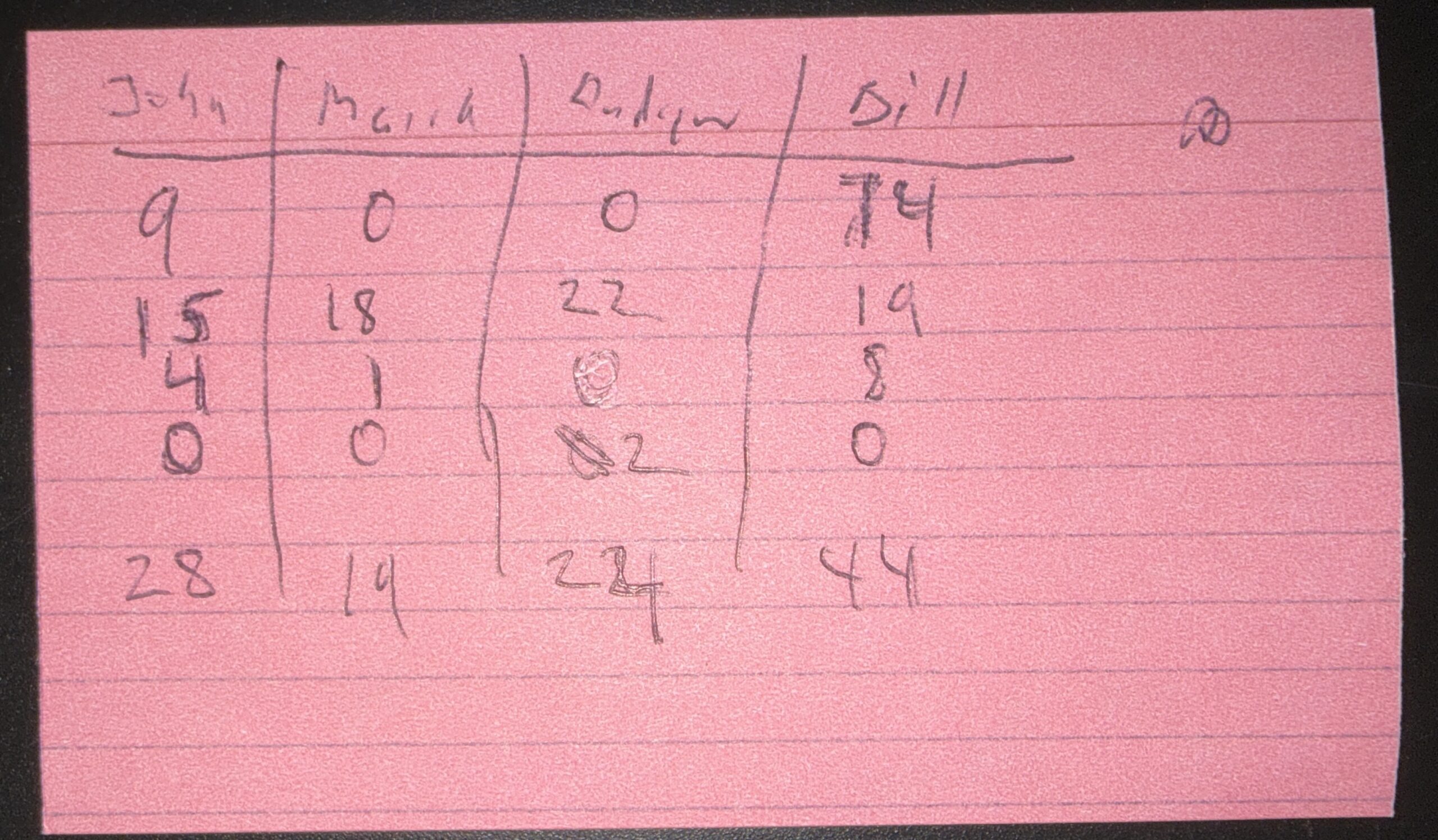
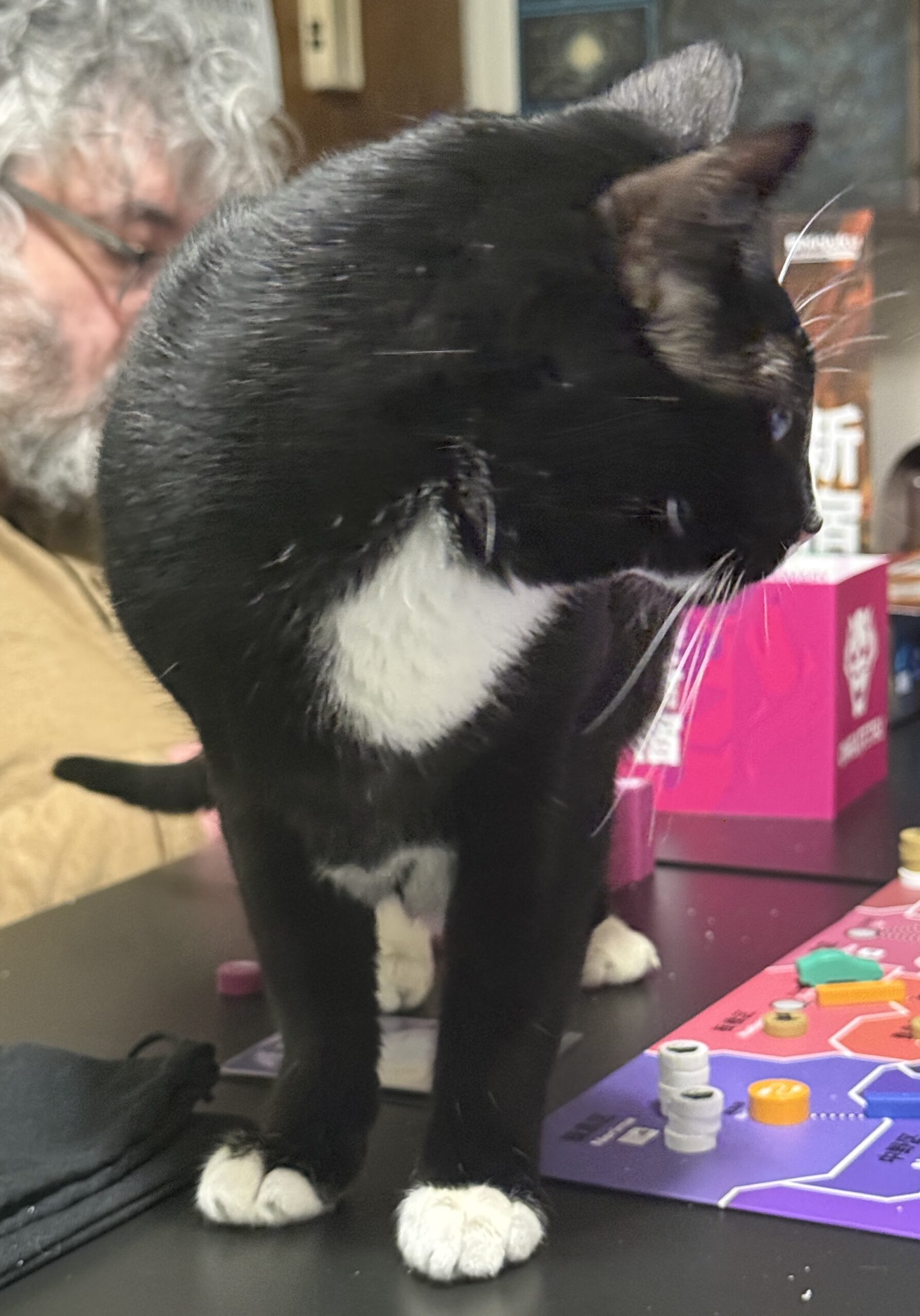
Shinjuku is game about setting up stores and railroad networks in Tokyo.Every player gets a shield that also acts as a helper card. The card lacks some important information; namely, the cost of performing some Actions. The discs represents stores you can build, the tall rectangles are department stores, the thin rectangles are railroads, and the car represents your CEO.The game includes a piece to represent Godzilla. All games should include Godzilla. (It might be hard to include it in Bridge… but wouldn’t it be wonderful?)The central game board represents districts in the city of Tokyo, with a map of the rail systems superimposed. The white and gold discs represent Customers. These discs don’t start splayed out like this; John wanted to show us what they looked like. The gold discs count as two Customers for end-game scoring.These are my four starting District cards. They control in which District you can perform an Action, at least mostly. The numbers at the bottom of the card indicate how many duplicates of that card are in the game. For example, there are only two Toshima cards in the deck, so it might be a risky strategy to depend on performing many Actions in Toshima.It may be a rare card, but Shuba thinks it’s the tastiest.When it’s a player’s turn, they always take the right-most card in this tableau in the lower right of the game board. Any Customers on the card are placed in the card’s district. Players can do some planning ahead; e.g., because we played a four-player game and each player takes one card per turn, the next player after the one who takes Adachi knows that they’ll take the Shinjuku card on their turn.An example of a “Build a Store” Action. I picked up the Shinjuku District card from the tableau. It had two Food Customers on it, which I placed in the Shinjuku District. Then I played the Shinjuku card, which I’d just added to my hand, in order to build a Store in one of the stations in the District.What good is a CEO? In Shinjuku (the game, not the particular District) a player’s CEO in a given District turns makes that District’s cards Wild for that player. Here, my CEO is in Chuo District, so the Chuo District card is Wild. I used it to represent the Shinjuku District to perform another Action in that District, namely to attract one of the Food Customers.Ultimately the game’s scoring depends on collecting sets of different Customers. That one Food Customer I just collected will hopefully become part of a set at the end of the game.This is a rewards track for building Department stores. It controls how many Customers are added to those District cards that players collect at the start of their turn. When a player builds a Deparment store, they get those Wild Customer tokens, which can help build sets for end-game scoring.The game board a few rounds later. You can see that both me (green) and Andrew (blue) have upgraded our Stores to Department stores. Shinjuku is a train game, so Andrew also built Railroads to stations in other Districts to transport Customers to Adachi.As we neared the end of the game, John (purple) pointed out to the rest of us that we’d misunderstood the mechanics of transporting Customers over the Railroad lines. In the middle of this picture, you can see that Godzilla has entered the game, and is presently in the Minato District. When he enters a District, all the Customers in that District flee into an adjacent one.Shuba, playing yellow, gazes at his rival for Ultimate Destruction on the game board. (Thanks to Maria for the photo, and for moving Shuba’s pieces for him.)Behold the scoring Customers of the winner, me. Each Gold Customer was worth two, meaning it could be used in two different sets. That, with the two Wild Customers, gave me two complete sets of four at 10 points each. Two additional sets of two different Customers gave me 3 points each. My grand total was 26 points.Our second game of the session was Trickster Gods. This is a picture of the instruction book; it comes in a simple cloth bag.The unique feature of Trickster Gods is this central “equation” that determines end-of-round scoring. Players can modify how this equation works as they win and lose tricks.Each player receives this set of game-altering cards. Each card can be invoked once per game. “Change Trump,” as the name suggests, changes which suit is trump for the round. “Flip Operator” changes the arithmetic of that scoring equation. “Invert Rank” means changing the trick-taking victory condition from highest card to lowest (or vice versa).John spread out a suit to show us what it looks like. Of special note are the animal cards and the cards marked with a “G” (gods). The winner of a trick can choose to sacrifice one of their cards to the equation to affect end-round scoring.Here’s the equation in action. This is how it looked at the end of one of our rounds, as a result of trick winners placing cards into it, and those who lost the lead choosing to play their game-altering cards. This equation reads: Take the number of Cups cards in the tricks you’ve won, add the number of odd-numbered cards in the tricks you’ve won… and multiply that by the number of pigs you’ve got in your tricks. Those players who had no pigs scored zero!The equation in our final round: number of stars, minus the number of cups, multiplied by the number of fish.My scoring area at the end of that round (and game). I had two fish and thought multiplication would make a big difference in my score… only to see that I had the same number of stars and cups, so all those fish were multiplying zero. D’oh!The final end-game scoring. John must have been tired as he tallied up my score, since I actually earned 31 points, not 44.
Although I won twice, it was not due to skill. I mis-understood the rules of both games more than once. Shinjuku would have played out differently if the rest of us had understood why John was building his Railroad network. Trickster Gods is very “swingy”; Andrew compared it to Fluxx.
It was a fun night, especially for those of us covered in fur.