Roughly speaking, Vestige is the science-fiction version of Vindication, which is one of my favorite games. There are significant differences, however.
We had to stop that game because it was getting late. This time, we decided to start the evening with Vestige.
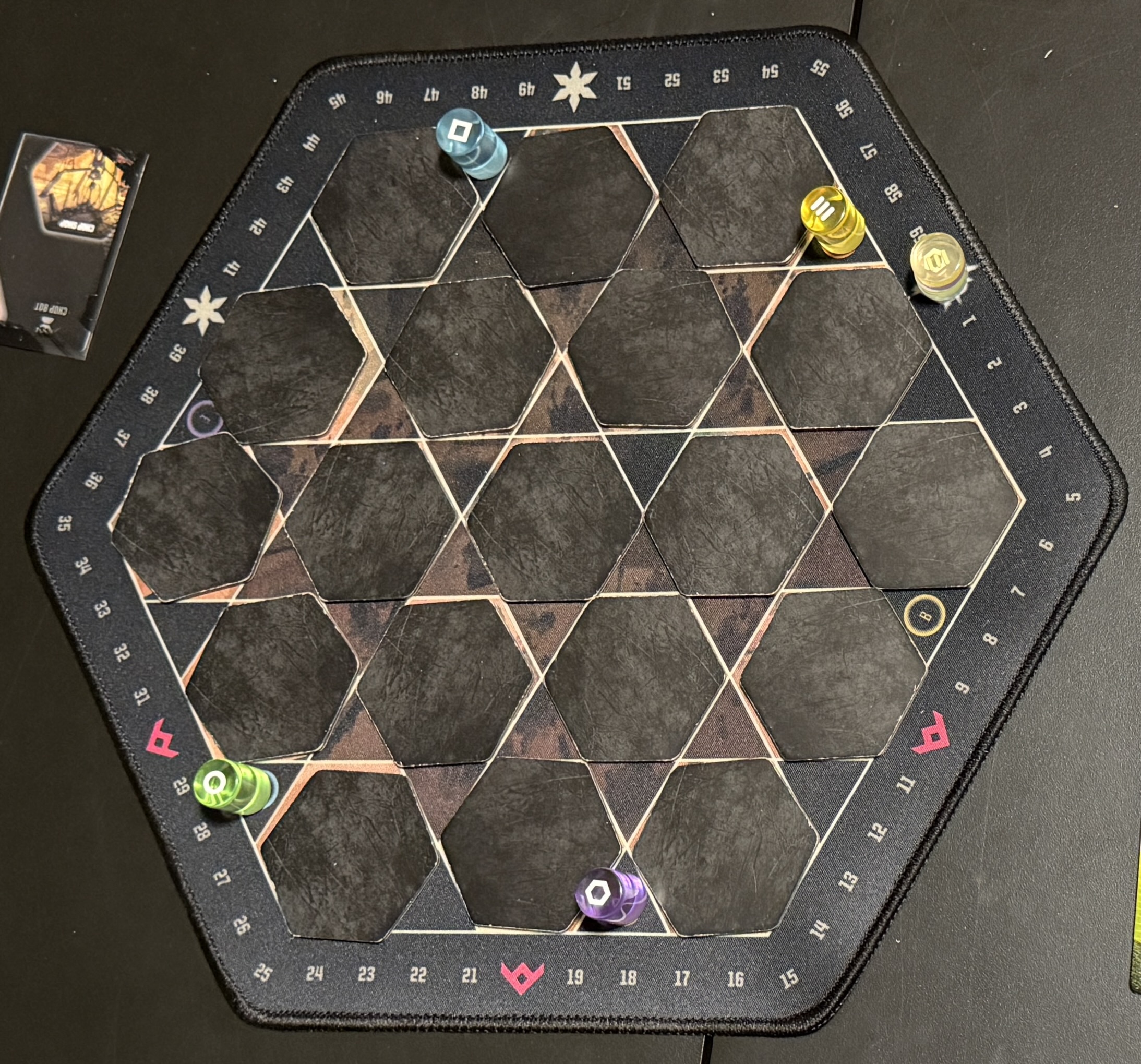
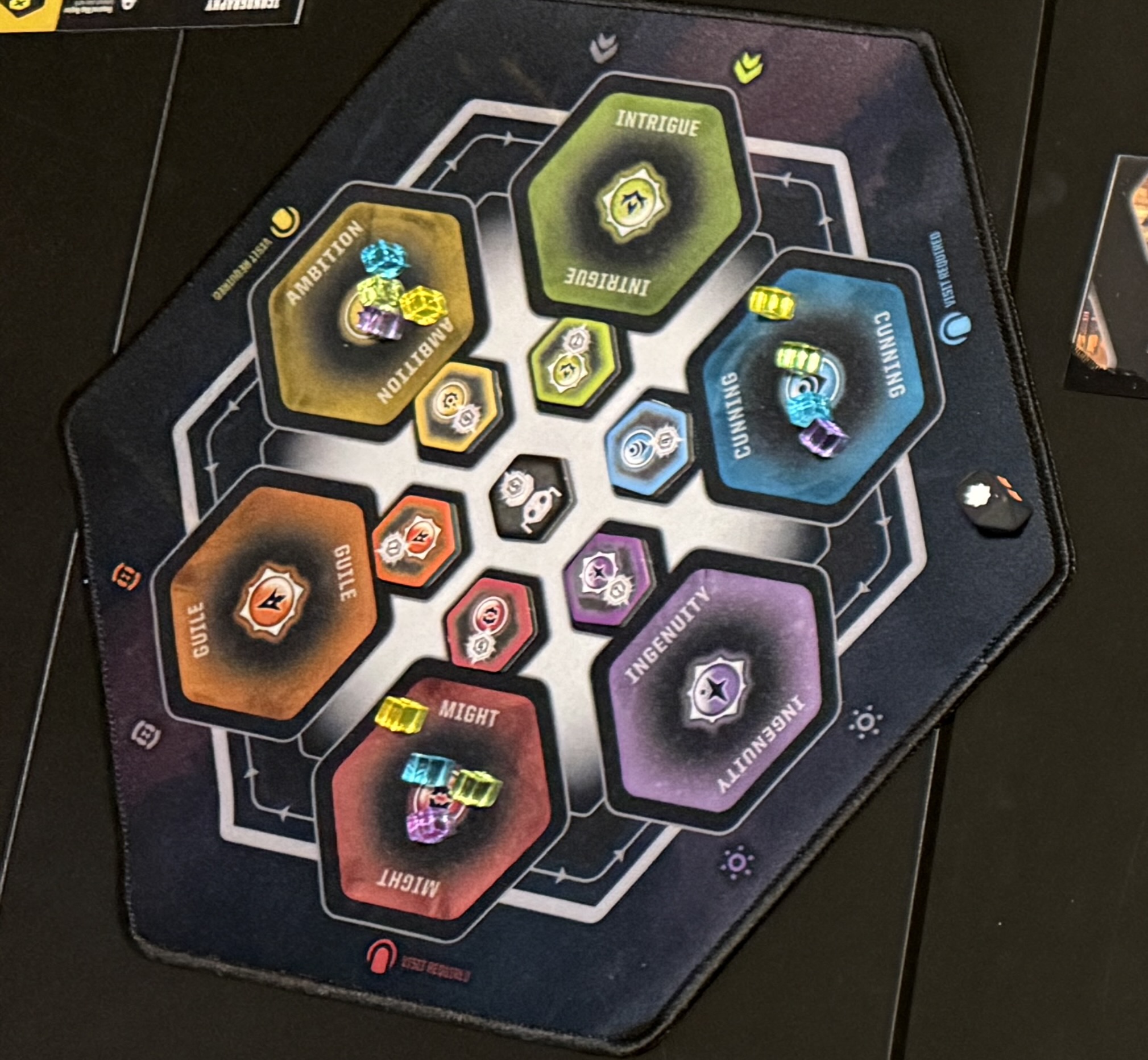
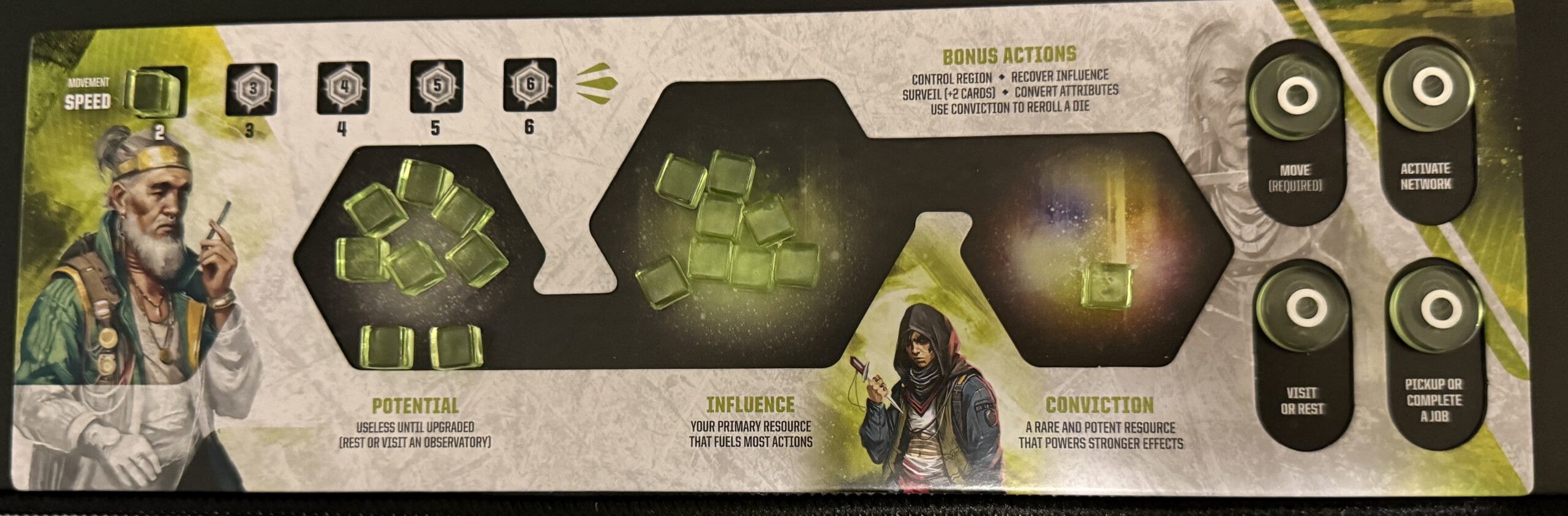
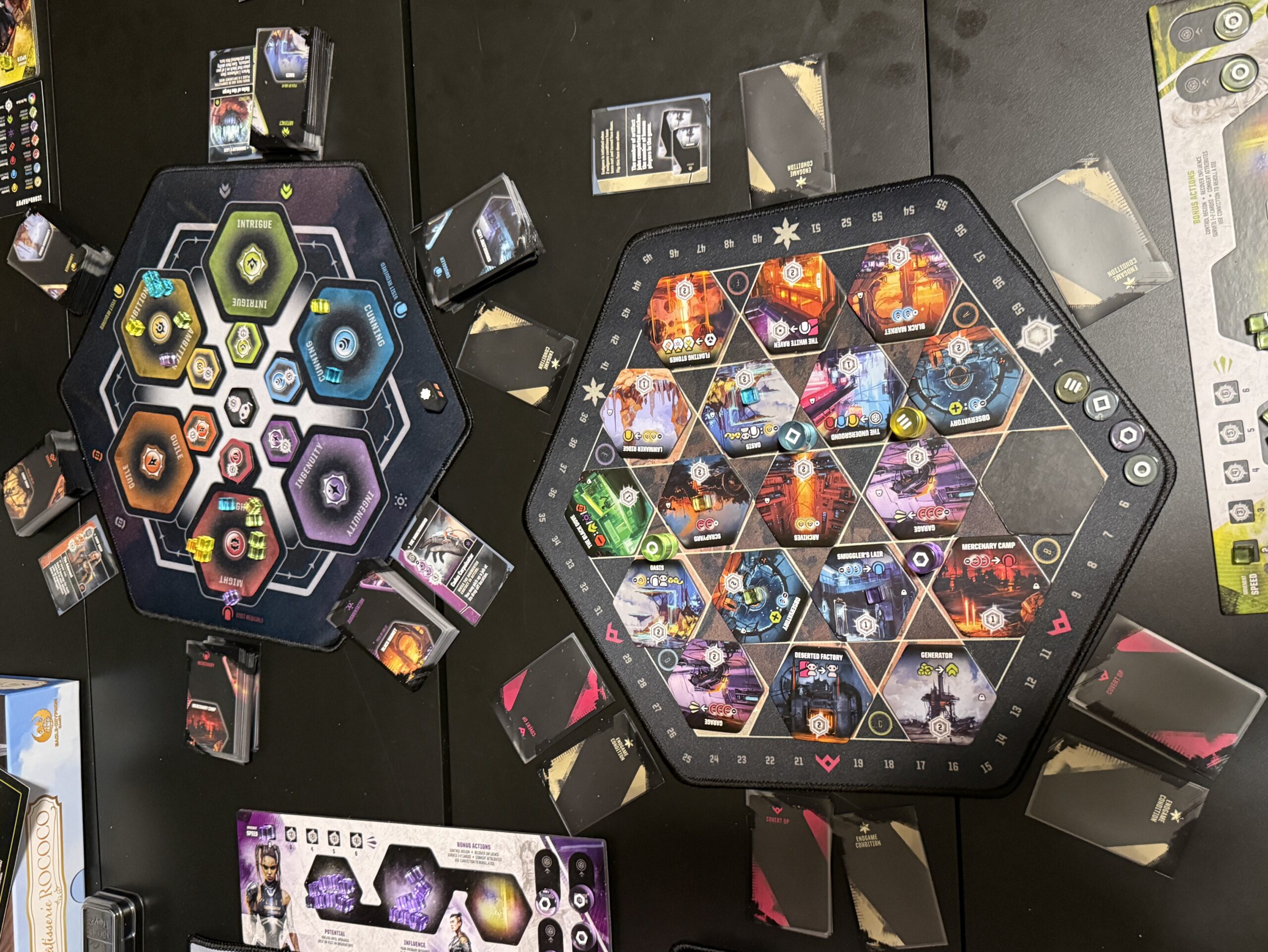
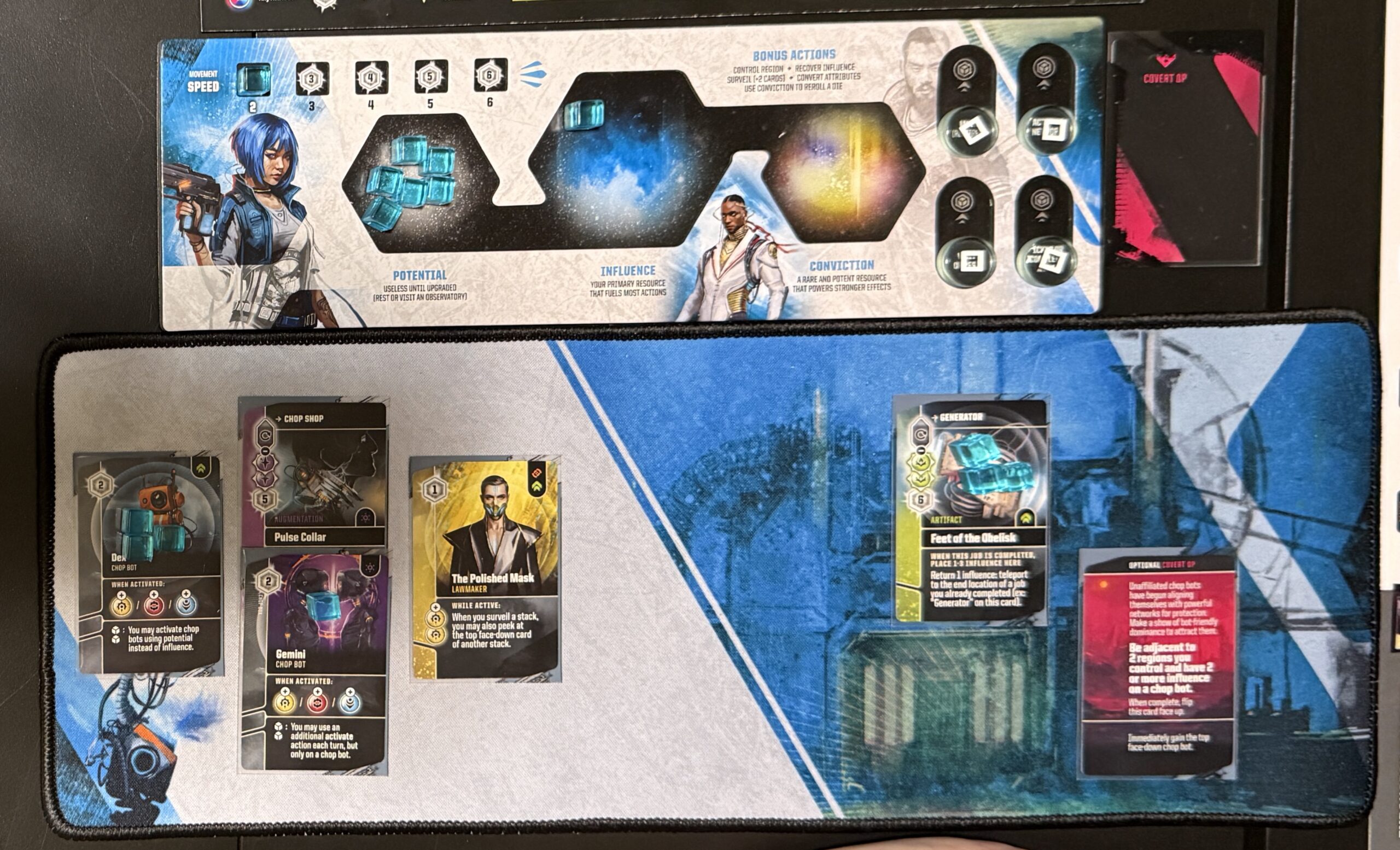
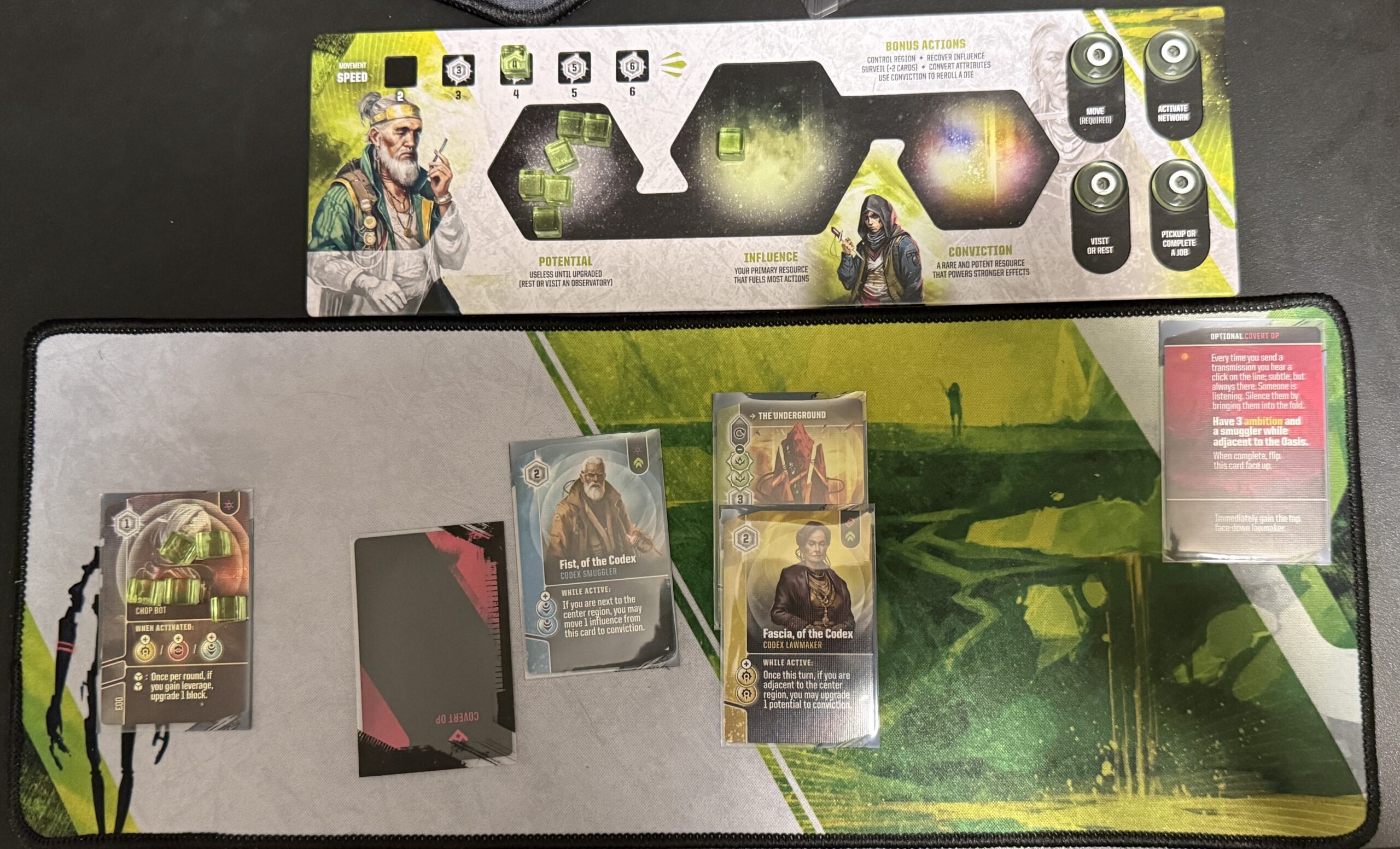
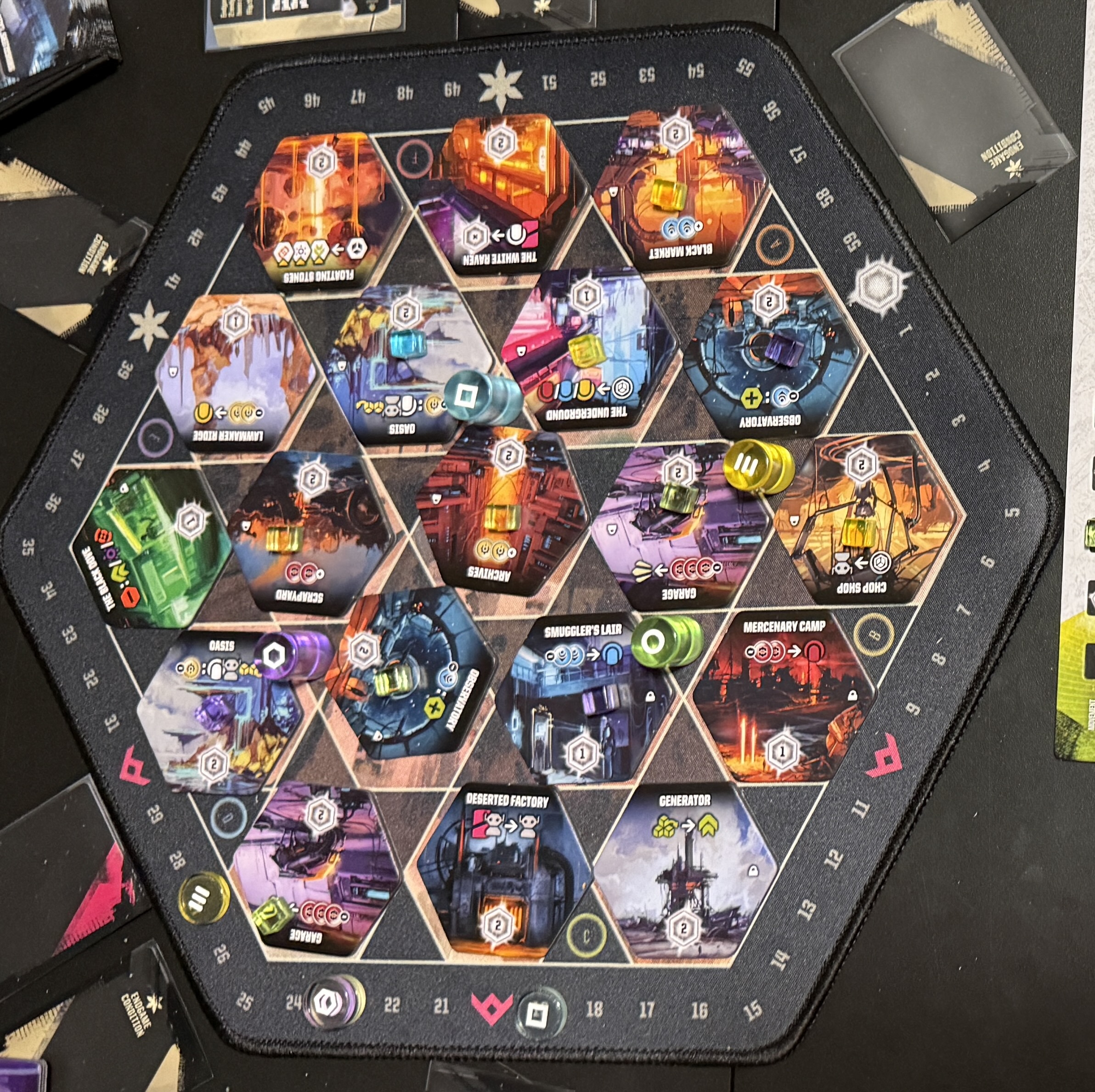
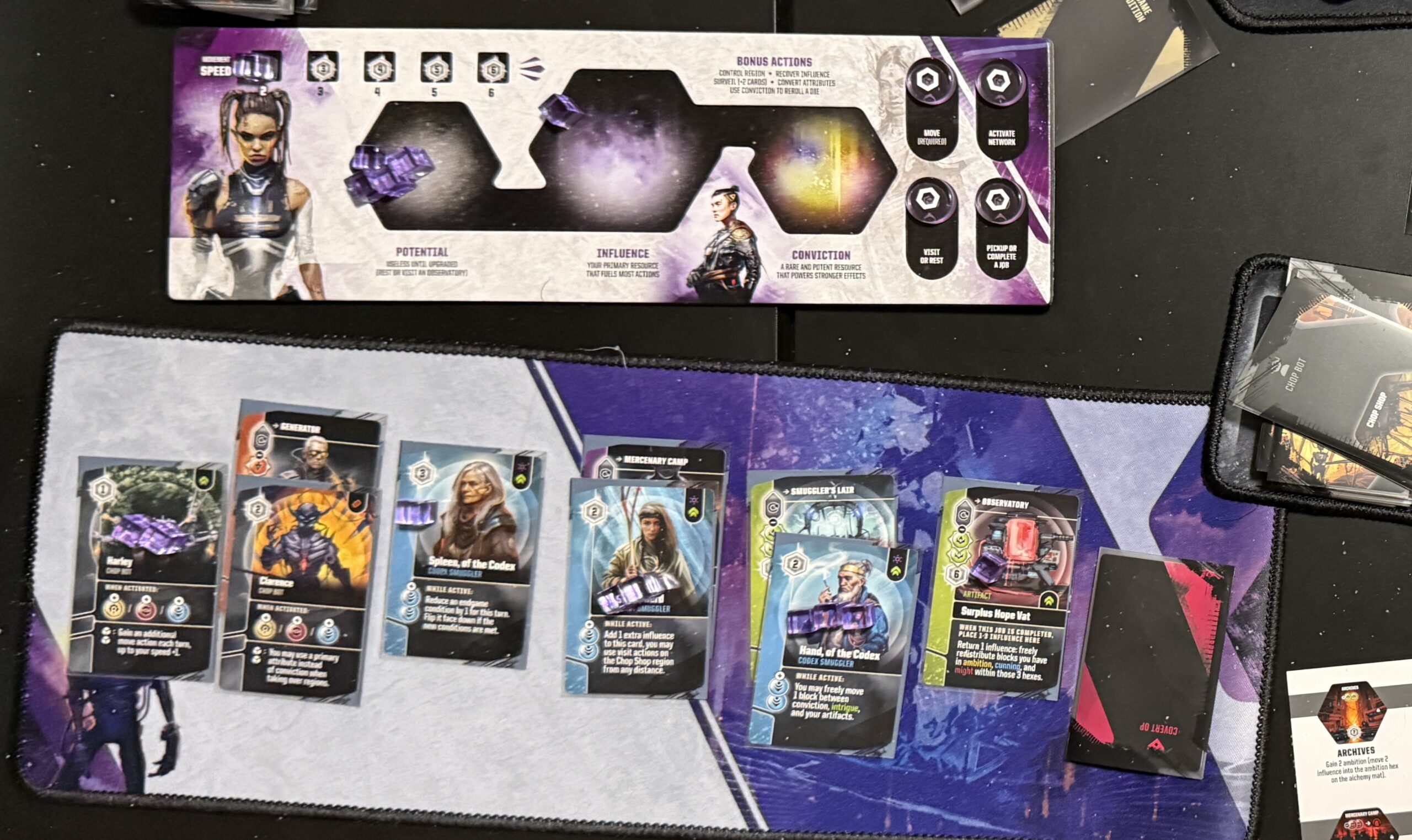
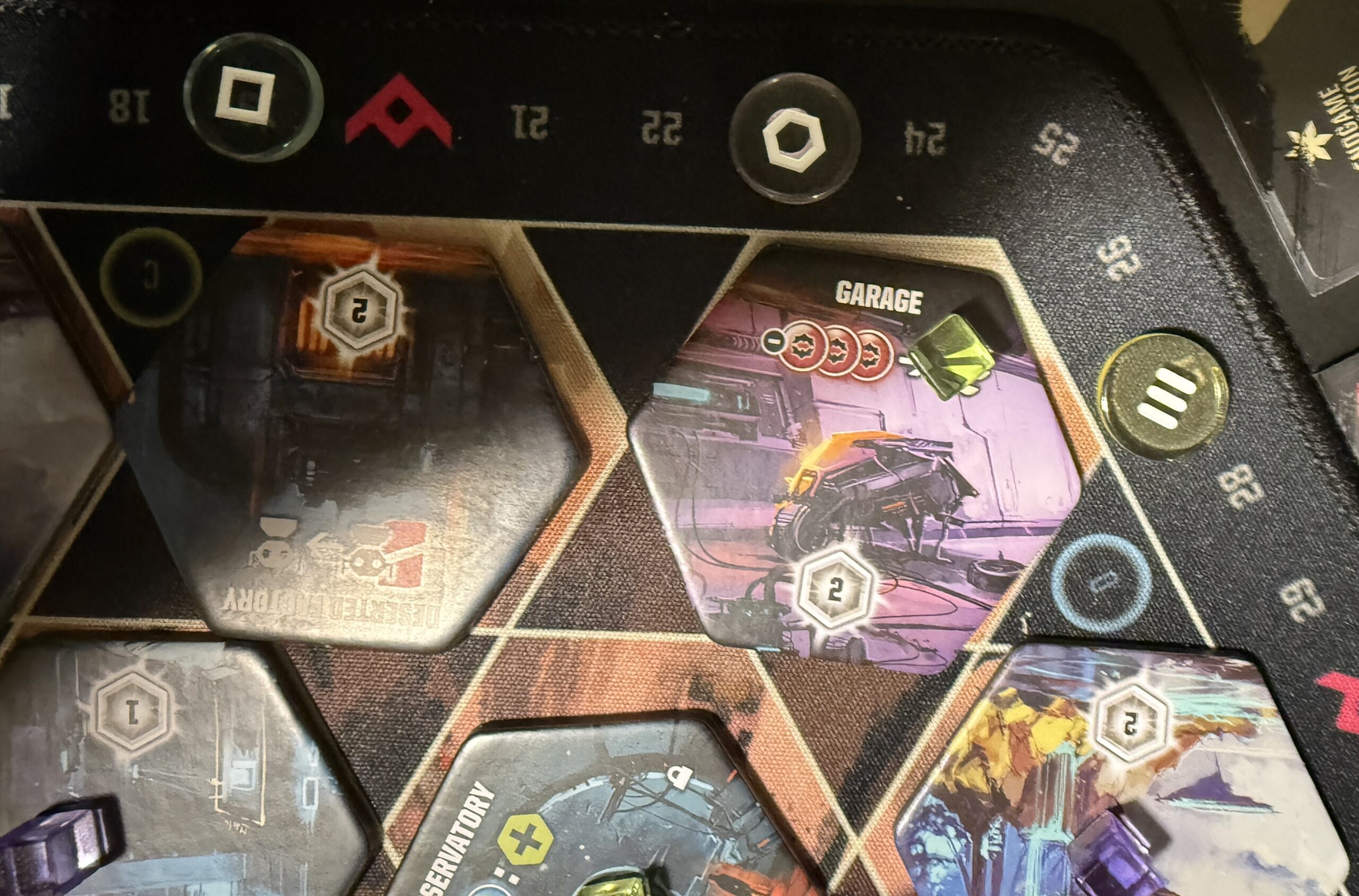
A superficial description of Vestige is that it’s Vindication with a dystopian cyperpunk theme. Instead of exploring an island, you’re navigating a high-tech city. At the start of the game, all the locations and hidden. You learn where things are by traveling across this map.This color map keeps track of the players’ character’s attributes. The primary attributes are Might, Cunning… Who am I fooling? No one calls them that. You’ve got Red, Blue, and Yellow. You create secondary attributes Green, Orange, and Purple by combining cubes for their adjacent primary attributes.You use Influence cubes to mark what attributes you have, how much you’ve influenced your network, and how much control you have over the game map.The state of those board areas a few turns into our game. On the right, you can see we’ve explored most of the city. On the left, you can see how we’ve added Influence cubes to indicate our attributes; for example, in the Red hex, there are four green cubes to indicate that I (green player) have four points in Red. Around the rims of the maps are cards you can acquire to build your network.A picture of Andrew’s play area a short while into our game. Everyone starts with one Chop Bot (trying saying that three times fast). He purchased a second one, and a contact (The Polished Mask). The main way of gaining Leverage (victory points) is to complete jobs. Andrew’s Gemini Chop Bot is working on completing the job Pulse Collar. He’s already completed one Green job on the right, Feet of the Obelisk. He’s also completed one Covert Ops mission, on the far right.Here’s my play area at roughly the same time. Notice that my player board at the top has fewer Influence cubes, because I’ve spread myself out on the map and have lots of cubes on my Chop Bot. This means I don’t have enough cubes to do much when it’s my turn. I may have played myself into a corner.With so many small pieces on the table, we couldn’t let Shuba wander on top of it. We had to be exceptionally cruel, and gently pick him up and place him on the floor. He tried to make us feel guilty about this abusive treatment however he could.The city map when we stopped playing. If there’s a cube on a hex, it means a player took control of that hex and earns victory points for it. They’ll also earn points if another player visits that location.The state of John’s play area at the same time. It’s not obvious, but he’s built up a very good engine. If we’d continued, he probably would have dominated the game.The score at the conclusion of the game. Since she had the most “raw” victory points (27), we declared Maria (yellow player) to be the winner.
From the wording of the above picture captions, you’ve probably figured out that we didn’t finish the game. We were about 60% done, but we’d been playing for over three-and-a-half hours and it was getting late. The play time is listed at 20 minutes/player; evidently they never met us. It often took a long time to figure out what to do on a given turn.
Though it was a partial playthrough, and I generally enjoyed myself, I can point to some production weaknesses:
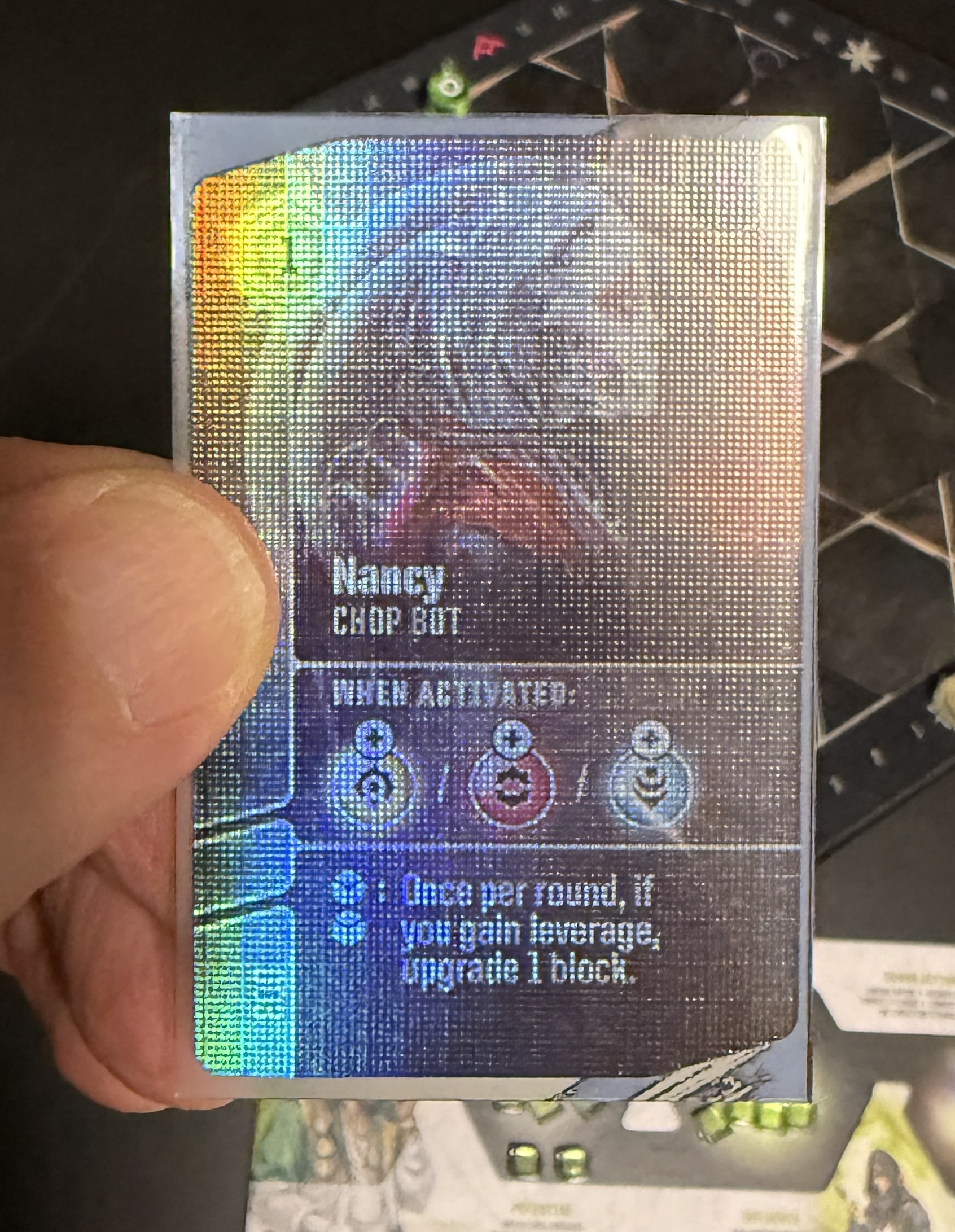
In the swanky edition, some of the cards are “shiny.” This sounds cool, but it turns out that it makes the cards difficult to read. Nancy the Chop Bot was a great card, though.
If you look at the “Maria wins” picture above, you may have trouble distinguishing between the pastel translucent colors of the different pieces. If you look at the maps, you may find it hard to tell the yellow cubes (Maria’s) from the green ones (mine). The clear plastic looks cooler than wooden pieces at first glance, but in practice the solid colors would probably be better. This is one of the few times where the regular edition of a game may be better than the “deluxe” version.
There’s a critical typo in the set-up instructions in the published version of the rulebook. It states that there are 12 map hexes that must be in every game, and 7 additional randomly-chosen tiles to be added to the map. In fact, there are 13 mandatory tiles and 6 optional ones. This confused us both times we played the game.
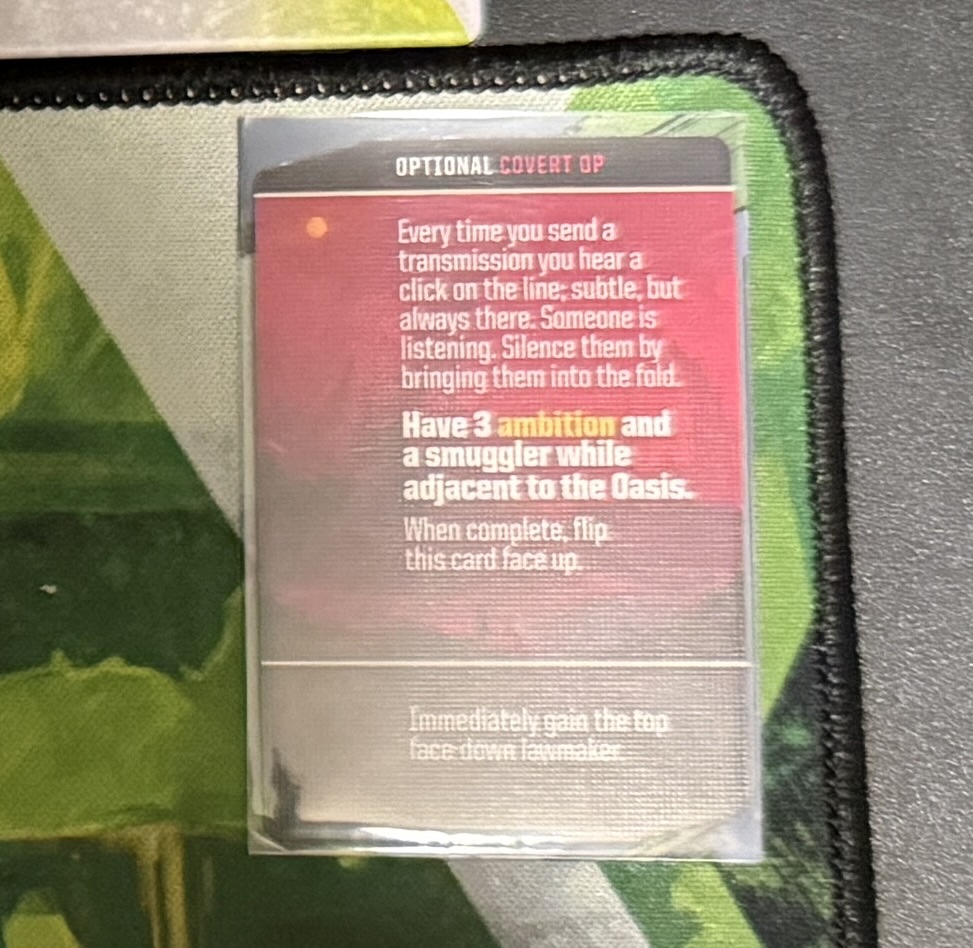
Flavor text is all well and good, but the game is unhelpful in much of such text on both the cards and in the rules. For example, no one thinks of the contacts as “Smugglers” or “Lawmakers” or “Mercenaries.” They’re the Blue, Yellow, or Red humans. It would help if the rules consistently put those names in the corresponding colors, the way it’s done with printing “ambition” in Yellow on this card. As it was, when I saw that this Covert Op required a “smuggler,” I had to hunt the play area to learn that I needed to get a Blue contact.
We may try to play Vestige again on a full game day, instead of an evening, to see if we can get through the game.