At last night’s gaming session, John and Andrew both agreed that I could use their full names in these posts; I don’t have to call them “J” and “A” anymore. M couldn’t make it last night; I’ll ask her about this the next time I see her.
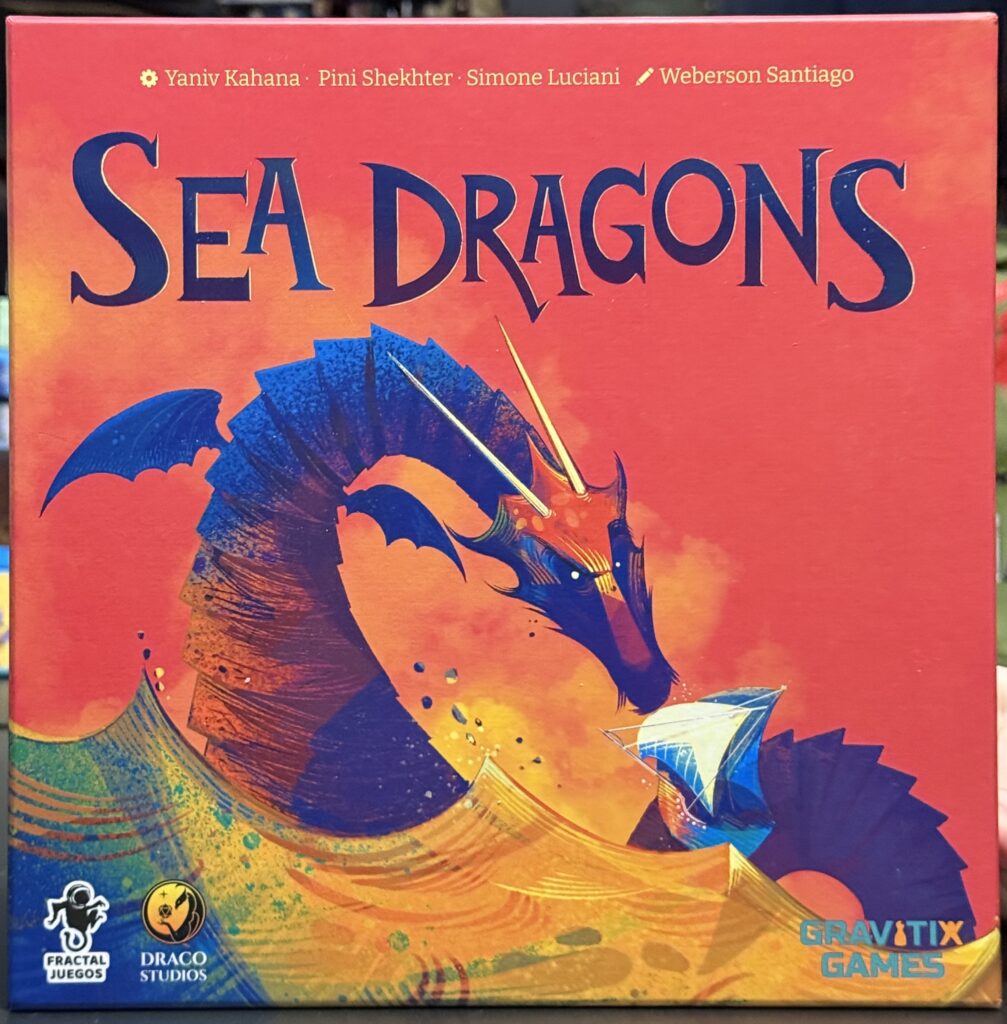
The first game we played was Sea Dragons. It’s an area-control game, but it’s not combative.For some reason, I couldn’t get an angle in which my arms weren’t casting a shadow in my pictures. Sorry about that.
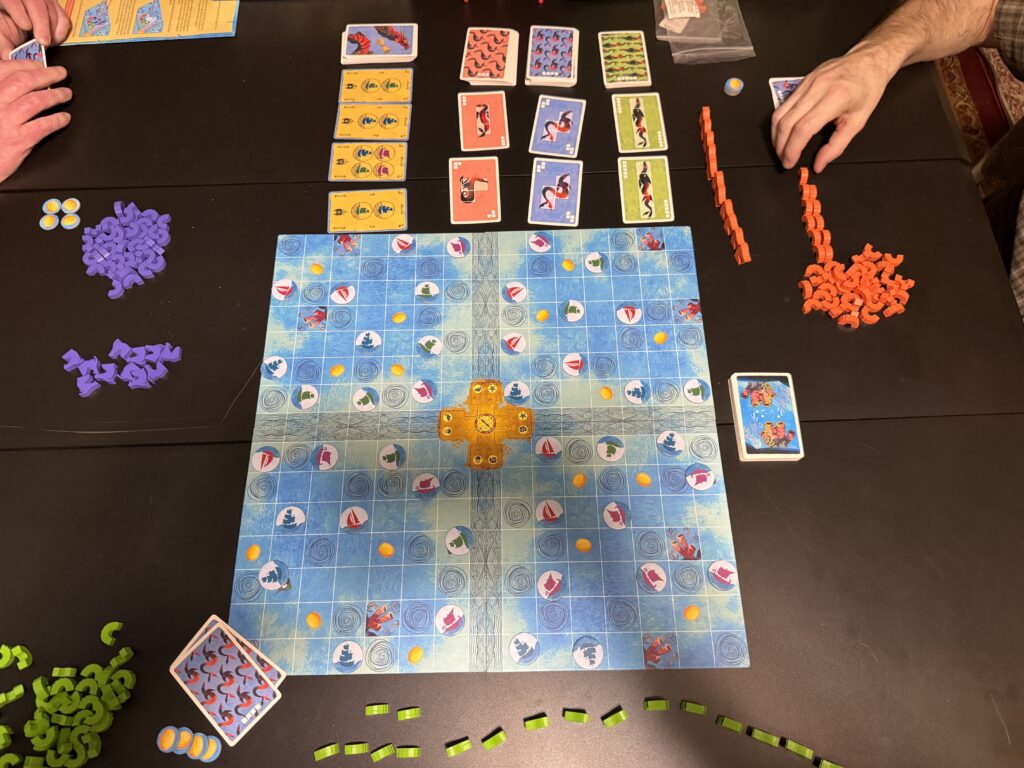
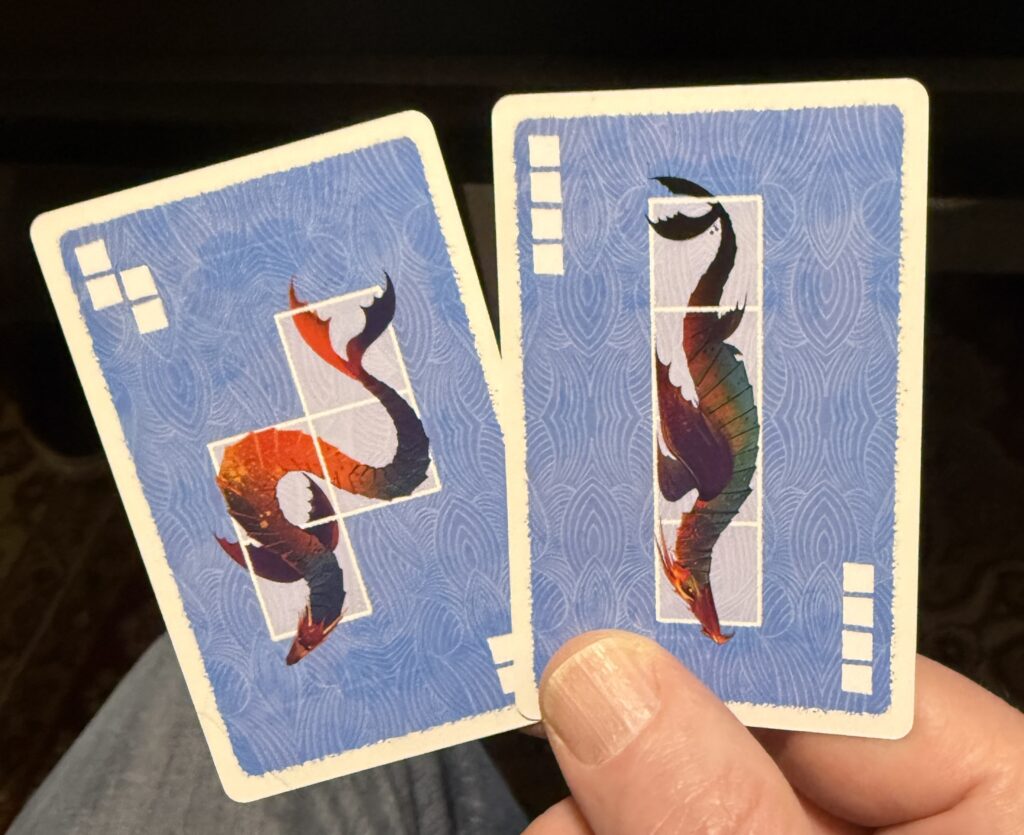
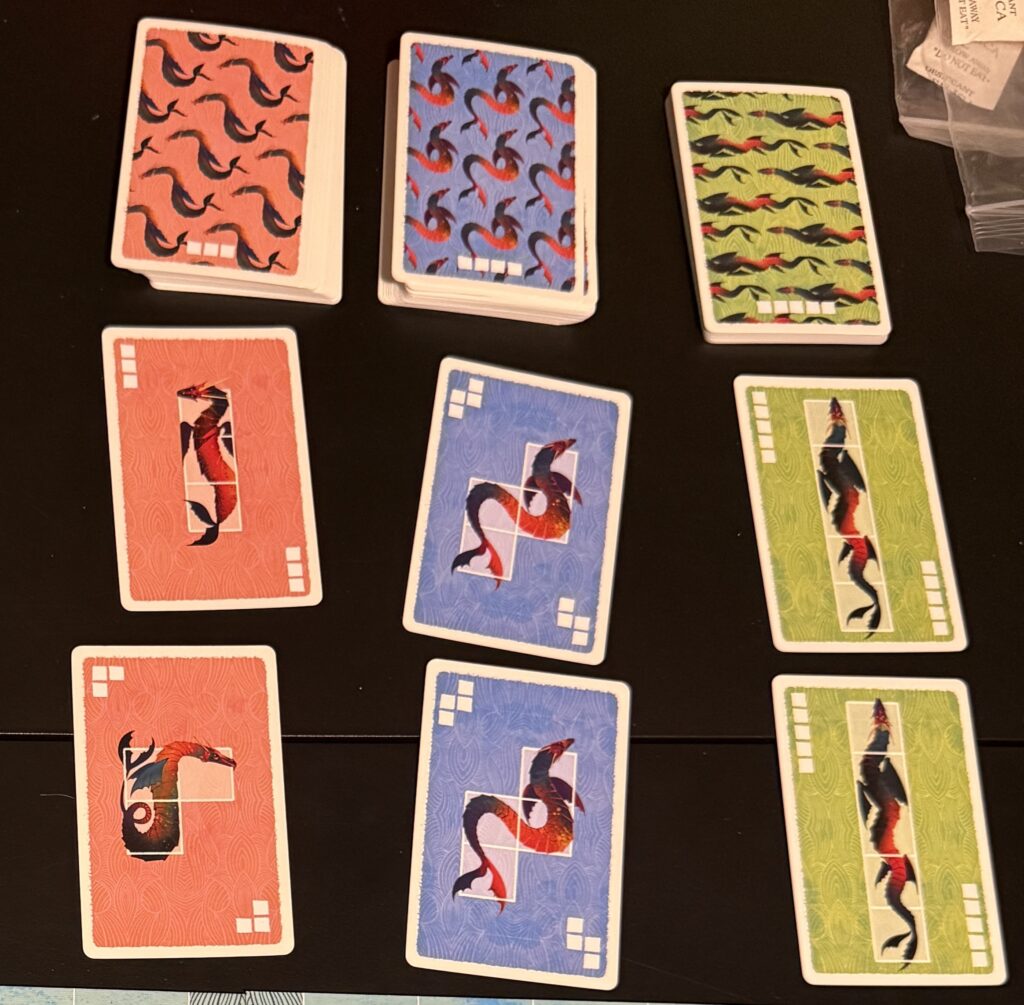
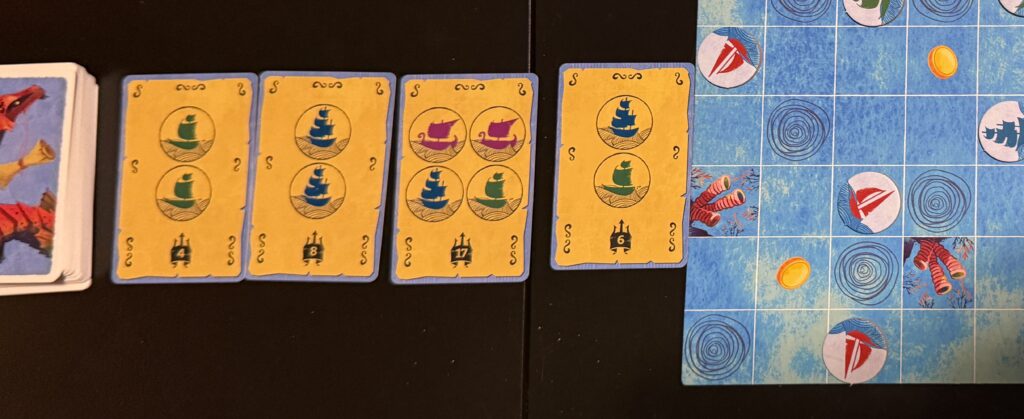
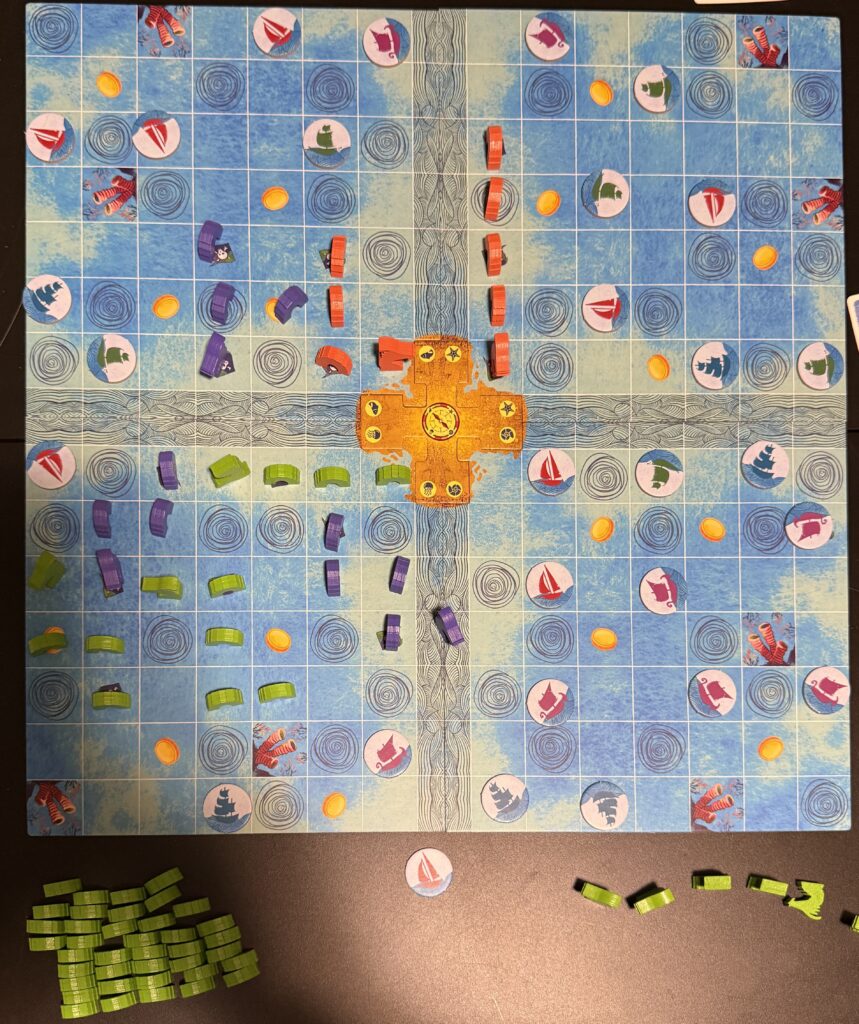
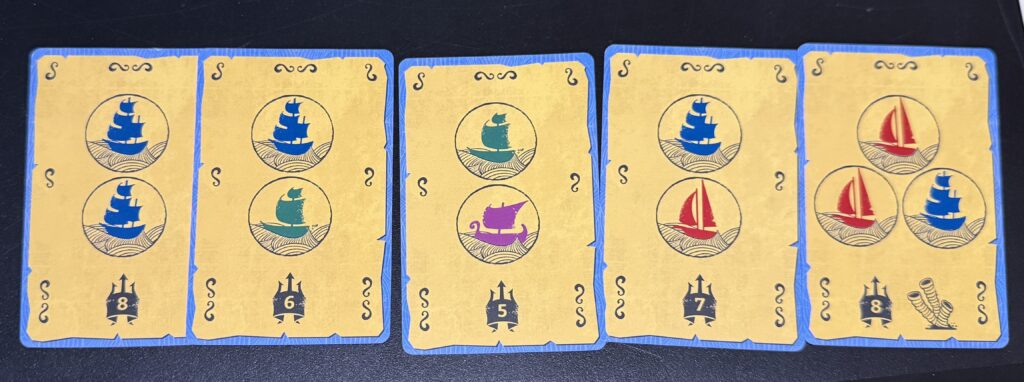
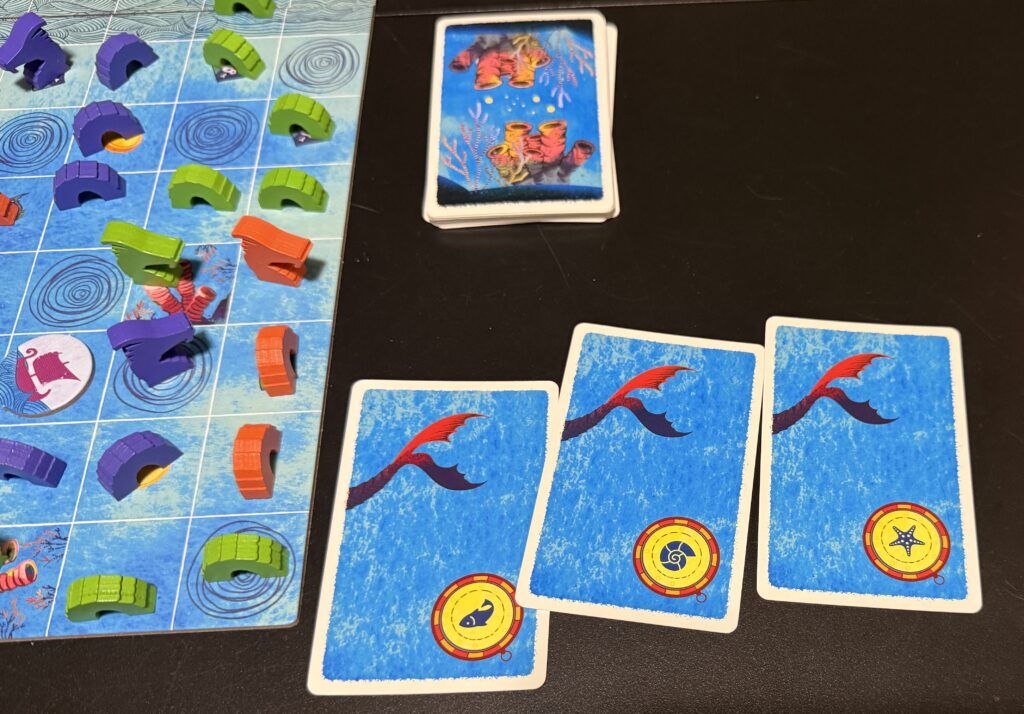
The game is played by placing sea dragone on the map.At the start of your turn, you have two polyomino cards in your hand. You can place a dragon with one of those shapes. You can freely rotate or flip the shapes, as long as they fit on the orthogonal grid on the board.At the end of your turn, after you’ve played a card and placed a sea dragon, you pick a new card for your hand. The restriction is that you can’t pick one of the same color (= number of tiles) as the one you just played.If you place a sea dragon such that it overlaps a pirate ship token, you take that token. You can turn in matching tokens to gain the corresponding quest card.Here we are a few rounds into the game. I’m green, John is Purple, Andrew is Orange. The rules of sea dragon placement are: you can’t place a dragon so that it touches one of your previous dragons; you have to place a dragon either adjacent to that central island or another player’s sea dragon. If you place next to another player(s) dragons(s), they each get a gold. If you place a dragon segment on a whirlpool or current square, you pay two gold.
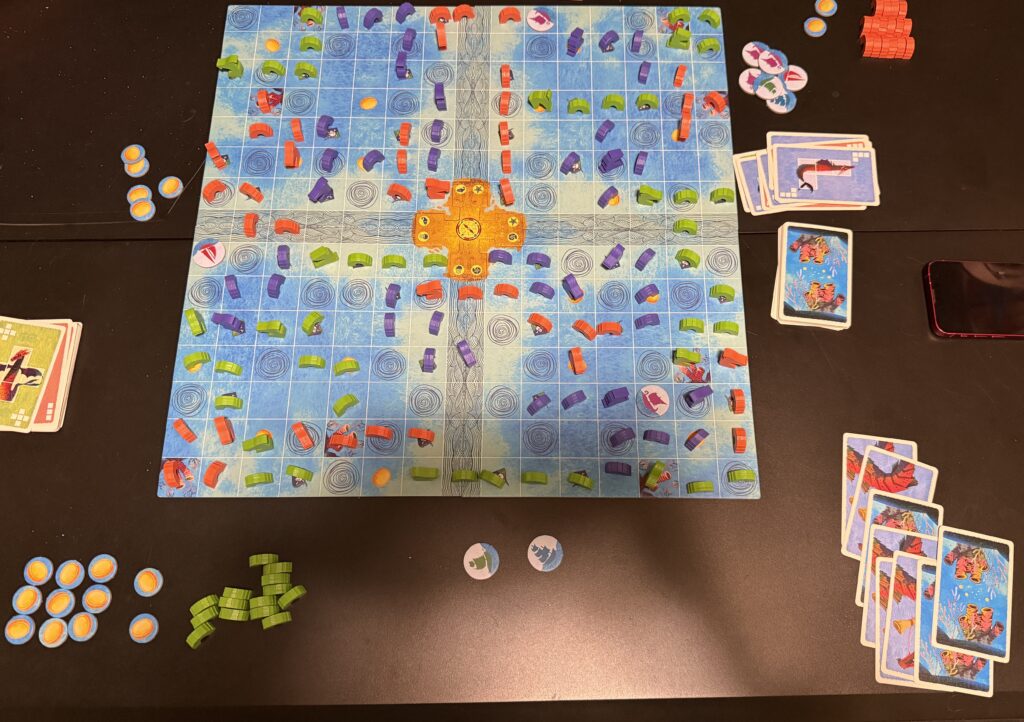
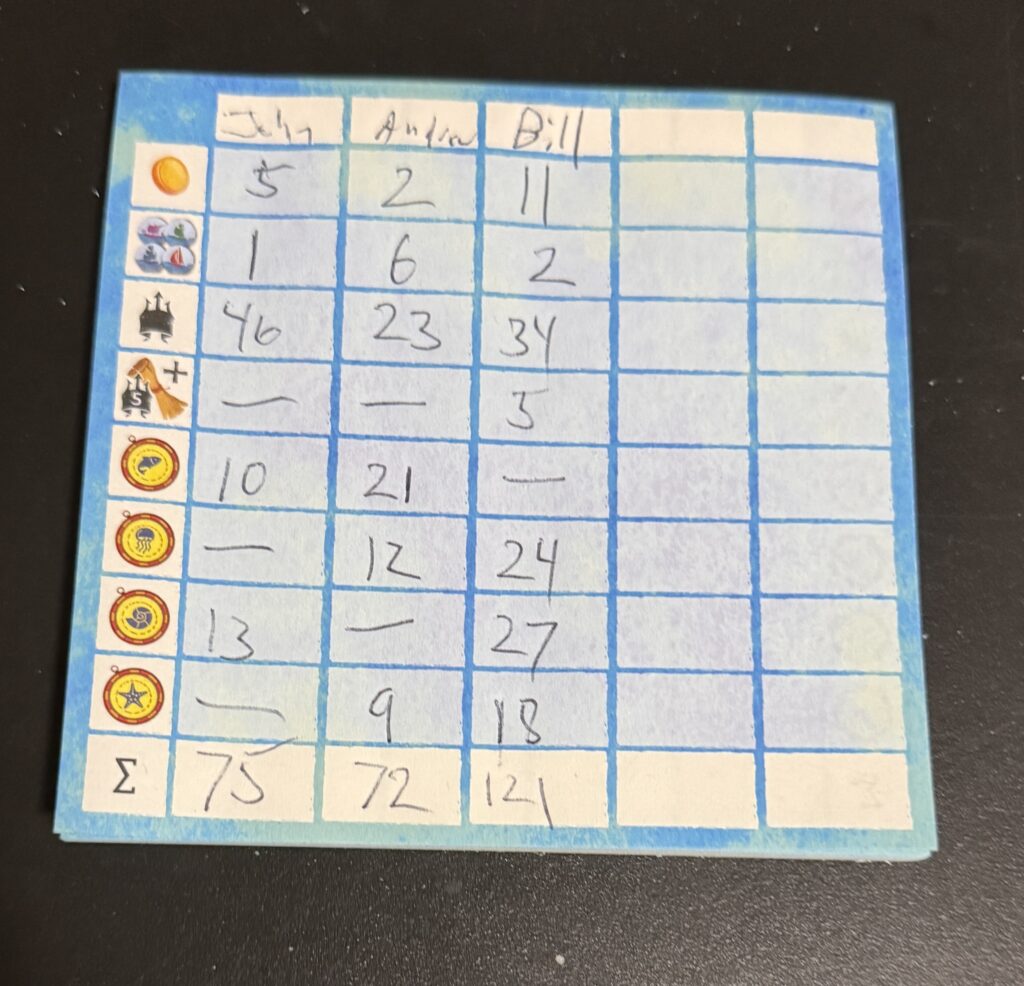
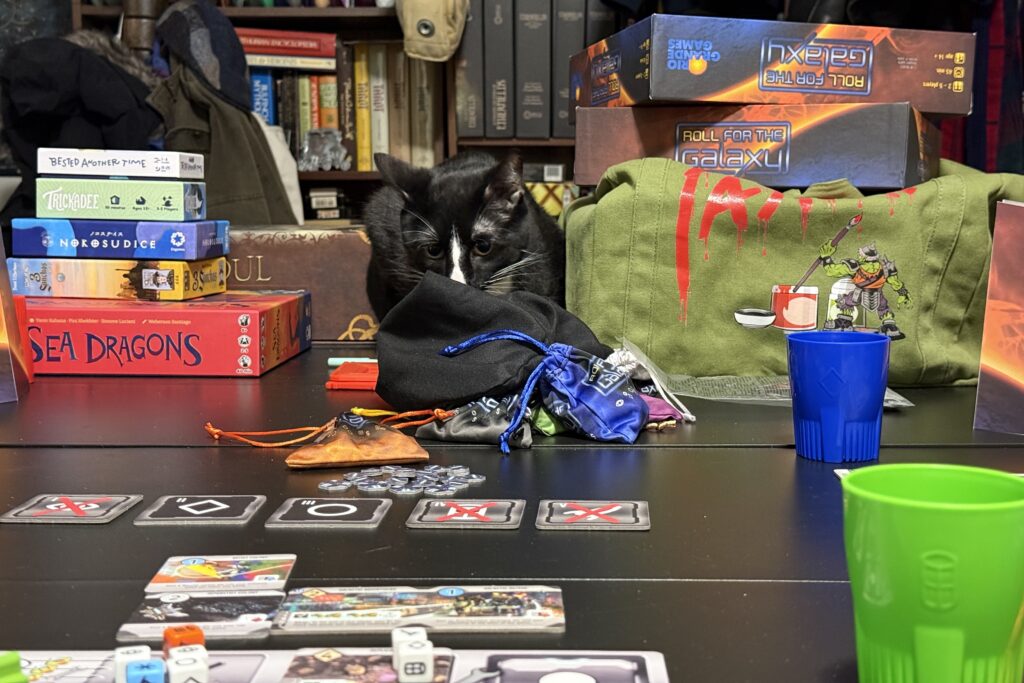
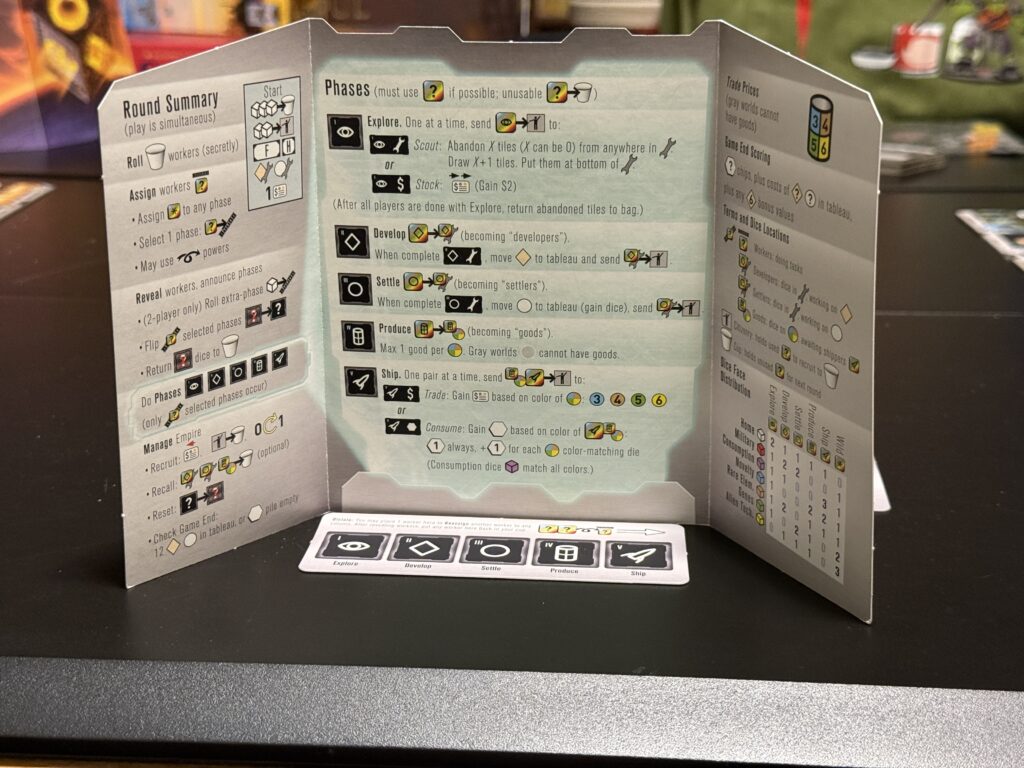
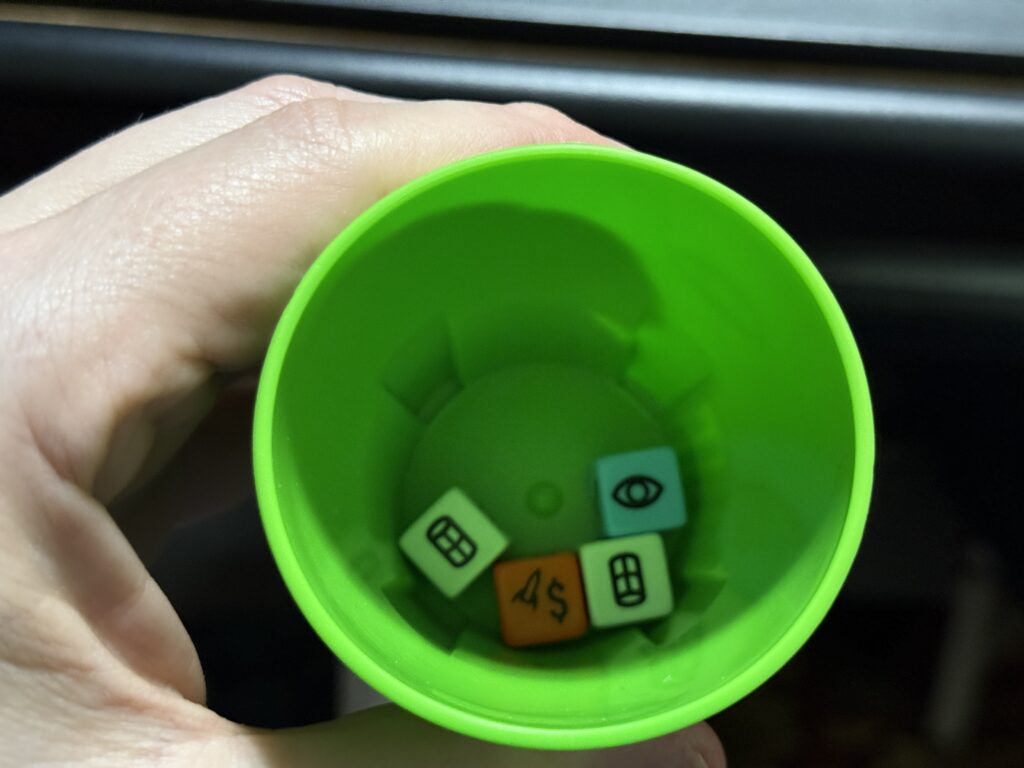
You can see that John and I were competing for the lower left quadrant of the board. If you compare this to an earlier image, you’ll see that we were both placing in order to collect as many pirate ships as we could.The board at the end of our game. The game ends when the players have placed all their dragons; that’s 11 dragons for a three-player game.These were the quests I managed to complete by the end of the game.I also collected a few reef cards, by placing sea dragons on reef spaces on the board. These cards count as additional dragons for area control for end-of-game scoring.The scorepad reveals that I won the game. What put me over the top is that I managed, through a combination of sea dragon placement and those reef cards, to have control of three out of the four quadrants of the board.From there we moved to a classic, Roll for the Galaxy.Shuba kindly pointed out that with all the rolling dice and the drawstrings in the Deluxe edition bags, this game is just one cat toy after another. Finally, a game he can appreciate!I’ve played this game before. However, the last time I played was several years ago, and even then I played it irregularly. What typically puts me off Roll for the Galaxy are the busy icons on the screen. The game seems more procedurally complex than it actually is.Since the name of the game is Roll for the Galaxy, you’ll be intensely surprised to learn that it involves rolling dice. The icons on the dice indicate what kinds of actions you can do in your turn.You can assign dice to actions depending on what you’ve rolled, but you can only designate one of potential actions as primary. A given action can be only performed by players if at least one of them has selected it as a primary action.
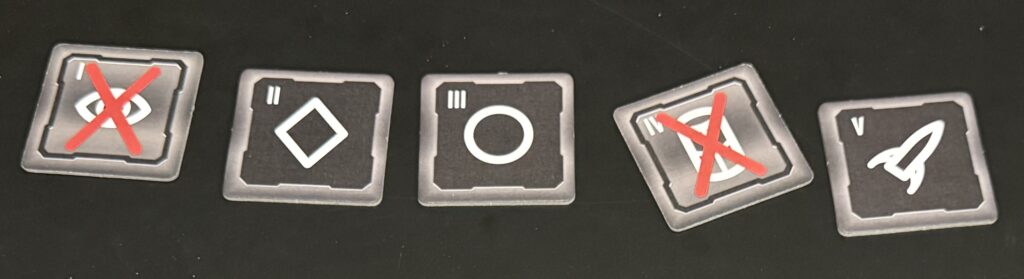
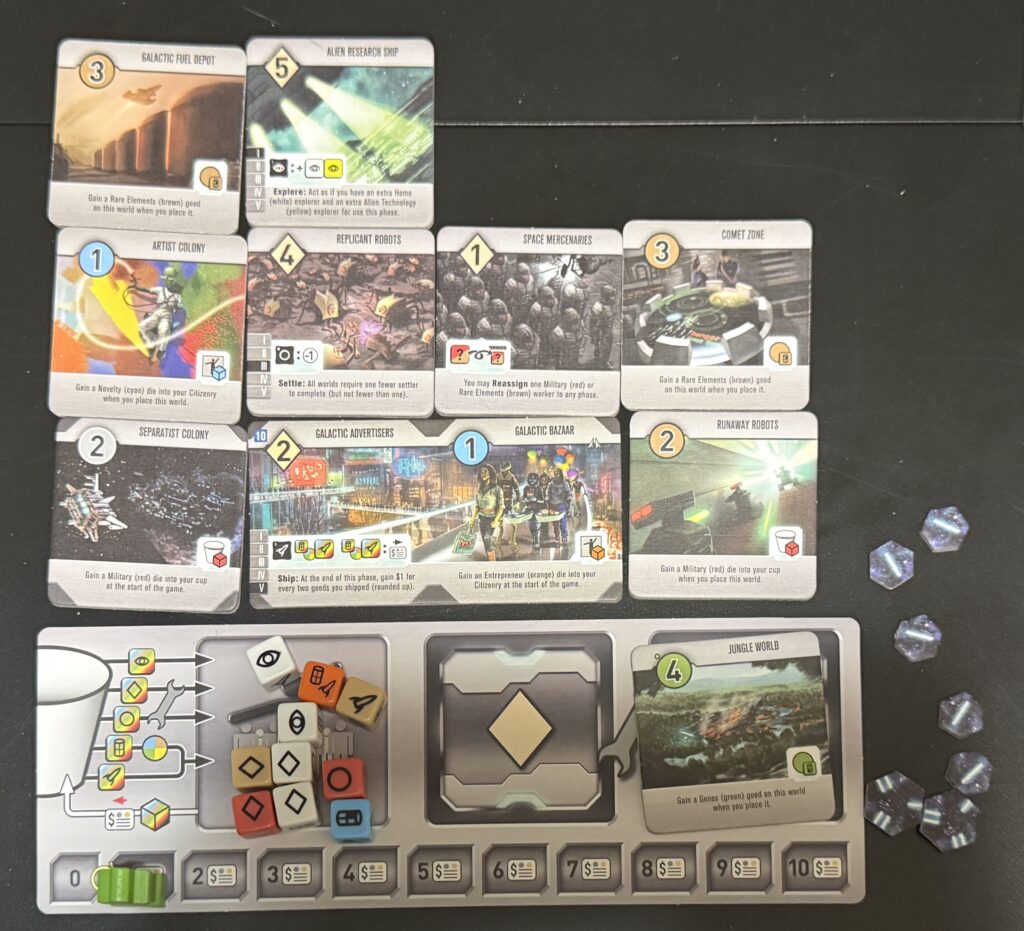
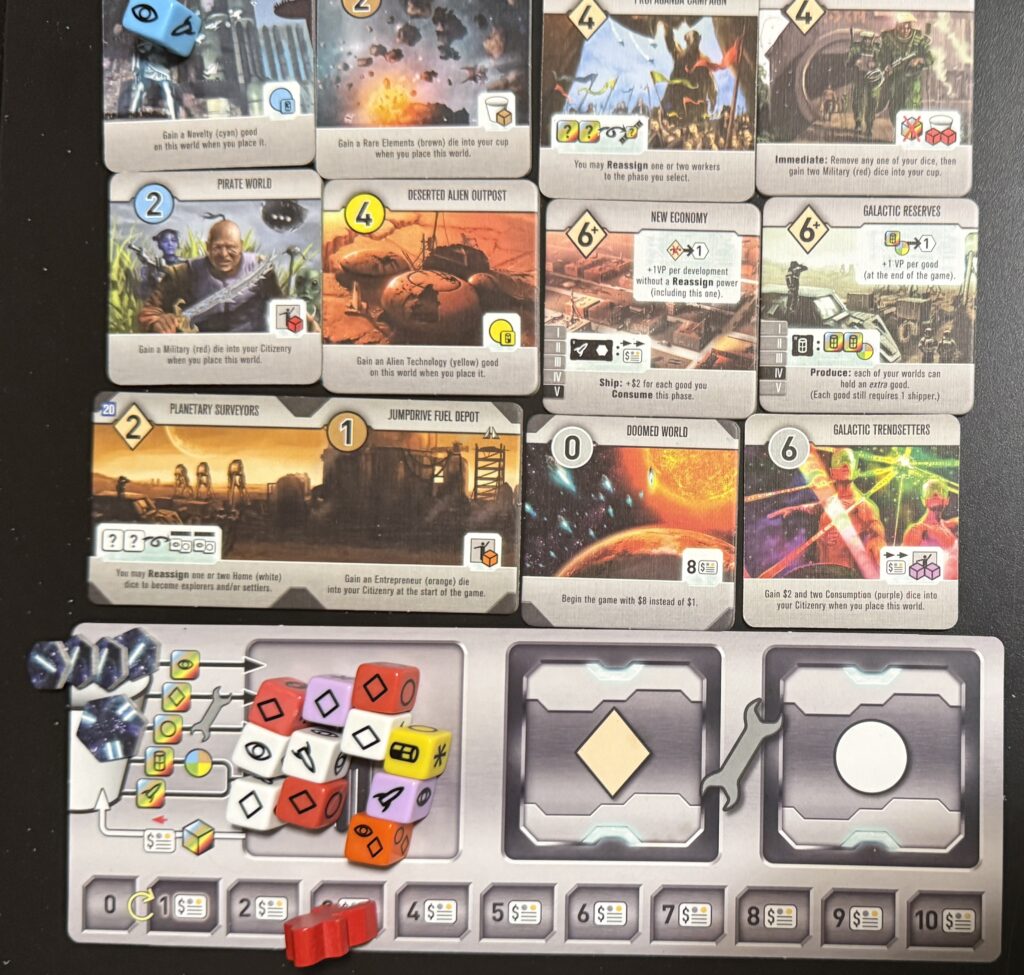
Here we can see that one of us selected diamond (Develop), another selected circle (Settle), and a third selected spaceship (Shipping). If anyone assigned dice to eye (Exploration) or cylinder (Goods), those dice are not used and go back into that cup.My play area at the end of the game. You can see that I’ve settled some planets (tiles with the circle on the upper left), developed some technologies (tiles with the diamond on the upper left), gained more dice for my pool (lower left of the image), and gained some victory points through shipping (hexagonal counters on the lower right). I came in last.Behold the play area of the winner, John. He not only gained more tiles than Andrew or I, but had higher-value tiles that worked well together.
It was a fun night. Sea Dragons was more like a Tetris puzzle than area control. Roll for the Galaxy became more familiar as I played it, reminding me of gaming in years gone by. I enjoyed both games.
Pingback: Last Night’s Game – Trickadee and Martian Fluxx – The Argothald Journal
Pingback: Last Night’s Game – Mystic Vale Harmony, Race for the Galaxy, Dice Forge – The Argothald Journal