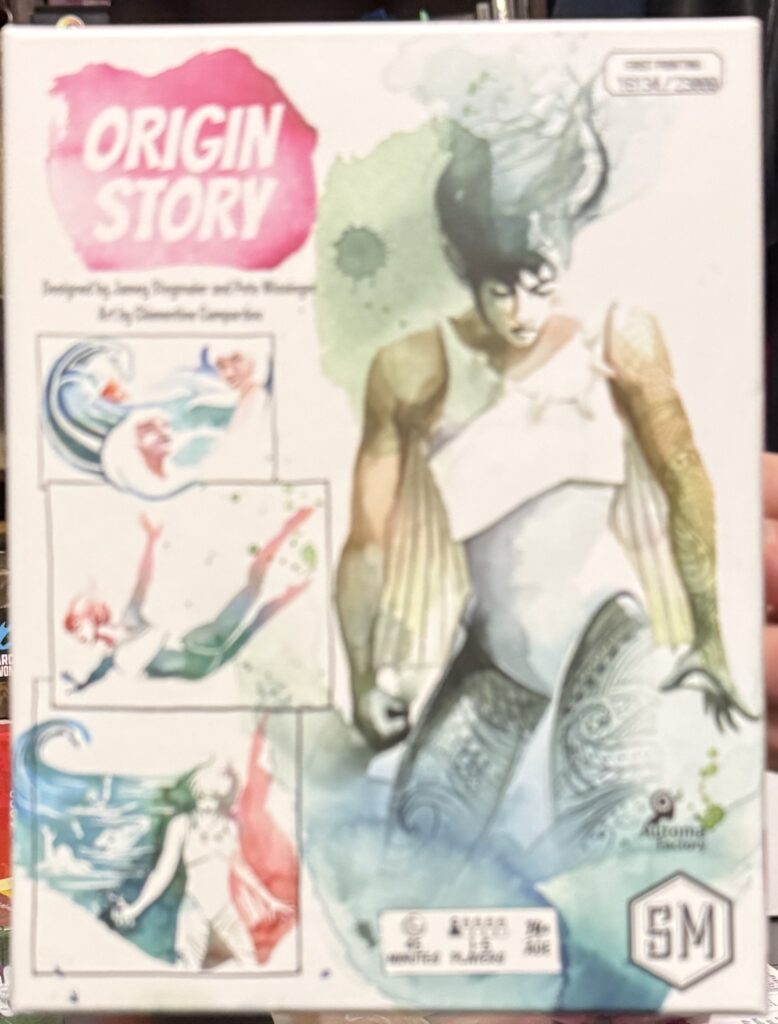
Last night I sat down with M, J, and A for a game session. The one we picked was Origin Story
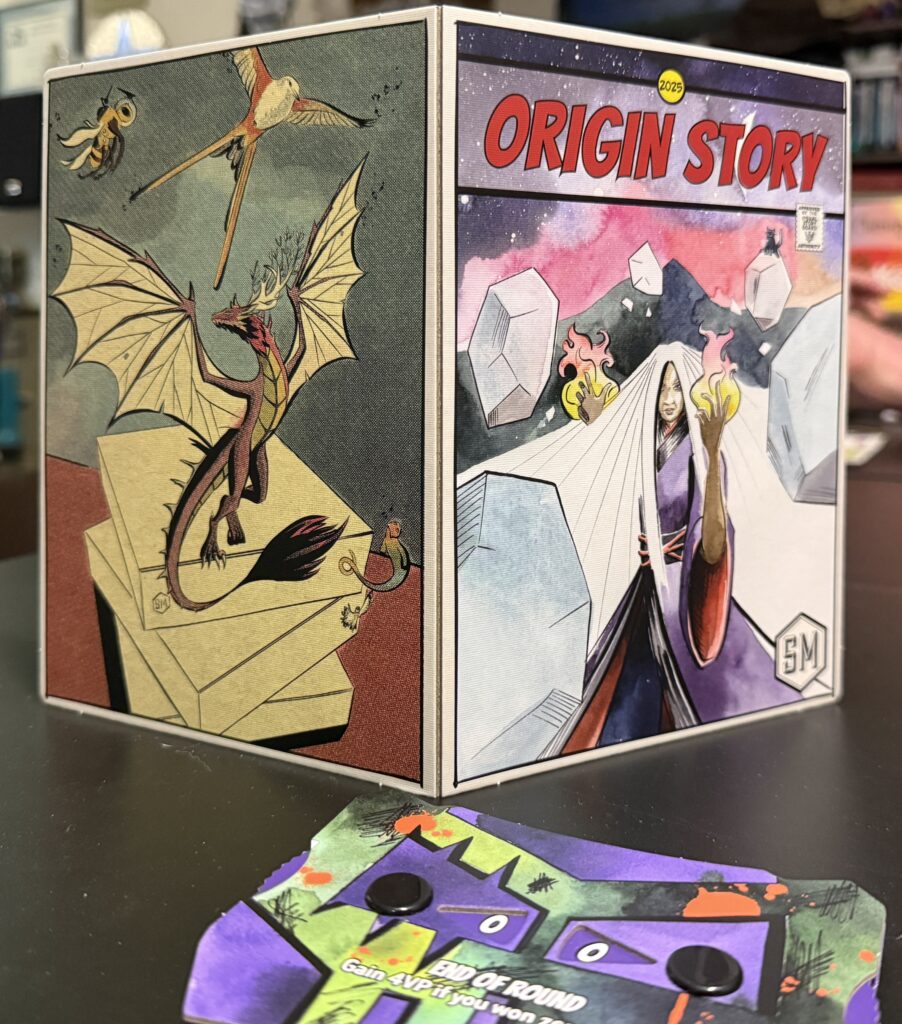
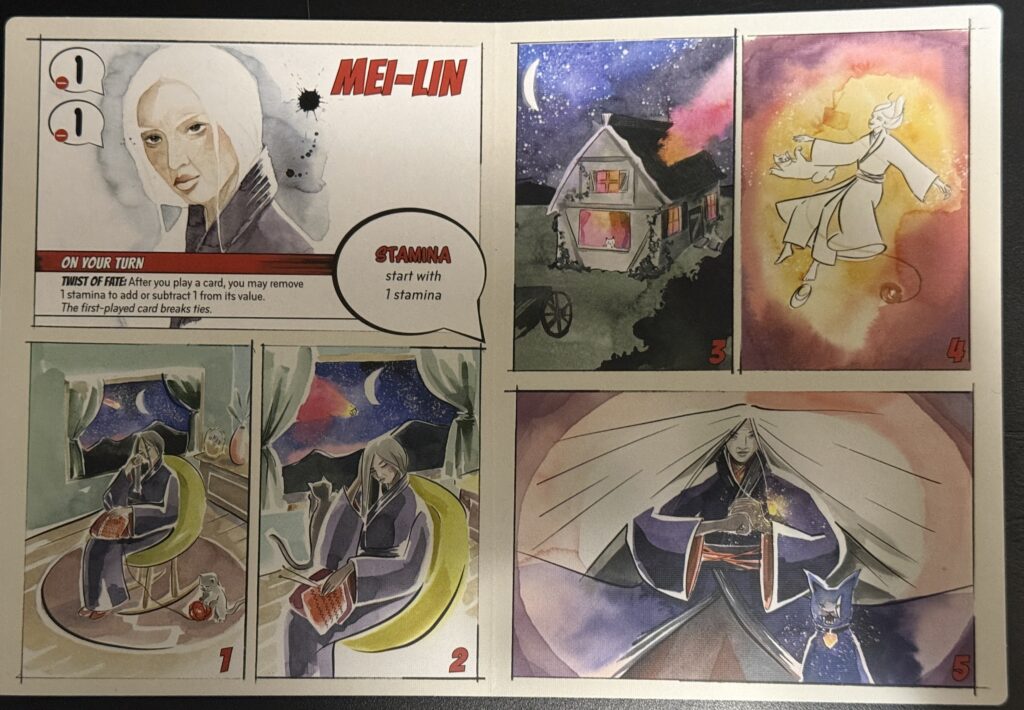
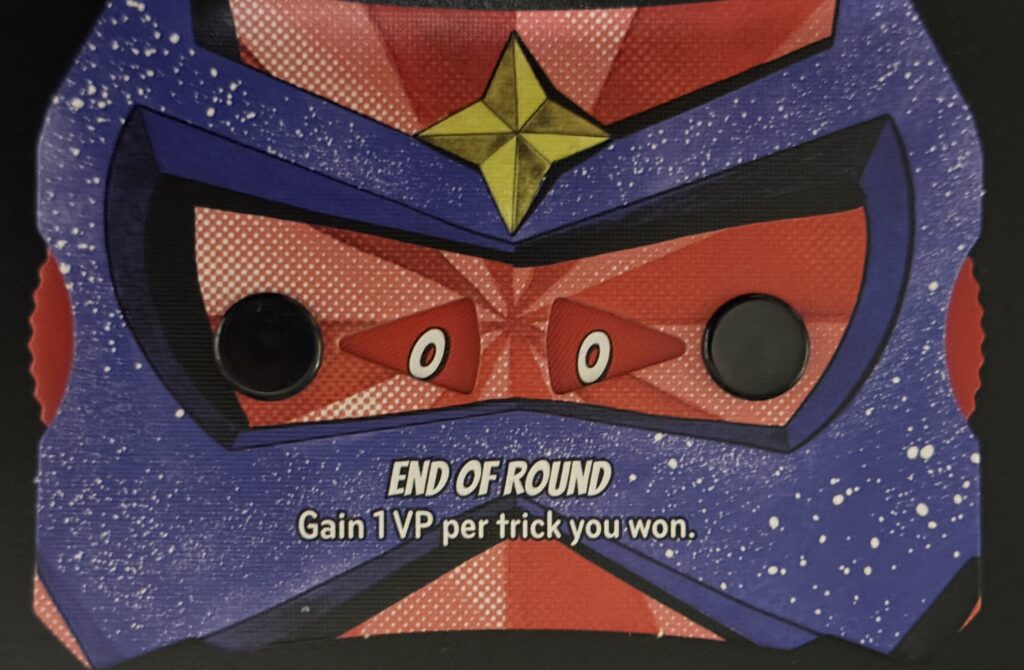
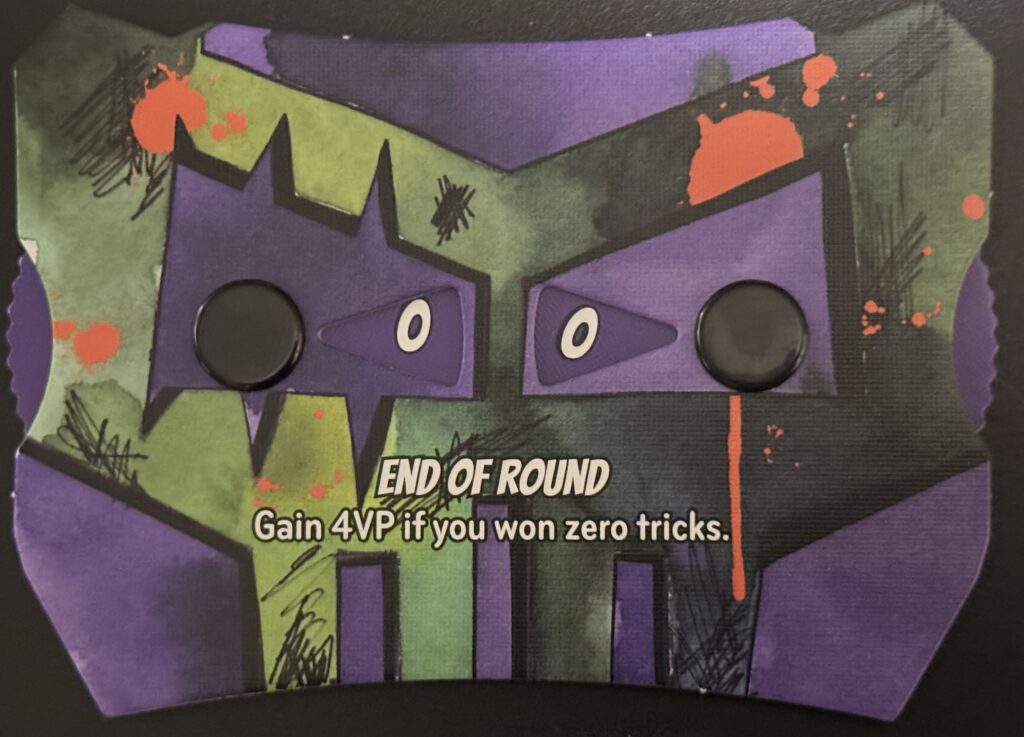
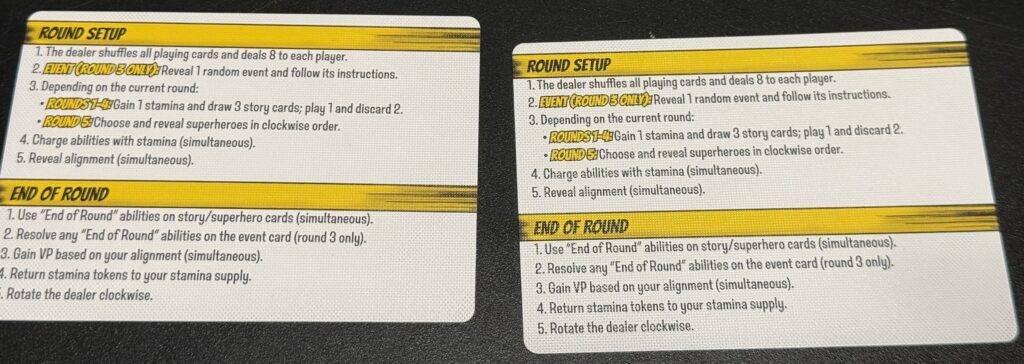
Origin Story is a trick-taking game. Players take turns playing cards. Whoever plays the highest card within the same suit as the initial card wins the “trick.” So far, this sounds like Bridge or Hearts, and there’s some similar strategy, but there’s more to it than that.Through the course of the game, you’re building the powers of the superhero you’ll become. The player boards look like comic books from the outside.There’s different artwork on each of the player boards, both for the “front cover” of the comic, and the main layout on the inside. Here we see that I’m starting as a normal person, Mei-Lin. Each character in the game has a unique ability that is powered by Stamina markers.Each player has a scoring dial with two sides. One side, as shown above, is the Hero side; this gives you 1 Victory Point (VP) for every trick you win. The other side, as shown below, is the Villain side; this gives you 4 VP if you don’t win any tricks that round, and is equivalent to “shooting” as in a game like Hearts. You get to choose Hero vs. Villain at the start of each round of eight trick-taking turns.
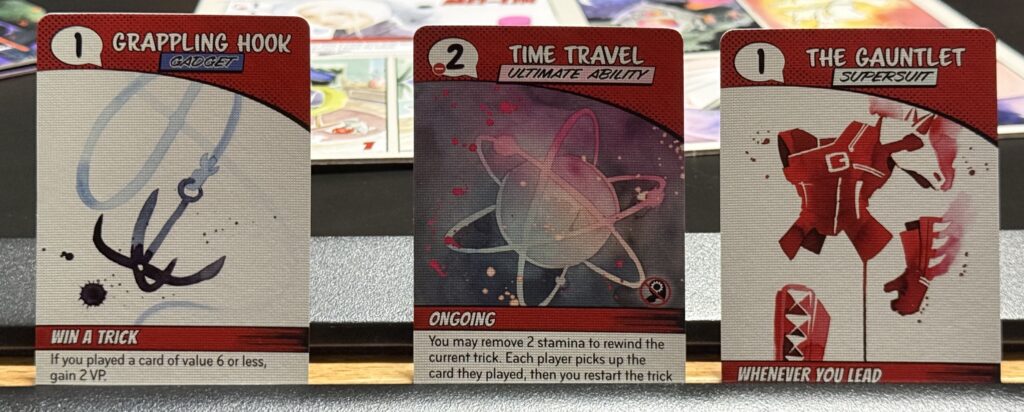
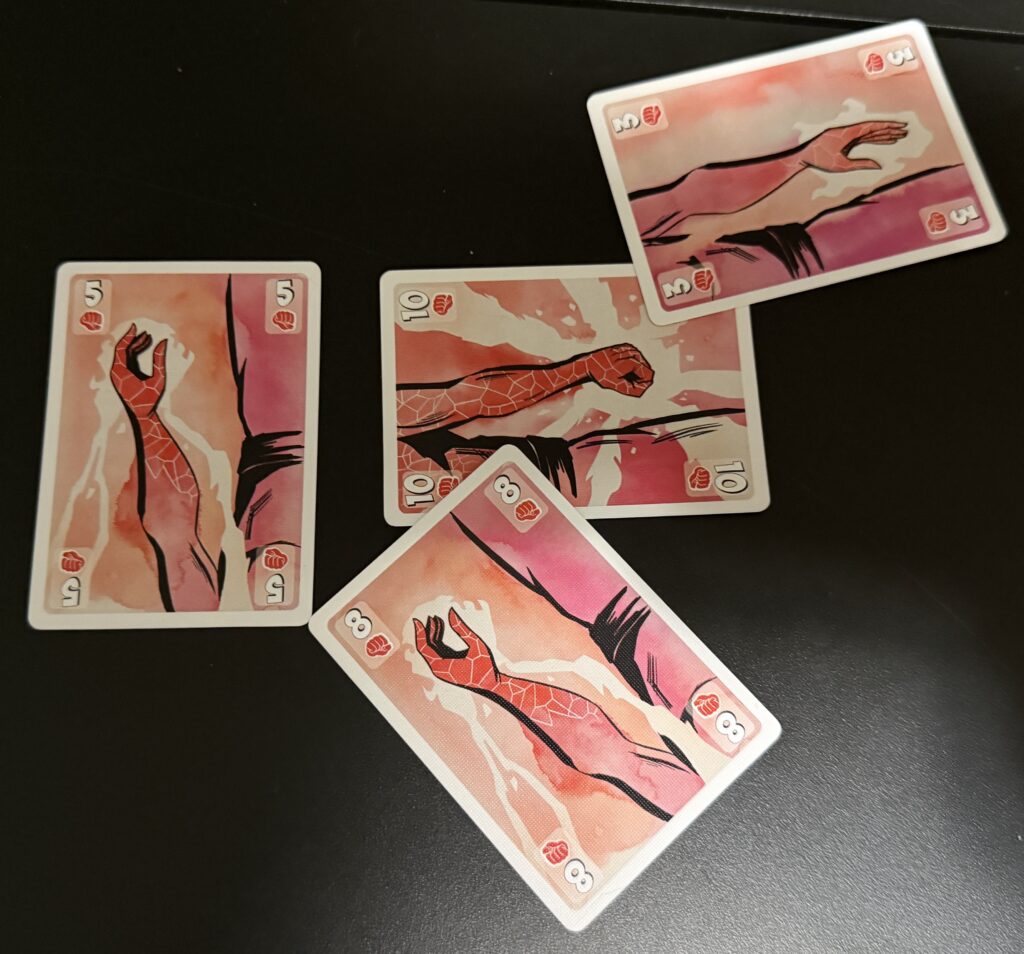
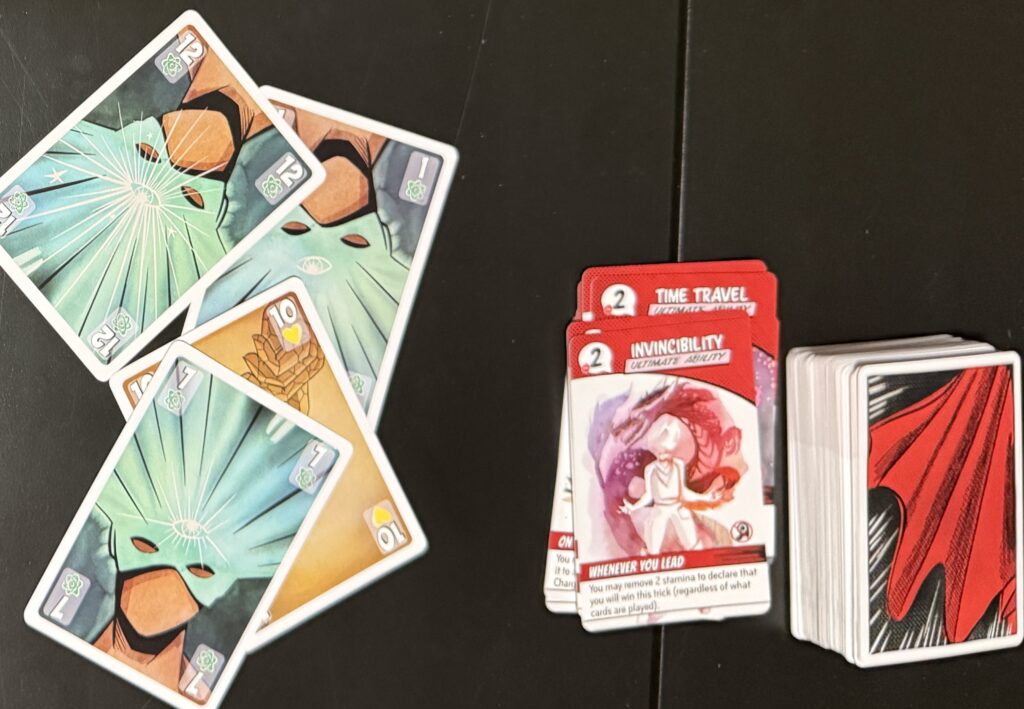
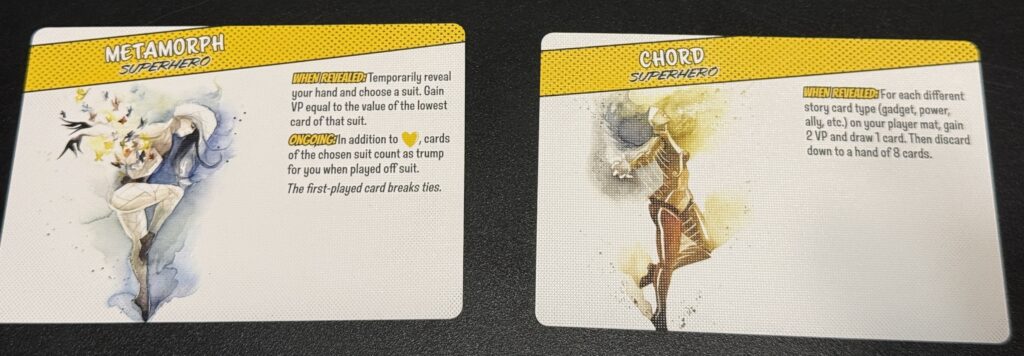
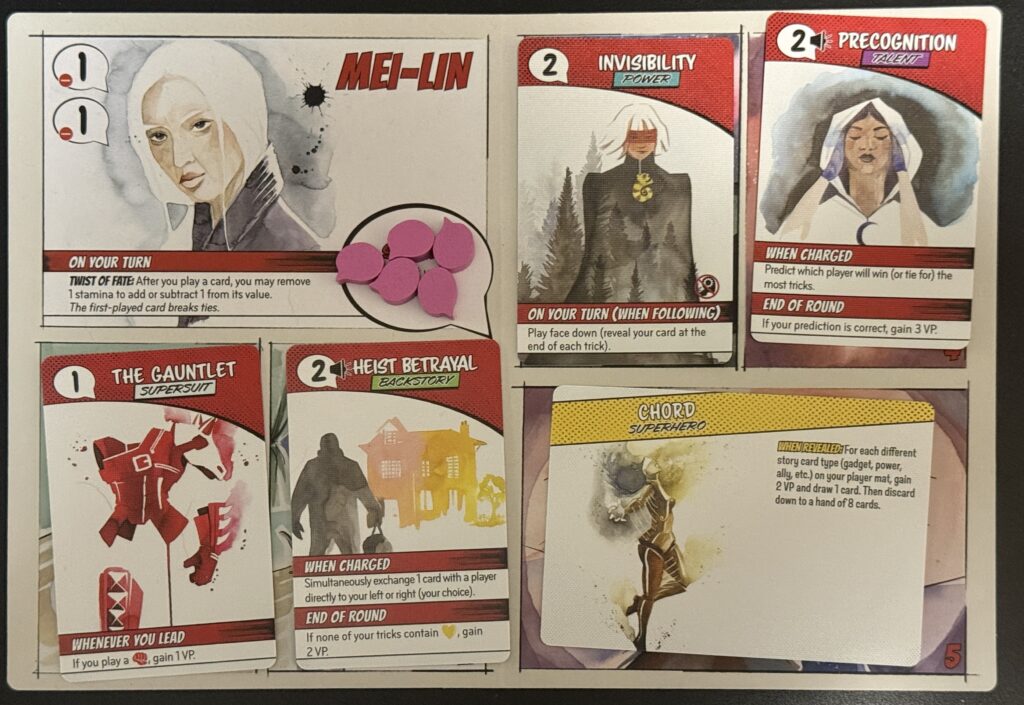
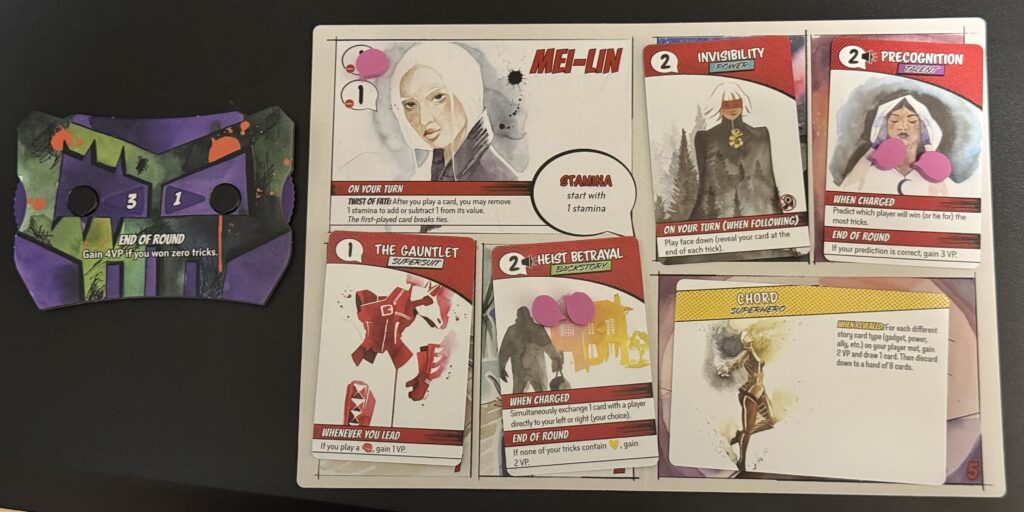
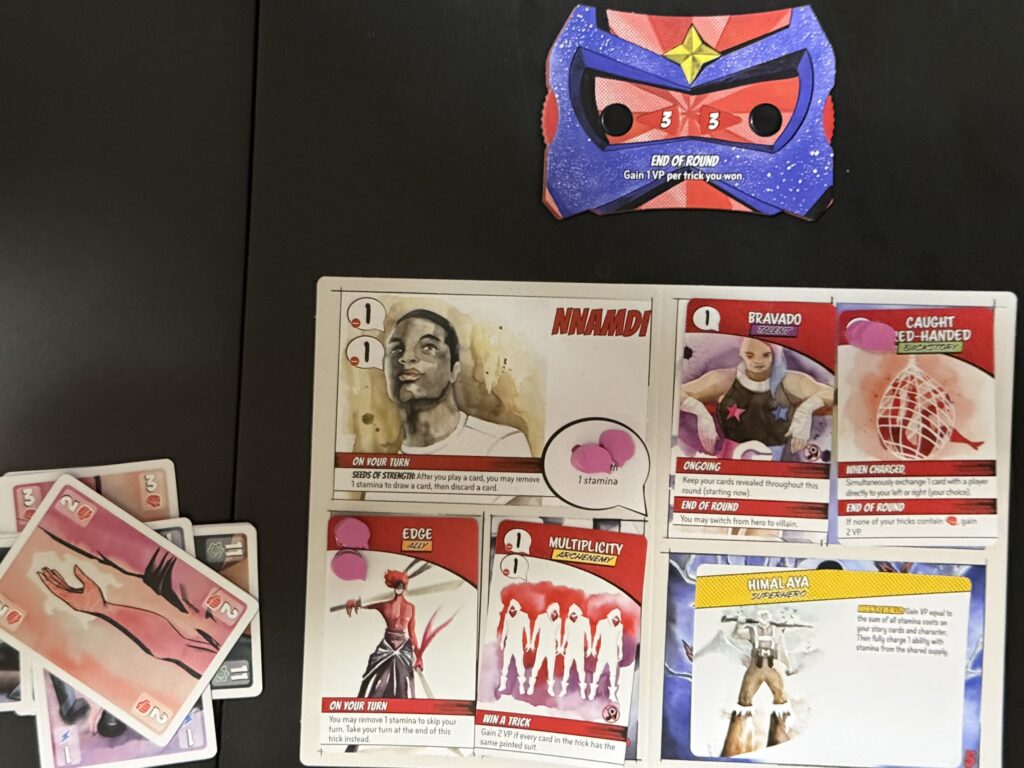
At the start of rounds 1-4, you get to choose from one of three randomly-drawn powers to add to your player board. They are activated by placing Stamina on the card during the course of the round. These were my choices in the first round of our game.Every player gets a hand of eight cards at the start of each round. The deck is structured like a standard playing-card deck, with four suits of 13 cards each. Here we see the four cards of a trick, which was won by whoever played the “10 of Fists.” Note how the artwork on each card is different.In Origin Story, the “Hearts” suit is trump. Though the “12 of science” was the highest card played, it’s the “10 of hearts” that wins the trick. The one who played that card was only able to do so because they had no “science” cards in their hand.At the start of the game, you get two of these helper cards. Why two?Because on the other side of each card is a unique Superhero whom you can choose to become. At the start of the fifth round, you’ll pick which of the two cards to add to your player board. These were my options during our game.This was my player board at the start of the fifth round. The pink “voice balloons” are Stamina markers. Players get an additional marker at the start of each round. They use those markers to empower the abilities of their choice.My player board and scoring dial at the end of the game. You can see how I chose to allocate my Stamina.Behold the play area of the winner, A. I came in third; J was just ahead of me. I chose a risky strategy, of playing the Villain in every round. I thought I was doing poorly (I had to take a trick in the second round), but it turns out that worked better than I thought. It didn’t get me the win, though.
The evening was running a bit late, and we decided not to start a fresh game. We finished out the night by playing Origin Story again.
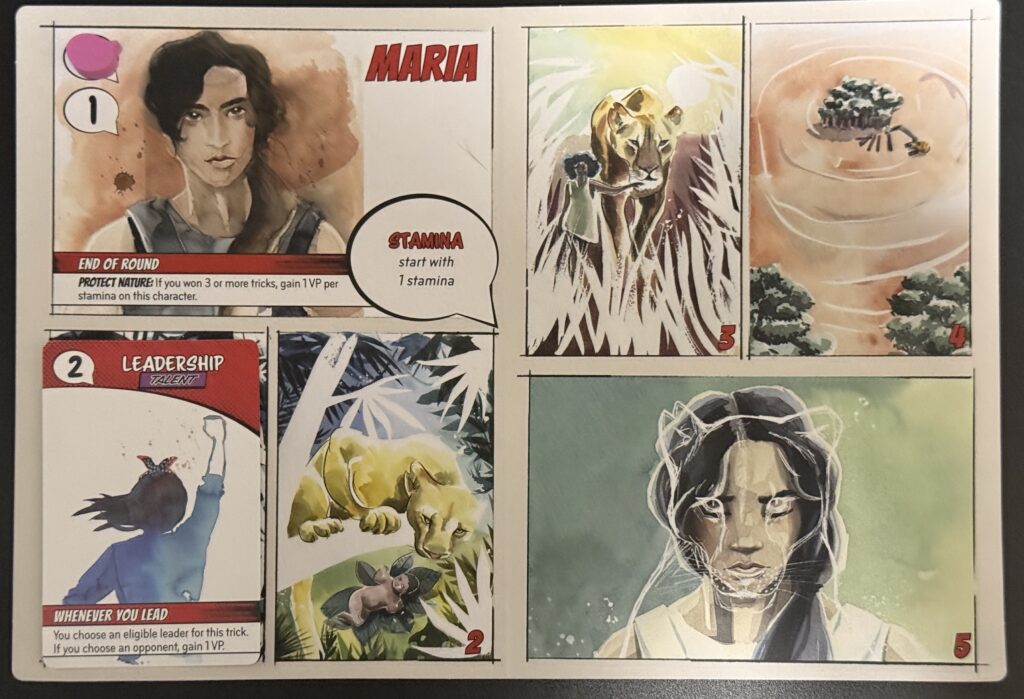
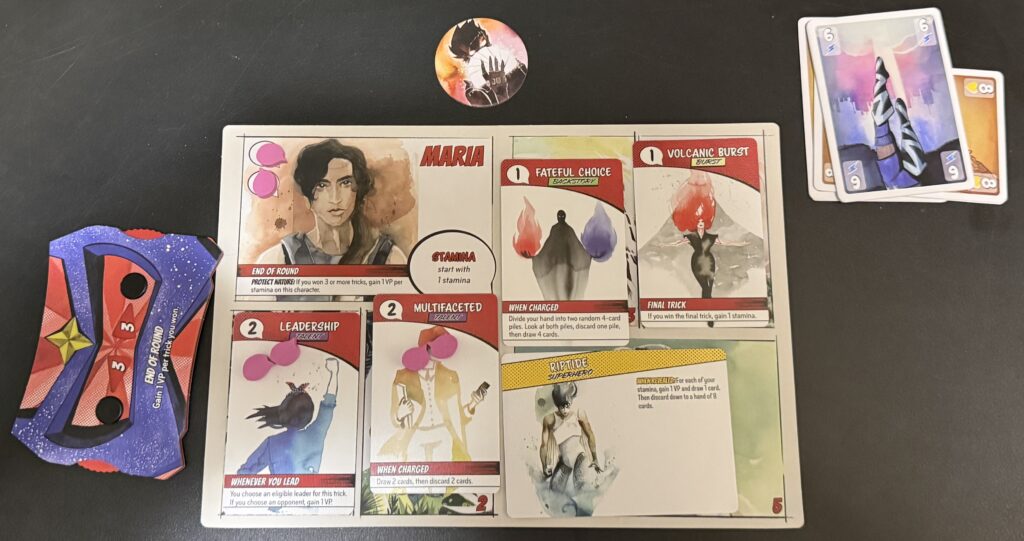
My player board near the start of our second game. I’m playing Maria. Given her starting ability, it made sense for me to drop any thought of the Villain strategy. In the first round, I didn’t have enough Stamina to empower the Leadership card you see in the lower left. In the second and subsequent rounds, Leadership turned out to be over-powered. There was no reason for me not to pick that the person to my immediate left, J, to play the first card in the trick. This kept him at a disadvantage for the rest of the game, since I could usually win a trick if I could see all the other cards played before me in a turn.Behold the player board of the winner, me. Now that I look at Maria’s main ability again, I see that I should have had even more victory points that this; I was only collecting 1 VP if I won three or more tricks, when I should have gained 1 VP per Stamina.
This leads to our main criticism of the game: It’s “swingy.” Everything depends on the powers you collect. I had an exceptionally good combo of powers, which is why I won the second game. I’m not good at trick-taking games, so it was more luck than skill that got me the win.
As an illustration of this, in both games we played there were three players who had scores within 3 points of each other, and one who was simply left behind with only half as many points. In both cases, for the lowest-scoring player it was a matter of “luck of the draw” of the powers and abilities, as opposed to any strategy they could have implemented. My Leadership card was an example; anyone who had it could simply pound on the player who sat to their left.
With that acknowledged, I enjoyed Origin Story. I liked the extra layer of mechanics on top of a traditional trick-taking game, along with the game’s theme and artwork.