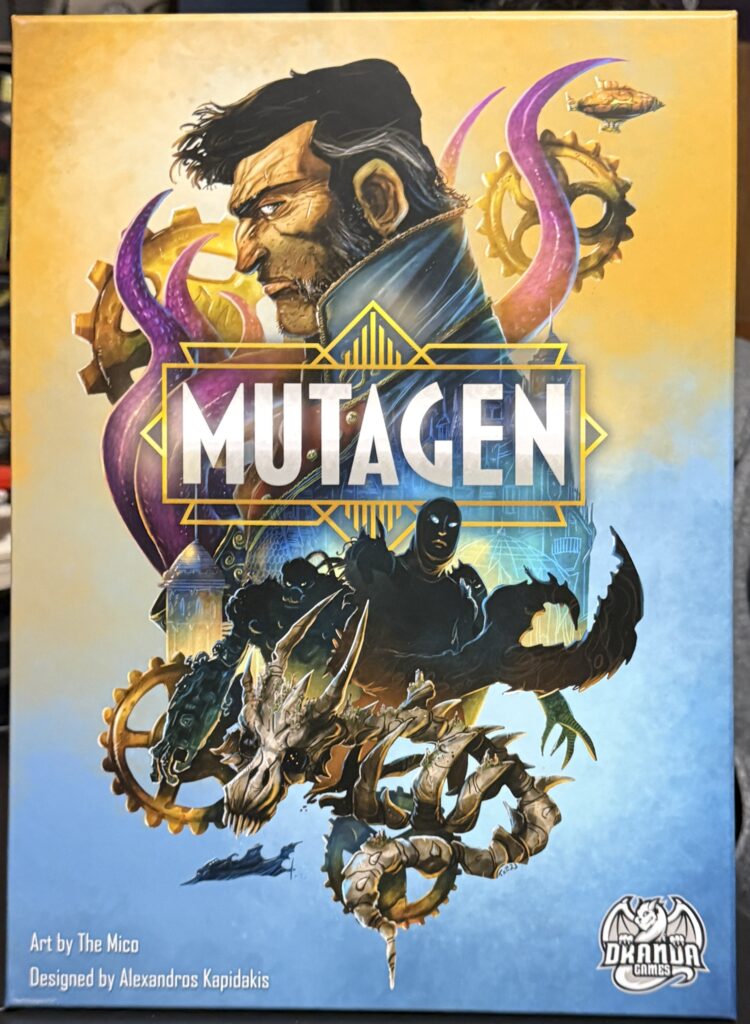
M, J, A, and I haven’t had the chance to game with each other for a month. We finally got together to play Mutagen.
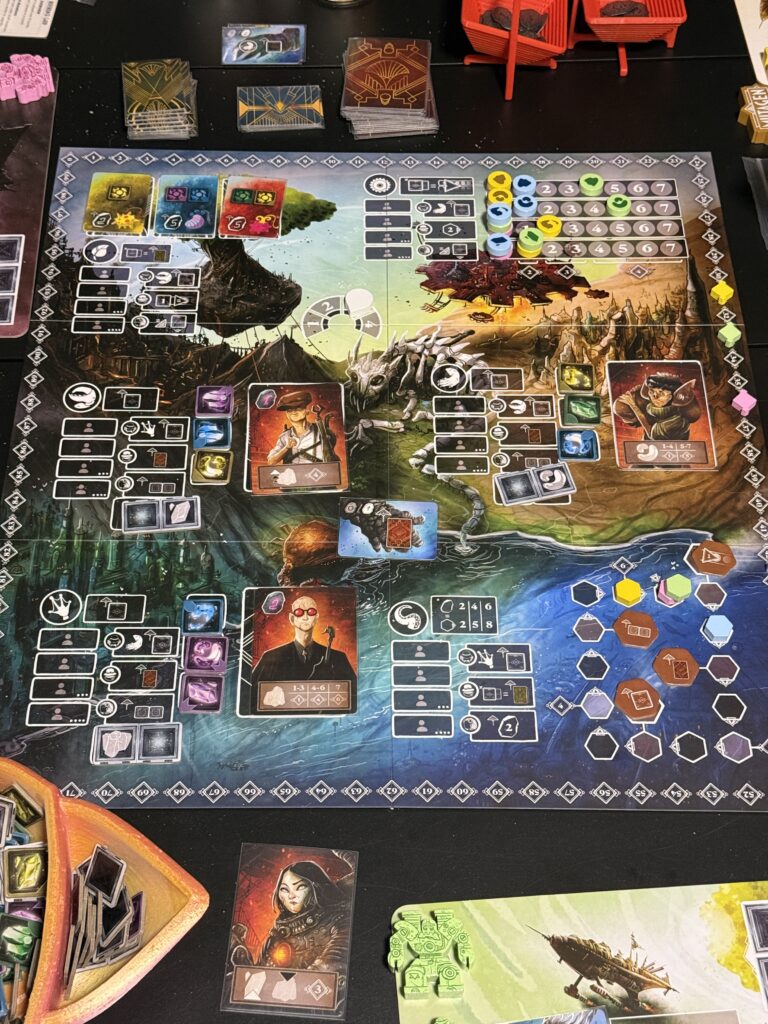
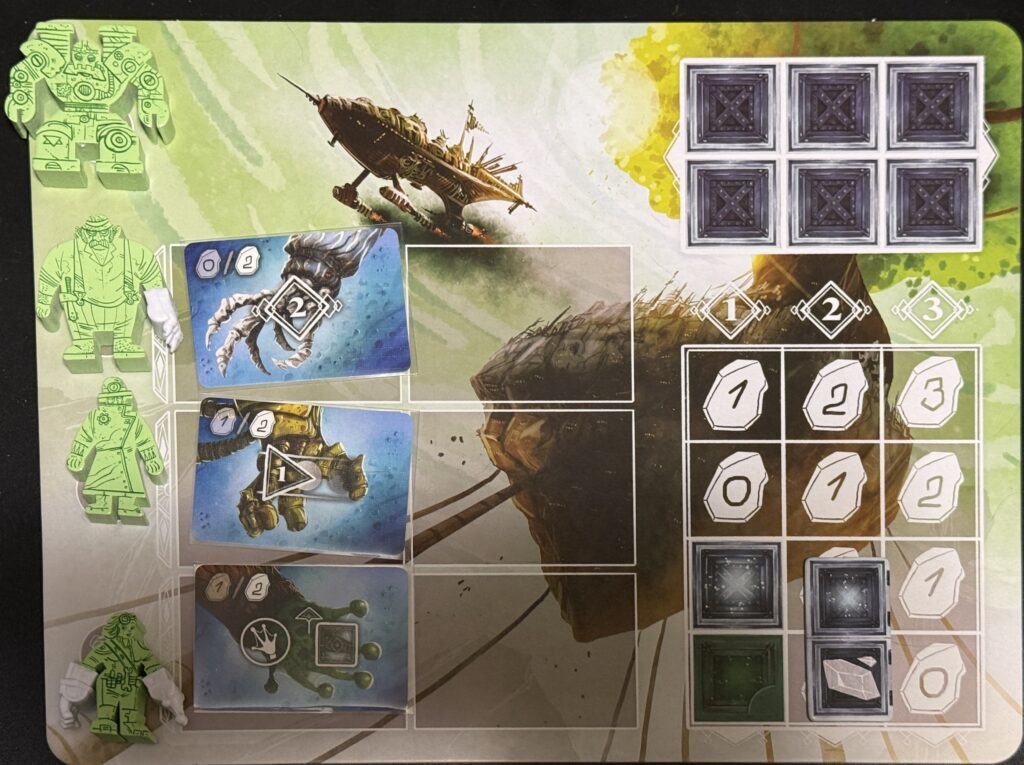
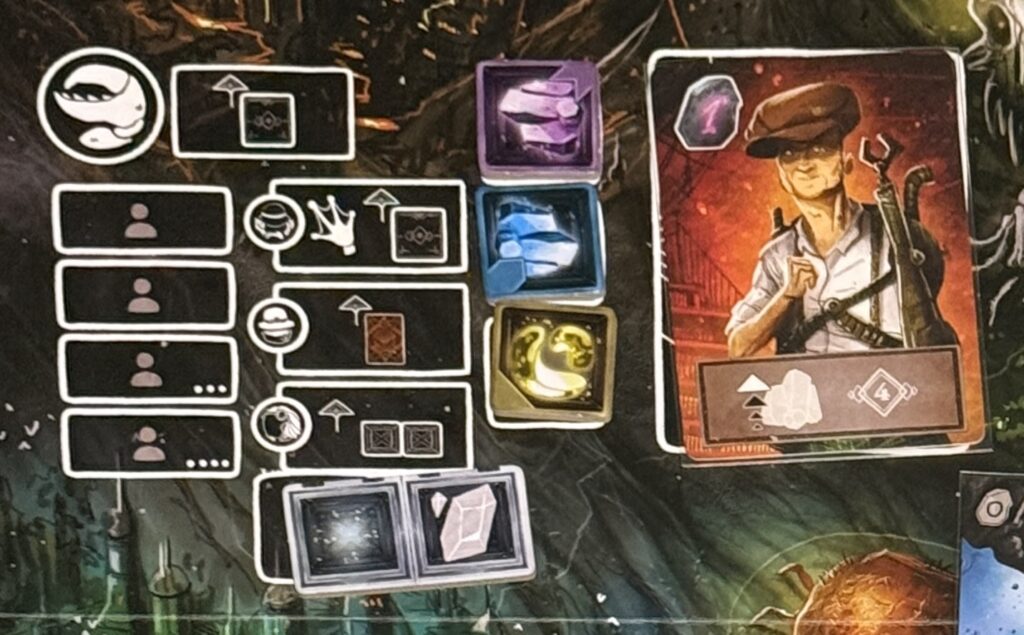
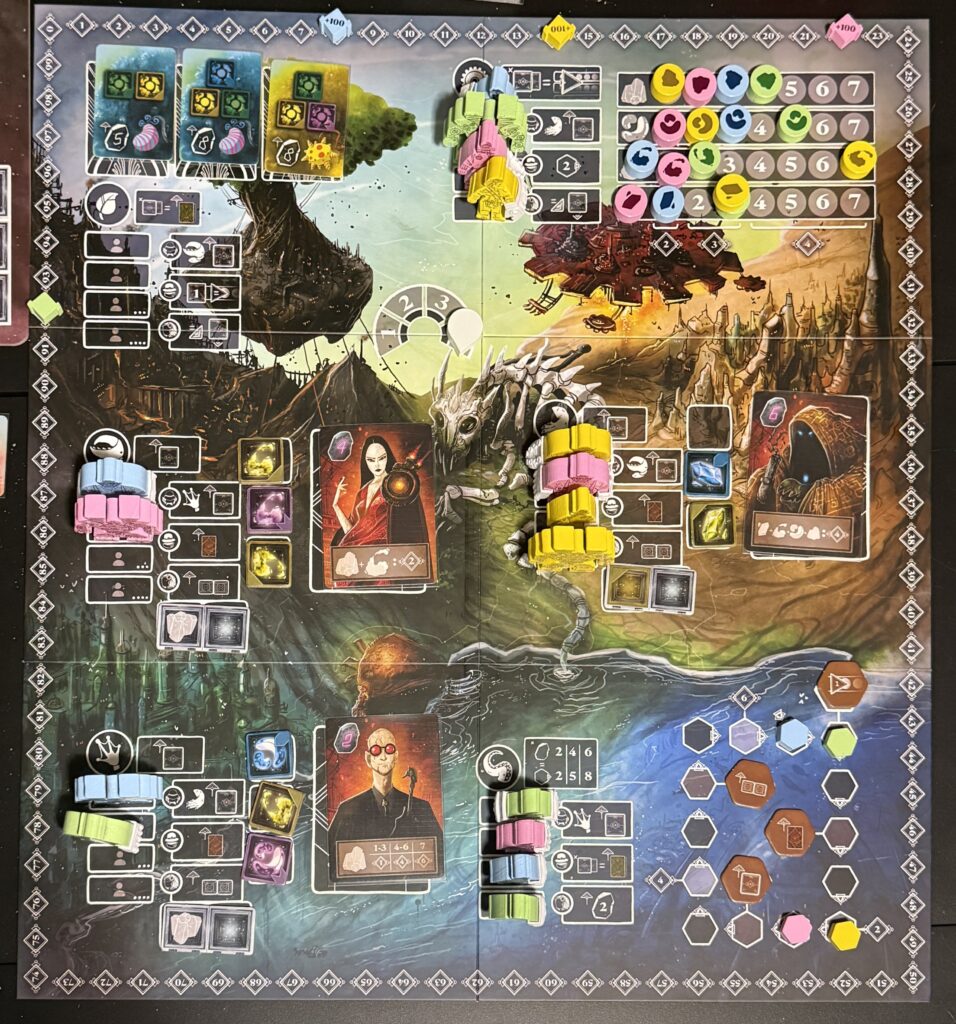
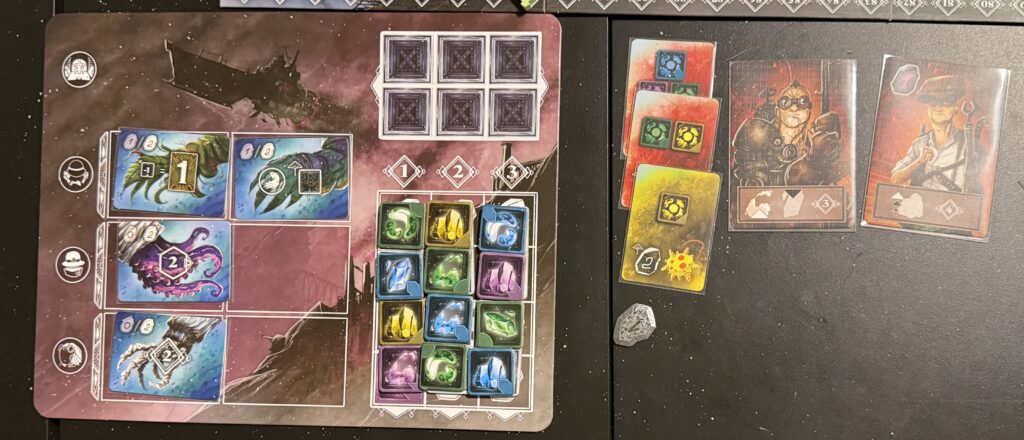
When I first heard the name of the game we were to play, I couldn’t help but think of Witcher 3. However, this game has nothing to do with that.The theme of the game is… well, as J put it, we’re playing the game for its mechanics, not for its tortured backstory. This pictures shows the central board state at roughly half-way through the game. Mutagen is a worker-placement game. You send your worker to the various areas on the board to gain elements, which can be further used to gain victory points.My player board at the same point in the game. Each player has four workers. During the course of the game, each player will get arms they attach to their workers. For example, my second worker from the top has a claw I attached to his figurine. This claw adds two victory points every time I place him.An example of a worker-placement area. The players put their figurines in the rectanges on the left. That lets them claim the benefit of the space; in this case, it’s to claim one of the elements (the square colored tiles in the middle of the photo). The player could also perform a class action related to the area; for example, if I placed that burly figure from the above picture, I could claim an additional element from the worker area labeled by a frog-like hand. The card on the right is a potential member of a player’s crew; they give end-game victory points based on certain conditions.The board state at the end of the game. You can see how we’ve placed our workers in the different areas. I’m playing green; as you can see, I came in last with 92 points. The winner was pink with 122 points. Who played pink?Behold the play area of the winner, J. The primary source of his victory points was filling up his cargo hold with elements as early in the game as possible. Those points are scored at the end of every round. It was a gift that kept on giving… victory points.
I came in last because I made a poor strategic decision at the beginning of the game, pursuing victory points in a different way than the other players. By the time I understood my bad choices, it was too late for me to catch up.
However, that’s not the reason I didn’t enjoy the game; after all, I’ve loved games that I’ve lost before. My problem with Mutagen were some questionable production choices. The icons for “gas” elements and “liquid” elements looked similar to me.
You can compare yourself: Look at J’s cargo hold in the previous picture, and compare the green tile in the upper left of his hold versus the tile diagonally down and to the right. I was confused about which icon was which, especially since the tiles could be rotated.
Even the the difference between “rock” and “crystal” (the two bottommost tiles in the the right-most column of J’s hold) could be confusing. One of the board areas only showed the outlines of the element icons and I found it easy to mix them up. As a result, I kept amplifying my poor beginning choice with mistakes based on which elements I accumulated and what I did with them.
The game designers put in additional visual clues on the tiles to aid color-blind players. But they didn’t consider how busy the overall effect was, at least for folks like me with less-than-perfect vision looking at the icons from across the table.
From my perspective, Mutagen is a game with interesting mechanics that’s marred by presentation.