As I’ve played and discussed Baldur’s Gate 3 with both Real Angela and Actual Sabrina, the subject of “dice checks” often comes up.

Their interest comes from different places. Actual Sabrina is new to gaming, and is learning how die-rolling works. Real Angela is an experienced gamer, and wants to understand how a flat bonus compares with rolling with advantages.
I thought it might help if I wrote up my understanding of how dice checks work in BG3. I’ll start with my usual disclaimers:
- I do not consider myself an expert on “Gygaxian” systems like BG3 and D&D. The likelihood that I’ve made a mistake somewhere in this essay is quite high.
- Only little bit of web searching will find many explanations of this topic. I even found a video. I don’t pretend that my explanation is any better than anyone else’s. I’m writing this essay in the hope that explaining things in my own style might help someone who has difficulty understanding other sources. Like all my D&D-related rules discussions, it’s something that “Gygaxian” system experts can laugh at.
- Portions of this essay come from one of my previous blog posts, 46!. That post focussed on a single die roll. This one examines the broader topic of dice checks.
- I claim to understand something about dice checks. I don’t claim to like these rules. I think this entire system is too baroque, and leads to long discussions with GMs in D&D and excessive min-maxing in BG3. Please don’t consider this blog post to be an endorsement.
The basics
A player wants to do something in the game. In a pure-strategy game like chess, there’s no randomness involved; the piece you choose will move to the place you choose based on the rules of the game.
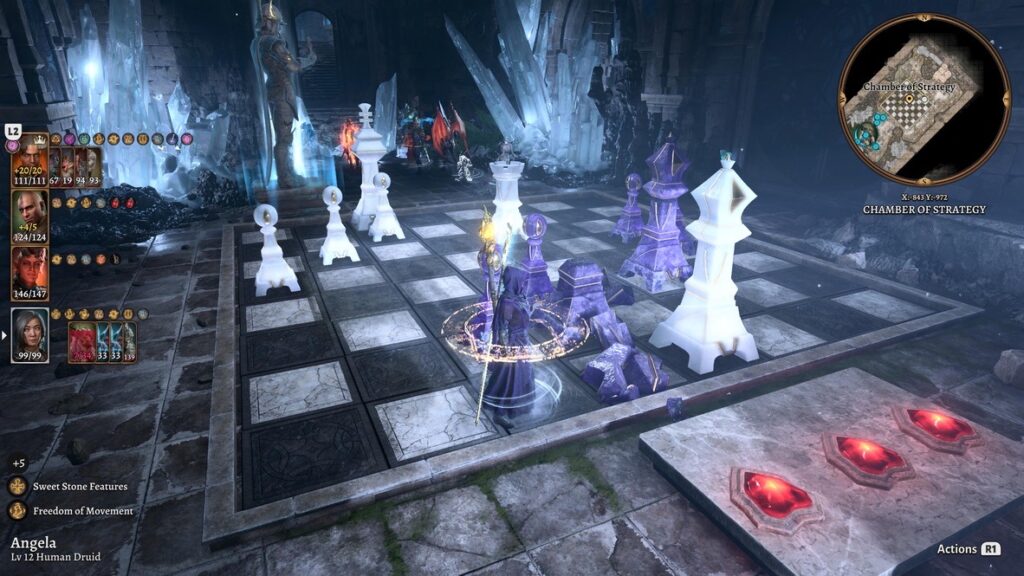
In a “world-simulation” game like BG3, the success or failure of a task depends on a random number. The process is:
- A number called a dice check, a difficulty class, or simply DC is determined by the rules of the game.
- One or more dice are rolled. If the result is the same as or greater than the DC, the task succeeds. If the result is lower than the DC, it fails.
In the current D&D rules, and in BG3, the die that’s rolled is an icosahedron, which has 20 sides. This is usually abbreviated by gamers as a “D20.” That’s why systems of this sort are called “D20 systems.”
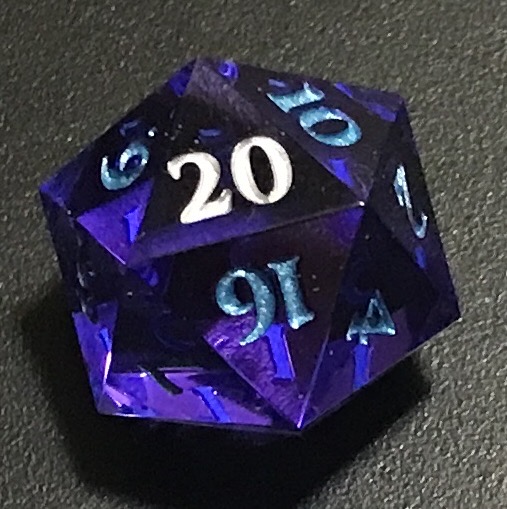
There are other role-playing-game systems that use six-sided dice to determine whether a task succeeds. Can you guess what those systems are called? (No prizes will be awarded if you guessed “D6 systems.”)
Rolling the dice
The value of the dice check (DC) depends on what you’re trying to do.
- A simple task might require a DC of 5; that is, you’re trying to roll 5 or more on a D20. You’ll succeed 16 out of 20 times, or 80% of the time.
- A moderate task might require a DC of 10 (succeed 11 out of 20 times, or 55% of the time).
- A difficult task might require a DC of 18 (succeed 3 out of 20 times = 15%) or even 20 (succeed 1 out of 20 times = 5%).
There are a couple of exceptions. They involve “natural rolls,” that is, what the face of the die that shows before any bonuses or penalties are applied. (I’ll delve into the topic of “bonuses” below.)
-
A natural 1 is always a failure, no matter what other bonuses you may have. This is called a “critical failure.”
-
A natural 20 is always a success, no matter what the DC. This is a “critical success.”
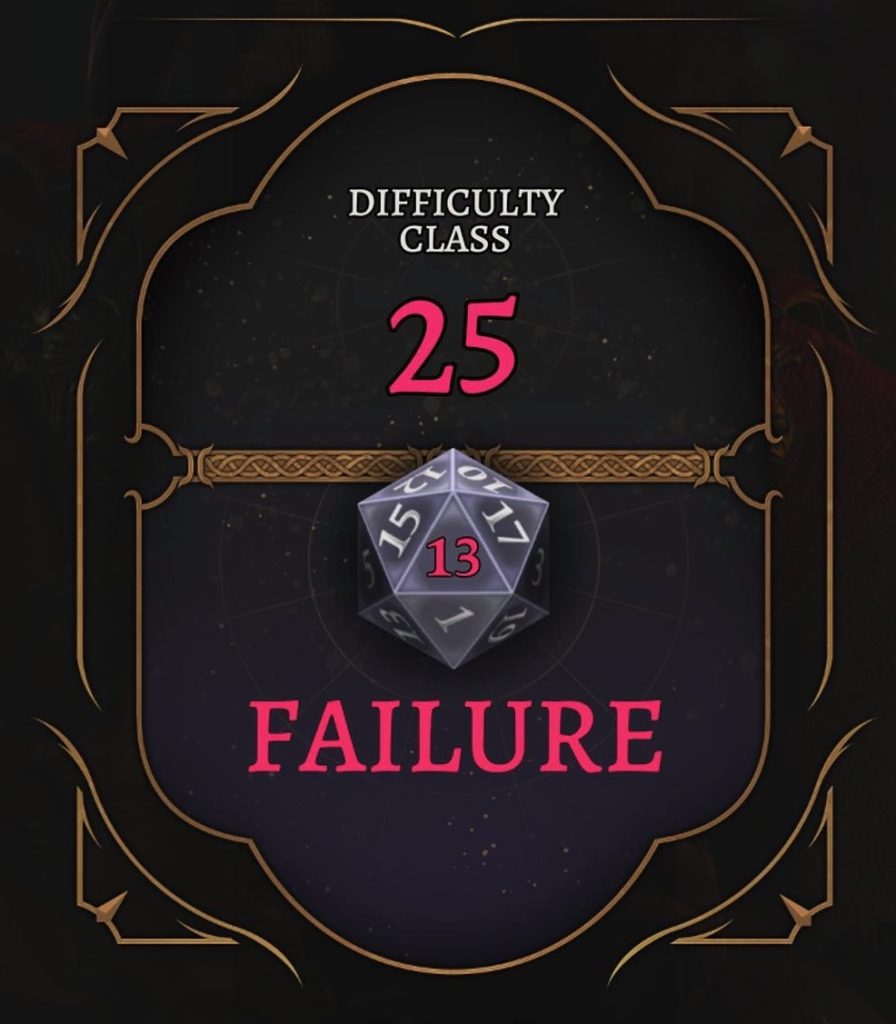
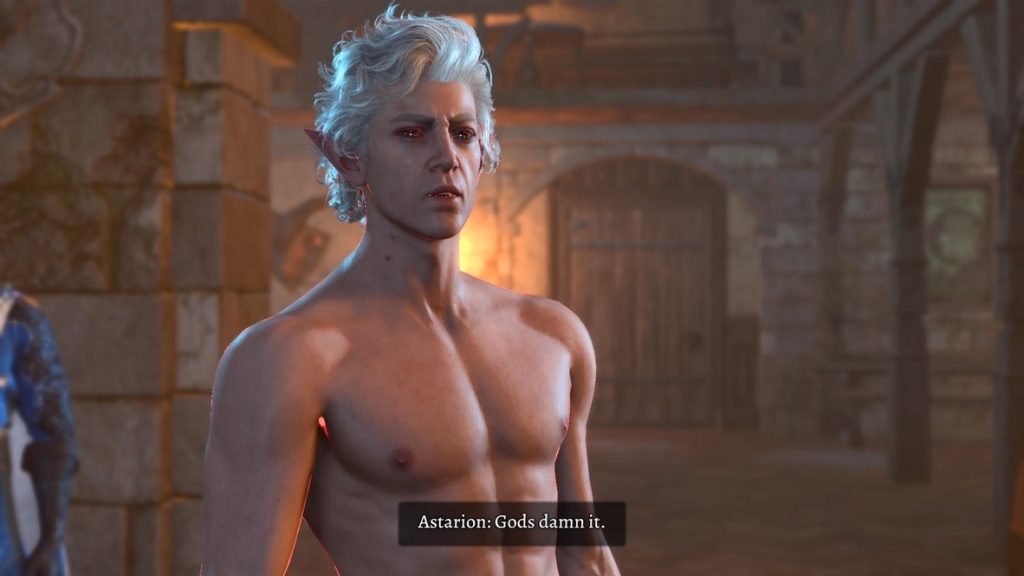
For example, look up a couple of photos (giving you another excuse to look at Astarion’s bare chest); you’ll see a DC of 25 for a task that’s meant to be extremely difficult. Even without bonuses, if I rolled a 20 I would have succeeded.
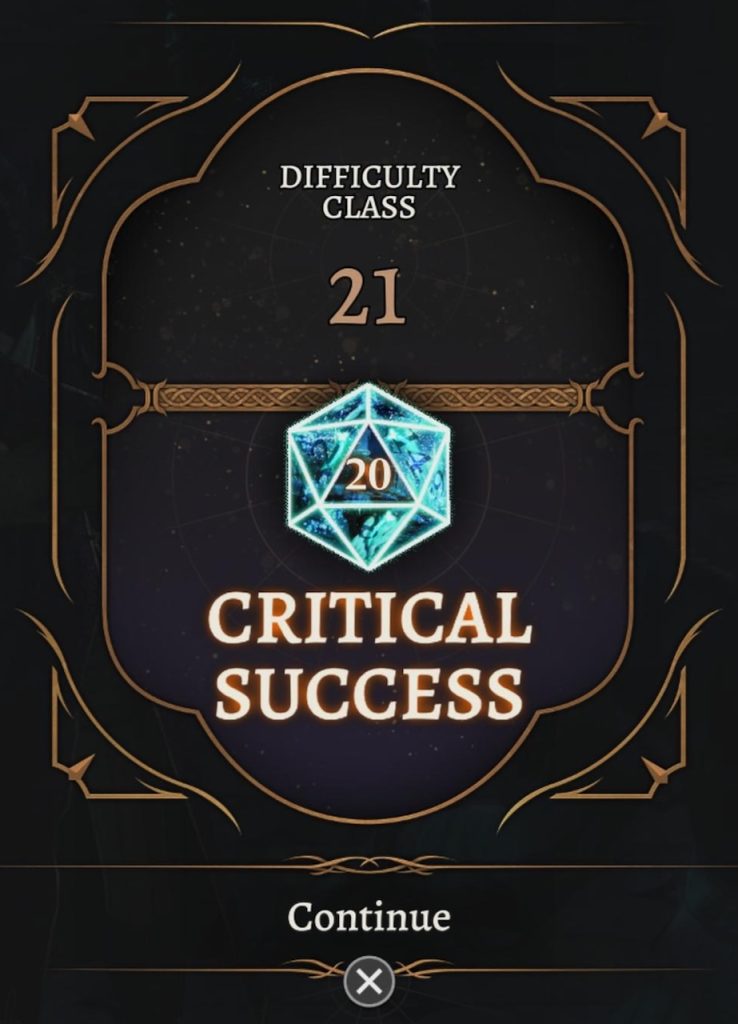
Here’s a critical success when the difficulty was 21, but I rolled a “natural 20.”
Advantages and disadvantages
There are two more important modifiers for die rolls:
- “Roll with advantage” – this means to roll two D20s, and use the higher of the numbers.
- “Roll with disadvantage” – this means to roll two D20s, and use the lower of the numbers.
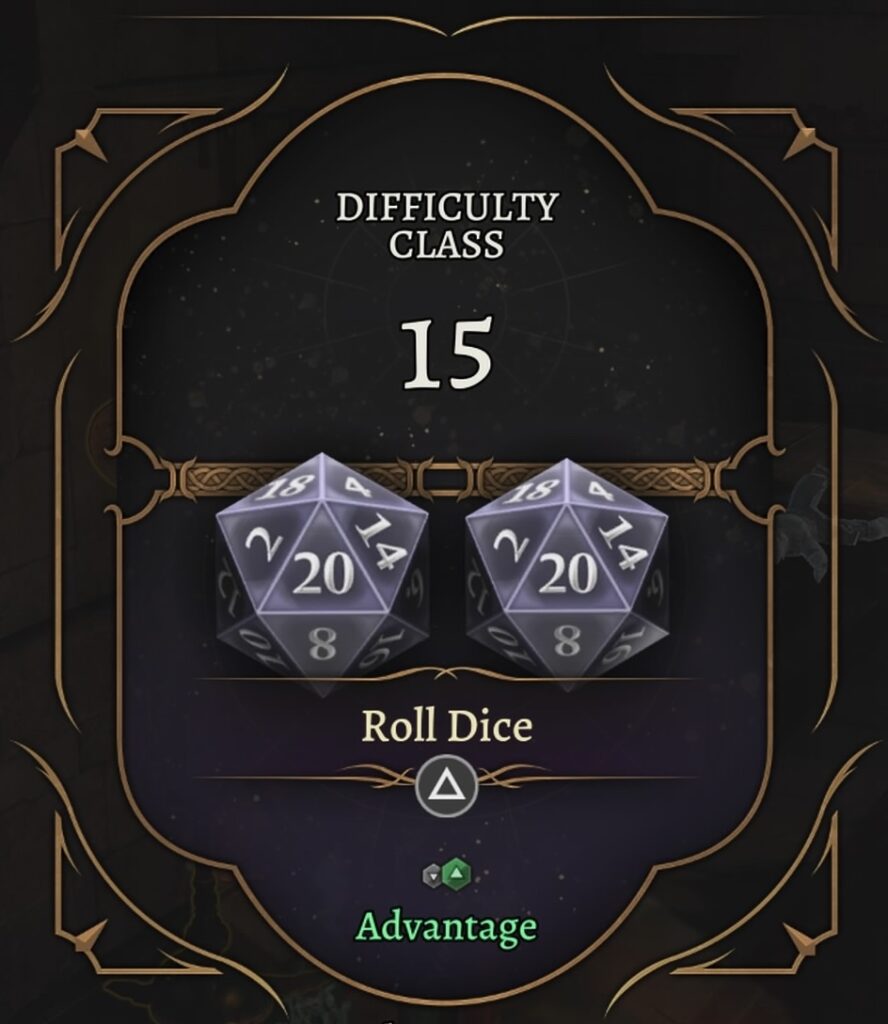
Advantages and disadvantages can be granted by various items, spells, and abilities you gain during the game. They can also be situational.
For example, if you’re on top of a cliff and you’re throwing a stone at a creature at the base of the cliff, you might be told to roll with advantage. If that creature is trying to throw a javelin at you, it might be forced to roll with disadvantage.

The rules for critical rolls also apply here, but advantage/disadvantage takes precedence:
-
If you’re rolling with advantage, and only one of the dice rolls a natural 1, it’s ignored. It’s the value on the other, higher die that will matter.
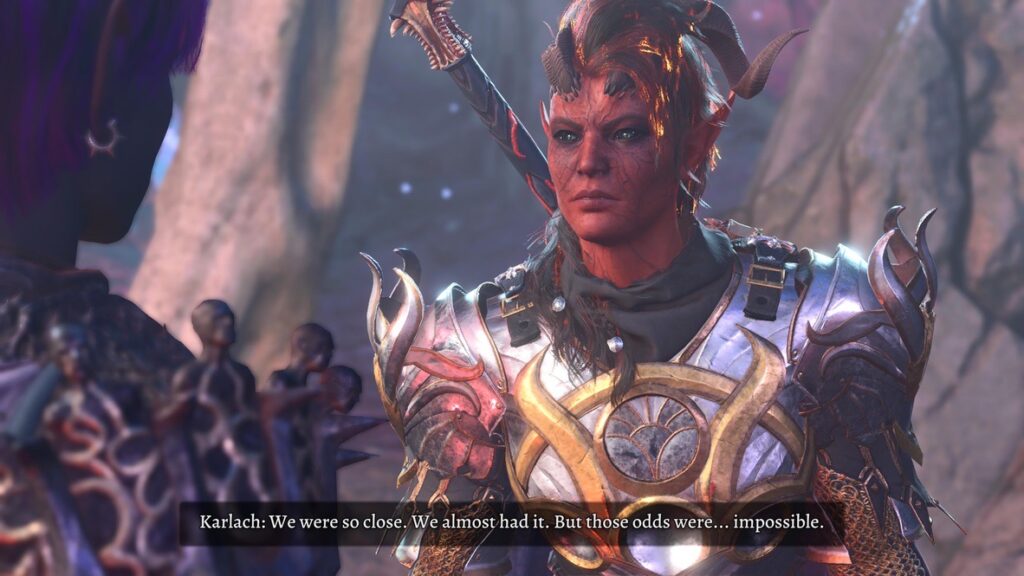
When you’re rolling with advantage, the only way you can get a “critical fail” is if you roll a 1 on both dice. If you do the math (I’ll get to the math below), there’s a 1 out of 400 chance for this to happen. I’ve seen it. I’ve seen it happen twice in a row. It isn’t pretty.
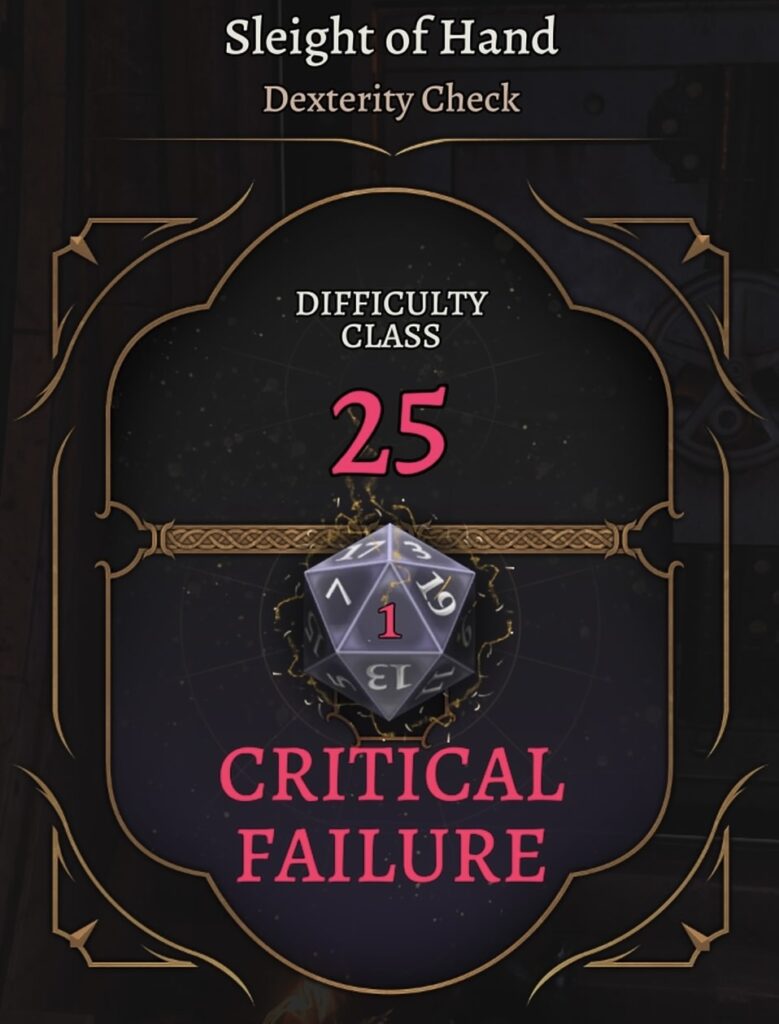
This happened while I was preparing this essay. In one of my playthroughs, Astarion always has Advantage on his Dexterity-related ability checks, including Sleight of Hand. He has so many bonuses that I fully expected him to pass this dice check. But he rolled 1 on both of his dice. I told you this wasn’t pretty! -
If you’re rolling with disadvantage, and only one of the dice rolls a natural 20, it’s ignored. It’s the value on the other, lower die that will matter.
If you’re rolling with disadvantage, the only way to get a “critical success” is to roll a natural 20 on both dice. Again, there’s only a 1 in 400 chance (0.25%). I don’t think I’ve ever seen this.
What are the odds?
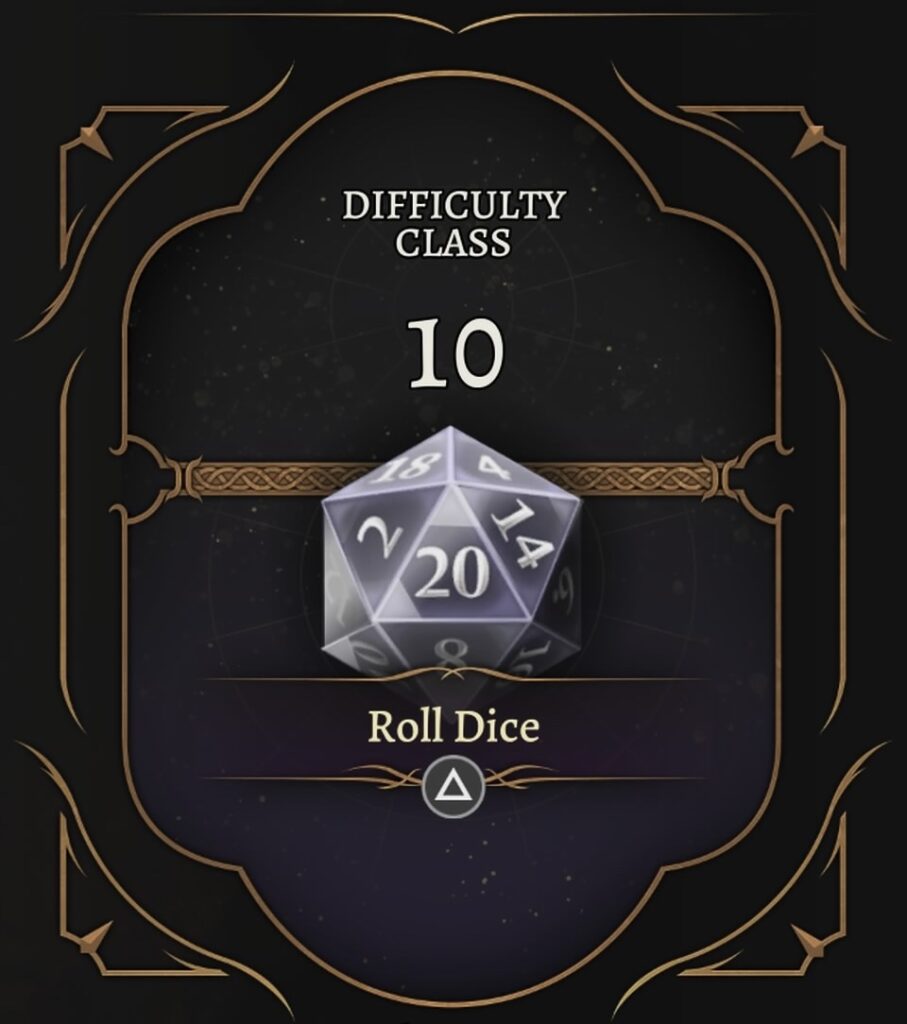
Suppose you’re told that the DC to succeed is 10. What are the chances that you’ll succeed?
To answer that question, I came up with a spreadsheet. Disclaimer: I’m far from the first person to develop a spreadsheet for this calculation. If you search around and find a better probability calculator/spreadsheet, by all means use it.
I created the spreadsheet in Microsoft Excel. Here’s the link to the file on Dropbox.
If you click on that link, you’ll get a static and badly-formatted image of the sheet. I recommend that you download the file (there’s an icon on the upper right of the page) and open the spreadsheet in whatever program is convenient for you: Microsoft Excel, Apple Numbers, LibreOffice, etc. (The highlighted link gives you a clue as to which program I recommend.)
If you don’t want to download anything, you can view a web-based version of the spreadsheet on Google Sheets.
Let me walk you though the spreadsheet, and show you how to use it.
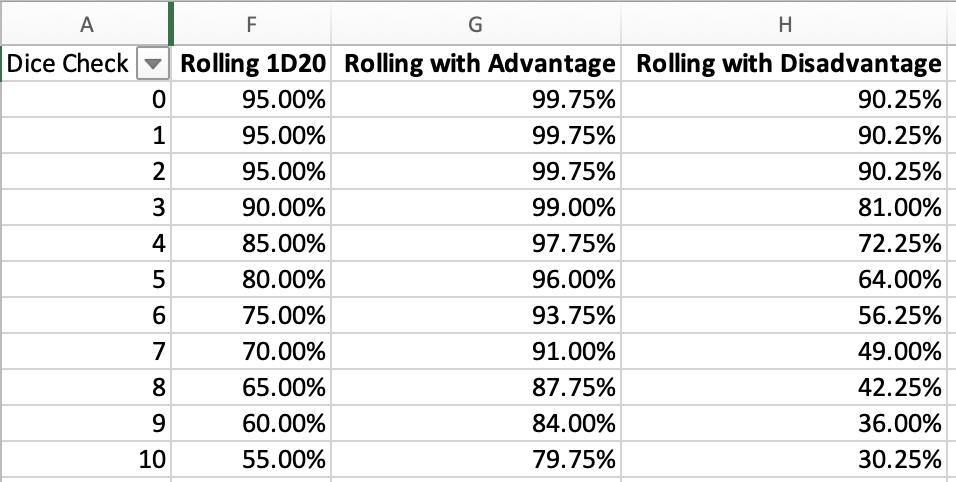
Remember, we’re interested in the specific question: What are the chances of success if the DC is 10?
To answer that, in the spreadsheet picture above, or in the spreadsheet itself, look at the table row in the “Dice Check” column with the value 10.
- In the column labeled “Rolling 1D20” you see 55%. That agrees with what I said above: you have 11 chances out of 20 to roll a 10 or higher on a 20-sided die.
- In the column labeled “Rolling with Advantage” the value is 79.75%. So if you’re rolling two 20-sided dice, you have about an 80% chance to roll 10 or above on at least one of them.
- In the “Rolling with Disadvantage” column the value is 30.25%. This means if you’re rolling two D20s, there’s about a 30% chance to roll 10 or higher on both of them.
Let’s look at another example: a DC of 2. Yes, there are dice checks in BG3 with a value that low.
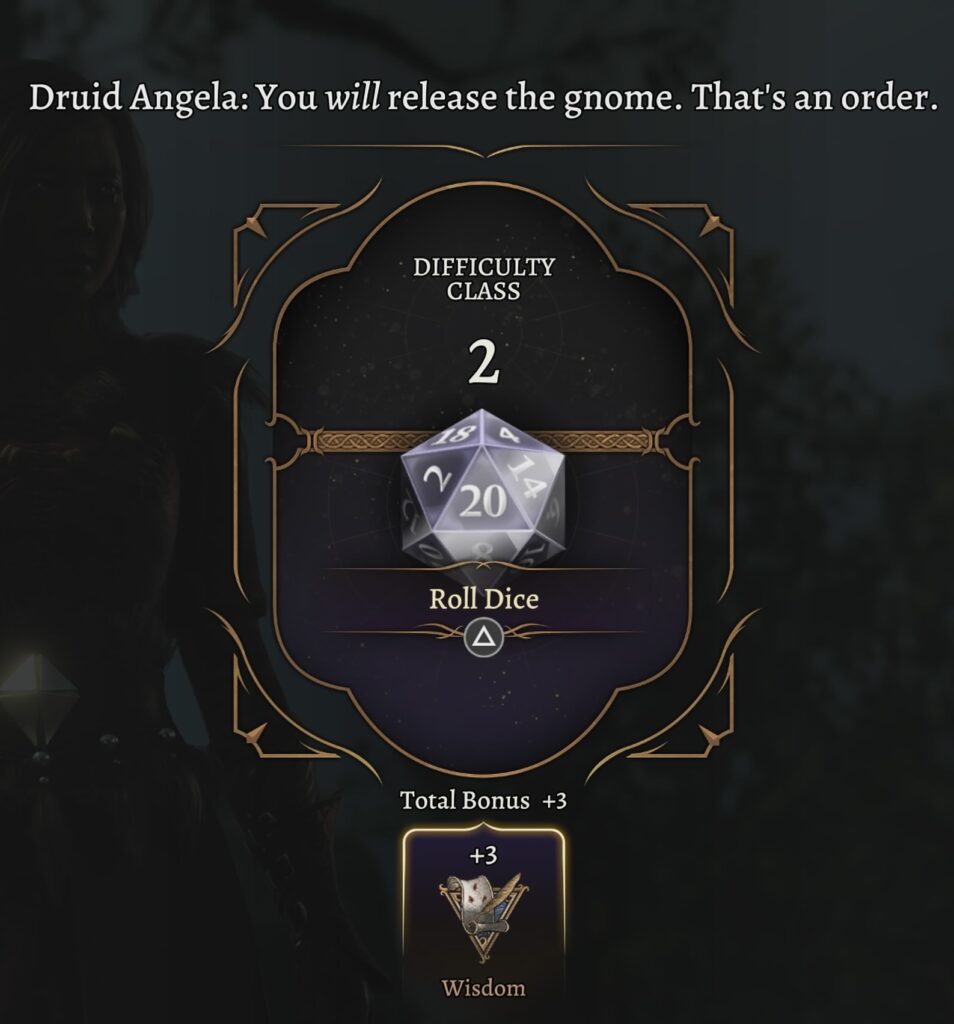
Rolling 2 or greater on a 20-sided die is not quite automatic. Let’s look at the row for DC 2 in the above spreadsheet picture:
- In the column labeled “Rolling 1D20” you see 95%. That’s because you’ll fail if you roll a 1, a critical fail. Even if you have bonuses (I’ll get to bonuses, I promise!) you’ll still fail if the die shows a 1.
- In the column labeled “Rolling with Advantage” the value is 99.75%. As I said above, the only way to fail this dice check is if you roll a 1 on both dice. 99.75% is failure rate of 1 in 400.
- In the “Rolling with Disadvantage” column, the value is 90.25%. That’s the odds of rolling a 1 on either die.
If you go to the spreadsheet and scroll down to a DC of 30 (and yes, this a DC you’ll find in BG3) you’ll see the “inverse” of these figures:
- 5% for a normal roll; you can always roll a natural 20
- 9.75% for rolling with advantage (rolling a 20 on either die)
- 0.25% when rolling with disadvantage; that’s the 1 in 400 chance of rolling 20 on both dice
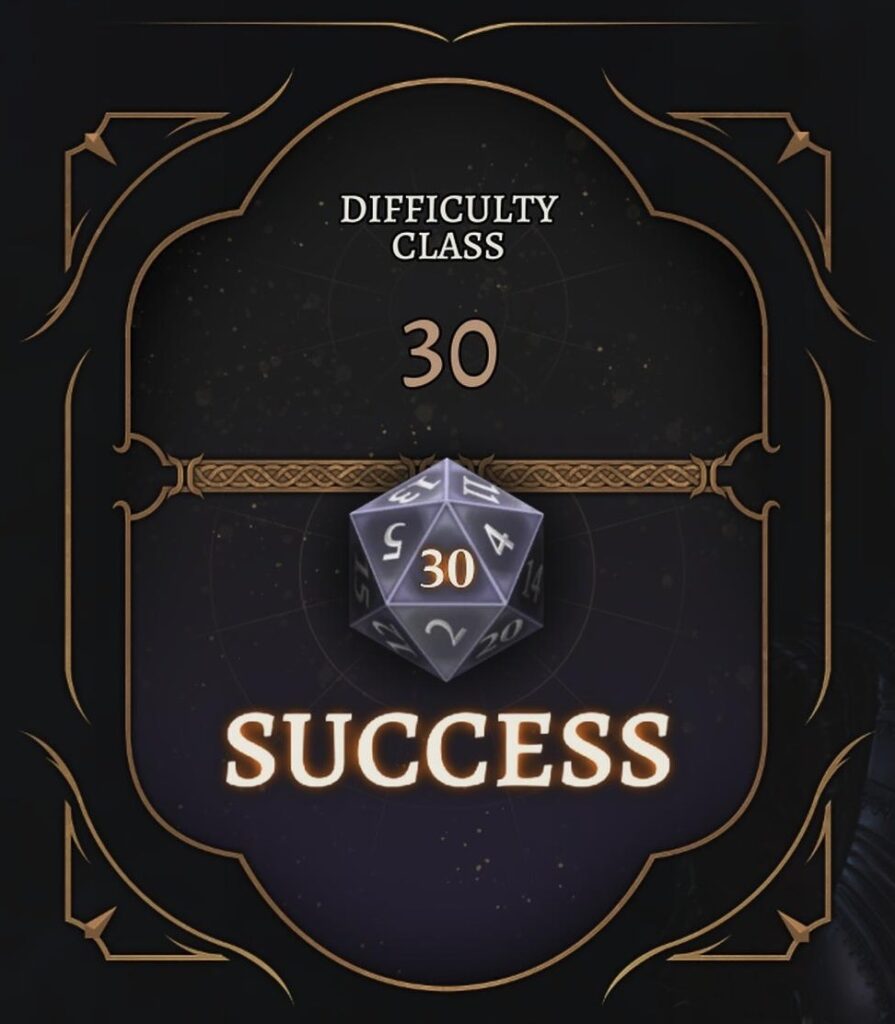
Success is never certain. But failure is never certain either.
Bonuses and penalties
If you don’t roll a 1 or a 20 (a “natural 1” or a “natural 20”), the number you’ve rolled on a D20 might be modified by bonuses (add to the number you’ve rolled) or penalties (subtract from the number you’ve rolled).
For example, assume the game tells you that to hit a creature with a sword, you need to roll a 15. You roll a D20, and the number you see is a 14. But the sword you’re holding is a magic sword, a “Sword + 1.” That means you add a +1 bonus to your die roll when you try to hit with that sword. You rolled 14, you add 1 from the magic sword, and the result is treated as 15. You hit the creature! Yay!
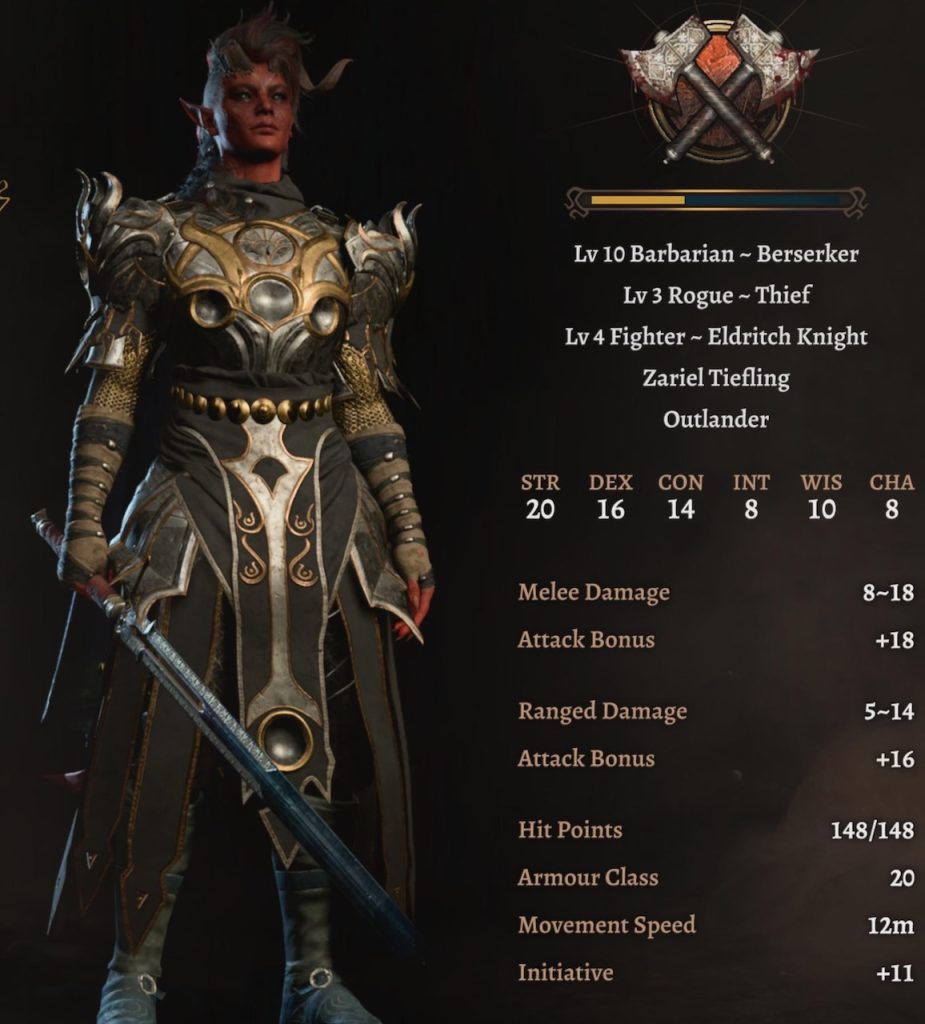
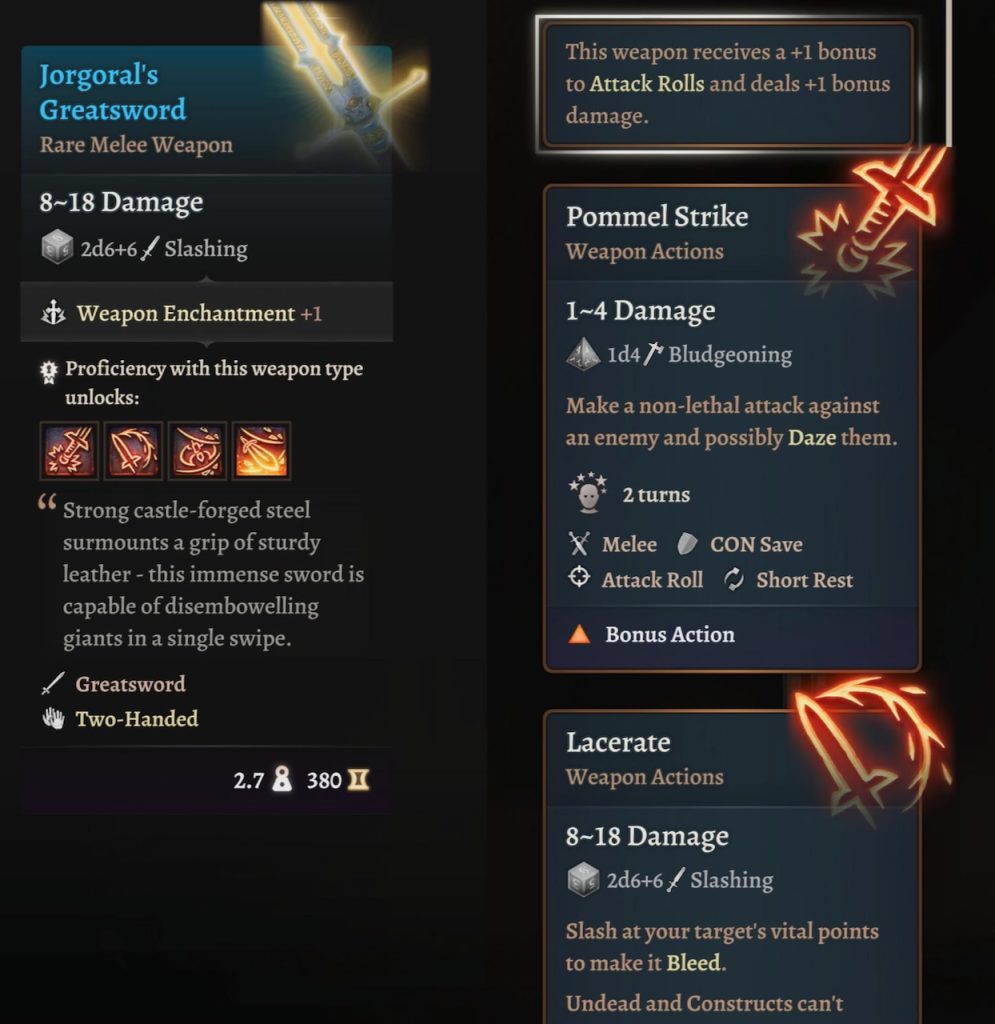
A couple of asides:
- If you’re a math or language geek, you may justifiably complain that the phrase “add a +1 bonus” is at least triply redundant. You’re right, but this is the syntax that’s been adopted by the tabletop gaming community. Take it up with them.
-
If, after applying all the bonuses and penalties, the result is arithmetically 1 or 20, it’s not a “natural” or “critical” roll. The “automatic failure or success” rules don’t apply.
A result of 20 that’s not natural is called a “dirty 20.”
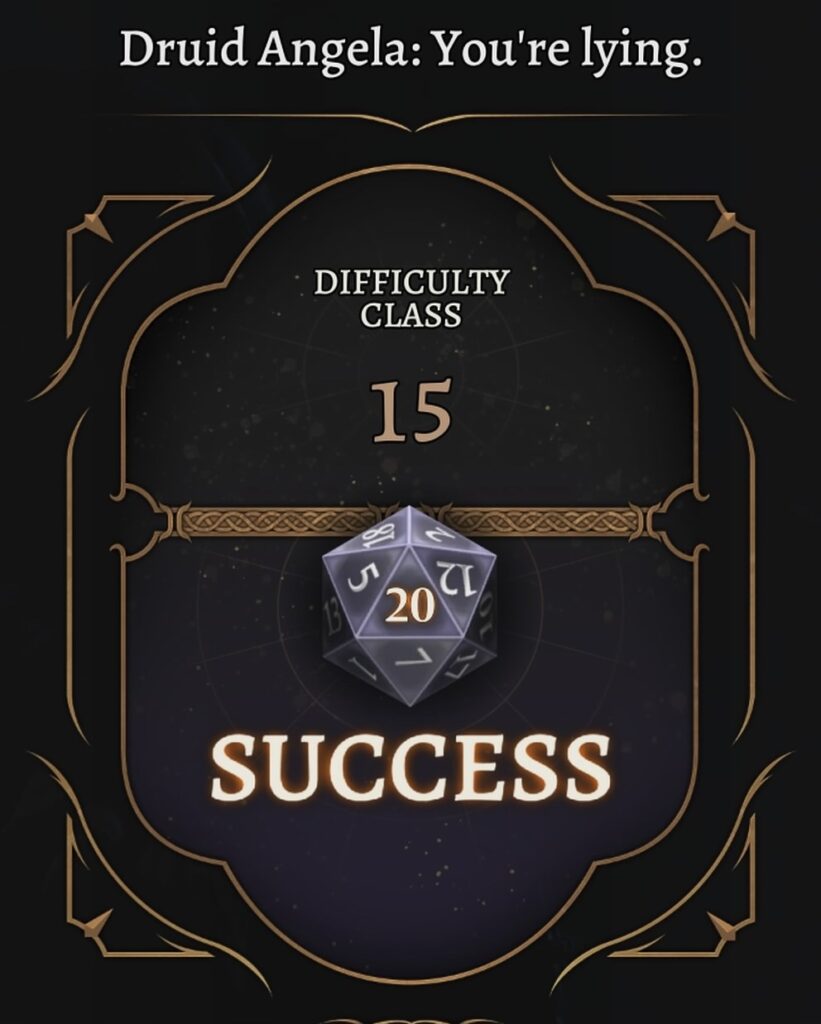
This is an example of a “dirty 20.” Druid Angela has successfully passed an Insight check and knows she’s being lied to. The numeric result of the dice check was 20, but that was after bonuses were applied.
Where do these bonuses come from? The following are the sources I can think of; there may be others. I’ll define terms like “Proficiency bonus,” “Attack rolls,” and “Armor Class” later. For now, let’s talk about the broad categories.
- You can find equipment that gives bonuses. There’s an example of this above, with a Weapon Enchantment + 1.
- There are magic spells, potions, and other consumables that provide bonuses.
-
A character’s “Ability points” provide bonuses to all tasks related to a given ability. I’ll go into more detail below.
As a quick example: If your character has a high Dexterity, it will add a bonus to most Dexterity-related tasks, such as shooting with a bow or picking a lock.
- There’s a bonus that depends on a character’s level, called a “Proficiency bonus,” that applies in some cases.
After you roll the “bare” D20, all the bonuses and penalties are applied to that number on the face of the die. It’s that total that’s compared to the DC to see whether the task succeeds.
As you might guess, it can be complex to determine all of these numbers. In tabletop D&D, it can take a while! In a computer game like BG3 it’s calculated for you; it’s much faster because you can’t argue with the gamesmaster about whether a given bonus applies to the current game situation.
Now we’ll take a “deep dive” into the sources of the above bonuses.
Equipment and gear
Many items, especially higher-quality ones such as magic weapons, have bonuses of some sort. Whenever you pick up a new item in the game, you normally look at its description, searching for bonuses that will enhance your character’s abilities.
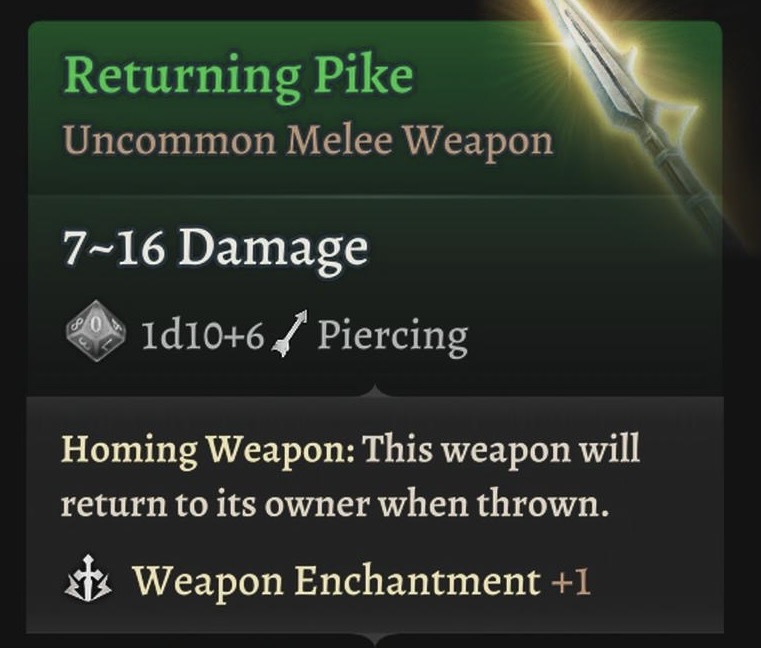

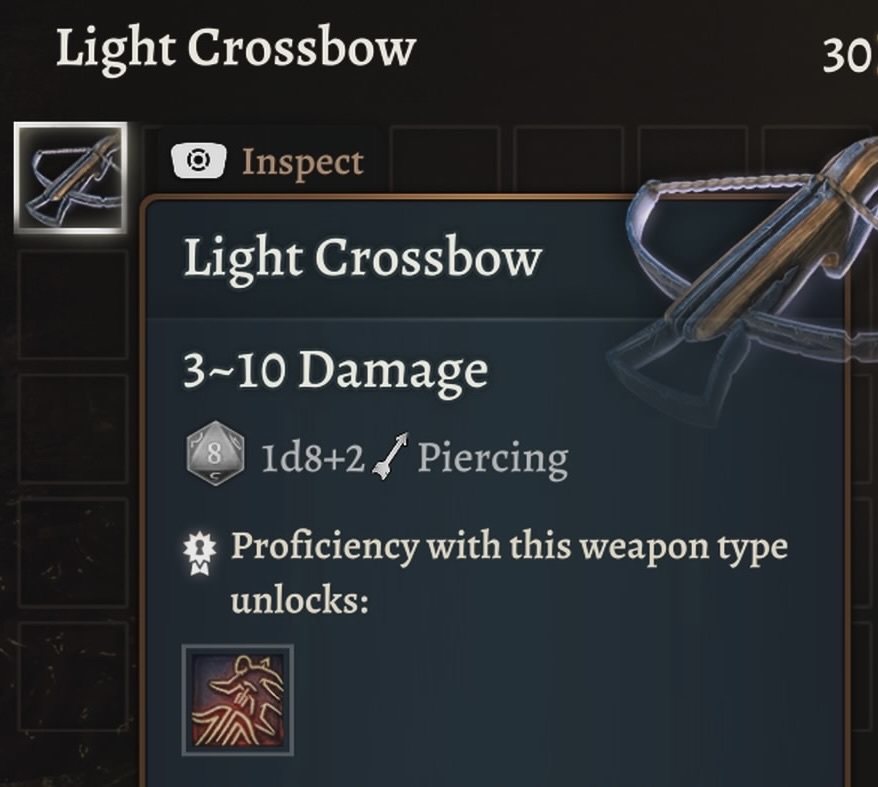
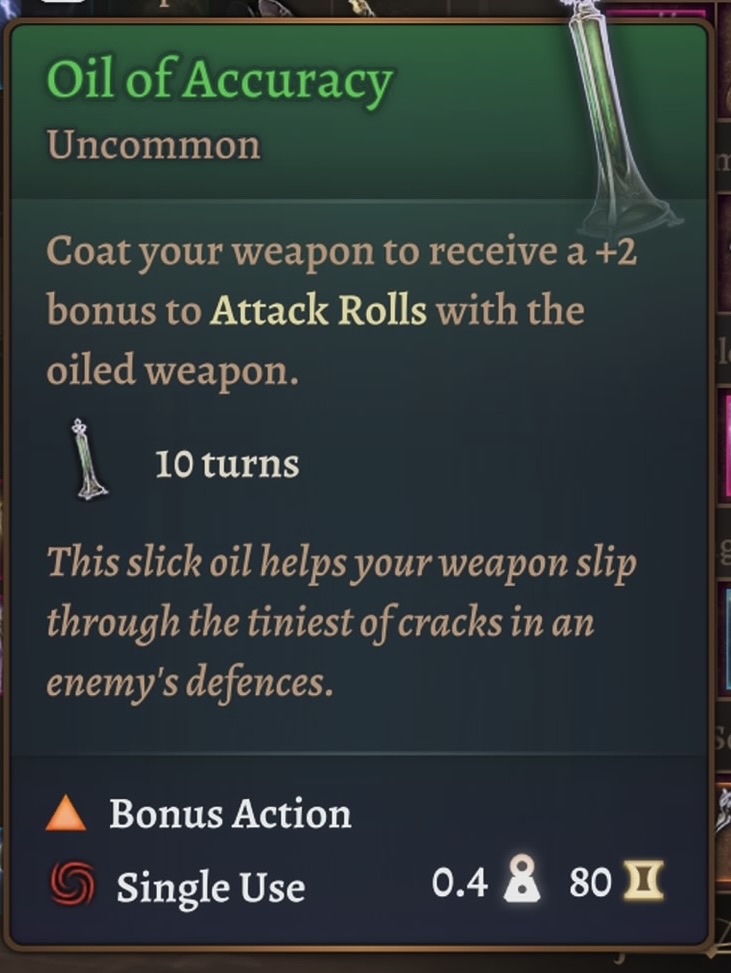
Spells, potions, elixirs, weapon coatings, and other consumables
I’ve written entire post on potions and such. Some of those can add bonuses.
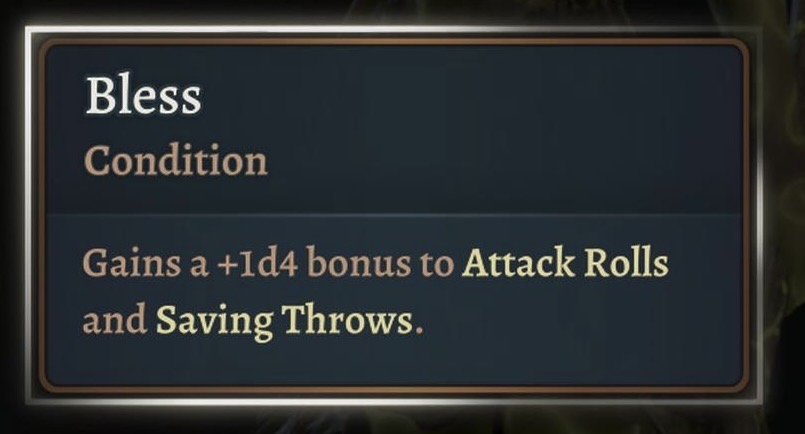
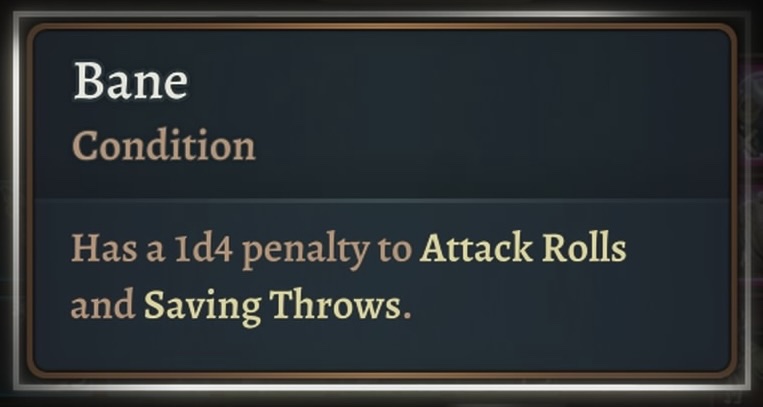
Magic spells can also give a bonus. For example, there’s the spell Bless.
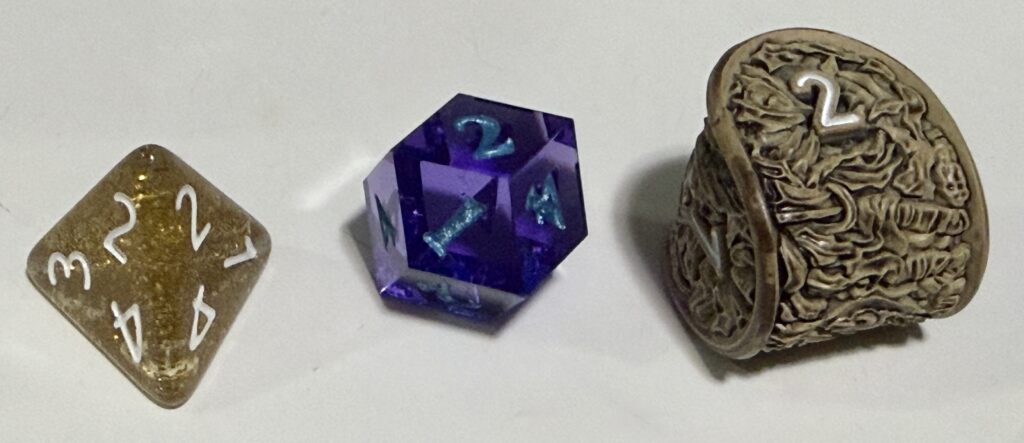
Since I’ve mentioned Bless, I should include Bane, which does the opposite.
Ability Points
If you’re skimming this post, the takeaway from this section is that your character’s ability values can give you bonuses (and penalties) to your die rolls.
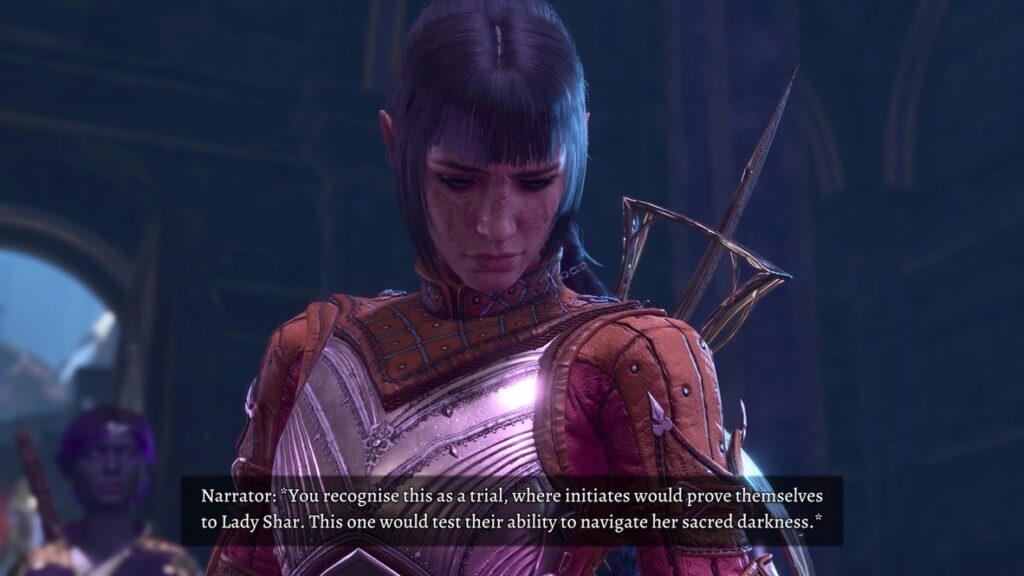
The list of character abilities in D&D haven’t changed since the 1970s: Strength, Dexterity, Constitution, Intelligence, Wisdom, Charisma. Their standard abbreviations are STR, DEX, CON, INT, WIS, and CHA respectively.
Over the years there have been variations on how these abilities are generated when you create your character, and the various charts and tables associated with their bonuses. But those six abilities have not changed.
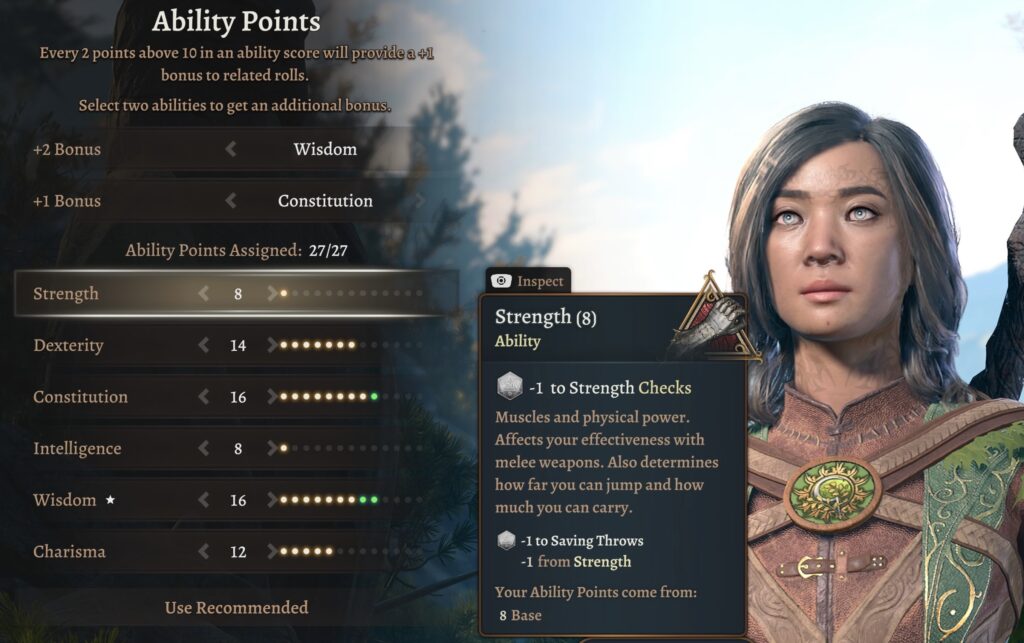
That picture shows a portion of Druid Angela’s character-creation process. The rules for assigning points to abilities are tricky and deserve a separate article.
For now, I ask you focus on the tooltip associated with her Strength. Her Strength is 8. The tooltip says that with such a low STR, she will have -1 subtracted from her die rolls associated with tasks that involve Strength. Examples are attacks with some melee weapons, and Strength-related “saving throws.”
That leaves us with two questions: How do abilities affect bonuses to die rolls? And why is Druid Angela’s STR so low that it gives her a penalty?
Let’s deal with the “how”: The value of an ability affects the bonus/penalty associated with tasks related to that ability. That bonus, the ability modifier, is determined by a chart:
| Ability value | Bonus/penalty |
|---|---|
| 6 | -2 |
| 8 | -1 |
| 10 | 0 |
| 12 | +1 |
| 14 | +2 |
| 16 | +3 |
| 18 | +4 |
| 20 | +5 |
| 22 | +6 |
| 24 | +7 |
| 26 | +8 |
Some notes on that table:
-
If you examine the table, you’ll see that only even-numbered ability values have an effect on the bonuses. If you have an ability with an odd number like 13, it rounds down to 12.
That’s why the standard advice, for both D&D and BG3, is to make all your abilities have even values. Any points assigned to make a value odd are wasted.
If you look at the suggested starting abilities for any of the characters during the BG3 character-creation process (the one that Tav describes in the fanfic of my playthrough 3′ post), you’ll see that they all have at least one ability value that’s an odd number. For an experienced D&D player, this is a signal that the designers of BG3 expect and encourage you to change their values when you can.
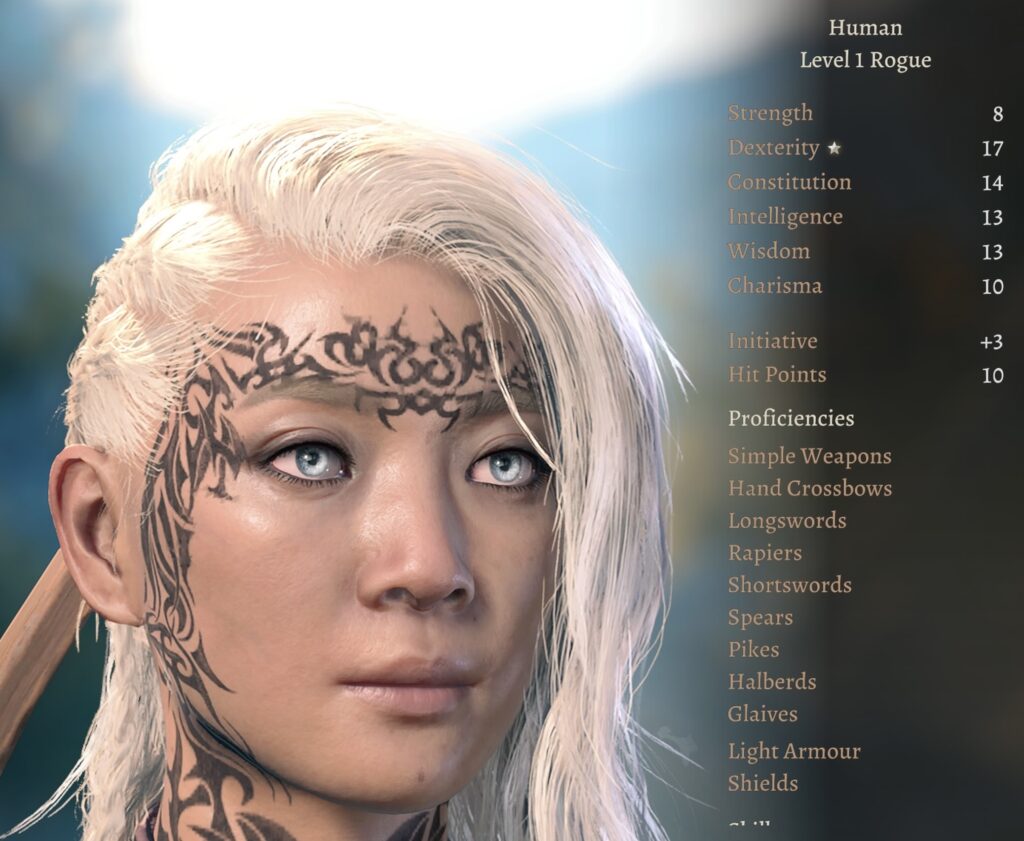
Here’s an example. Way back in playthrough 8, before she became Druid Angela, the hireling was a Rogue named Maddala Deadeye. On the right you can see the starting ability scores for the character. The three odd-valued Abilities scream “Change me!” -
When you create a character, the highest you can make any ability is 17. However, that “17” won’t give you any direct benefit from having the value be above “16.”
The reason to make an ability 17 is that you’re familiar enough with the game to find a way to add 1 to the ability score later. For most characters, especially when you’re a new player, 16 is the highest you’ll make any ability.
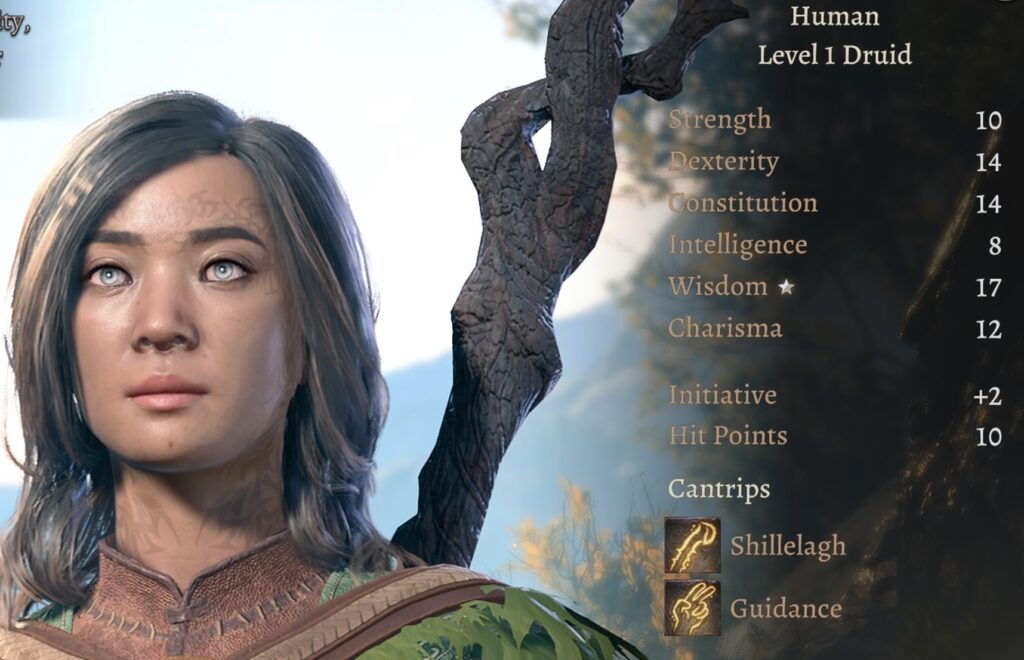
This is from a variation that Druid Angela considered before starting her new adventure. Note that her WIS is 17. She knows of a way to add 1 to WIS so that would be 18. But upon reflection, she decided this option was a long way into the story. It felt better to spend the ability point elsewhere. - Without something special, the highest you can get an ability during the course of the game via gaining ability points is 20. However, there are items and story events that can get an ability higher than that; in my 67!! post I show how to get DEX to 24, and an Elixir of Cloud Giant Strength can set STR to 27.
-
The lowest you can make any ability at the start of the game is 8. There are game effects that can drive an ability to lower than that. That’s why I included the “6” line.
If your character encounters such an effect: RUN!
That deals with the question of how ability values affect the die-roll bonuses. Now let’s address the second question: Why did Druid Angela make her Strength so low that she has a penalty?
Answer: Because it’s not mathematically possible in the rules of the game to make every Ability score a 16. There have to be trade-offs. Let’s take a look at couple of Abilities for which Druid Angela has a bonus to her die rolls:
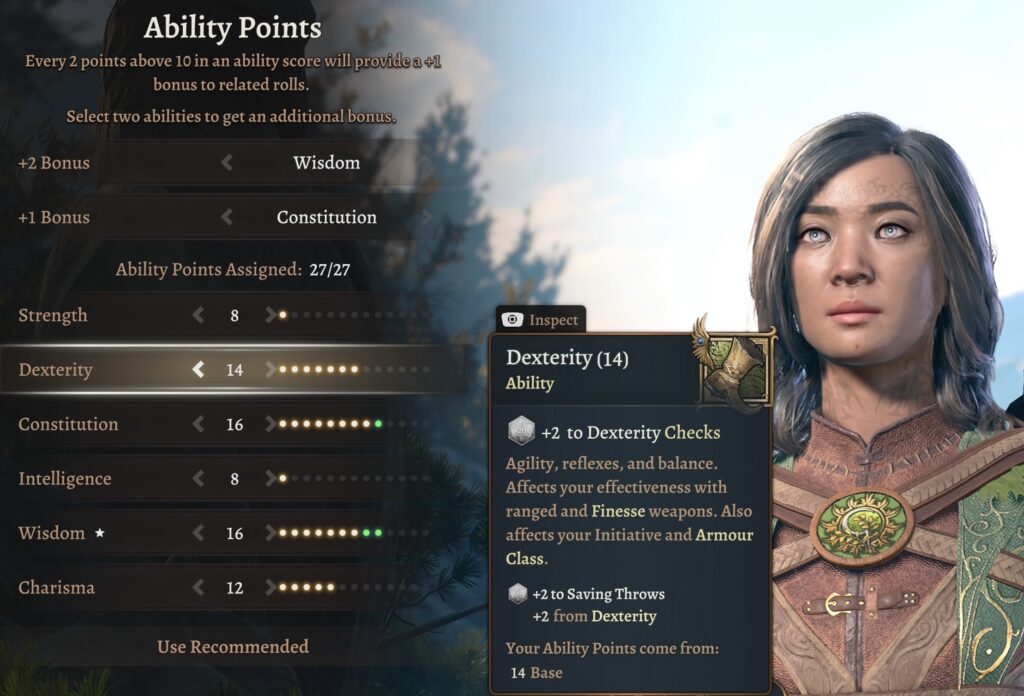
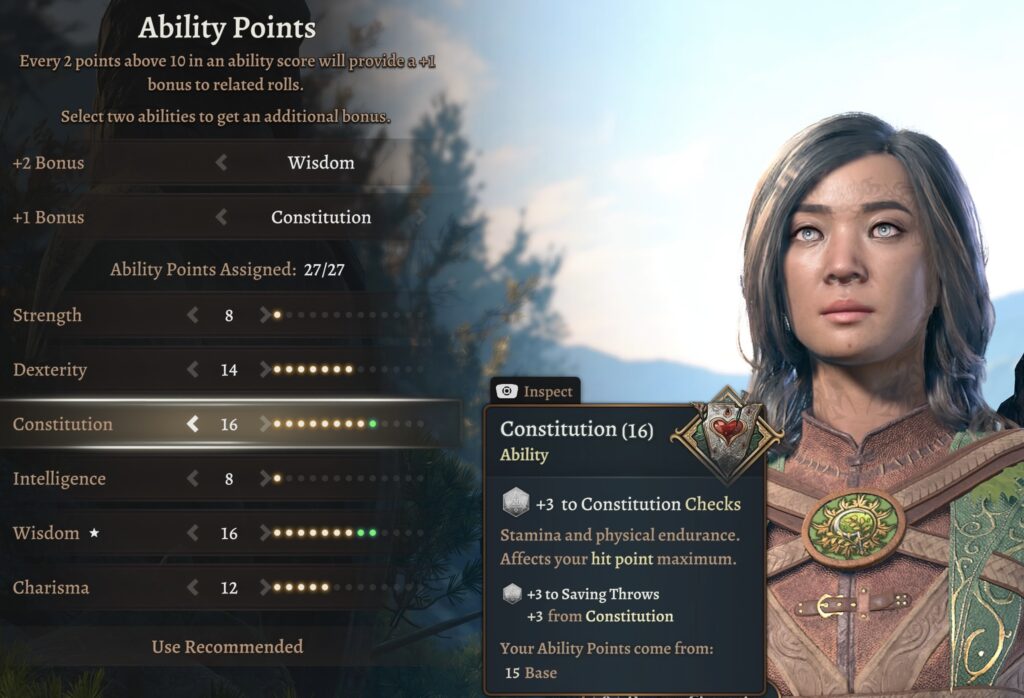
When Druid Angela wants to hit someone with a weapon, she’s going to cast the spell Shillelagh first. This causes her ability bonus from a weapon attack to be based on her Wisdom, not her Strength. I have a discussion of this in one of my Arctic Druid Angela build posts.
The practical result is that a high Strength would do nothing for her melee combat. After a time, she won’t make many melee attacks anyway, but rely on her spells and minions.
There are consequences to having a low STR value: she can’t carry as much weight. She’s more likely to be shoved off the edge of a cliff if any enemy chooses that strategy. So she has to be careful.
As a counter-example, consider Real Angela. She prefers to play characters that get up close to an enemy and bash their faces with powerful melee weapons. When she created a character in her earlier playthroughs, she gave them high Strength.
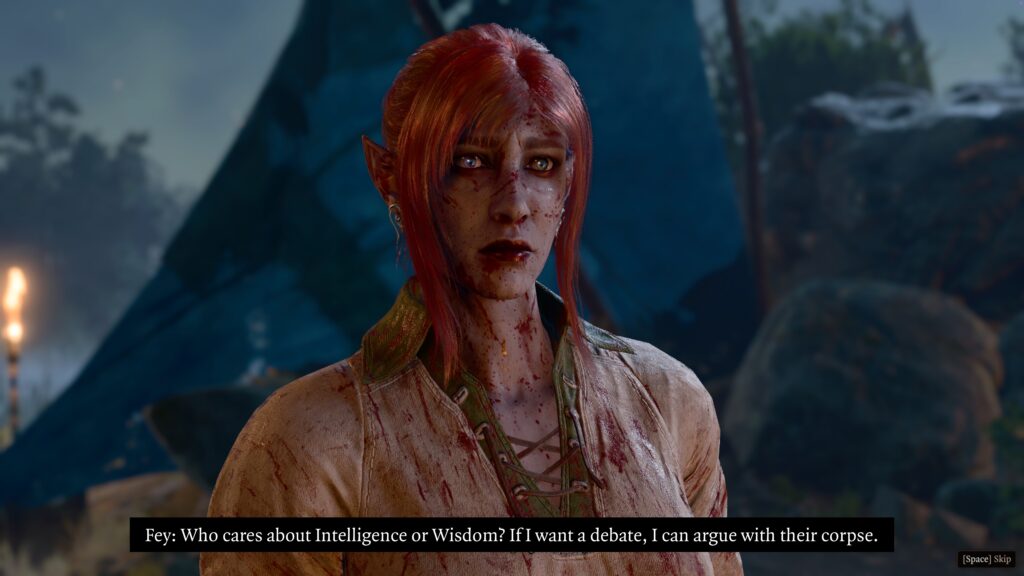
Getting back to a different fictional character: Druid Angela wants a high Dexterity and Constitution for reasons other than hurting the enemy. A high Dexterity means that she’ll tend to go first in combat. A high Constitution means she’s less likely to lose Concentration on a spell if an enemy hits her.
She has a moderate Charisma because that relates to how well she can negotiate with vendors and have positive reactions in conversations. I’ll discuss this further when we talk about how “Proficiency” affects die rolls.
She gave herself a high Wisdom value because, for a Druid, that is the Ability associated with casting spells successfully.
As for an Intelligence of 8: Yes, that can have consequences. I’ll bring this up later, when I talk about story-related dice checks.
If you look at the Druid Angela articles I link to, and compare the Ability scores to the ones I have in the above pictures, you’ll see they’re different. This is because Druid Angela will face different challenges early in her adventure compared to later. Eventually, when she’s ready, she can change her attributes.
Proficiency
For months I was confused by the word “proficiency” as used in BG3. I finally understood that the word has different meanings in different contexts.
Proficiency bonus
The term Proficiency bonus is the one with the most relevance to dice checks. It refers to a modifier that can be added to die rolls under certain conditions. The amount of this bonus is based on your character’s level:
- From levels 1-4, this bonus is +2.
- From levels 5-8, this bonus is +3.
- From levels 9-12, this bonus is +4.
There’s also an extra bonus called Expertise. It’s available to Bards, Rogues, and Knowledge Domain Clerics. It adds the Proficiency bonus again for a skill that you’re already Proficient in.
What are those “certain conditions” for which this bonus is added to a die roll?
Saving Throws
A Saving Throw is a die roll that determines if a character has been harmed in some way. A typical Saving Throw determines:
- whether a character has been affected by a spell
- if a character has been damaged by an explosion or a trap
- if a character is affected by a poison or other weapon coating
Saving Throws don’t apply to weapon attacks. I’ll cover those below.
Saving Throw Proficiency means that the character adds their Proficiency bonus to their Saving Throw die roll.
Saving Throw Proficiencies are determined by a character’s class. For example, a Druid has Saving Throw Proficiency in Wisdom and Intelligence.
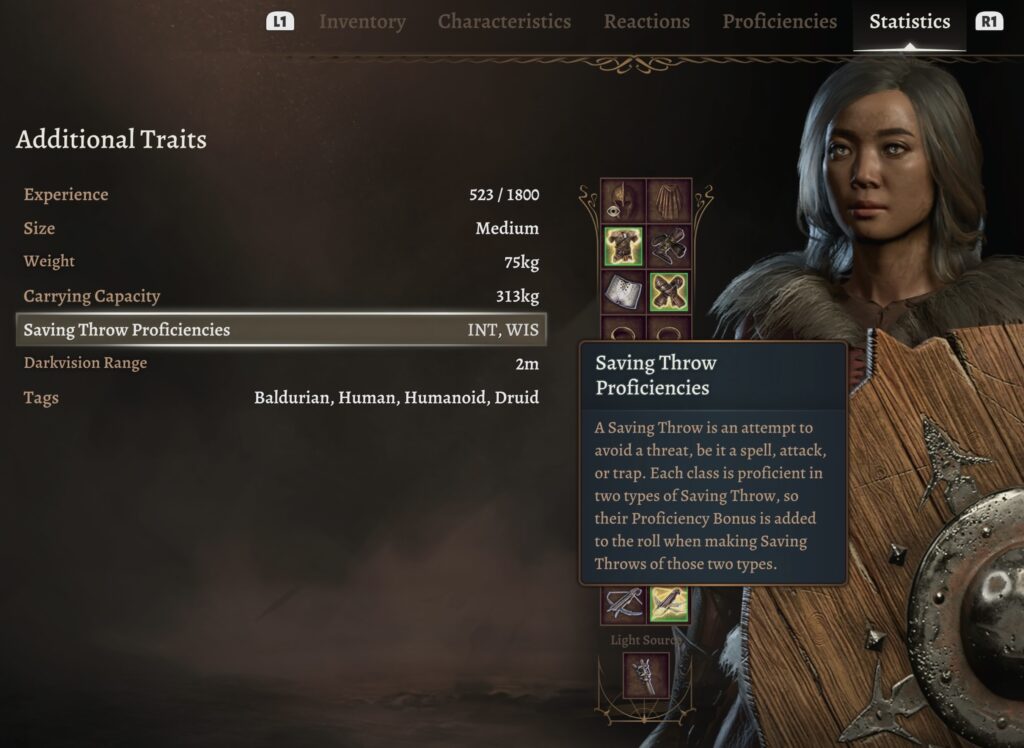
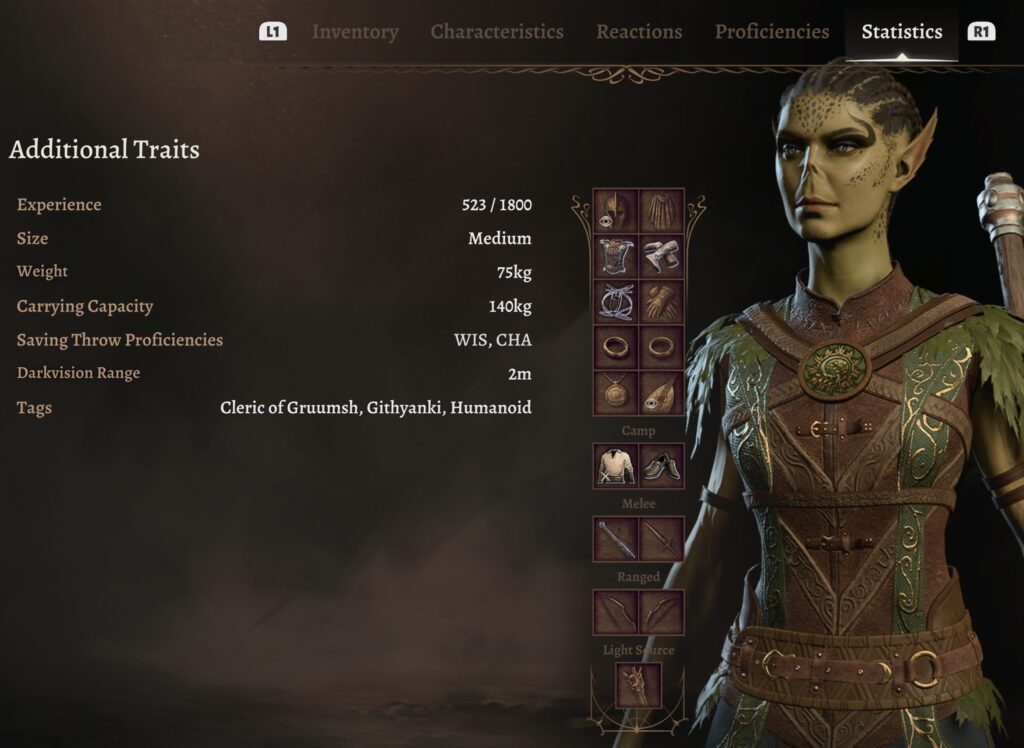
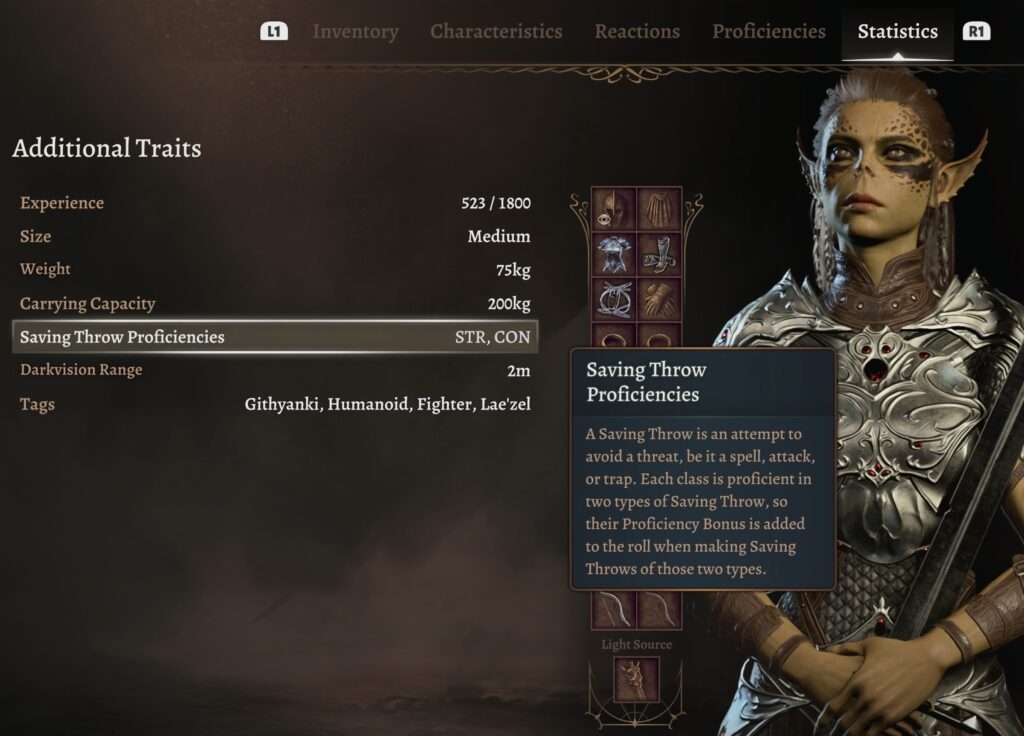
How does this work? The formula is:
- Roll a D20 (or two if Advantage/Disadvantage is involved)
- Add the adjustment from the target character’s relevant ability
- Add the Saving Throw Proficiency for that ability, if there is one
The resulting number (assuming no critical rolls) is compared to the DC to see if the target has resisted the spell, also known as “making their Saving Throw.”
Let’s look at a practical example. Consider the spell Hold Person:
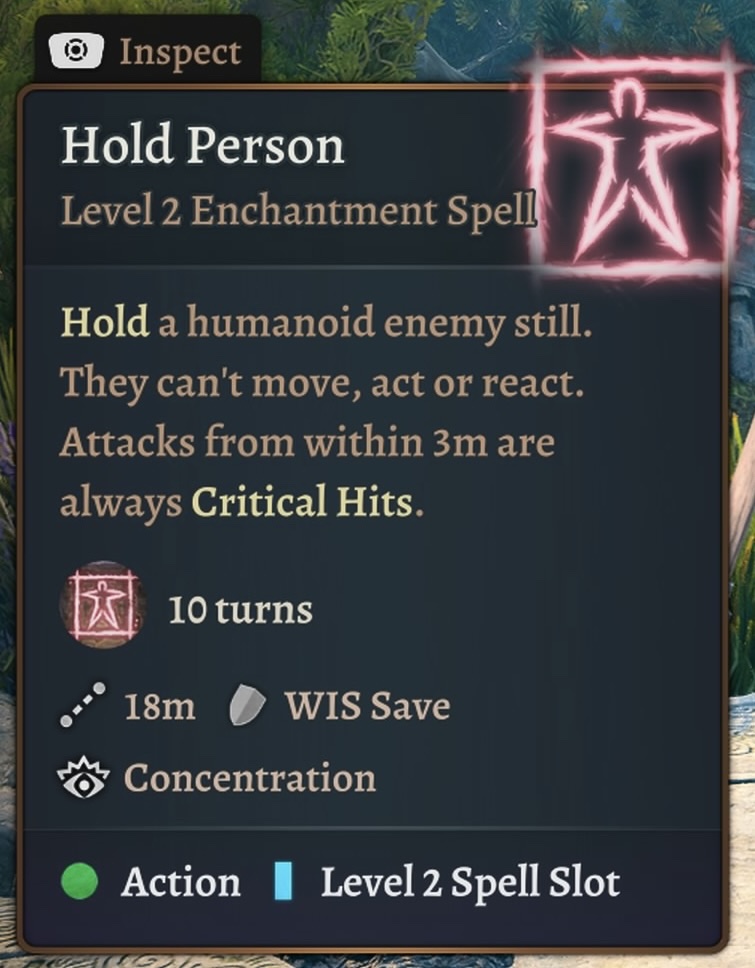
Note the text “WIS Save” in the above image. That means the relevant Ability is Wisdom.
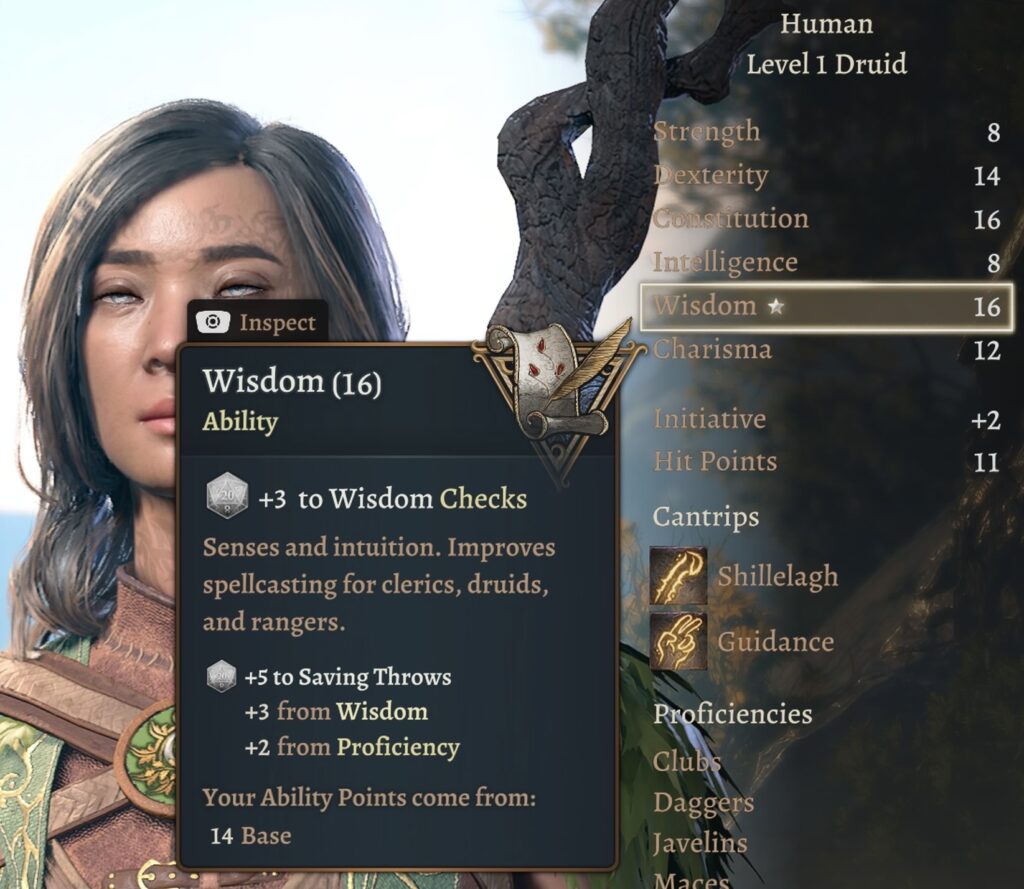
Assume that an enemy is trying to cast Hold Person on Druid Angela. Her Wisdom is 16, which means (…scrolling up, finding the Ability Modifier table from earlier in the essay…) that her Ability Bonus is +3.
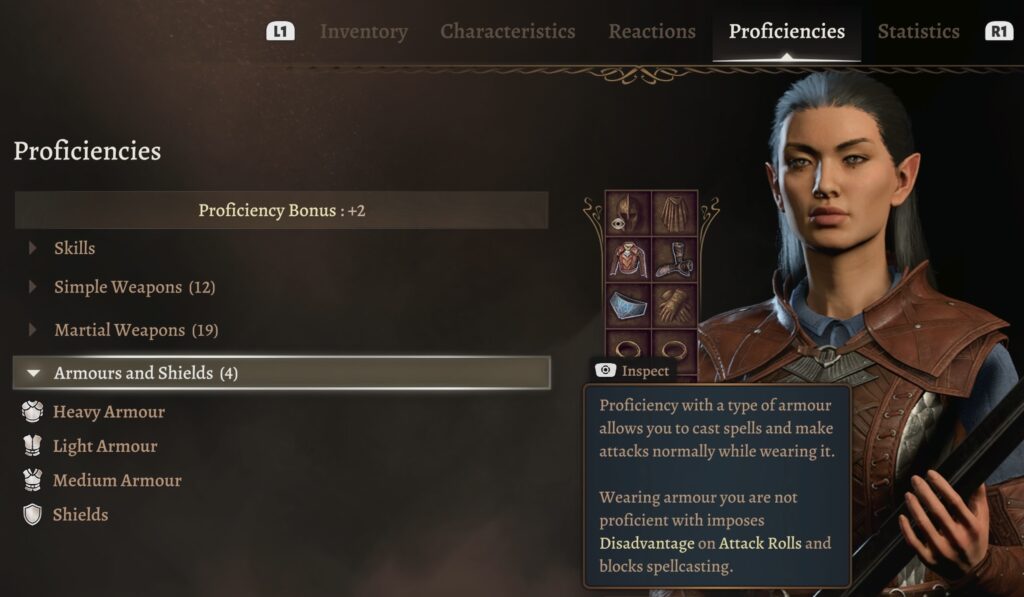
One of the images above shows what her Saving Throw Proficiencies are. So you don’t have to scroll up, here’s a section of that image:
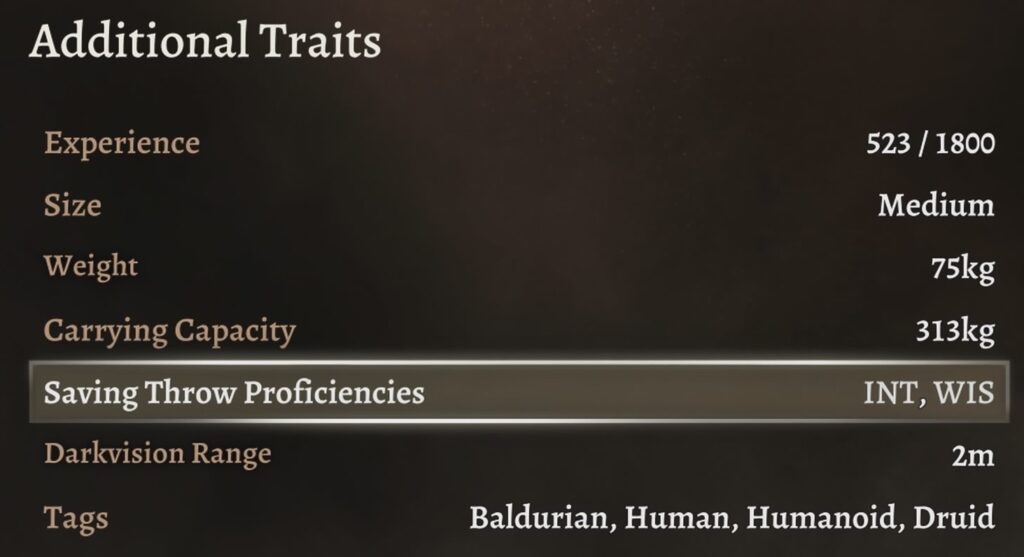
This means that when Druid Angela is trying to make her Saving Throw against Hold Person, she adds her Proficiency bonus. The example images I’m showing in this essay come from when Druid Angela is 3rd level. This means (…hunting for that Proficiency bonus table earlier in this essay…) that her Proficiency bonus is +2.
Now the information in one of the earlier images may make more sense. Again, I’ll include that section here:
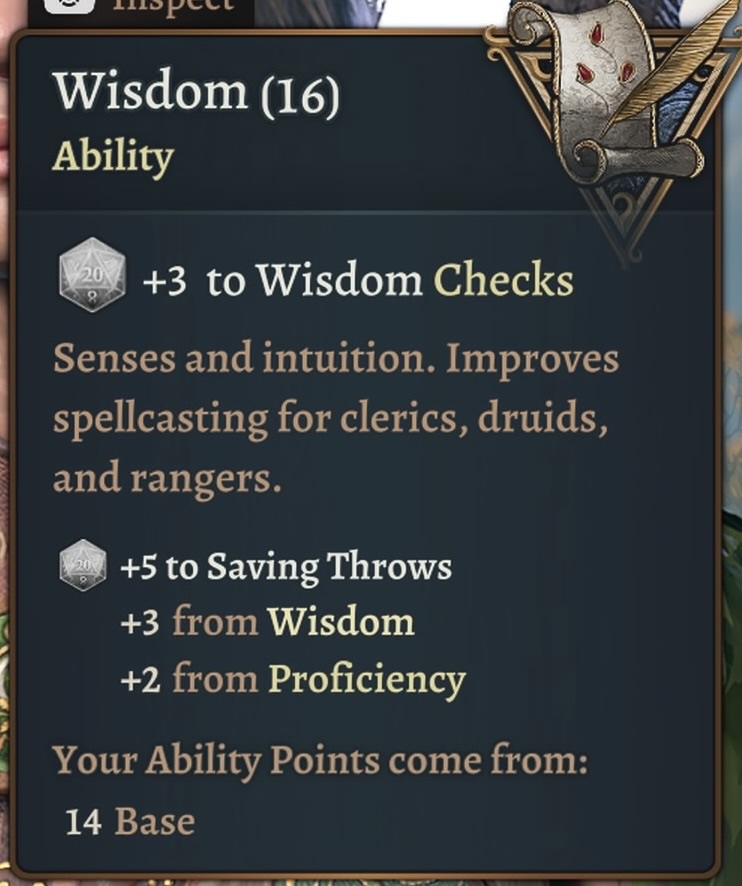
If someone casts Hold Person on Druid Angela, it requires a Wisdom Saving Throw. Druid Angela would roll the dice, and add a total of +5 to number she rolled.
Let’s consider what happens if an enemy tries to cast Hold Person on Lae’zel instead. We saw in an earlier image (I’ll spare you the scrolling) that Lae’zel has Proficiency in Strength and Constitution Saving Throws, but not in Wisdom. Here are her “vanilla” Ability values, the ones the game assigns her if you don’t make any changes:
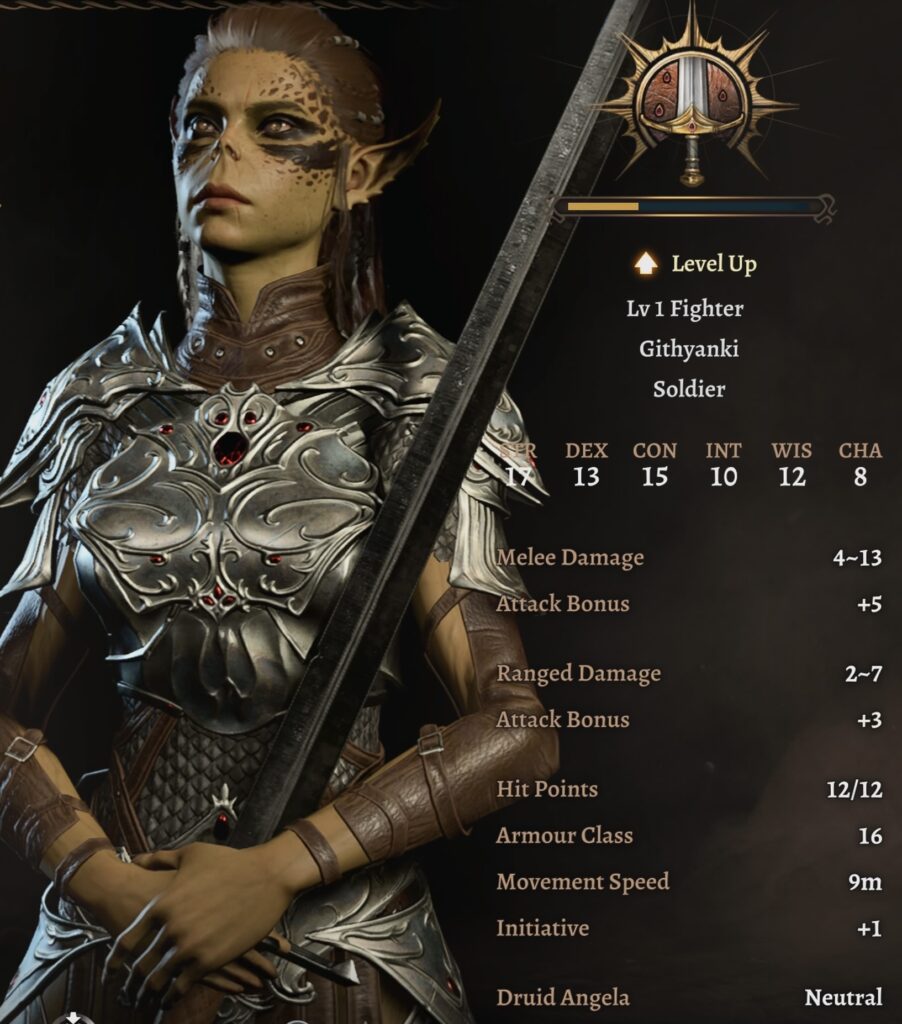
A Wisdom of 12 means her Ability bonus for Wisdom checks is +1.
So while Druid Angela adds +5 to her Saving Throw versus Hold Person, Lae’zel only adds +1. This means that it’s more likely Lae’zel would be affected by that particular spell than Druid Angela.
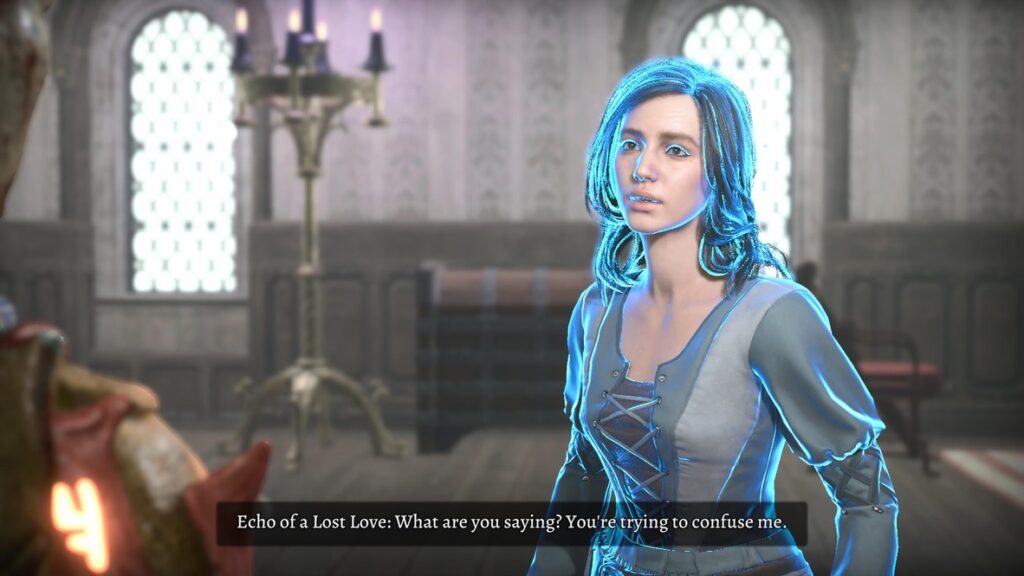
At this point, I anticipate that you may have one of two thoughts:
-
We have a formula to determine the Saving Throw:
Die roll + Ability bonus + Saving Throw Proficiency
This essay is supposed to be “an explanation of dice checks.” We have a Saving Throw number, but what is the DC that we’re comparing to?
I’ll have to give my usual promise: I’ll discuss this below.
-
This seems pretty complicated.
We’ve had to look up two different numbers buried in the BG3 information screens (Ability Points and Saving Throw Proficiencies), and look up numbers on two tables that are in the D&D rules but not explicitly displayed in BG3: Ability bonus and Proficiency bonus.
In BG3, a computer program keeps track of all of this for us. In tabletop D&D, don’t all these look-ups slow things down?
Even if we have BG3 calculate all this for us, don’t we have to consider these numbers and formula to play the game effectively?
My answer to both questions is: Yes.
Now you may have additional insight into why I hate the D&D system.
As we shall see below, the complexity continues!
Enemies
Your enemies get Saving Throws too.
Here’s an example from one of Druid Angela’s tests: She cast the spell Ice Knife at a Flaming Fist Archer:
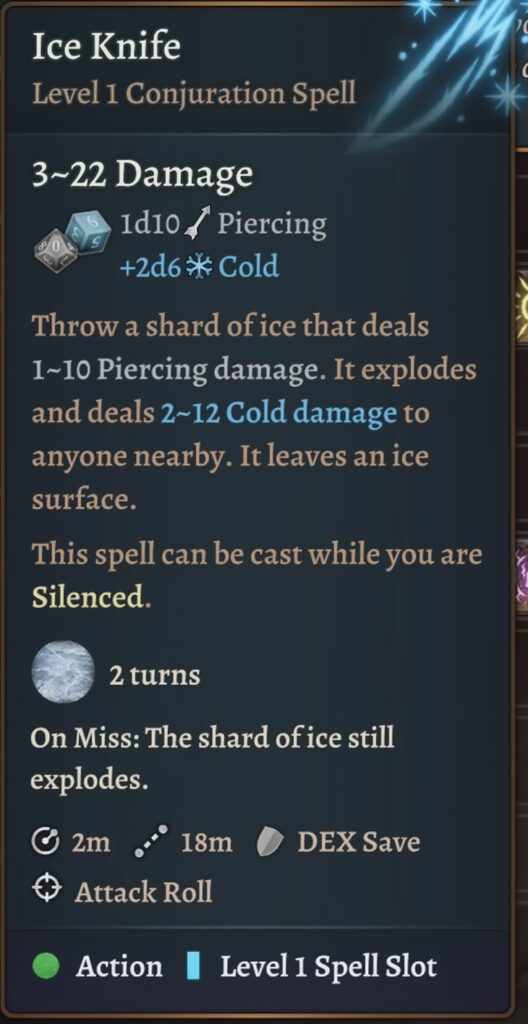
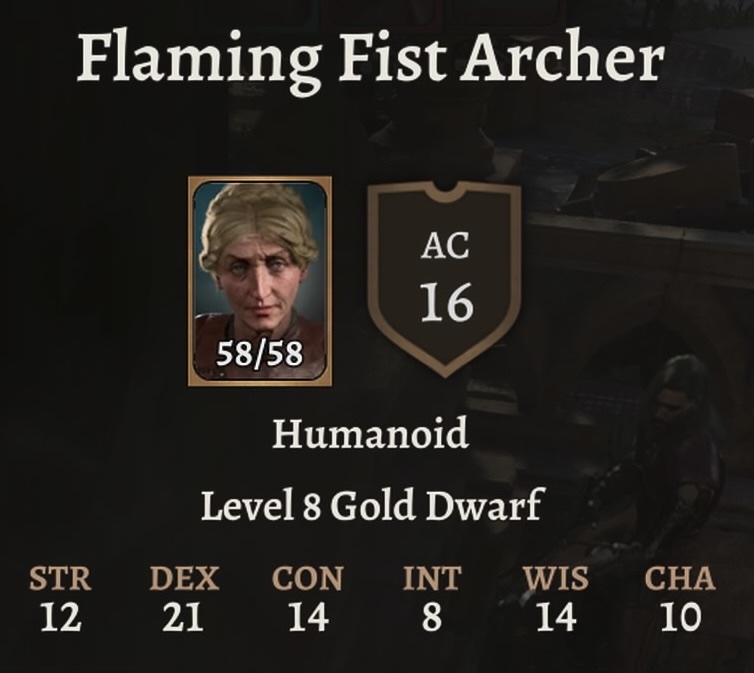
Druid Angela cast a spell with a DEX Save on an enemy with a high Dexterity. Of course she missed, wasting the Action.
The lesson: Look at the spell description, look at the enemy, and see whether the enemy has a strong defense against it. To return to an earlier example, casting Hold Person (WIS Save) against an enemy with high Wisdom is probably a bad idea.
Skill checks
We still haven’t finished discussing the concept of “Proficiency” and how it relates to dice checks.
In addition to Saving Throws, Proficiencies come into play when a character performs tasks within the game. What kinds of tasks?
For this discussion, let’s start with an image from Druid Angela’s character-creation process:
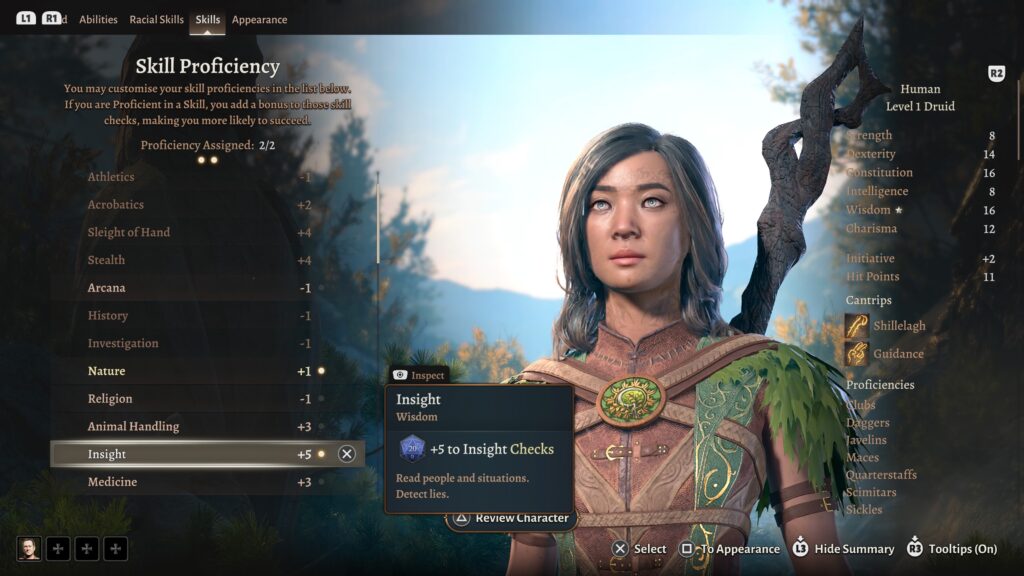
Let’s take note of her Ability scores on the right-hand side of the image: STR = 8; DEX = 14; CON = 16; INT = 8; WIS = 16; CHA = 12. We’ll have to refer to those numbers as we consider her Ability bonuses.
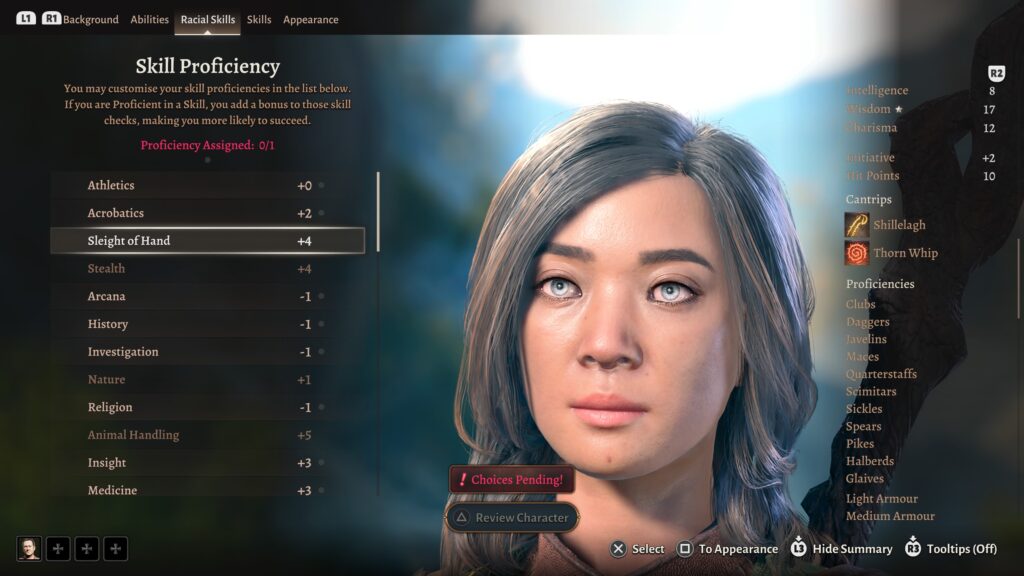
There’s a list of her skills on the left-hand side of the screen. There are more skills in the game than are listed here; one could see the others if we could scroll down the list. For now, let’s focus on the top of the list:
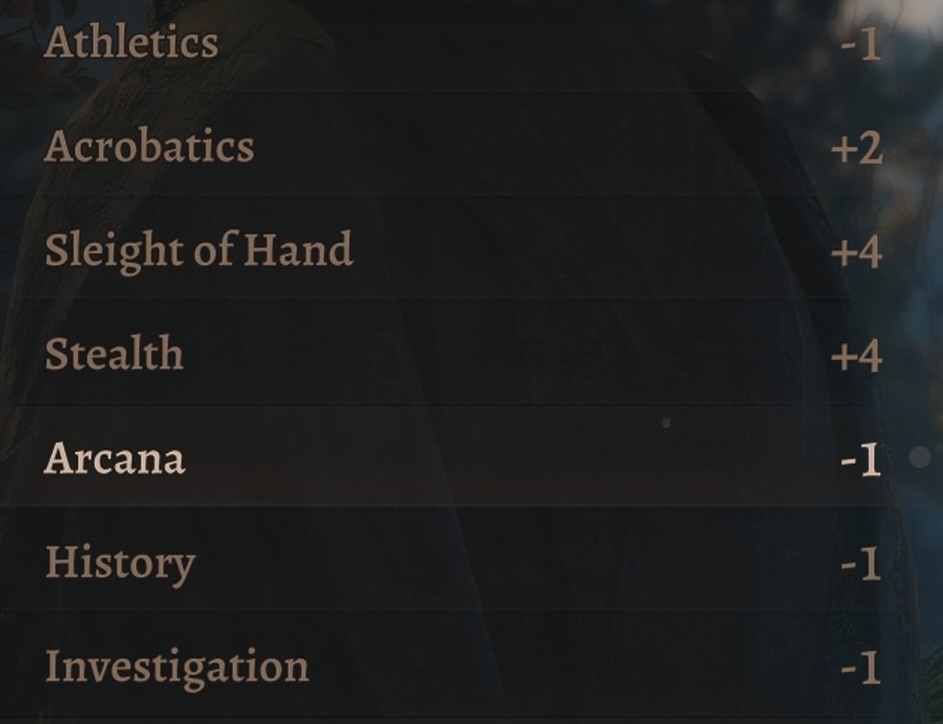
Next to each skill is the Skill modifier. For example, the first item on the list is Athletics. This skill is used when you try to Shove another character, or another character is trying to Shove you.
The skill Athletics is based on Strength. Druid Angela’s Strength is 8. The Ability modifier for STR 8 (…once again, we scroll up to that table…) is -1. That’s the source of the “-1” in the list; it means that Druid Angela must subtract -1 from her die roll when she makes an Athletics check.
The next skill is Acrobatics. This helps you resist being Shoved. If you’re being Shoved, the game will automatically use Athletics or Acrobatics for the dice check, whichever is higher. This is a Dexterity Skill. The Ability modifier is +2, because Druid Angela’s DEX is 14 (either take my word for it, or scroll up the table again to check for yourself).
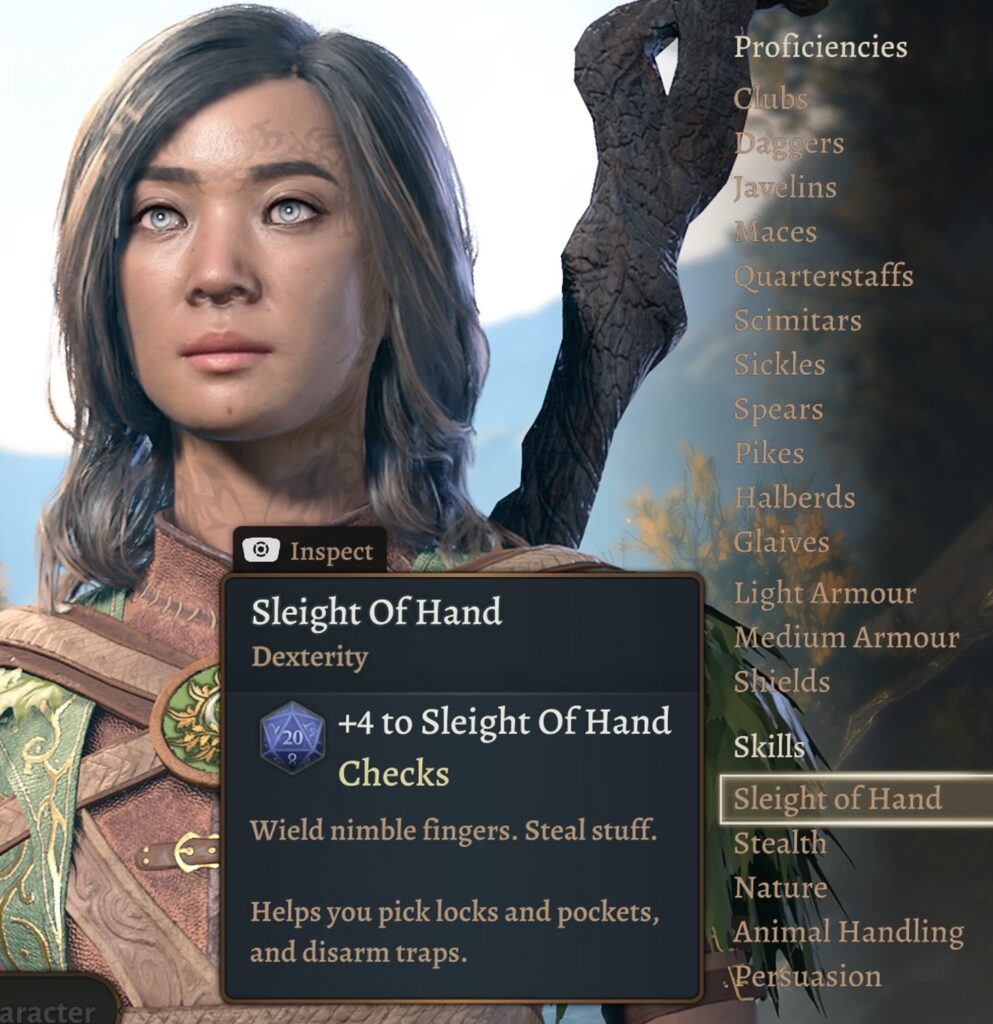
Next on the list is Sleight of Hand, used when picking pockets, picking locks, and disarming traps. It’s another DEX-based skill. And its Skill modifier is… +4? If Athletics’ modifier is +2 from Dexterity, how is Sleight of Hand +4?
The answer comes from Druid Angela’s background:

Druid Angela is an Urchin. This has some story consequences (related to Inspiration, which I’m not going to discuss in this overly-long essay). For our purposes, let’s note from the above image that being an Urchin gives a Proficiency bonus to the skills Sleight of Hand and Stealth.
The why we see “+4” next to both those skills: It’s +2 from Druid Angela’s Dexterity modifier, and +2 from her Proficiency bonus.
Next on that list is Arcana, a Intelligence Skill used in story-related events.
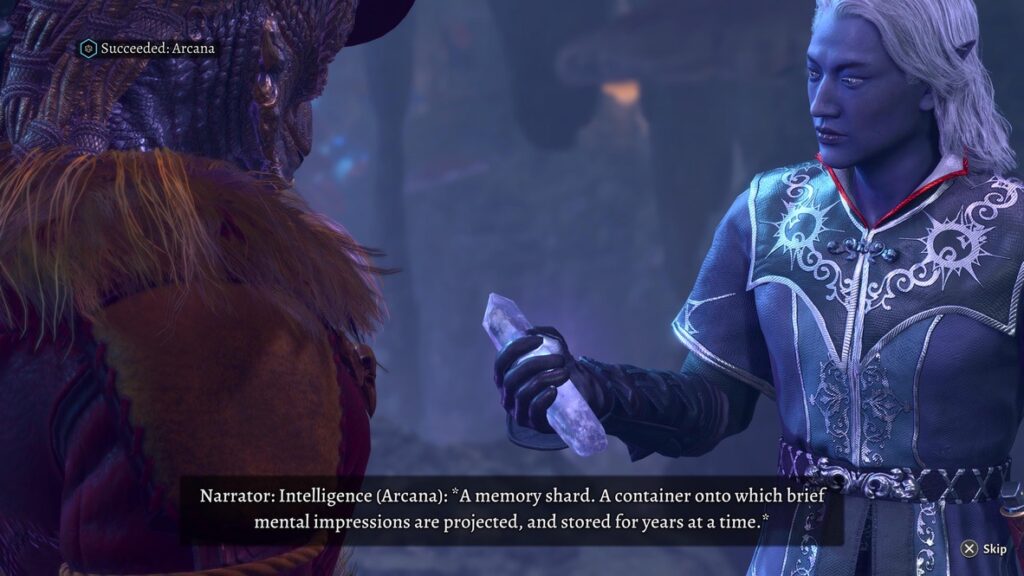
Druid Angela’s Arcana is -1. This makes sense, since her INT is 8. (Remember how I said earlier that an Intelligence of 8 could have story consequences? The above image is not from Druid Angela’s story; she’s likely to fail this check when she encounters it.) But why is that line highlighted?
To answer that, let’s go back to the longer list from a couple of images ago:
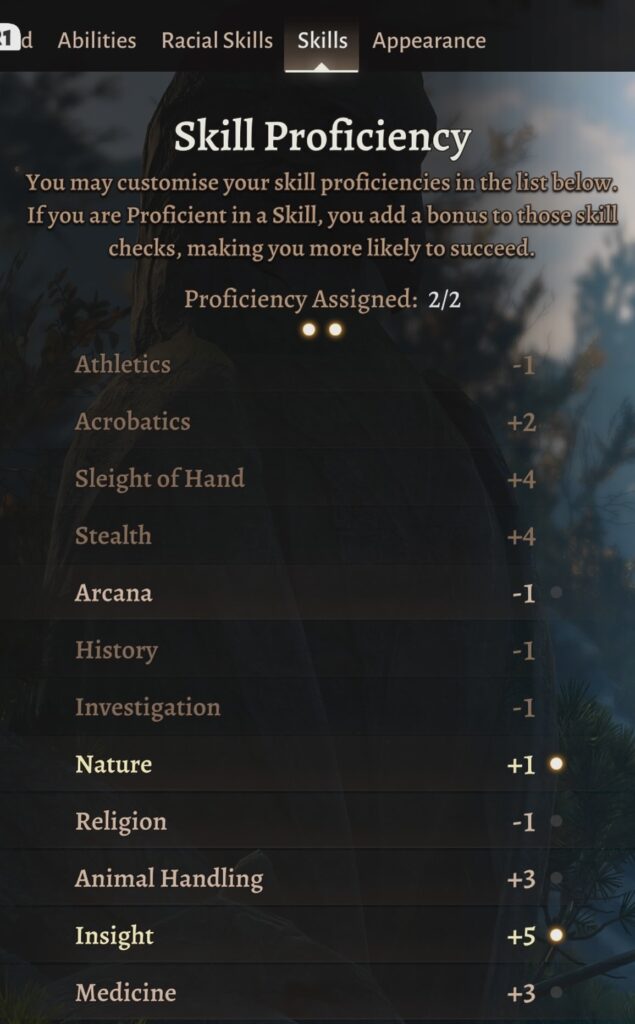
A character can’t get Proficiency in every skill. They’re limited by their Character Class. The highlighted Skills are those in which your character can add a Proficiency bonus.
Druid Angela is (write this down; this will be on the test) a Druid. She’s limited to Skill Proficiency in areas in which a Druid and a spellcaster might reasonably expect some level of competence. For example, she can get Proficiency in Religion or Animal Handling, but not in Investigation.
As the text in the image says, at least in this point in character creation, Druid Angela is limited to adding her Proficiency bonus to two skills. In the image, Nature (INT-based) and Insight (WIS-based) are checked, but I think I made other choices after I took the screenshot.
Weapon Proficiency
What confused me for so long about the word “proficiency” in this game is that Skill Proficiency, Weapon Proficiency, and Armor Proficiency have three different effects. We’ve discussed the first, so let’s consider the other two.
To be Proficient with a weapon means that you can use it to its full extent.
As you might guess, to have Proficiency in a given type of weapon means the character adds their Proficiency bonus to Attack rolls with the weapon. (To repeat a broken record: I’ll get into “Attack rolls” below.) This doesn’t affect the weapon’s damage, only its chance to hit.
As an example, let’s use Wings. Her role in Druid Angela’s playthrough is non-combat, so she has the least-powerful bow in the game: the Shortbow.
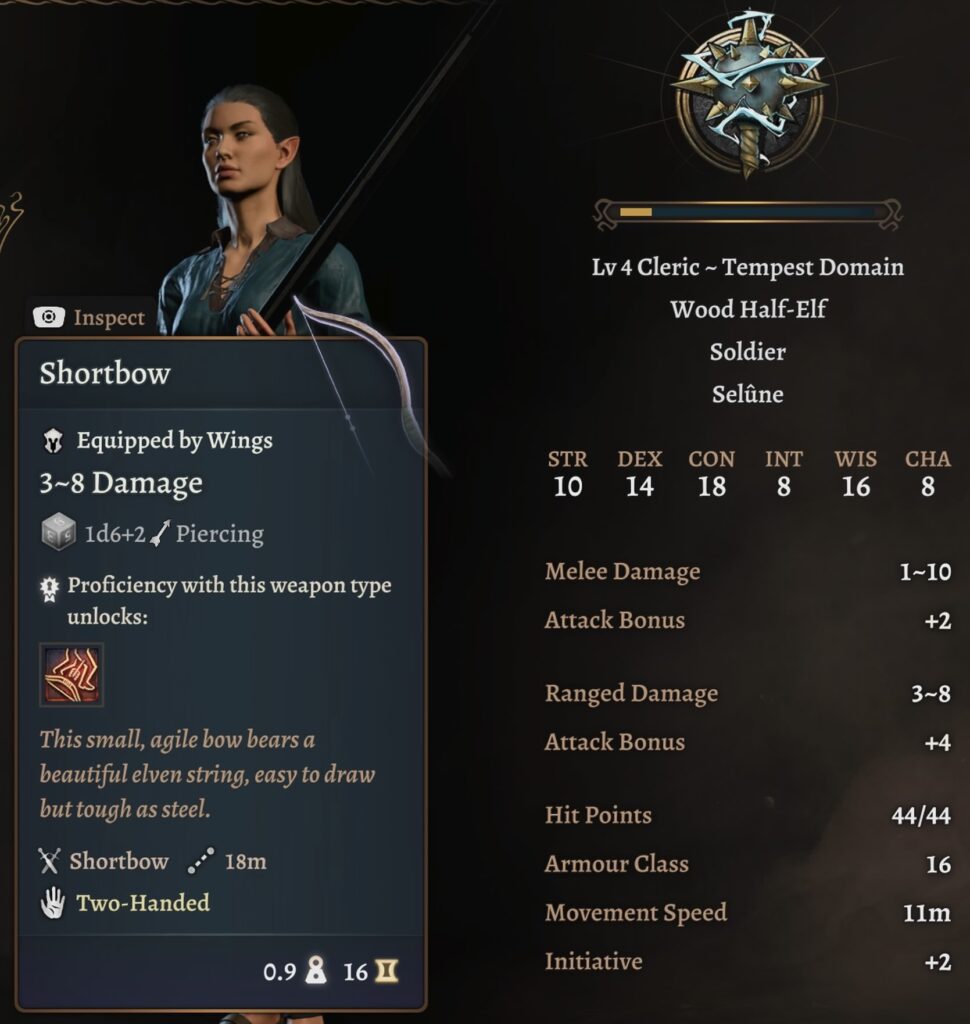
By itself, the Shortbow does 1D6 of damage. (Sorry, no picture of a six-sided die. You’ll have to use your imagination.) Wings’ DEX is 14, which has (yep, look at that table again) an Ability Bonus of +2. So if it hits, the Shortbow does 1D6 + 2 points of damage.
If you look at the middle right of the above image, you’ll see a line labeled “Attack bonus.” That’s the total bonus added to the die roll when she tries to hit the enemy with an arrow shot by the bow. The value there is +4; that’s +2 from her Dexterity, and another +2 from her Shortbow Proficiency.
If you highlight any line in that right-hand section, the game will display some details:
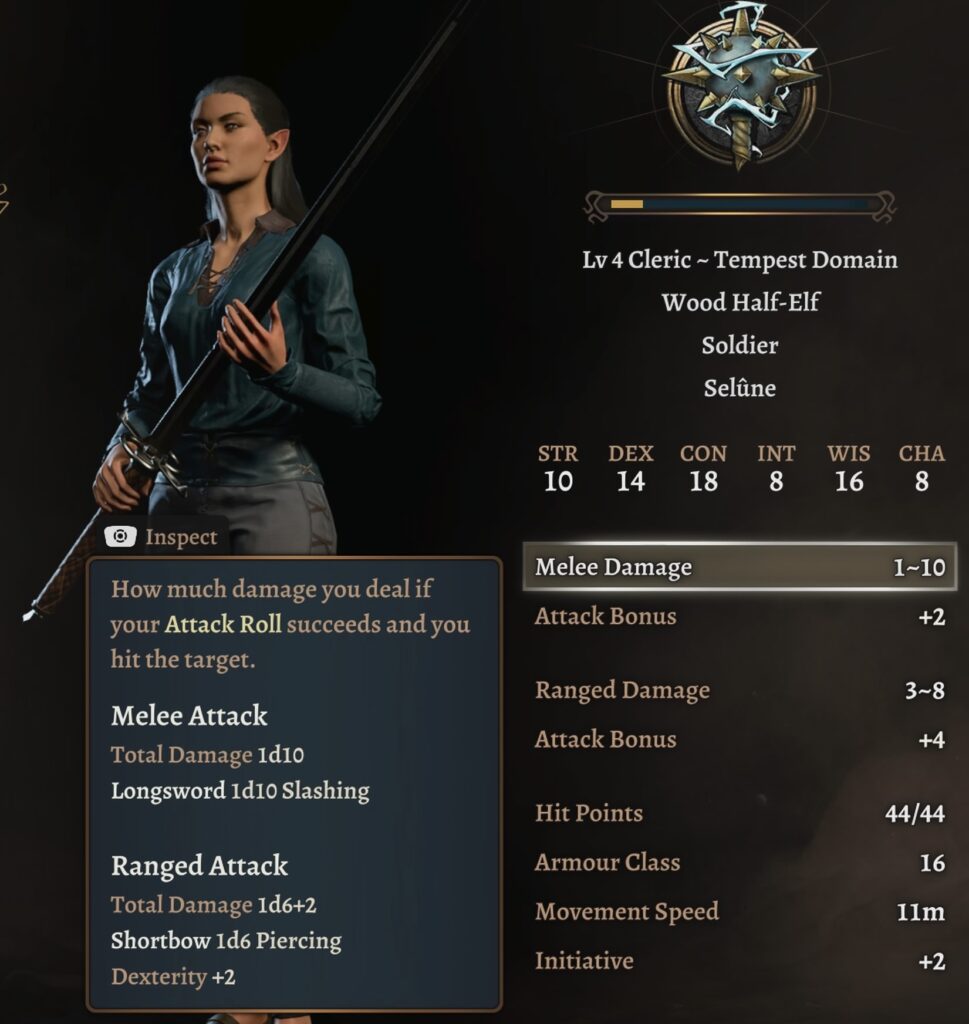
There’s something subtle in the description of the Shortbow: “Proficiency with this weapon type unlocks:” followed by an icon. That icon refers to Weapon Action, an additional Action made available by the weapon. To learn what the Weapon Action is for the Shortbow, I selected “Inspect”:
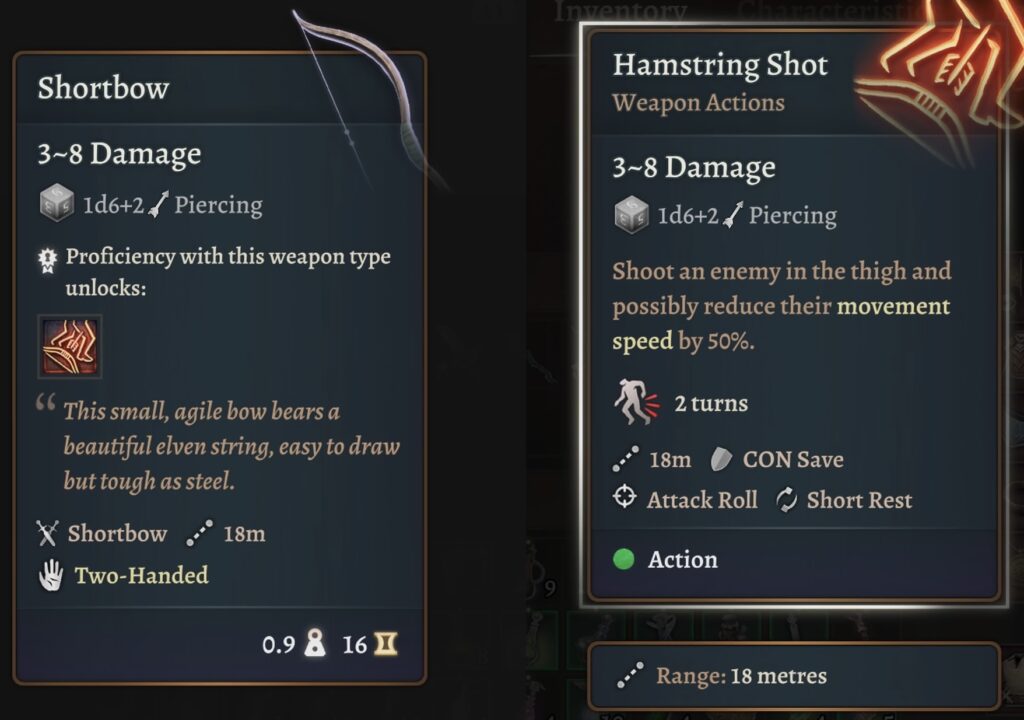
If you look on the upper right, you’ll see the icon represents a Weapon Action called Hamstring Shot. It does as much damage as a regular shot from the Shortbow, but has the potential of slowing the enemy down.
Almost all weapons in the game have Weapon Actions associated with them. Not all of them are useful. In the case of Hamstring Shot, it probably won’t have an additional effect (the enemy gets a CON Save), but it doesn’t hurt to try.
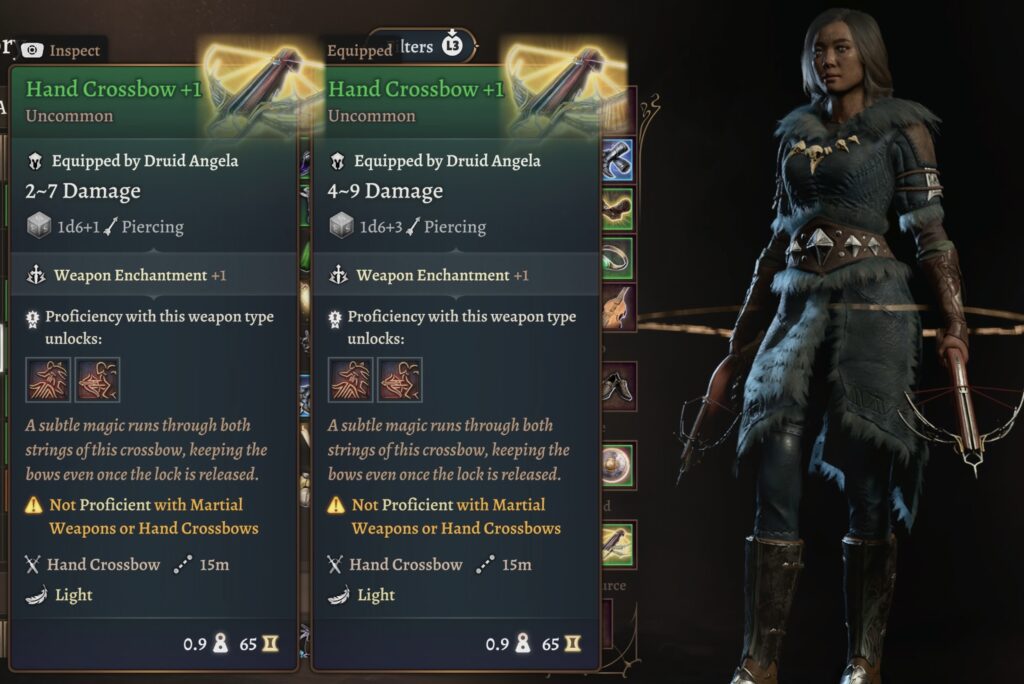
What if you don’t have Proficiency with a weapon?
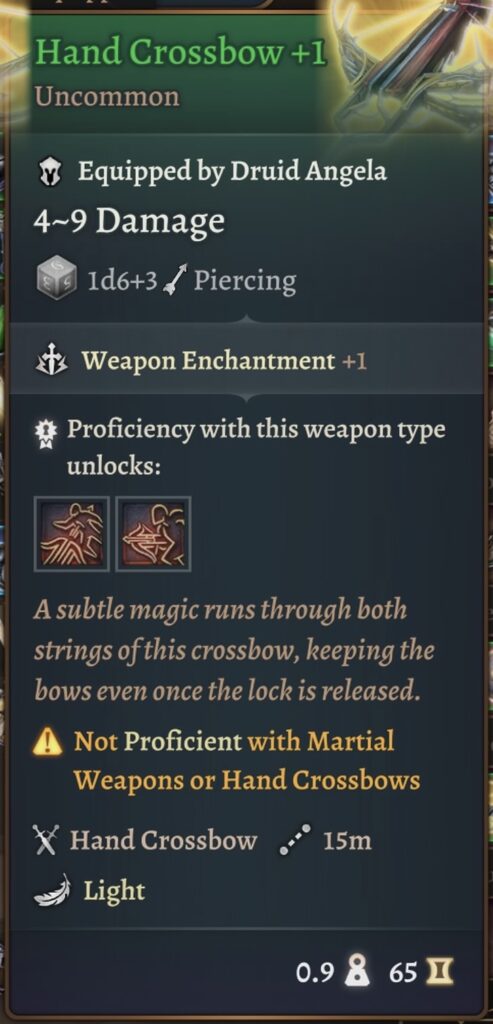
Her damage with the Hand Crossbow + 1 isn’t abysmal, as these things go. It reads “1D6 + 3”. The 1D6 is the base damage of the Hand Crossbow. The bonus damage is +2 from her Dexterity of 14, and another +1 because the crossbow is magical (“Weapon Enchantment + 1”).
However, if you compare the color of the orange icons in the middle section, you’ll see that it’s dimmer than the icon in Wings’ Shortbow above. Druid Angela can’t use any of the Weapon Actions.
Does this matter? In the early phases of the game, probably not. The Weapon Actions can be useful, but not game-changing. In later phases of the game some of the Weapon Actions are quite powerful. But Druid Angela is not likely to use those weapons, since by that time her full Arctic Druid abilities will be available. She’ll use items that enhance her magical powers, not those that offer alternative melee Actions.
Armor Proficiency
This has nothing to do with dice checks. But since I’m talking about Proficiencies in general, I should mention Armor Proficiency to be complete.
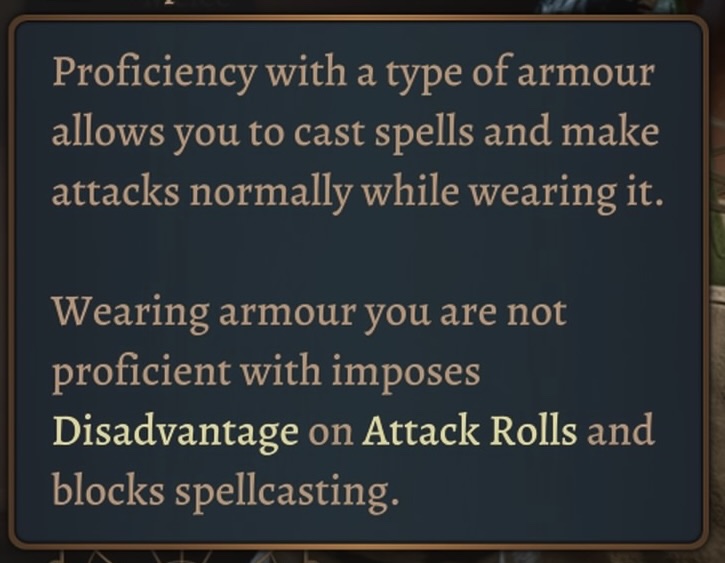
Where do item Proficiencies come from?
Skill Proficiencies mainly come a character’s background, race, and class. Weapon and Armor Proficiencies come from a character’s race and class as well.
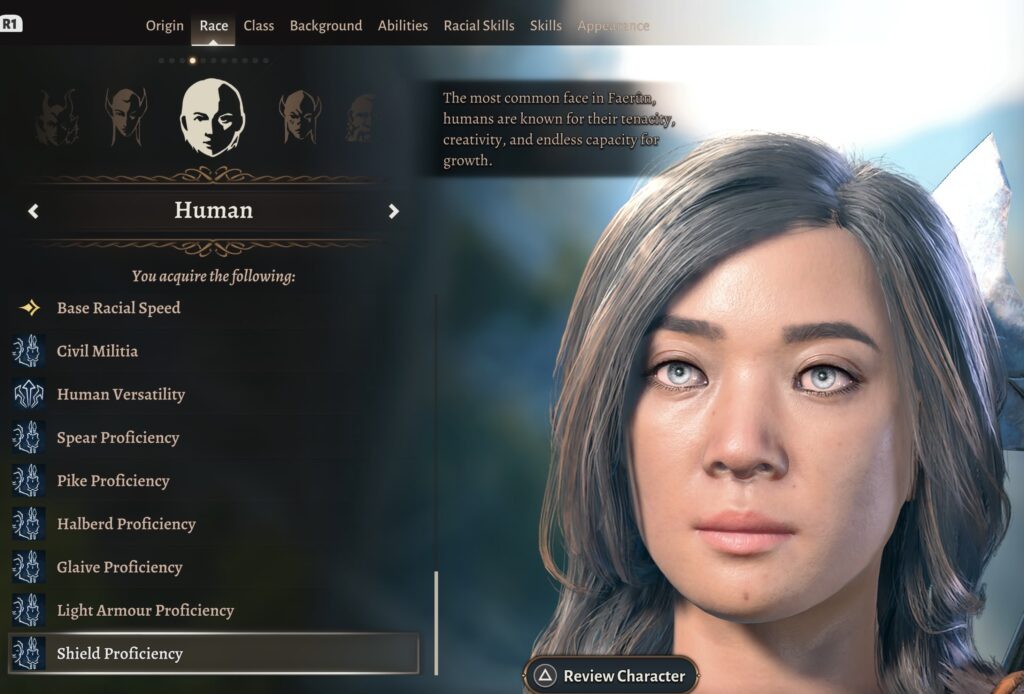
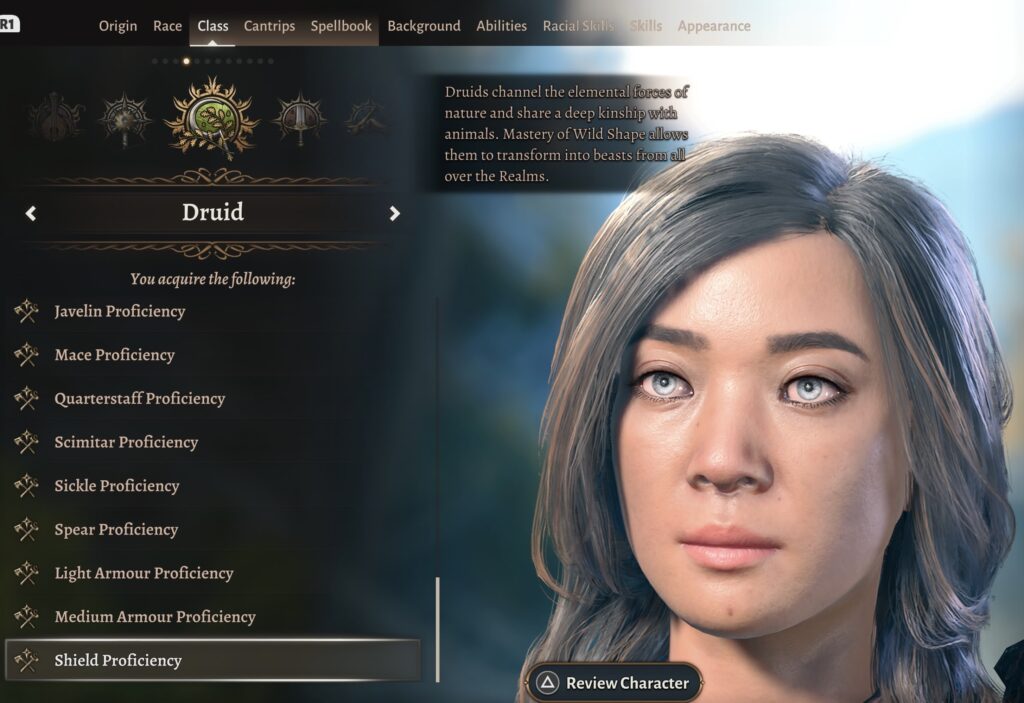
If you look carefully, you’ll see that the only ranged weapons for which Druid Angela has Proficiency are Javelins and Spears. Those are Thrown weapons, whose damage and Attack rolls are based on Strength… and Druid Angela has STR 8. She’ll stick with her Hand Crossbows.
Note the plural: Hand Crossbows can be dual-wielded, one in each hand. The off-hand crossbow can be fired as a Bonus Action. This gives her something to do with her Bonus Action, at least on her early levels.
(Don’t confuse a Bonus Action with the bonuses associated with dice checks. They’re different concepts that share a name.)
(The thing I like the most about these rules is their clarity.)
The spreadsheet and bonuses
We’ve just learned a lot about bonuses, perhaps too much! How do these bonuses affect the odds that we’ll succeed at a task?
Perhaps you’ve noticed a couple of extra boxes on the spreadsheet:
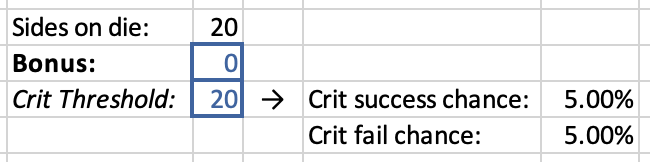
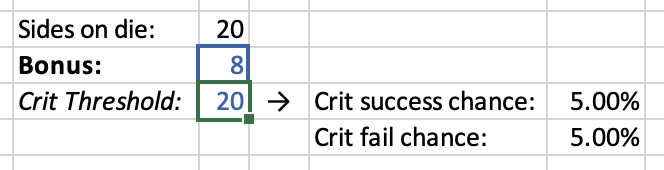
As you’ve already guessed, if you have a given bonus (or penalty), you can type that number in the Bonus box and you’ll see the percentages change.
In case you can’t try it out for yourself, I’ll give an example. Let’s assume you have a +2 Bonus in a task. You’d enter it into the spreadsheet’s Bonus box:
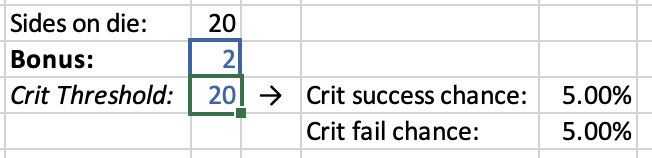
The odds on the rest of the spreadsheet would change:
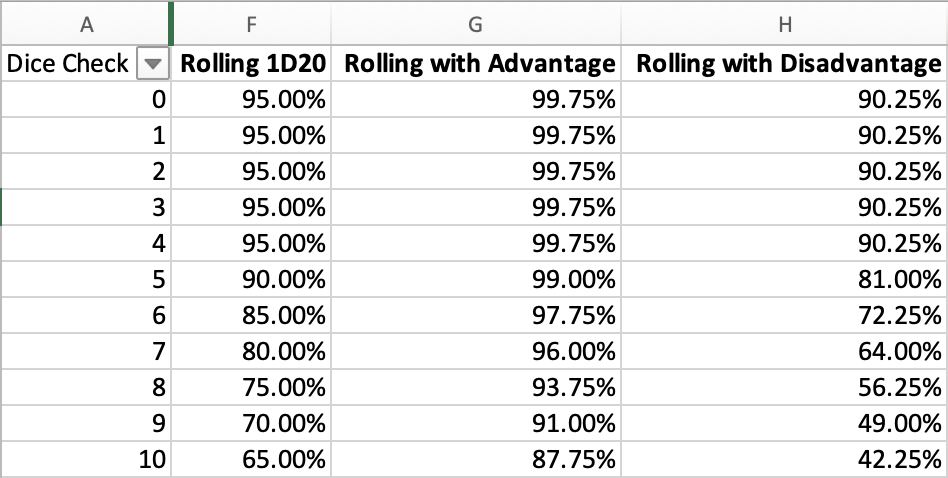
For example:
- without a bonus, the chance of rolling 10 or better on a D20 was 55%
- with the +2 bonus, the chance of getting a total of 10 or better by rolling a D20 and adding +2 (D20+2 in typical game notation) is now 65%
Critical Hits
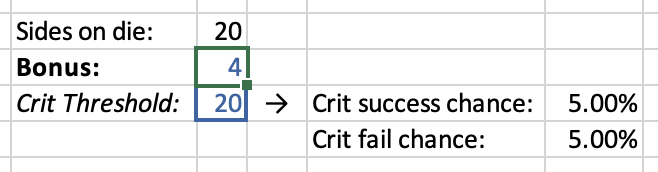
What is that Crit Threshold box for?
You already know that rolling a natural 20 is a Critical Success. If you roll a 20 when you’re hitting an enemy with an Attack (not a Skill roll), it’s called a Critical hit.
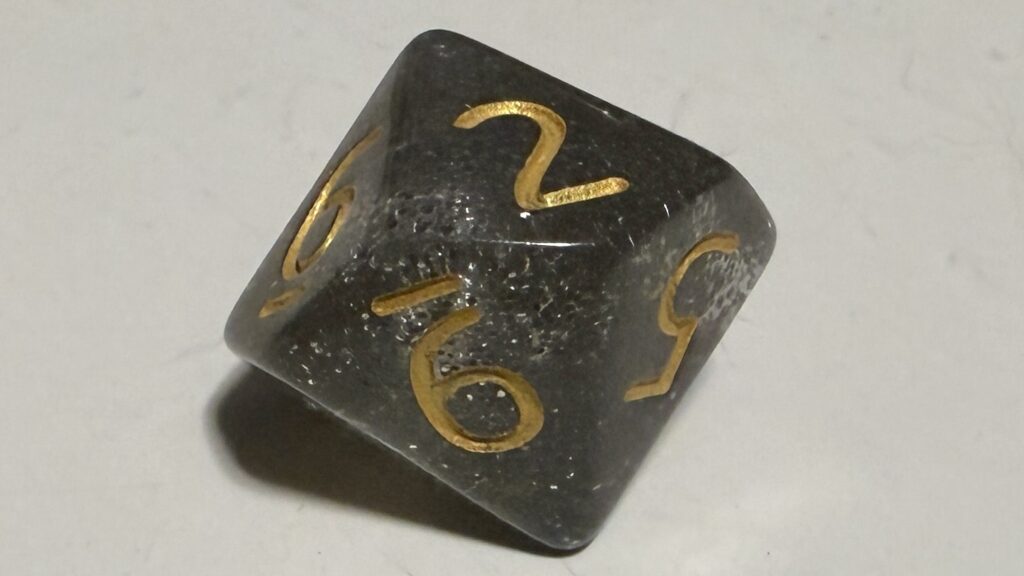
When you get a Critical Hit, the Attack succeeds (of course). What’s more interesting is that the damage dice are doubled. For example, if a weapon normally does 1D10 + 2 of damage, on a Critical hit it does 2D10 + 2 damage.
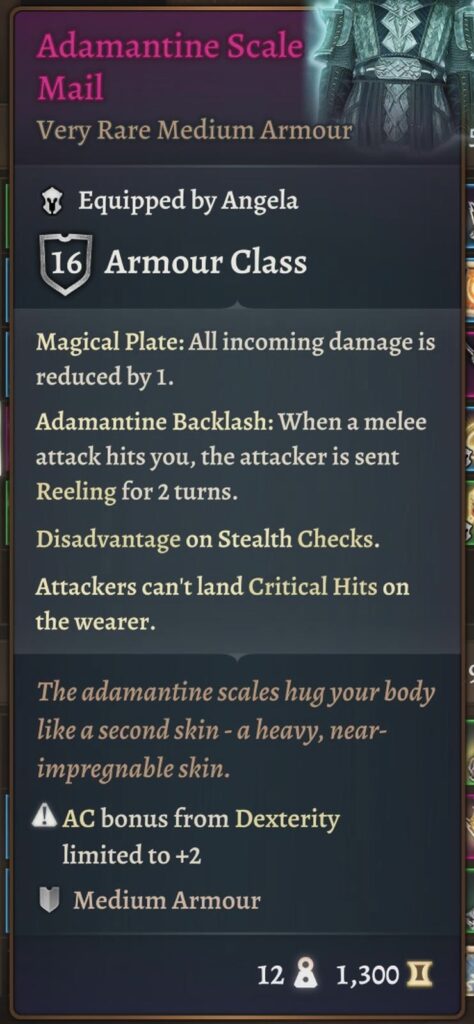
Critical hits are wonderful when you hit them. They’re not much fun when they hit you. However, there are a few pieces of armor that can block Critical Hits. Note the text “Attackers can’t land Critical Hits on the wearer” for the Adamantine Scale Mail:
There are items and classes in the game that can reduce the threshold for a Critical Hit. A couple of examples:
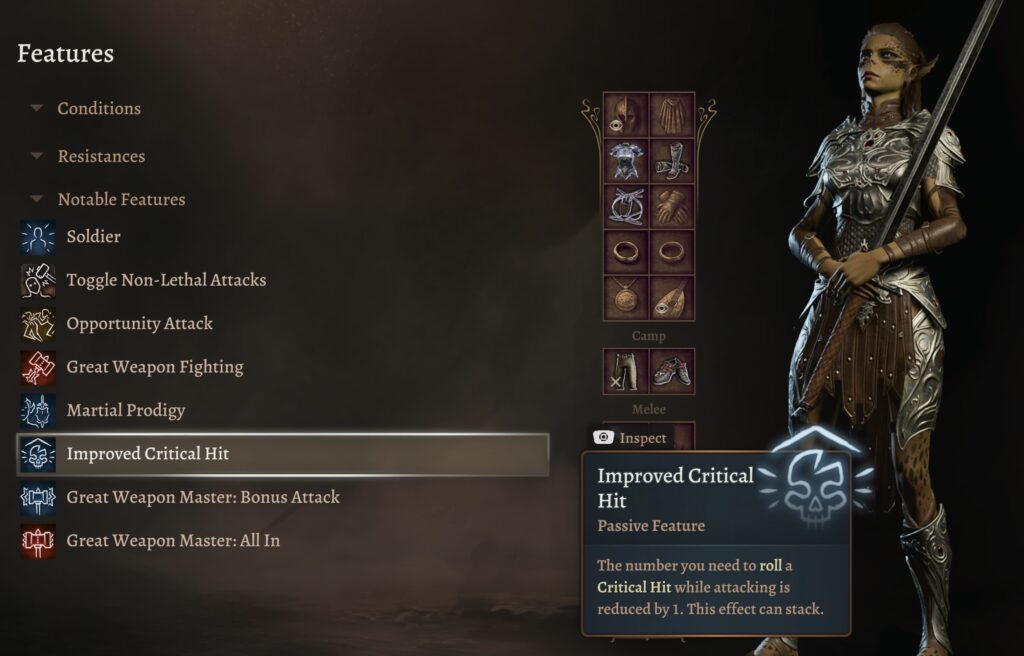
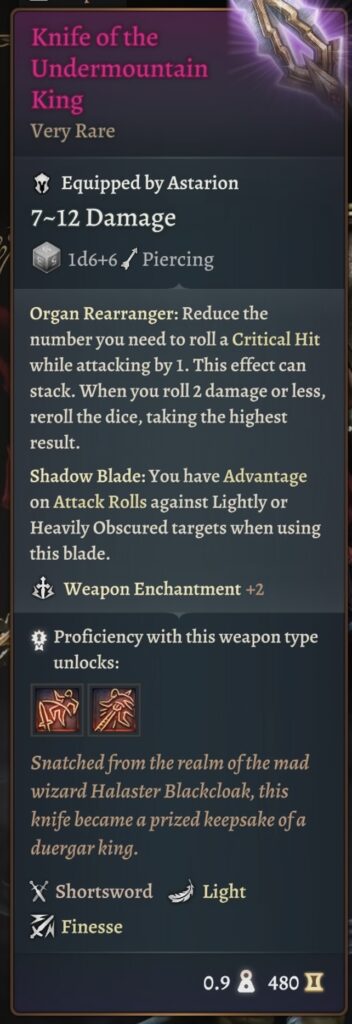
These Critical Hit threshold reductions stack. Real Angela told me that, in one of her playthroughs, she set up Astarion’s gear and abilities such that he had a Critical Hit on a roll of 12 or more. Impressive!
Since reducing the Critical Hit threshold is not the same thing as a normal Bonus, I put that adjustment in a separate box. If you replace 20 with 19 in the Crit Threshold box, you’ll see a change in the higher rows of the spreadsheet, as formerly-difficult rolls become easier.
For example, put Real Angela’s Critical Hit threshold of 12 into the Crit Threshold box. You’ll see that, while the odds of success for a DC of 12 or lower will remain unchanged, for a DC of 13 or greater it won’t go down from the DC 12 chances of success. The odds of success for a DC of 13 through 30 (or higher!) will be 45% on a D20.
What’s the DC?
We have that spreadsheet. It’s got a bunch of rows. You’ve figured that the higher the DC, the lower the chance of success.
At this point, it’s reasonable to ask, which row do I use? In other words, where does the value of the dice check come from?
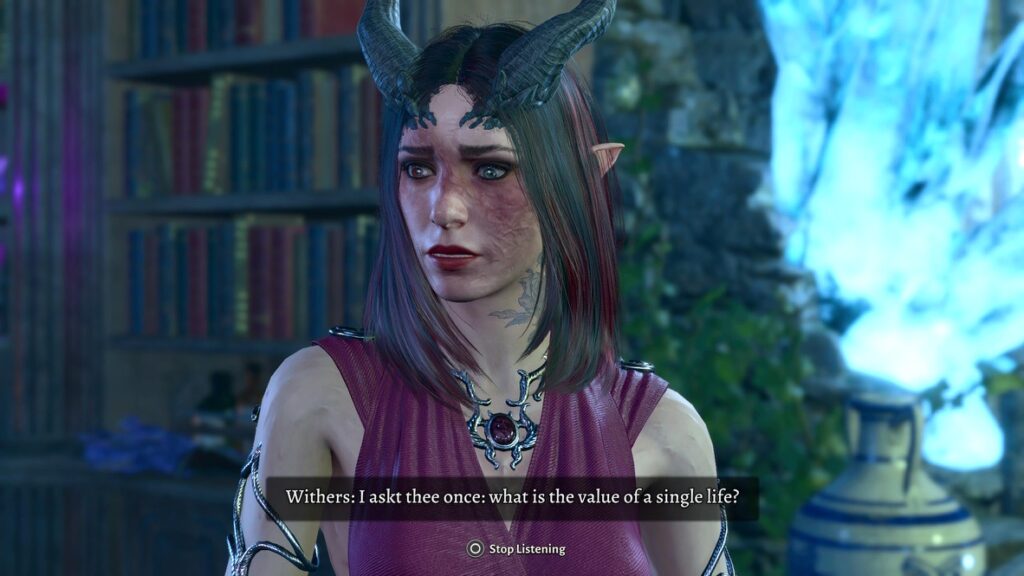
In BG3, the short answer is: It’s not always obvious.
Here’s how I break down the sources of dice checks in BG3:
- Fixed by the game’s designers: passive and active
- Attacks and Armor Class
- Spell Save DC and Saving Throws
Let’s explore each of these.
Fixed DC
These are dice checks whose value is set in the game. They don’t change. A given trap in a given location might have a DC of 15 to disarm. That can change with higher difficulty levels, but it won’t change between multiple playthroughs. What changes are the bonuses added when you roll to see if you succeed.
The annoying part is that it can be hard to tell what that DC is.
I’ll further divide that into two categories:
Passive checks
These are dice checks over which you have little control. They happen on the game’s terms, and there are few ways to influence them.
Such checks can be made in the midst of dialogs or similar exchanges. Here’s an example:
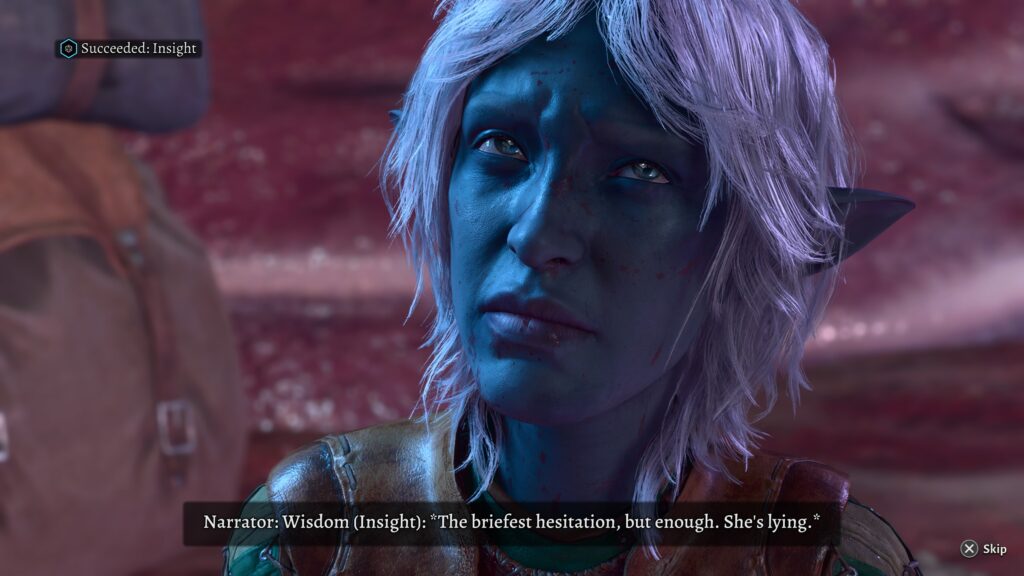
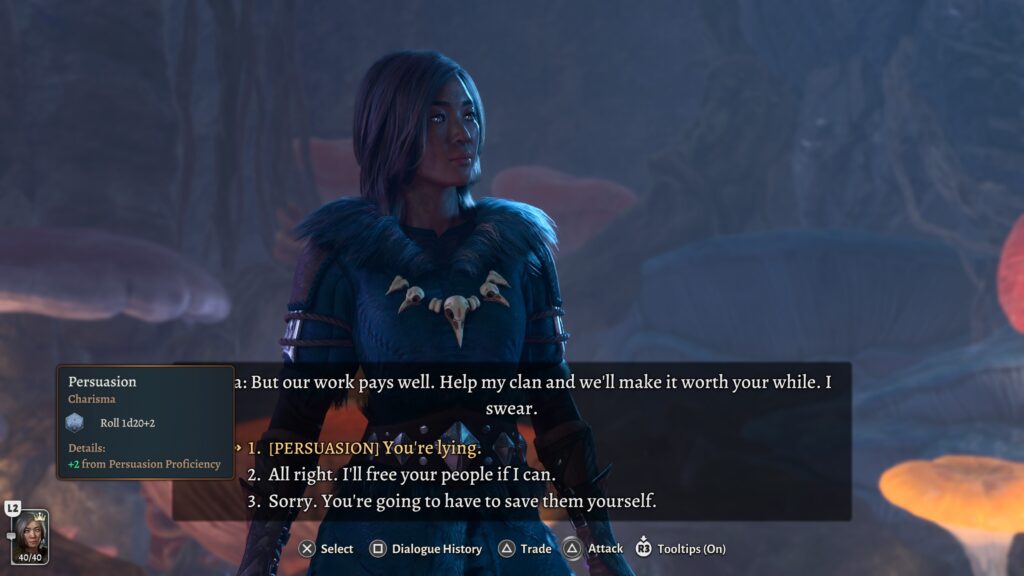
Did you catch the difference between those two checks? The first one was passive; Druid Angela had no direct control over it, and could not immediately improve it. The second check was active: Druid Angela chose it, she knew that the DC was 15, and she could have augmented her die roll with Guidance or other means if she wished to. One could even use my spreadsheet to judge her chances of success.
As you move through the game’s world of Faerûn, the game is making passive checks. You become aware of them by the game displaying “pass/fail” messages.
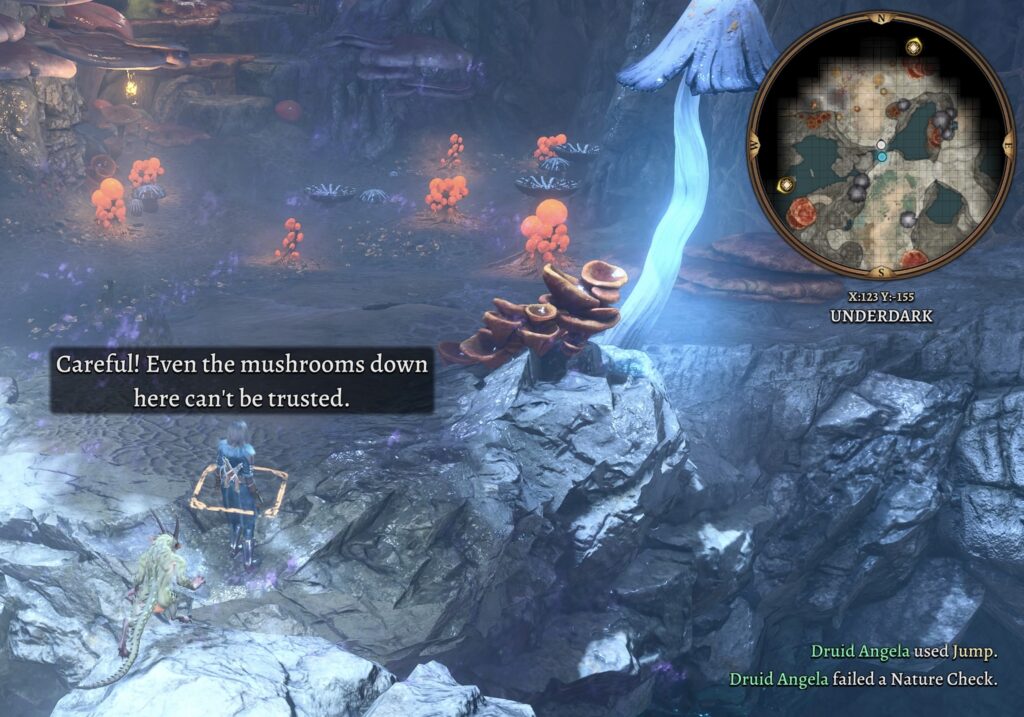
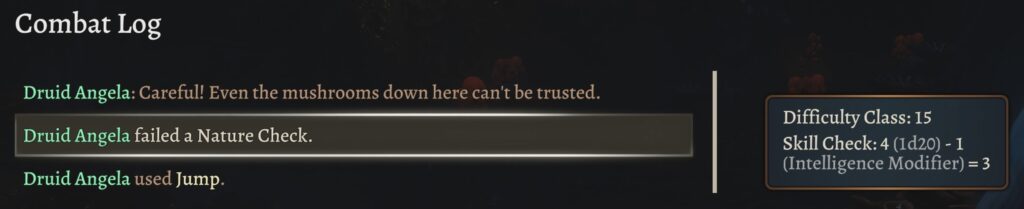
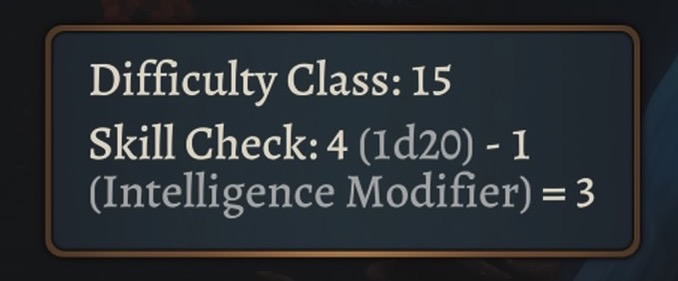
Another example:
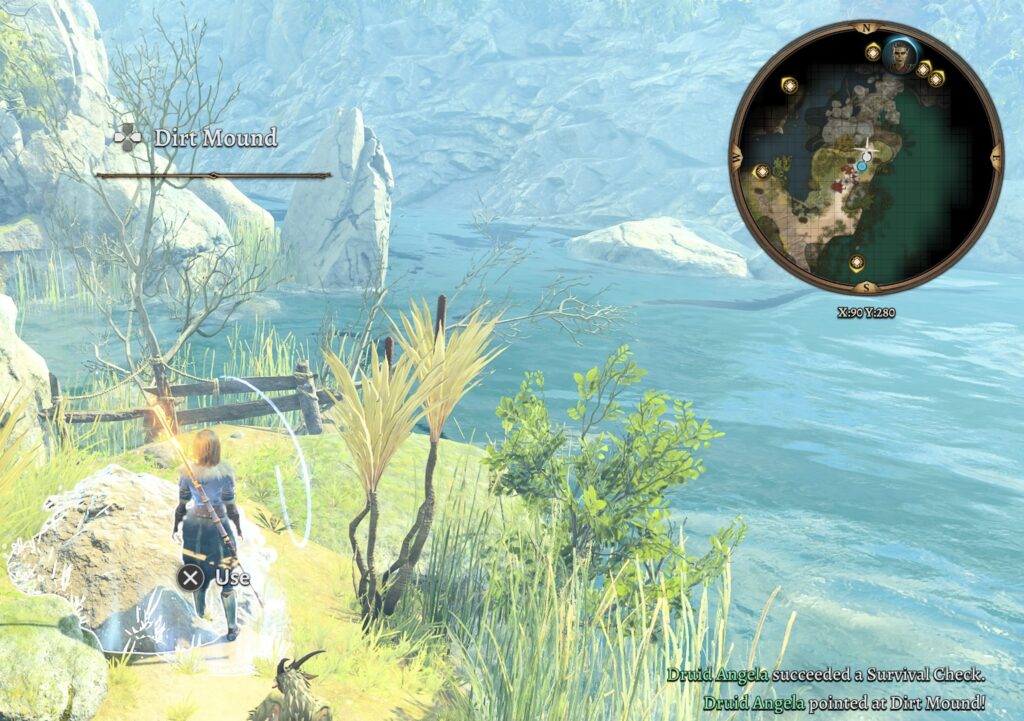
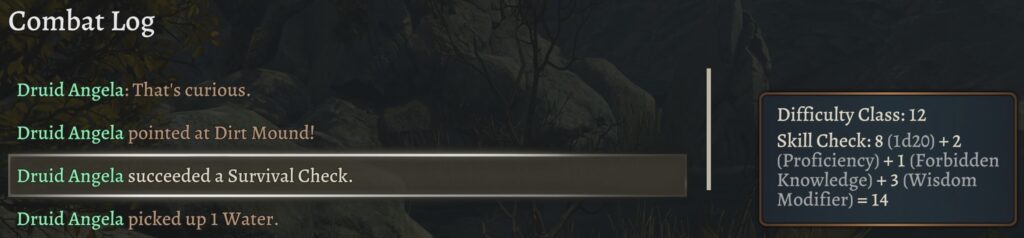
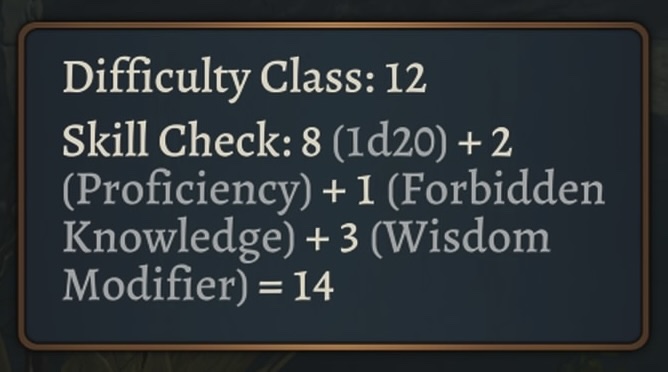
In BG3, the most common use for Survival is to detect buried treasure. The chests you dig up in this way just contain resources like gold or food; there’s nothing critical to the story or game-play. If you like the idea of finding treasure, get Survival Proficiency.
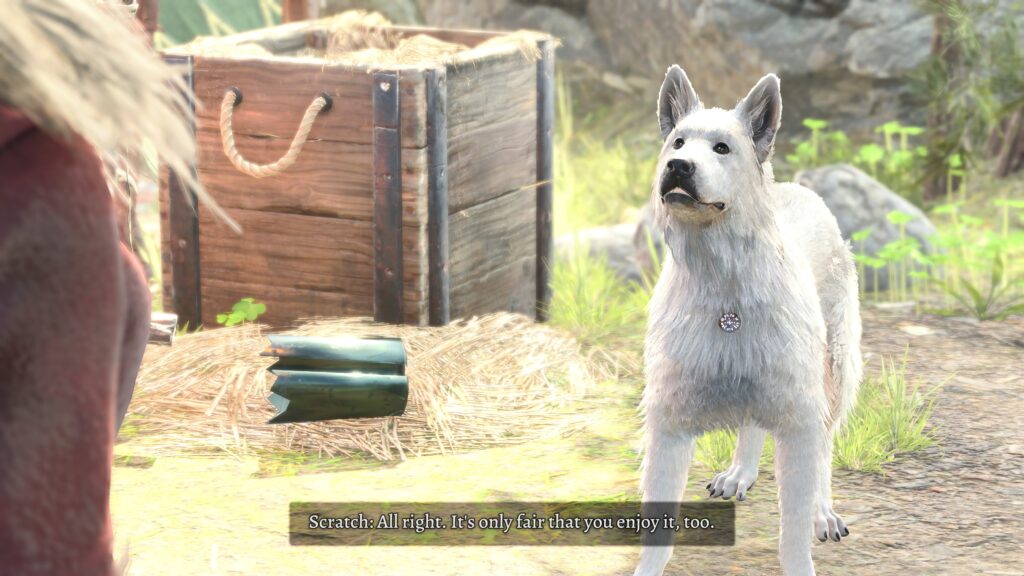
Checks of this sort usually don’t have a major effect on the game’s story. However, I can think of two big exceptions; one involves a demon’s song and the other relates to a mirror.
The main way to affect passive checks is to consider the Skills and their Proficiencies when you build your character. There are many Skills (for example: Arcana, History, Insight, Investigation, Religion) whose only function in BG3 is to be used for story-related dice checks.
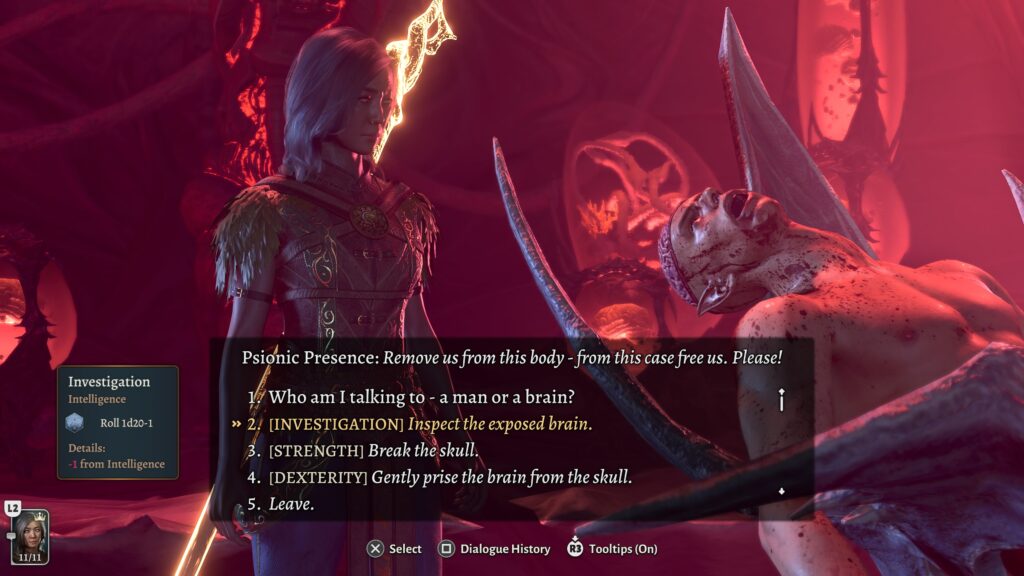
You can’t be an expert in everything. There will be some story-related dice checks that you will fail. The only option is to move on, build a different character for another playthrough (is this why Bill has played the game 18 times so far?)… or restore the game from a save
There’s one more important example: detecting traps.
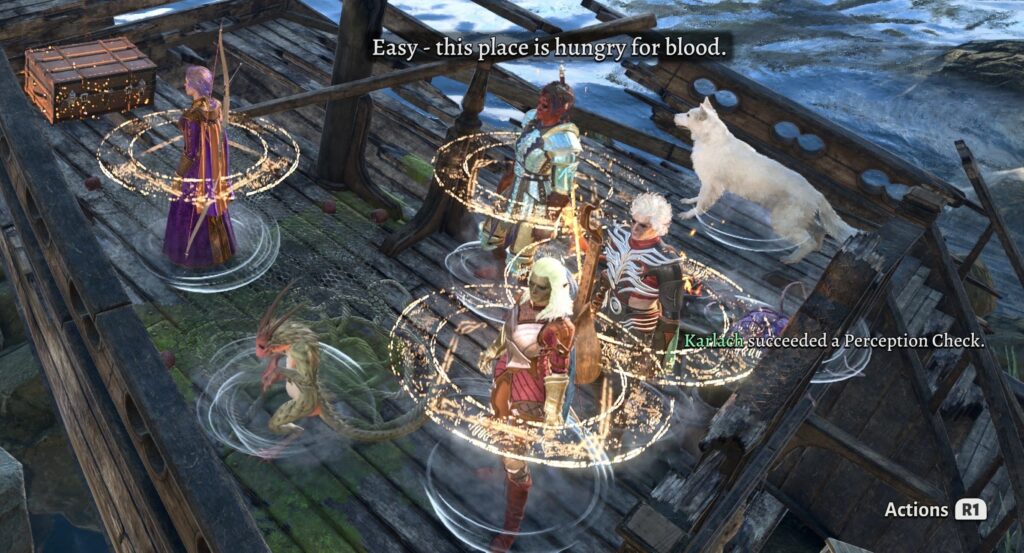
That’s a passive check using the Perception skill. In the course of researching for this blog post, I learned that the base DC for such checks is 10, to which are added the Wisdom Ability modifier and any Proficiency bonus. Some players make it a point to get Perception Proficiency to make sure they find any traps lying around.
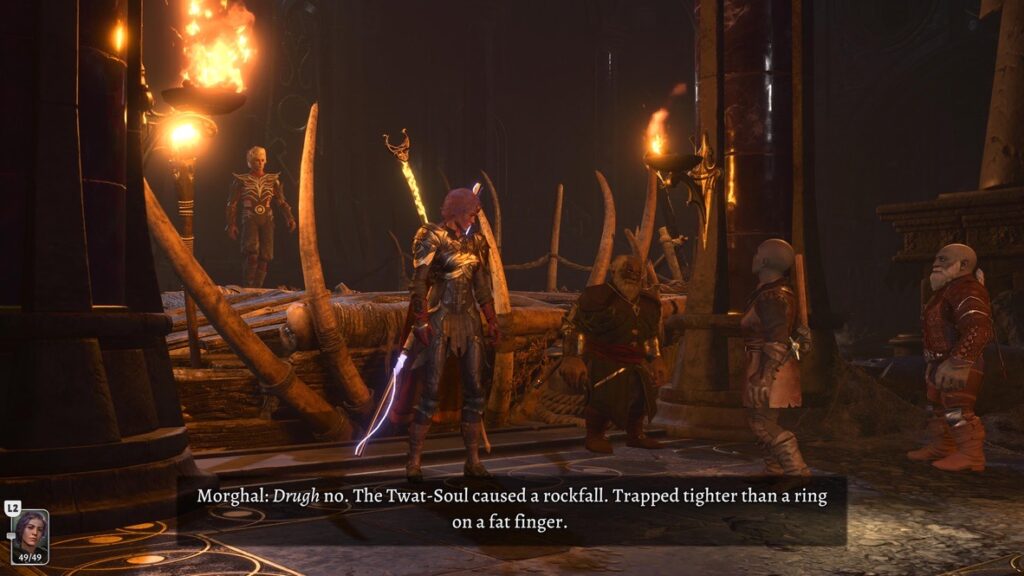
Once you detect a trap, you might want to disarm it. That leads us to…
Active checks
We’ve already had an example of this, in Druid Angela’s dialog with the Deep Gnome above.
I define an “active environment check” as one whose DC is pre-set in BG3, and over which you have control over the die roll: whether to perform the check, use abilities or items to adjust it, and so on. Because you know the DC, you can figure out the odds of success by using my spreadsheet or any other calculation you choose.
By far the most common active checks I make when I play BG3 are picking pockes, picking locks, and disarming traps.
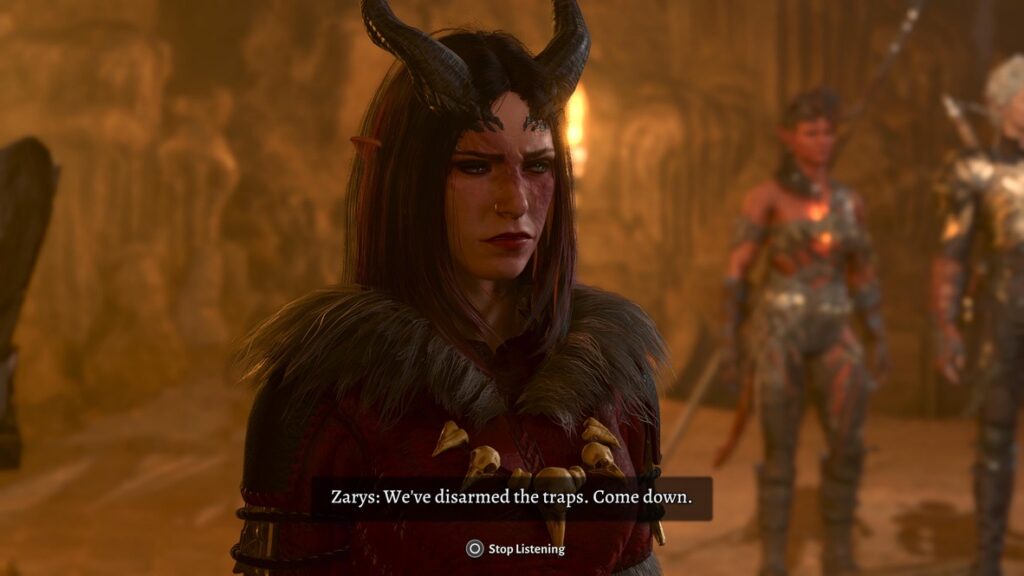
My 46! blog post, and follow-up die-roll essays, focus on disarming traps. What I say there also applies to active checks in general, so I’ll refer you to them rather than repeat their contents in this already-too-long essay.
There’s one peculiar die roll that my characters made more often as I moved on to higher difficulty levels: pickpocketing.
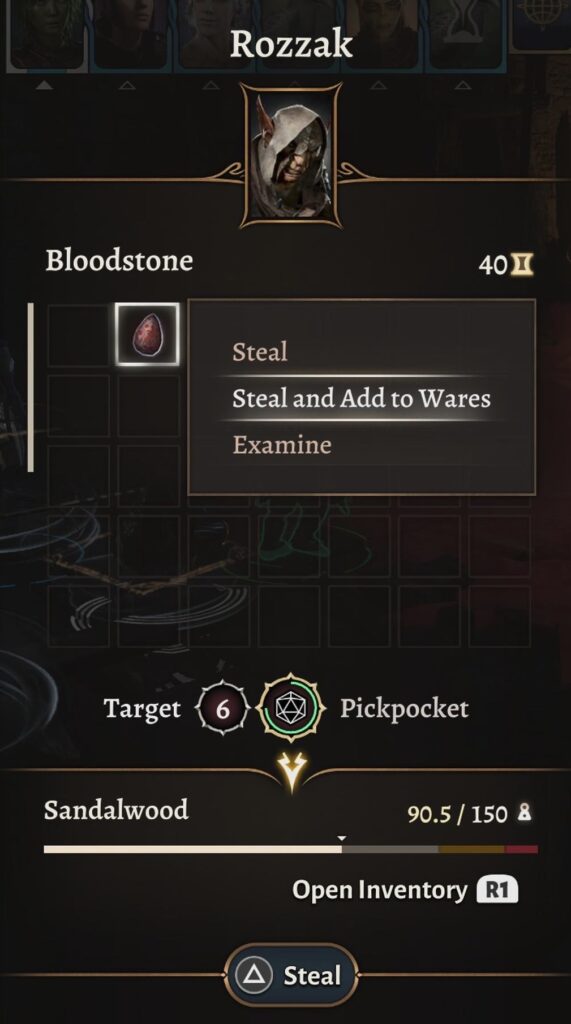
I say “peculiar” because, while it’s definitely an active roll (you choose to do it), you don’t see an animation of a rolling die and there’s no adjustment you can make to the roll just before you do it. It’s an active check that looks like a passive one. You have to plan your bonuses beforehand. This is sensible; a skilled thief has to be prepared.
Also, there’s a curious inconsistency between the “Target” number and the number you see when you roll each pickpocketing attempt. I often see that I’ve rolled a lower number than the target but the attempt succeeds. In other words, not all your bonuses show up in the DC result.
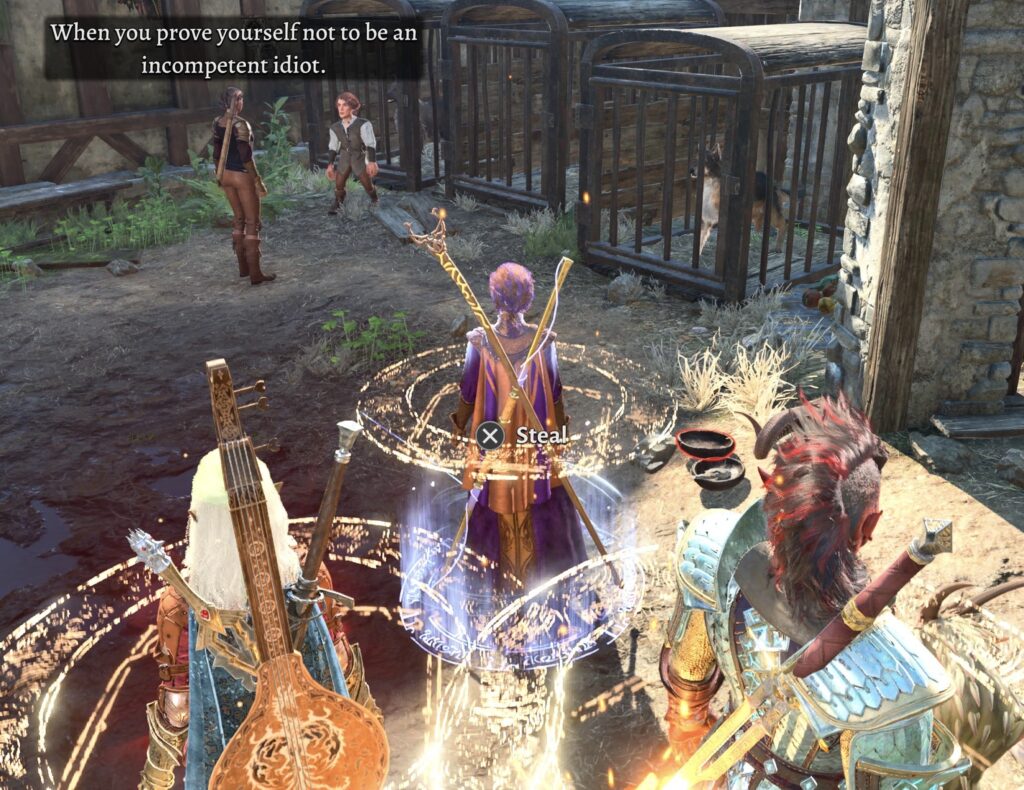
Real Angela found the same thing I did: At higher difficulty levels, the game’s prices go up. So does the game’s demand for resources like potions, elixirs, magic arrows, exotic herbs, etc. Although she was initially reluctant to steal from vendors in her playthrough 3, by the time of her playthrough 4 she was comfortable with it. She didn’t have much choice if she wanted to play the game productively.
All of which is a round-about way of making an excuse for Druid Angela to do the same thing. Art imitates life.
Attacks and Armor Class
Let’s get into the dice checks which lie at the heart of the D&D experience. Consider the following exchange, probably said during the first game of Dungeons & Dragons ever played:
Gamesmaster: The monster attacks!
Player: I swing my sword at it!
The player rolls a die to see if their character hits. The DC they have to pass depends on the monster’s defense.
The Attack roll is:
1D20 + Ability modifier + Proficiency Bonus + Weapon bonus + magic bonuses
To break this down:
- The 1D20 is where the Critical Hit (double damage dice; yay!) and Critical Miss (no damage; boo!) comes in.
-
The Ability modifier associated with a weapon attack depends on the weapon. Weapons that are gripped in a character’s hand typically use Strength. Bows use Dexterity. Some weapons are labeled Finesse, which means the the game will use the higher of Strength or Dexterity for the Ability modifier.
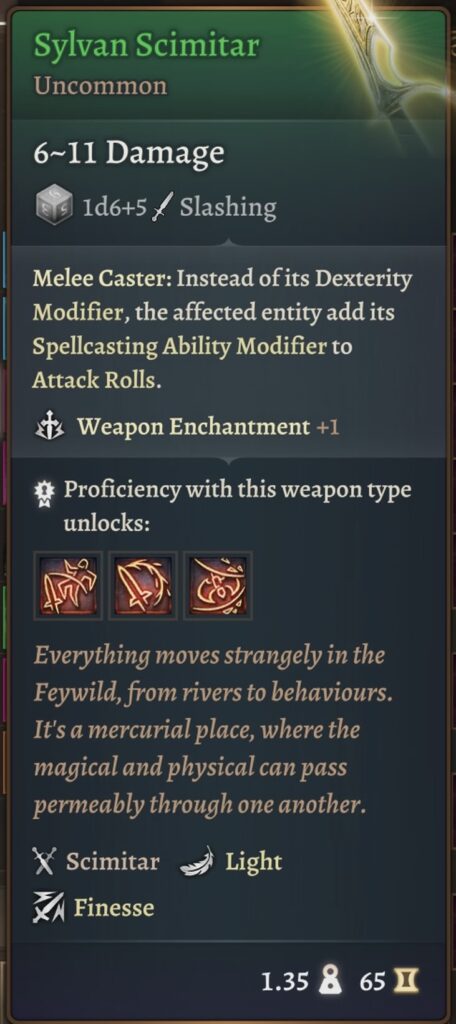
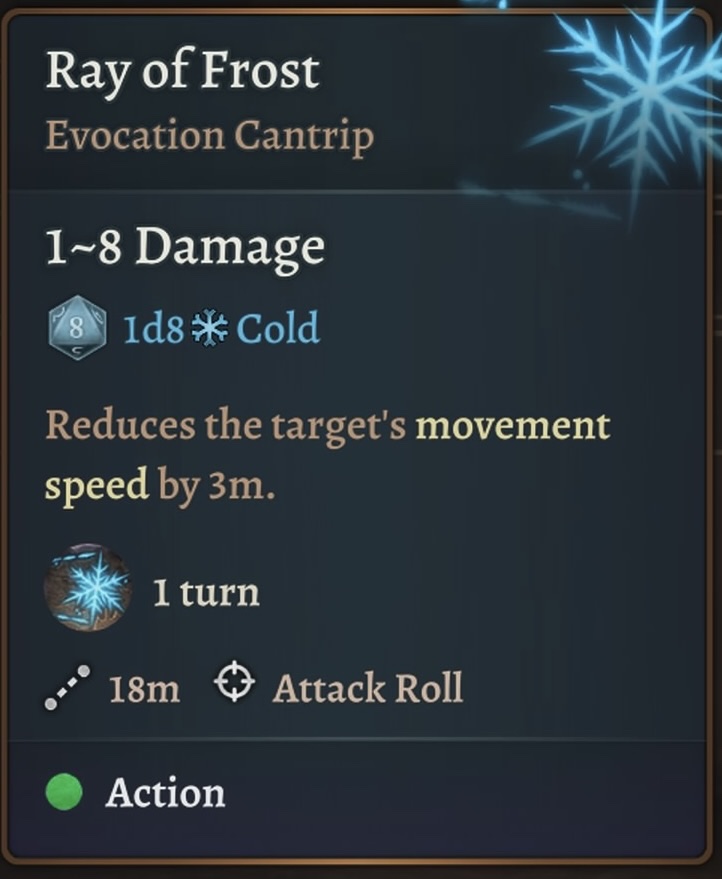
“Finesse” is not an unusual weapon property. Most light melee weapons are finesse weapons. What makes the Sylvan Scimitar unusual is that it uses a character’s spellcasting modifier (eg., Wisdom for Druids) as the Attack’s Ability Modifier. The spell Shillelagh does the same thing, but it only works on clubs and staffs. There are some spells that are considered to have “Attack rolls” instead of the Saving Throw that I’ll discuss in the next section. Remember Ray of Frost?
For spells like this, the Ability Modifier comes from the caster’s Spellcasting modifier. For example, for Druid Angela, this is Wisdom.
- As I discussed above, the Proficiency Bonus is applied if the character is Proficient in the particular weapon or spell the character is using.
- If there is a weapon bonus, it’s part of the item’s description or tooltip; e.g., “Enchantment + 2”.
- There are many magic spells, potions, and other effects that apply an Attack Bonus. For example, earlier I mentioned the spell Bless, which adds 1D4 to the Attack roll.
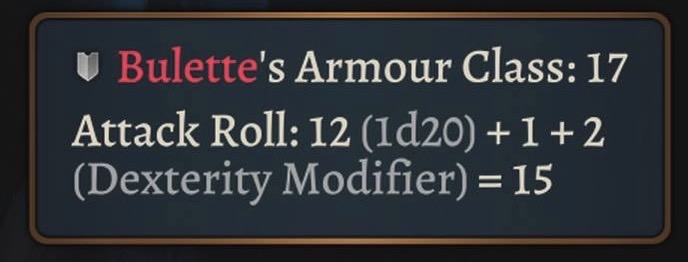
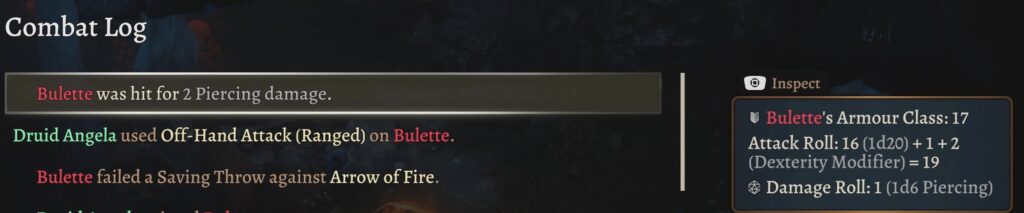
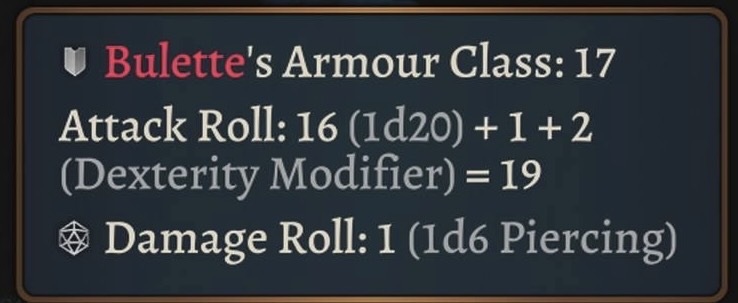
The number the attacker is rolling against, the dice check, comes from the target’s Armor Class (AC). The Armor Class applies whether the attack comes from a weapon or from an Attack spell.
There are four categories of armor in the game: cloth, light, medium, and heavy.
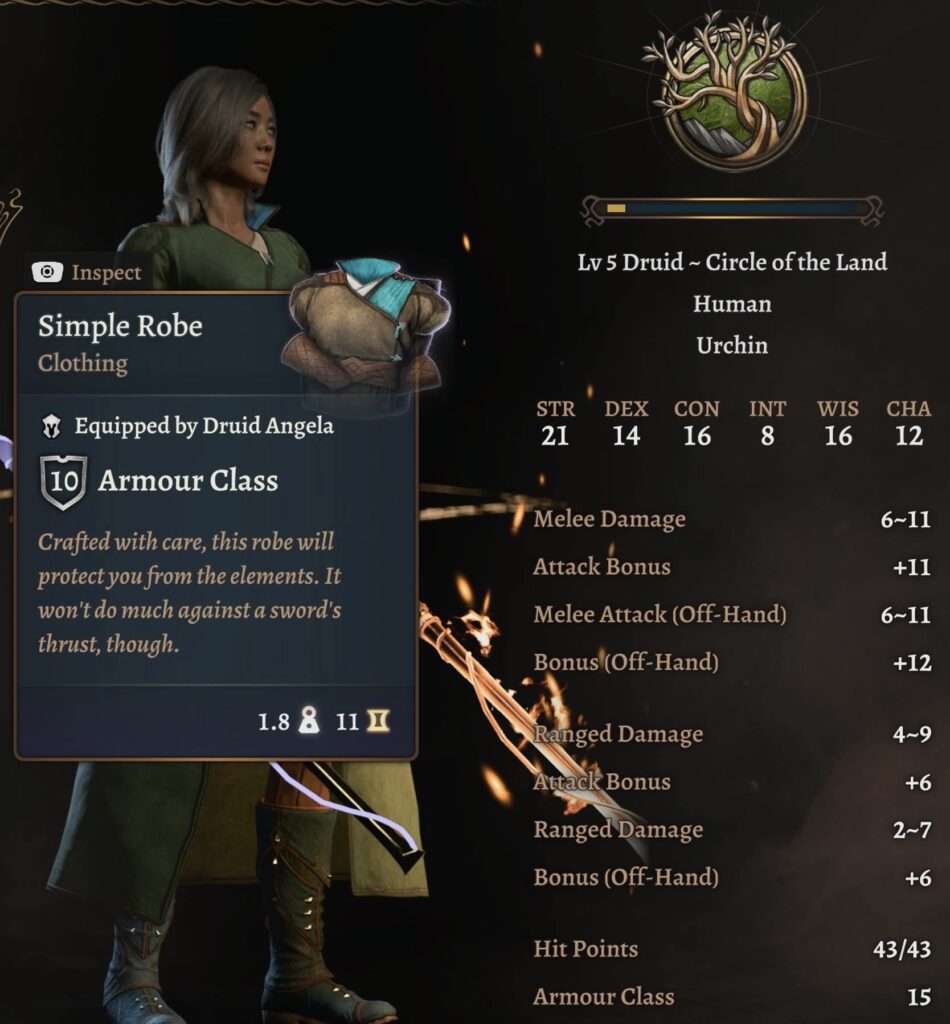
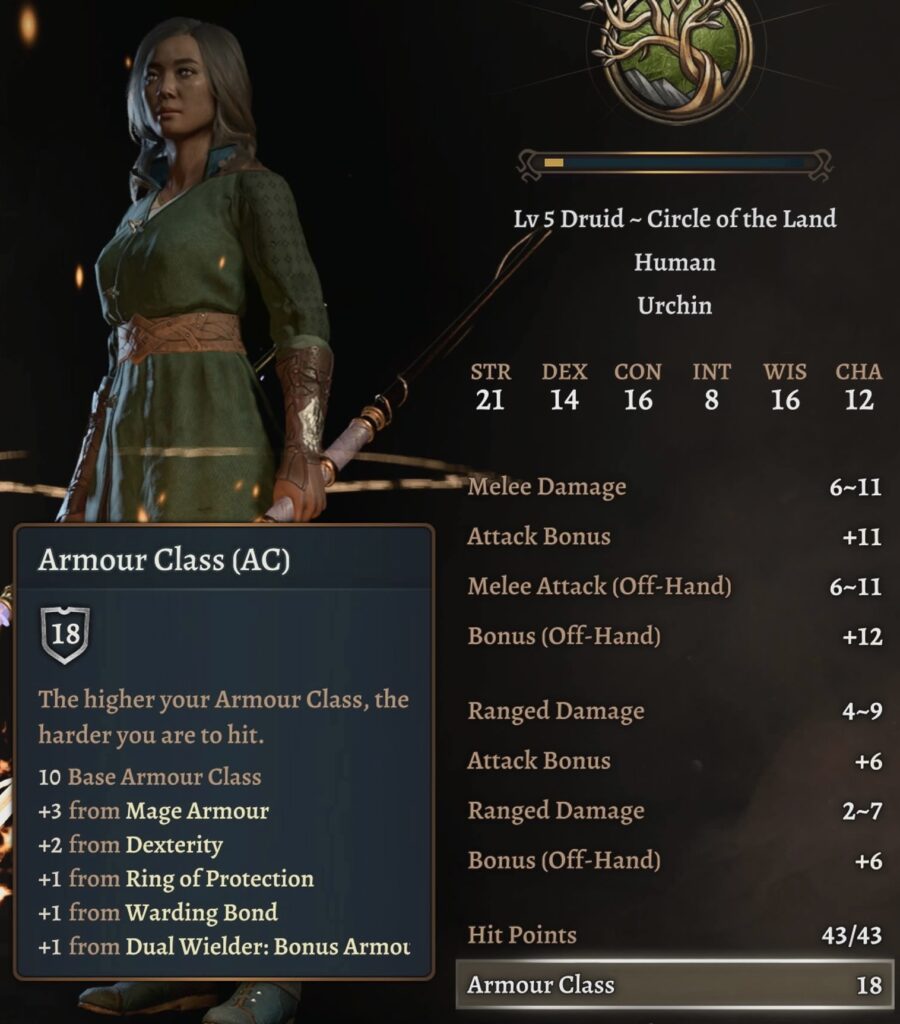
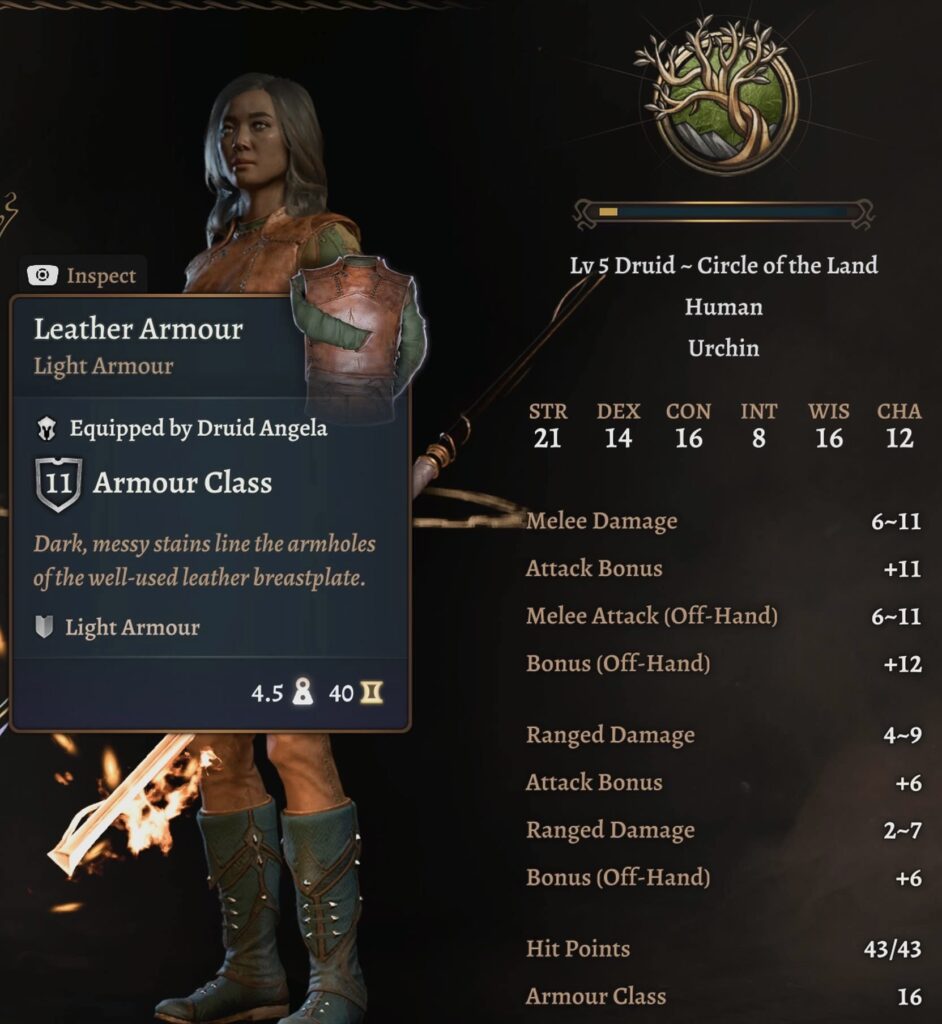
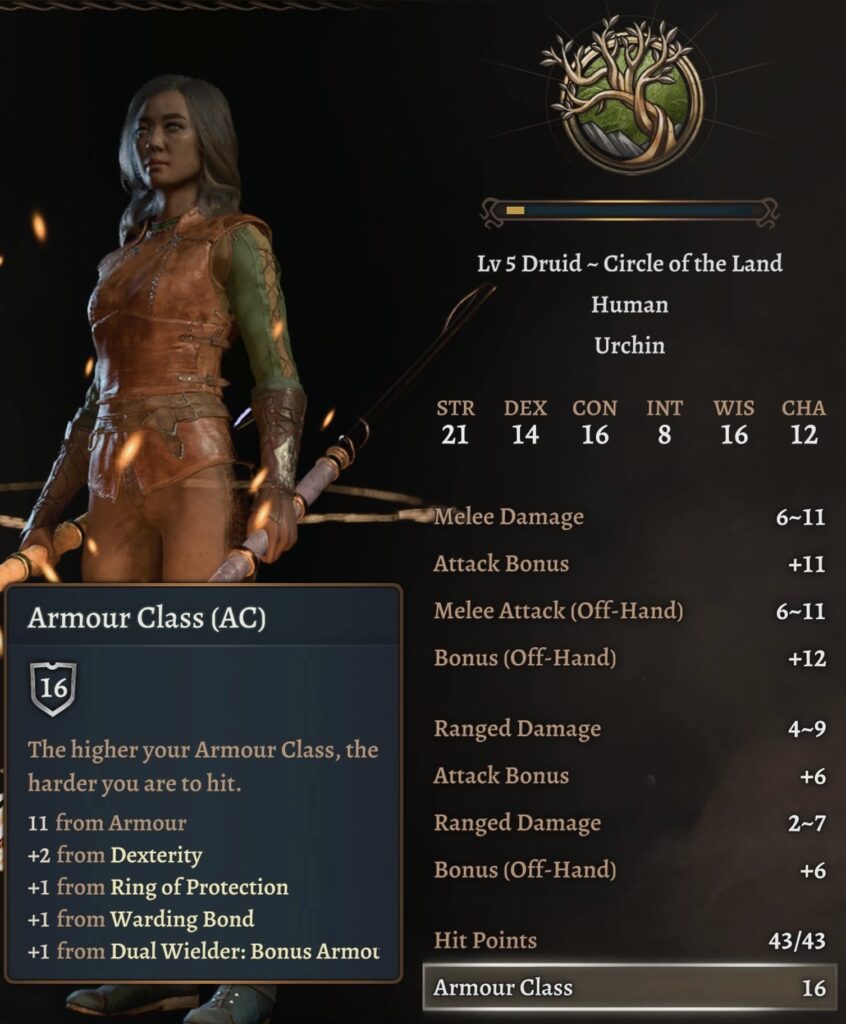
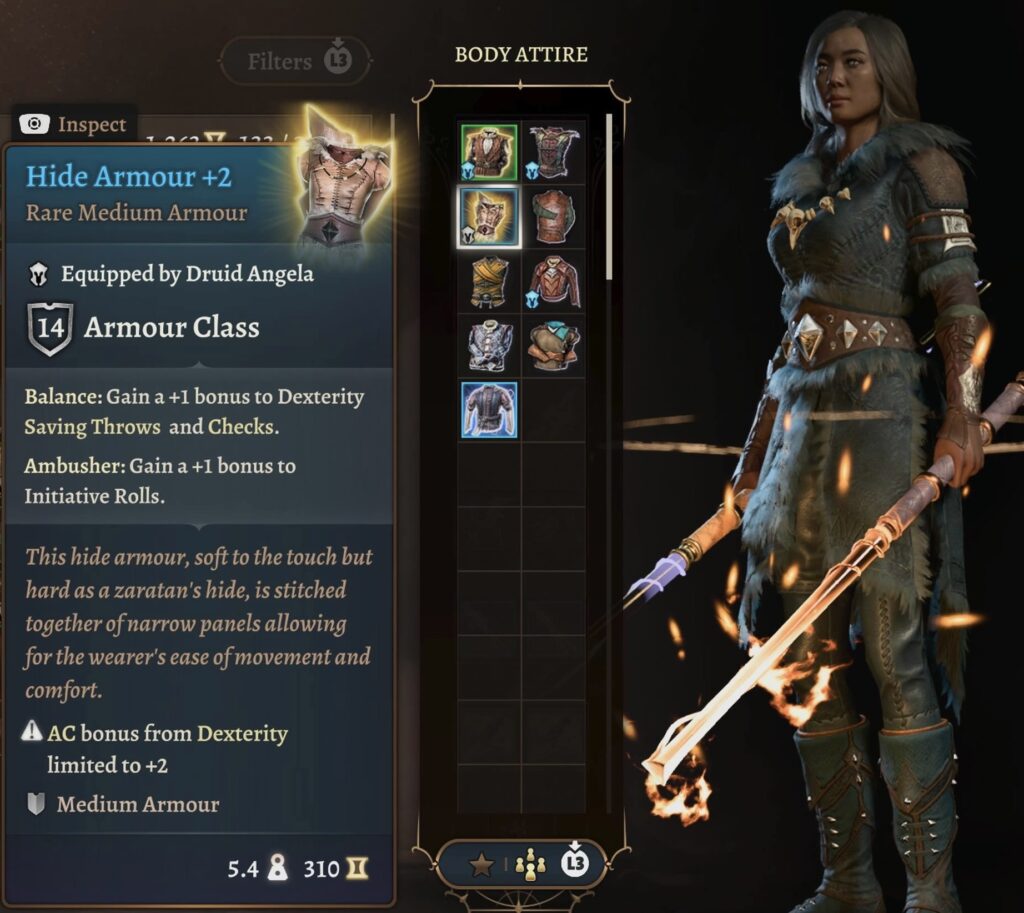
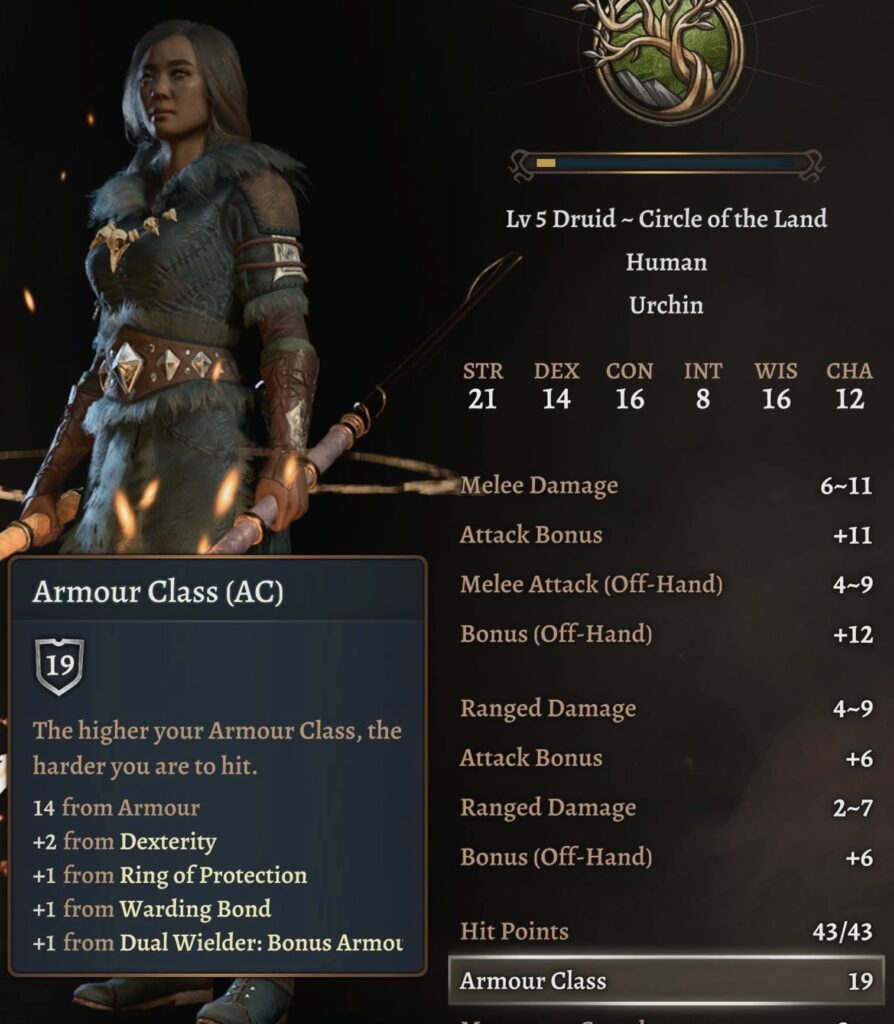
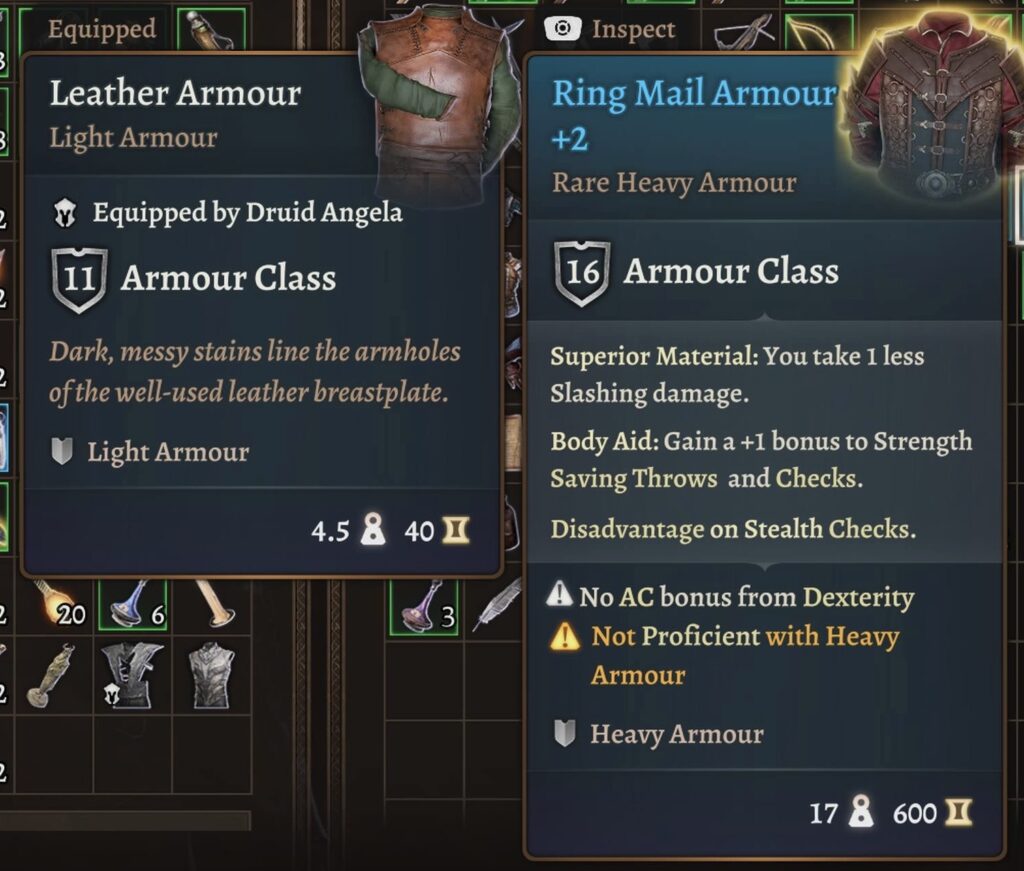
From these pictures, you’ve probably already figured out the formula for actual AC (or, if you will, the actual DC (or even the AC/DC)) that the enemy is rolling against:
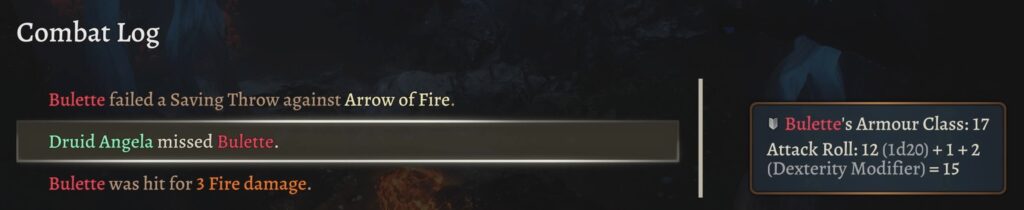
The listed AC of the armor + Dexterity ability modifier + bonuses due to skills/spells/items
One detail: For medium armor, the “Dexterity ability modifier” is limited to +2, the modifier for a DEX of 14, though there are reasons for having a higher DEX than that. For Heavy Armor, the DEX modifier is not added at all. Protection comes at a cost.
Here’s an example of how combat die-rolling works:
Spell Save DC
Earlier, I described Saving Throws. However, I deferred one part of that discussion: If one character is trying to cast a harmful spell on another, how do we calculate the dice check that the defender is making the Saving Throw against?
This is called the Spell Save Dice Check, or just Spell Save DC.
- If you are the one casting a spell on an enemy, you want your Spell Save DC to be as high as possible, to make things harder for your enemy.
- If an enemy is casting a spell on you, as I described with my Hold Person example above, you want your relevant Ability modifier and other defensive bonuses to be high, so that when you attempt to make your Saving Throw the result is higher than the Spell Save DC of the attacker.
This terminology confused me for roughly the first two years I played the game. “Spell Save DC” sounds like something the defender wants to improve so they can resist harmful spells. It’s actually something the attacker wants to improve so their spells will affect a target.

For the one casting the spell, the formula for the Spell Save DC is:
8 + Proficiency bonus + the spellcasting ability modifier + bonuses from spells and items and so forth
Compare that to the formula for the Saving Throw against the spell:
Die roll + Ability bonus + Saving Throw Proficiency + any bonuses
Let’s see how this works in practice. As I said above, Arctic Druid Angela’s favorite spell is Ray of Frost, but that’s an Attack spell, using Armor Class for the DC. So we’ll go to her second-favorite spell, Ice Storm:
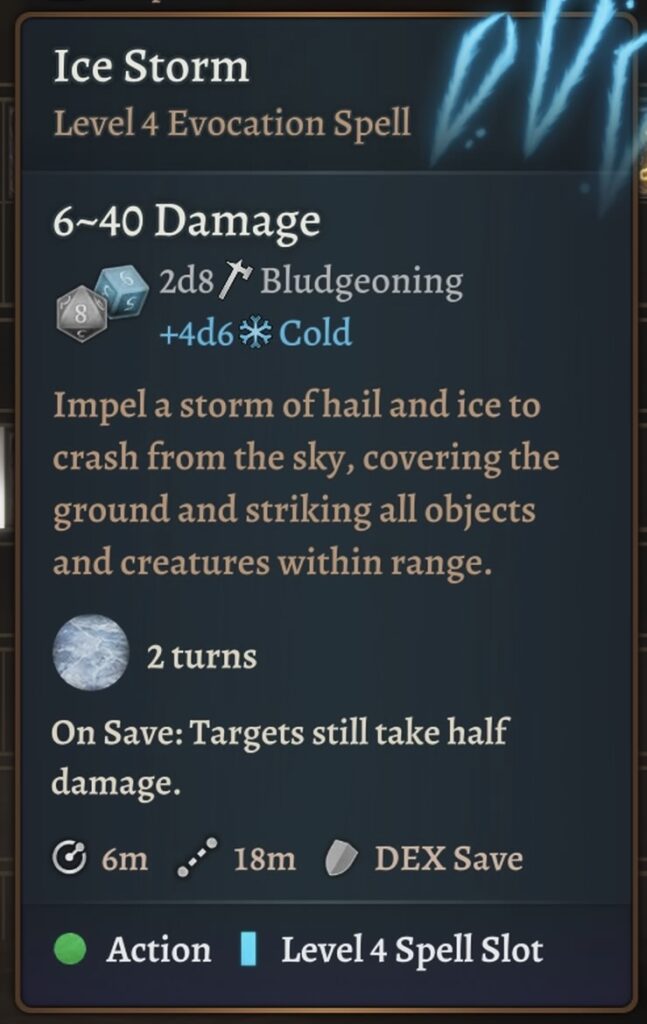
I’m taking the following numbers from the series of tests I made of the Arctic Druid Angela build.
For the Spell Save DC:
- She is a 12th-level character; one level in Barbarian and eleven levels in Land Druid (for reasons I explain in that essay). So her Proficiency bonus (scroll up; look at the table) is +4.
- As a Druid, her spellcasting ability is Wisdom. Her WIS was 18, which means (scroll up, look at the table) that her spellcasting ability modifier is +4.
-
She has several bonuses to her Spell Save DC from items and such. I did a detailed breakdown in the various test articles. I won’t repeat that here. Instead I’ll show you how to find out what this bonus is for your character, if you play the game using a controller as I do:
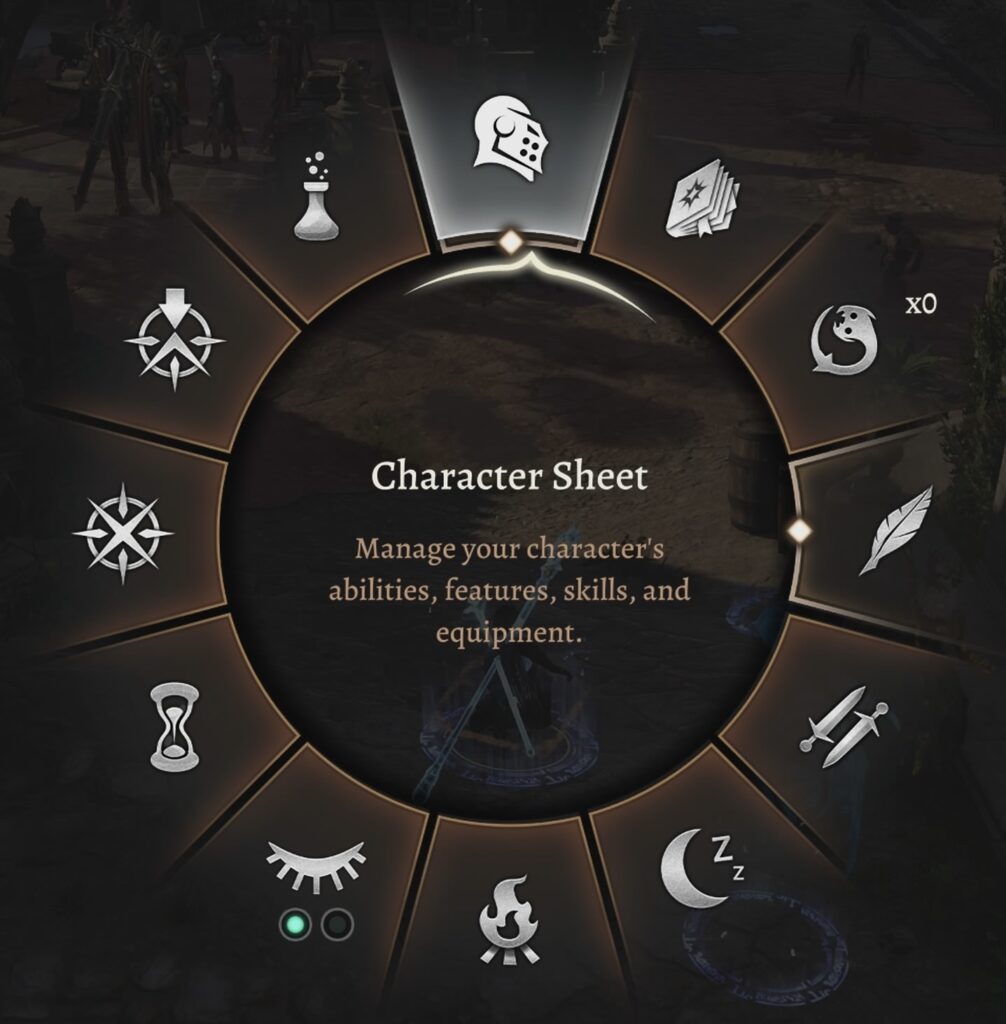
If you click on the controller’s R2, you see this wheel. Most of statistics and item examples I’ve shown so far in this article have come from the Character Sheet screens. 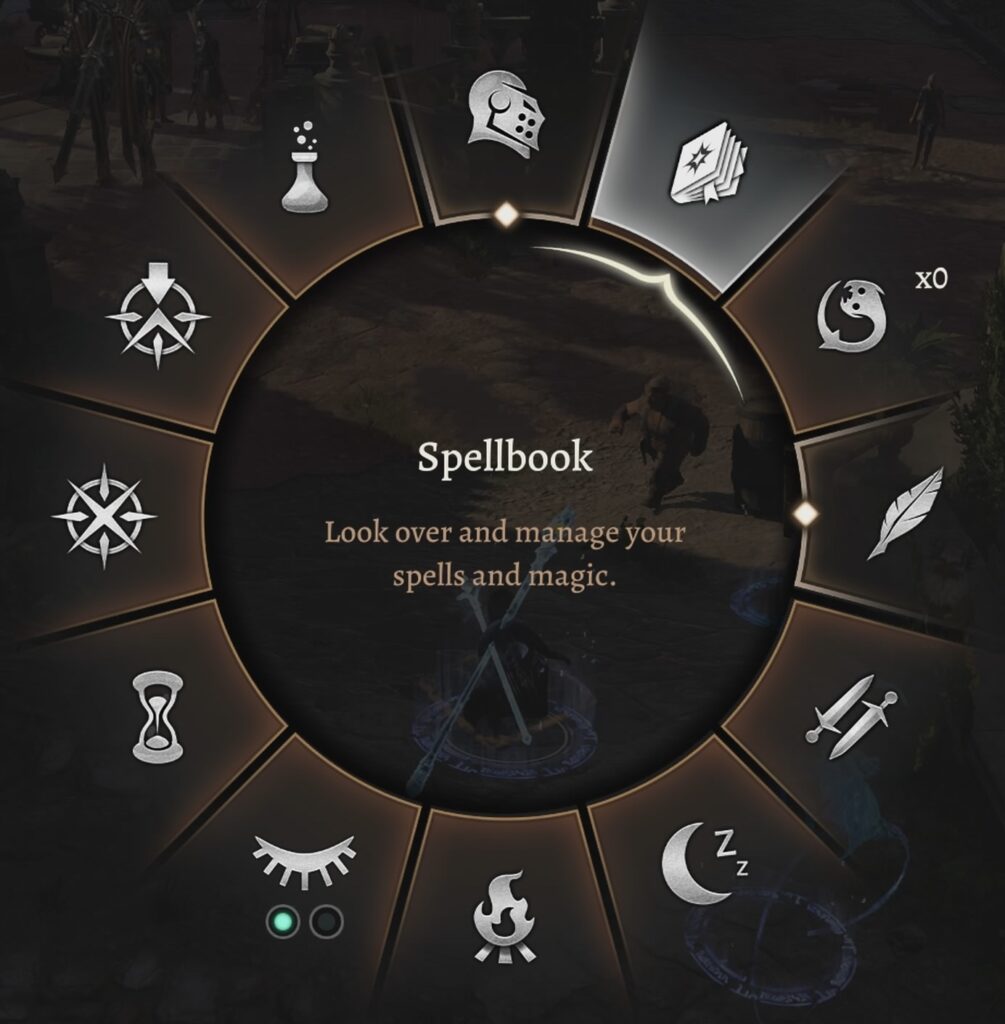
However, if you want to see your Spell Save DC, along with lists of the spells you know, you have to go to the Spellbook. 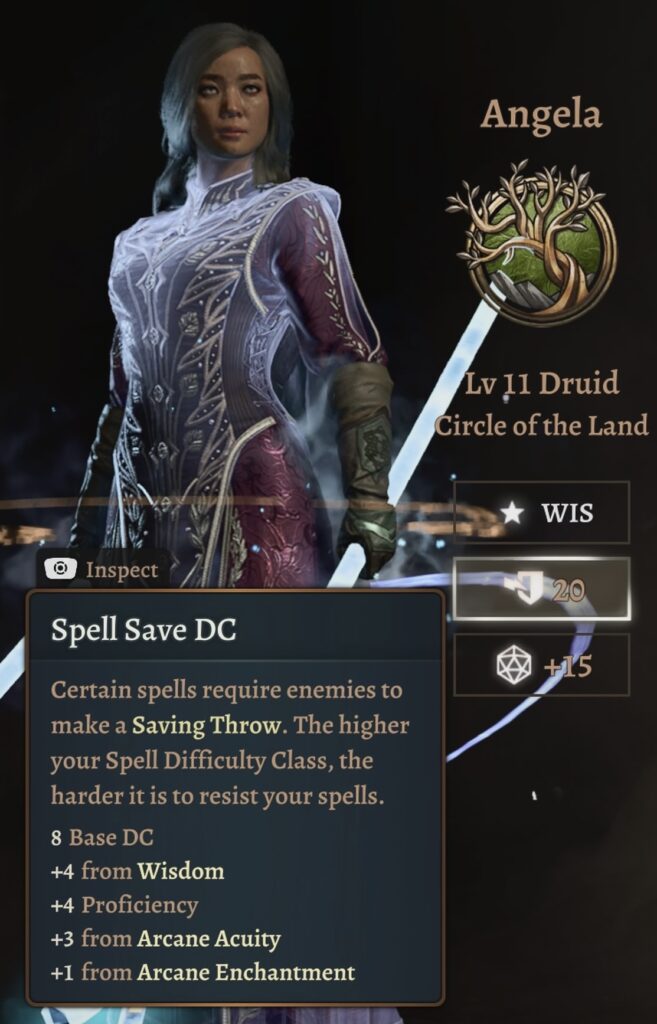
The Spell Save DC field isn’t labeled; you have to move the cursor to get this tooltip. Here we see that her total Spell Save DC is 20, with +4 coming from bonuses other than those from her Ability modifier and her Proficiency bonus. (The +15 is her bonus for Spell Attacks, like those made by Ray of Frost.)
For the Saving Throw, the description of Ice Storm says “DEX Save.” The enemies will take their Ability score modifier from their Dexterity, along with their Proficiency bonus if they have Saving Throw Proficiency in Dexterity.
Let’s consider one of the enemies Arctic Druid Angela faced in the test:
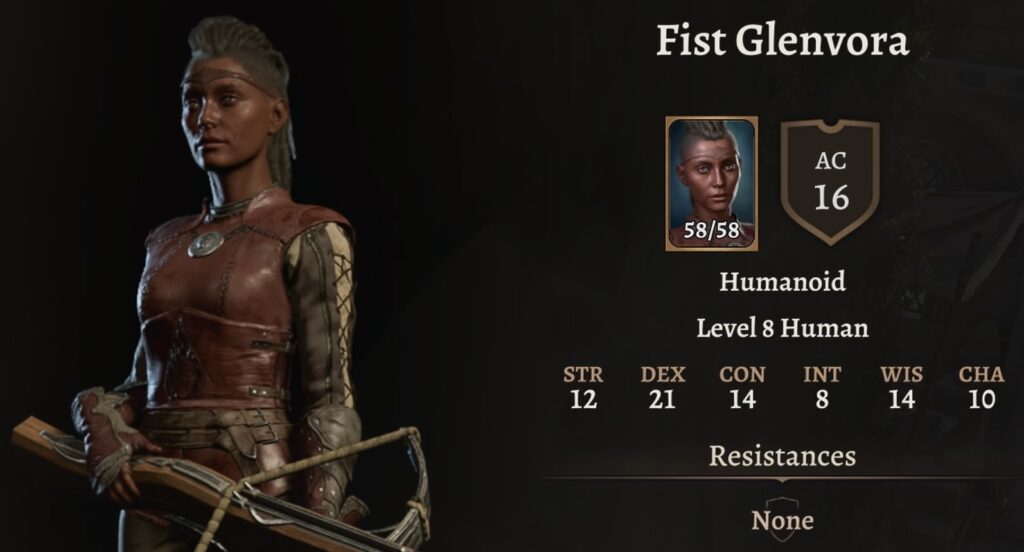
- Fist Glenvora’s DEX is 21. The Ability modifier is +5.
- Her information screen doesn’t say, but she’s holding a crossbow, so she’s probably a Ranger. She’d have Proficiency in Dexterity. She’s level 8, so her Proficiency Bonus would be +3.
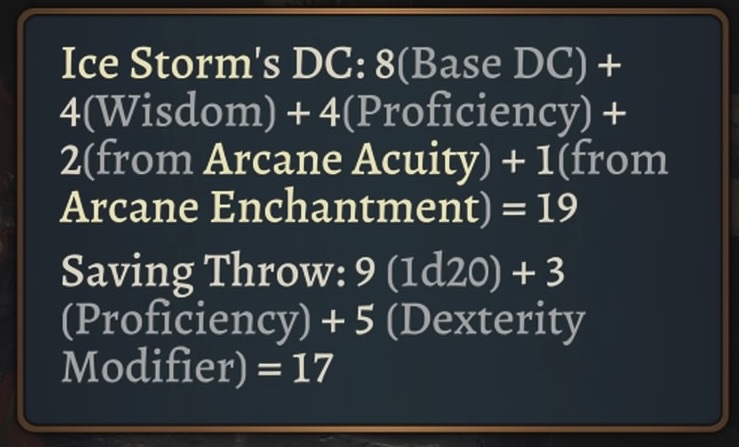
When Arctic Druid Angela casts Ice Storm, and Fist Glenvora is within range, it’s the Spell Save DC of 20 against Fist Glenvora’s Dexterity Saving Throw of 1D20 + 8. If we go to my spreadsheet and type 8 in the bonus field, on the DC 20 line it says that Fist Glenvora has a 45% chance to resist Druid Angela’s Ice Storm.
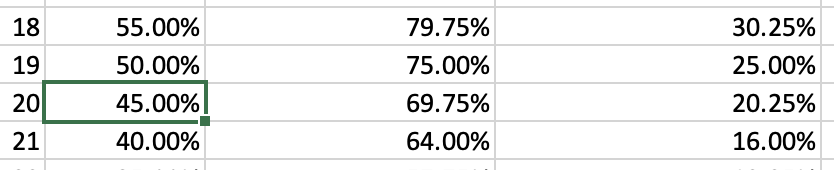
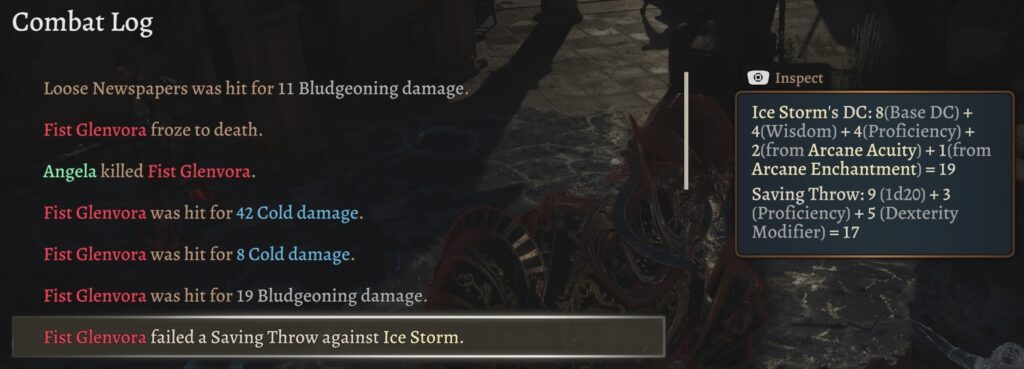
Here’s a fragment from the combat log of a slightly different test, in which Arctic Druid Angela’s Spell Save DC was 19 due to differences in gear. Fist Glenvora’s chance to resist the spell was therefore 50%.
Wrap-up
Are you confused by all of this? I don’t blame you.
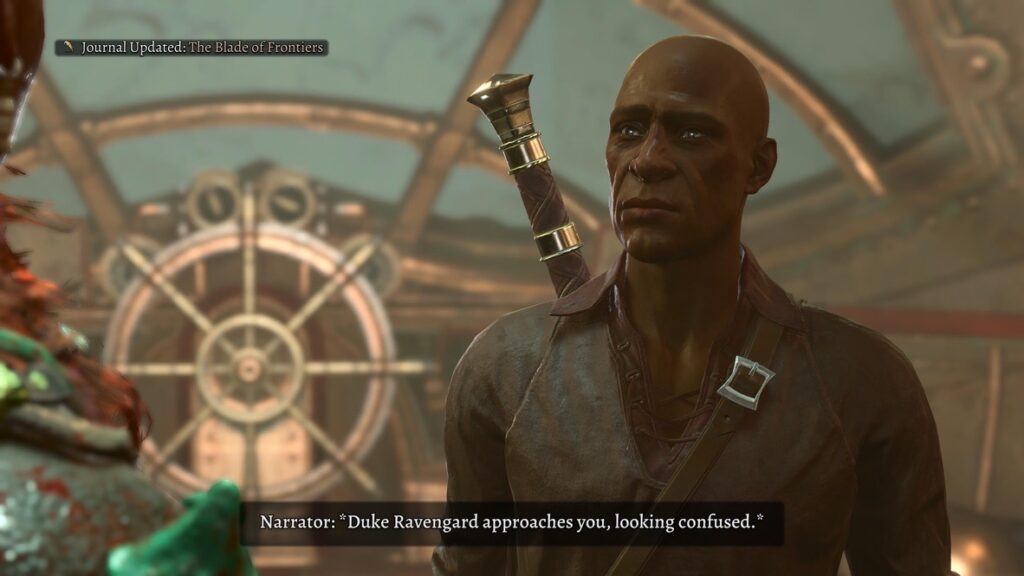
To inflict corporal punishment on a deceased equine, this is what it’s like to play D&D. I’m used to it, dead horse and all, but that doesn’t mean I’m comfortable with it.
Do I rush to my spreadsheet every time I have to make a die roll? Of course not! I just get the best gear I can and hope the dice roll in my favor.
During combat, BG3 will display the odds of success for an attack or a spell.
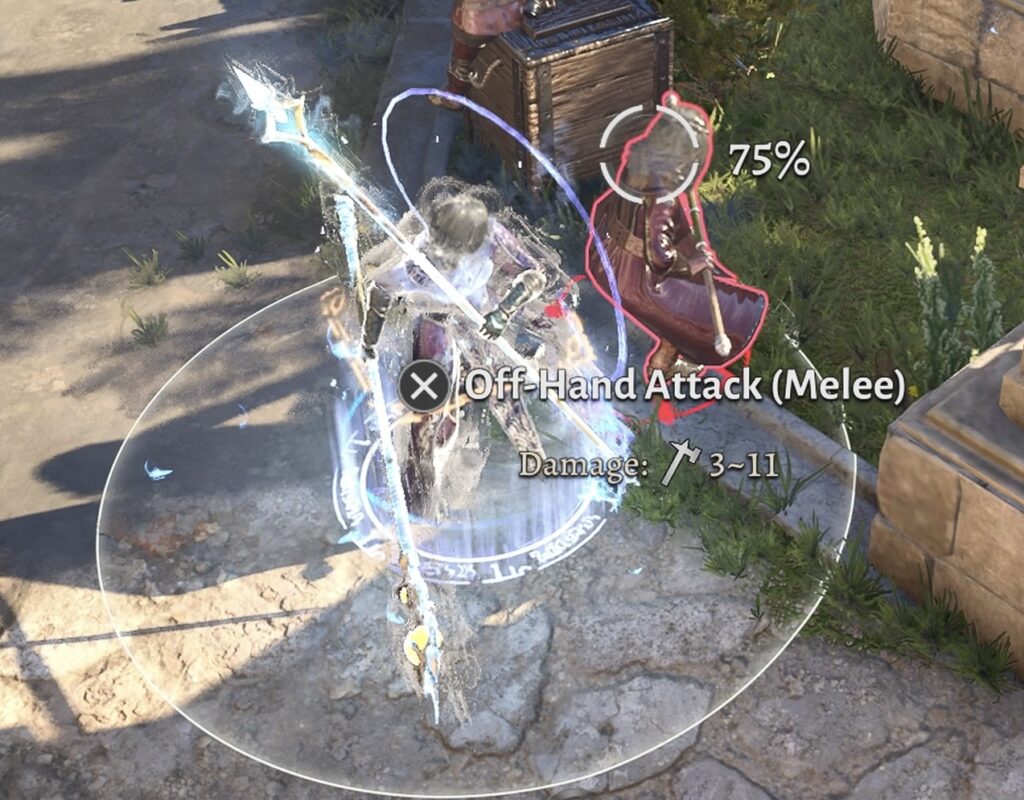
The main reason why I don’t use the spreadsheet is that it’s too much effort. Also, there’s a subtle flaw in my calculations. Did you spot it?
The flaw is that there are random bonuses. In the example I just showed, all the bonuses were fixed. Consider the Bless spell, which adds +1D4 to Attack rolls and Saving Throws. My spreadsheet can’t handle a random element on top of the dice check.
The spreadsheet, and then this essay, was inspired by a question that Real Angela asked me: Which is better, to make a dice check with Advantage or to get a +4 Bonus?
The answer turns out to be complicated. It depends on the dice check.
For a dice check of 15, the chance to succeed on a roll with Advantage is 51% without any bonuses.

You need a bonus of +4 to have roughly the same chance of success just rolling a D20.

Of course, in the actual game you try to make dice checks with both a bonus and with Advantage.

We’ve reached the end of the essay. It’s my second-longest; the longest being my multi-part playthrough 12 write-up.
We’ve also reached my main gripe for all of this: With this level of complexity (and believe me, there’s much I didn’t discuss, like the spellcasting modifier for characters who multi-class), the game can switch from the character vs. the Evil Enemy into the player vs. the system.
Should one be forced to understand these details in order to enjoy a story?
Some folks play for the story. Some play because they enjoy the system challenge. One of the benefits of Baldur’s Gate 3 is that you can choose which path you prefer.
What matters is that you play the game that you…
Pingback: BG3 – Alchemy and Transmutation Wizardry – The Argothald Journal
Pingback: Real Angela’s playthrough 7 – Druid Honeylocust – The Argothald Journal
Pingback: Real Angela’s playthrough 8 – Nightshade – The Argothald Journal