Perhaps it’s silly to wax lyrical over a room in a physics lab. This particular room is one that was a central part of my life for four decades. So I’m indulging in a bit of nostalgia.
Room 116 is an office in the research building of Columbia University’s Nevis Laboratories. An interesting side note: Most of the folks sitting the offices at Nevis have no idea what their room number is, even though that number is on the room’s door. If I say “I put it in room 117” they have no idea what I’m talking about; I have to say “I put it in the ATLAS student office.”
When I was doing my Ph.D. work for Columbia University’s physics department, I took data for my thesis while at Fermilab from 1987-1988. Fermilab is in Chicago. When I returned to Nevis, in Irvington NY, I was assigned a desk in room 116.
I didn’t know it then, but that space would be (more-or-less; I was moved to a different office for a couple of years) my Nevis working environment until yesterday as I type this.
Back then, the office was shared by four people (including me) working on the CCFR experiment. It was not only a productive working environment; we bounced ideas off of one another all the time. It was a social environment as well.
Room 116 became informally known as “the social center of Nevis Labs.” (I was the source of most of that informality.) Folks would stop by to discuss physics, of course, but would also engage in banter with all of us.
In the late 80s and early 90s, the Internet was still in its infancy. Folks had to physically come to Nevis to do their work. Nevis Labs was generally a crowded place, with researchers at their desks using terminals that connected to a single central computer system shared by all the physics research groups.
That changed. Partly that had to do with the nature of the physics experiments in which Nevis research participated. It increasingly more practical for folks doing research at Fermilab, CERN, Brookhaven, and other labs to stay on those sites.
The other part was, of course, the Internet and the rise of laptop technology. The central computer systems for your research might be at Nevis, but there was no reason to physically come to Nevis; one could spend most of one’s time on Columbia’s campus and not make the 40-minute commute to the lab solely to sit at a desk to do the same thing.
Gradually the number of room 116’s occupants went down to two, then three for a couple of years, then one: me. The number of researchers associated with Nevis remained the same, but the number of researchers at Nevis declined.
I could joke all I wanted, but room 116 was no longer the social center of Nevis Labs.
The room became known as “Bill’s office.” This wasn’t really fair to other people, but there wasn’t much other use for the space. The room had originally been meant for four grad students. As the sole occupant of the office, I was using a room that was larger than that of the tenured Nevis faculty.
To be sure, I was making use of that space. By 2005 I was the sole computer administrator for the Nevis particle-physics groups, all using me as a common resource. (In other places, typically each group appoints one of their researchers as the “computer guru”; that’s how I got started.) Room 116’s desks became filled with different pieces of computer equipment. It was more of a “lab” space than an “office” space.
In 2012, I had a medical crisis that kept me home-bound for several months. I began to work on tools that would enable my remote maintenance of the Nevis systems. In 2019, I had another crisis that kept me at home for months, which pushed me to further develop and refine those tools.
Of course, in 2020 we had the pandemic. The tools I’d spent the past several years developing proved crucial to me.
Since then, I’ve continued to isolate. I still go to Nevis occasionally, but mostly on evenings or weekends when I’m not likely to meet other people.
Those few times I’ve had to go to Nevis mid-day, everyone else in the room has taken care to wear masks, to respect my health issues. From this, you may have some insight as to why Nevis is such a great place to work.
The world continues to evolve. I’m not sure about how the arrangement was made (the whole process is far above my pay grade), but the result: Columbia’s School of Engineering and Applied Sciences (SEAS) is moving their robotics department to Nevis Labs.
Broadly speaking, this is good for Nevis as a site. It gets people in the space again.
However, some serious accommodations have to be made for the SEAS group. They are substantially renovating large portions of the research building. Among those changes: Room 116 is going away. It will be demolished. The wall between that room and the adjacent Nevis lunchroom will be torn down, to create a larger space for meetings. (The room presently used as a library, lined with wooden shelves and filled with old books that no one reads, will be demolished as well and refitted as the new lunchroom/pantry.)
I’m to be relocated to a new, smaller room that has not yet been built. Another room is being split in two; one part will be an “IT manager’s room” (for me) and the other a “public safety room” (for a security guard). It will be a much smaller space but, to be fair, I’m not at Nevis often enough these days to justify a larger one.
I’ve known this was coming for over a year. Some months ago the head administrator at Nevis asked me to start cleaning out the room’s shelves of old books and experiment documentation. I started reducing my pile of reference books, both scientific and computing, setting them aside to be donated to the Give My Books Network.
Finally, the Nevis administration told me that the construction for SEAS Robotics was going to happen… but they didn’t know when. It might be next week, it might be months from now. However, if this project is similar to other smaller construction projects that have happened at Nevis, there’d be almost no warning. They’d be told “It starts tomorrow” and that’s about it.
So yesterday (Saturday) I went to Nevis to evacuate room 116.
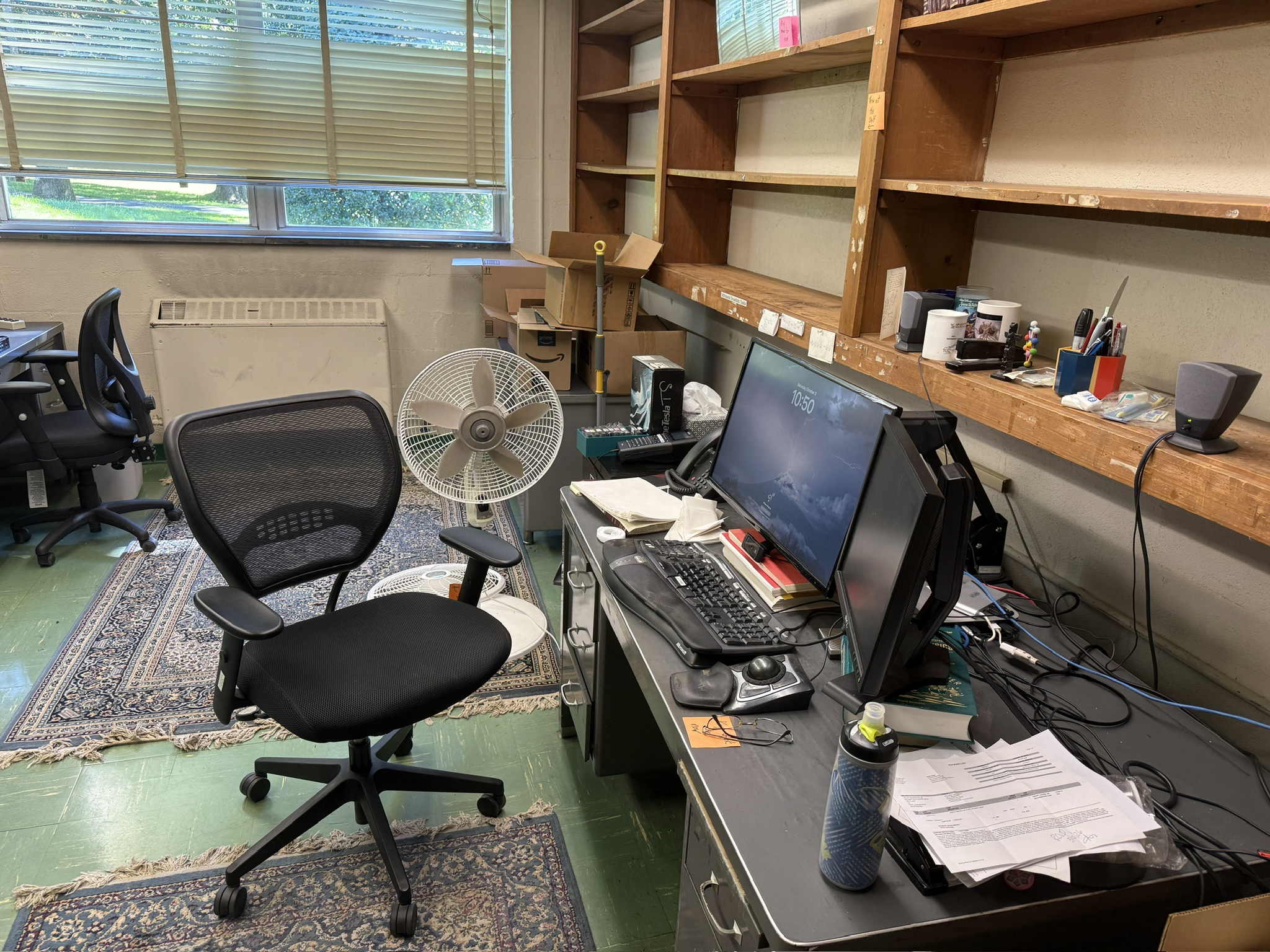
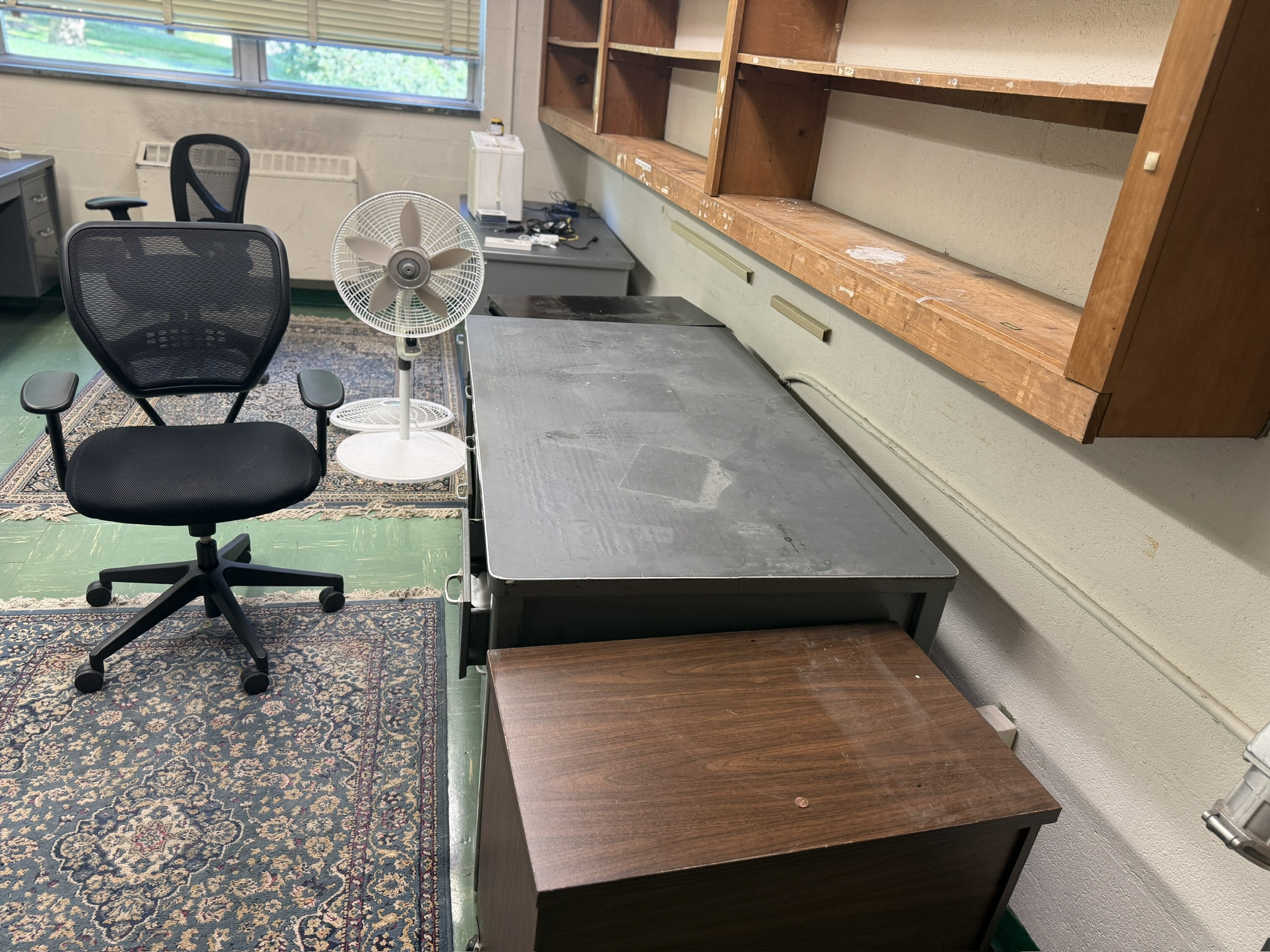
I relocated to the office of one of the Nevis faculty members who’s rarely there; years go by without him visiting his office. Months from now, when it’s ready, I’ll relocate again to room 111B, an office that does not presently exist.
What can I say? It was nice while it lasted.
A lot of people passed through that office during the time I was there. I’ll mention a few remarkable individuals:
-
Janet Conrad is a Professor of Physics at MIT. For a while, she was part of the Nevis faculty (and a key person in getting me through the final phases of my Ph.D. research).
In the early 2000s, there was a rash of thefts at Nevis. Both Janet and I had the habit of working late in the building. With the thefts going on, she felt more comfortable sharing the space with a 6’4″ 300-lb man (both of those figures have reduced since then) than sitting alone in her office late at night. So she’d move from her office into room 116 during those late hours.
I was able to provide some minor assistance to her (I emphasize the word because Janet’s achievements are her own) in doing research on the role of women in physics education. However, the fact that she felt she needed a male presence to protect her at night speaks volumes unto itself.
-
I spent a total of 12 years working on my physics Ph.D. This is an unusually long time to spend on physics Ph.D. research, and is a story of its own. Once my thesis was published, Bonnie Fleming, then a grad student at Nevis, picked up my work.
She spent only three years working on the same data and produced better results than I ever could.
Bonnie went on to become a tenured professor at Yale, a spokesperson for some high-profile physics experiments, a research director at Fermilab, and is now a member of the faculty at the University of Chicago.
Again, I had nothing to do with any of that, other than playing La Bohéme daily on my CD player (at her request). According to quantum mechanics, there was a small-but-finite possibility that Mimi would survive at the end. Alas, she never did.
-
Cynthia McNulty had the toughest job of anyone passing through room 116: She was both a physics graduate student and a single mother.
Cynthia was an exemplar of why a physics Ph.D. doesn’t go to waste even if it’s not your career. She went from room 116 to a job in the financial world, leveraging her analytic skills to the mathematics of investment. Lately, after retiring from a successful career, she’s returned to physics, working on the DUNE experiment.
Cynthia’s daily musical preference was West Side Story. Again, there was always the slight quantum-tunneling chance that Tony would survive.
-
Steve Rabinowitz worked on the same physics experiment that I did. He went on to work at a defense think-tank that provided advice to the Pentagon.
A political discussion with him could be infuriating, but never dull. He would listen daily to Rush Limbaugh on the radio, then at noon switch to WBAI, an ultra-liberal radio station. Then we’d spin around in our chairs due to the angular momentum provided by the political shift.
-
Matt Toups was one of the “last three” I mentioned above. While he was in room 116, he worked on the Double Chooz experiment. You saw a piece of his work if you regularly watched The Big Bang Theory.
Matt moved on to become a spokesperson on MicroBooNE and is presently working on DUNE.
Matt’s distinguishing feature on this list is that he put up with my snoring. A consequence of some of my health issues is that I often found myself taking involuntary midday naps. Given the volume of my audio output, this would have been impossible for him to ignore, yet he was polite enough not to mention it.
-
Actually, that distinguishing feature doesn’t belong to Matt alone. Arthur Franke was the third of the “three.” He’s gone on to work in the world of finance.
Arthur introduced me to Dropbox, a tool I use to this day. It’s part of the suite of tools I use for working on the Nevis systems remotely.
There were others. Most of them don’t have convenient web links. Even if I don’t mention your name, I haven’t forgotten you.
To all those who passed through room 116, my gratitude and thanks. The space in which we met will be gone. I hope the memories remain.
I should add that, for all that the folks above have accomplished, I had little or nothing to do with it. Apart from their own talents and skills, the person who deserves the real credit for giving them training and inspiration would be Professor Michael Shaevitz, their thesis advisor at Columbia University. (Janet Conrad wasn’t a student at Columbia, but Mike was the one who hired her.) If it were solely up to him, I probably would still be allowed to stay in room 116.
A postscript
One of the features of room 116 was a wall clock that ran backwards. I wasn’t the one who originally came up with the idea, but I maintained it over time. It took only a minor change to the clock’s mechanism, and made practical use of knowledge gained from my Electricity and Magnetism courses.
That clock was notorious. Even though there was a sign under the clock that said
and there was a clearly visible mirror (you can see it in one of the above photos), folks ignored that. They’d glance at the backward clock… and be late for their meeting.
Yesterday I took that clock from room 116 to temporarily install it in my new working space. The clock slipped off the wall and shattered.
Maybe it’s a sign that I was in room 116 for took long. Or that time has to move forward again.
Or that it’s just an old broken clock.