Last night, I played Gnome Hollow with A, J, and M.
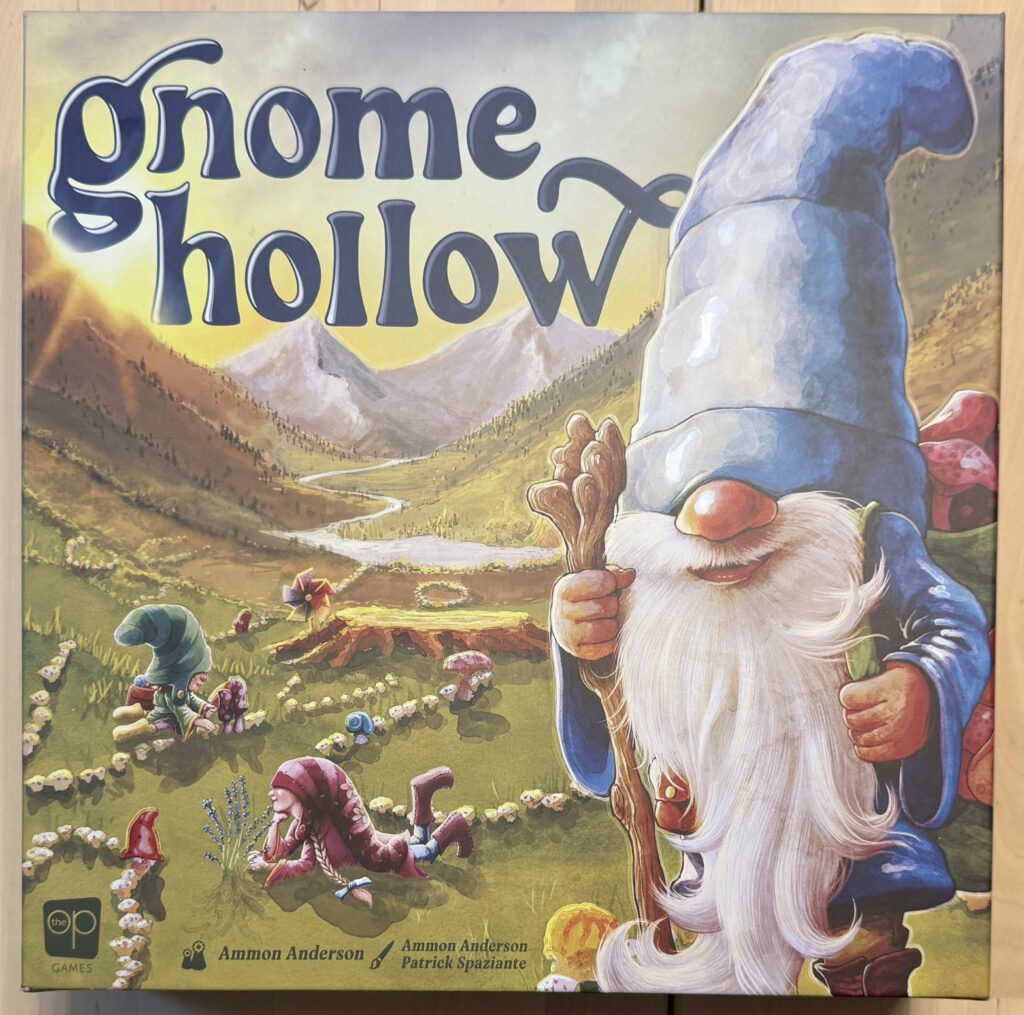
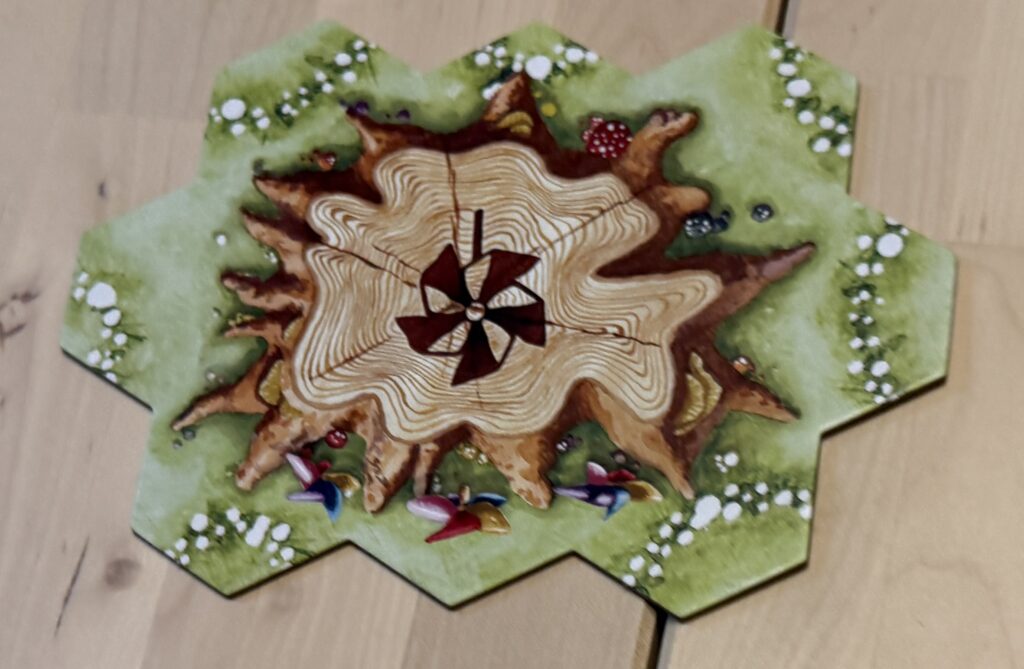
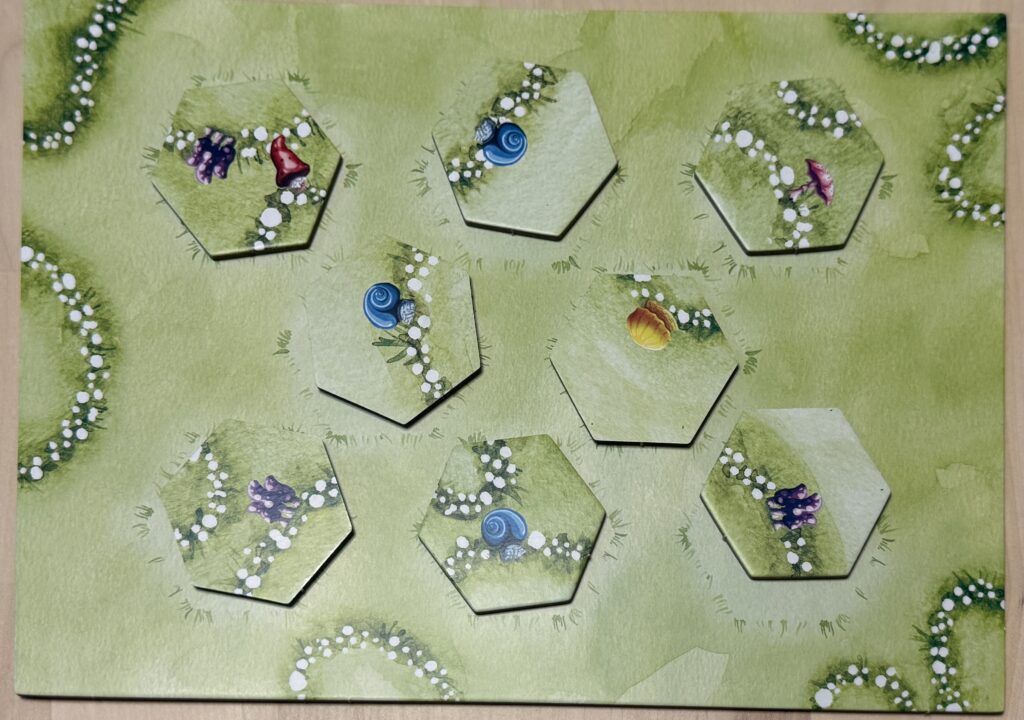
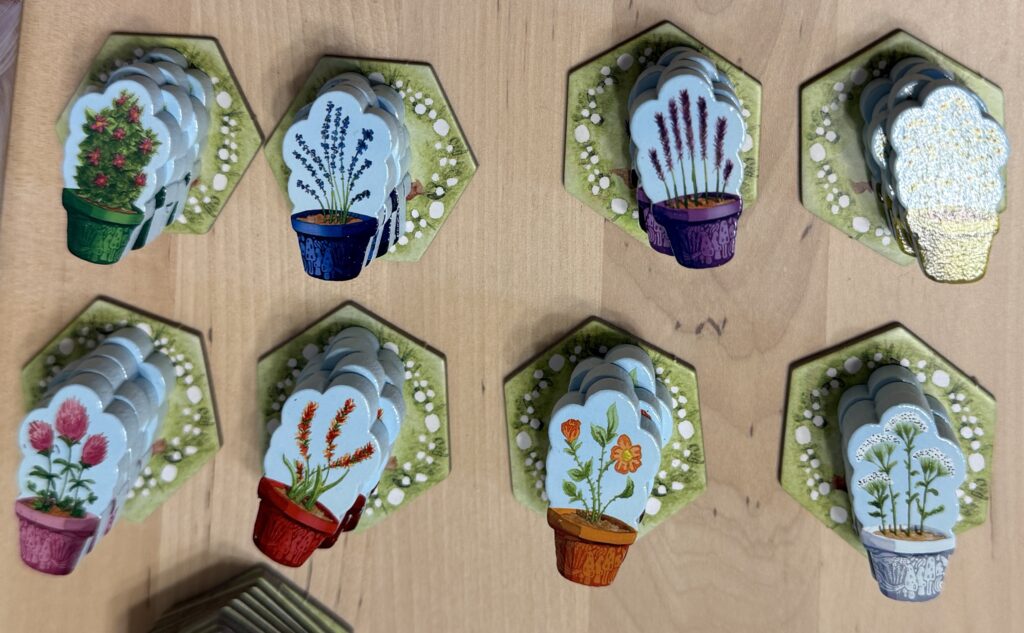
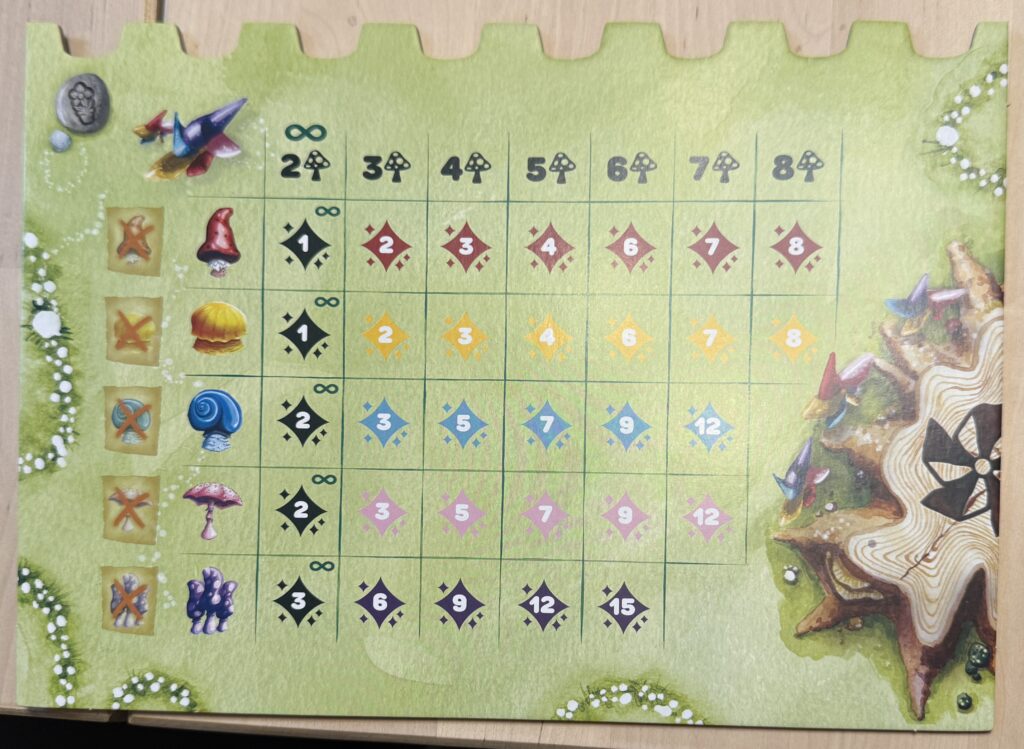
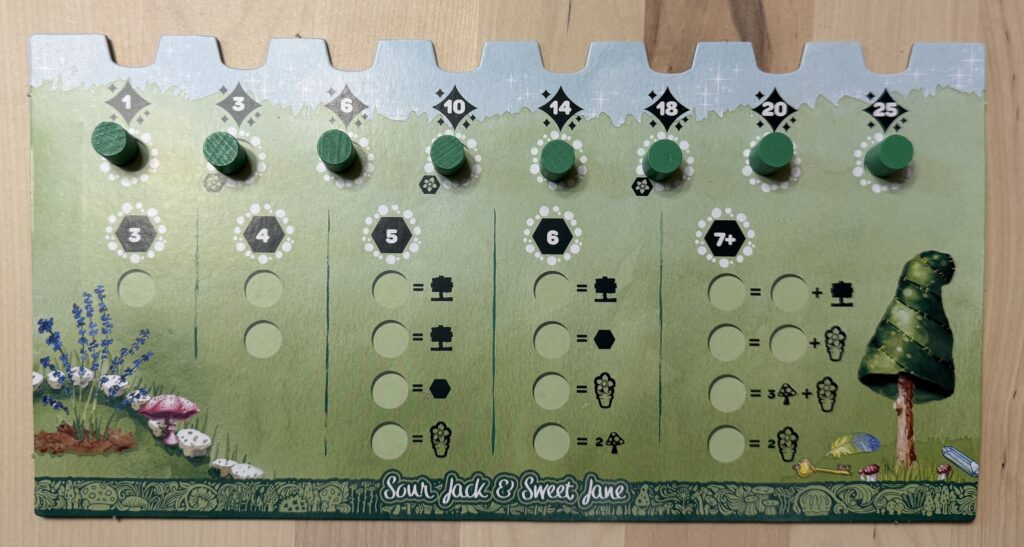
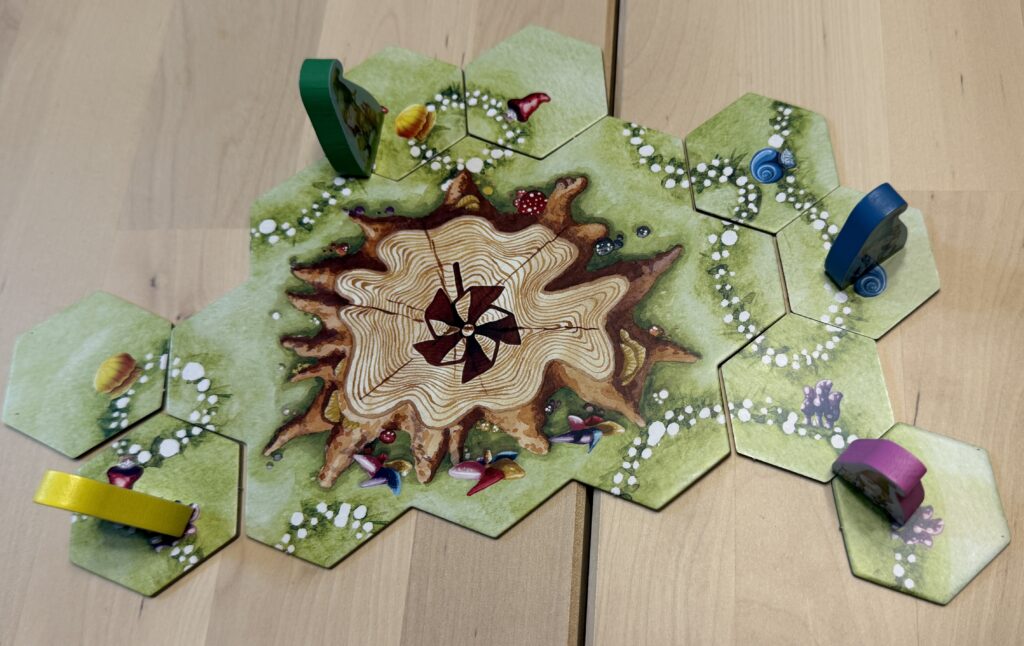
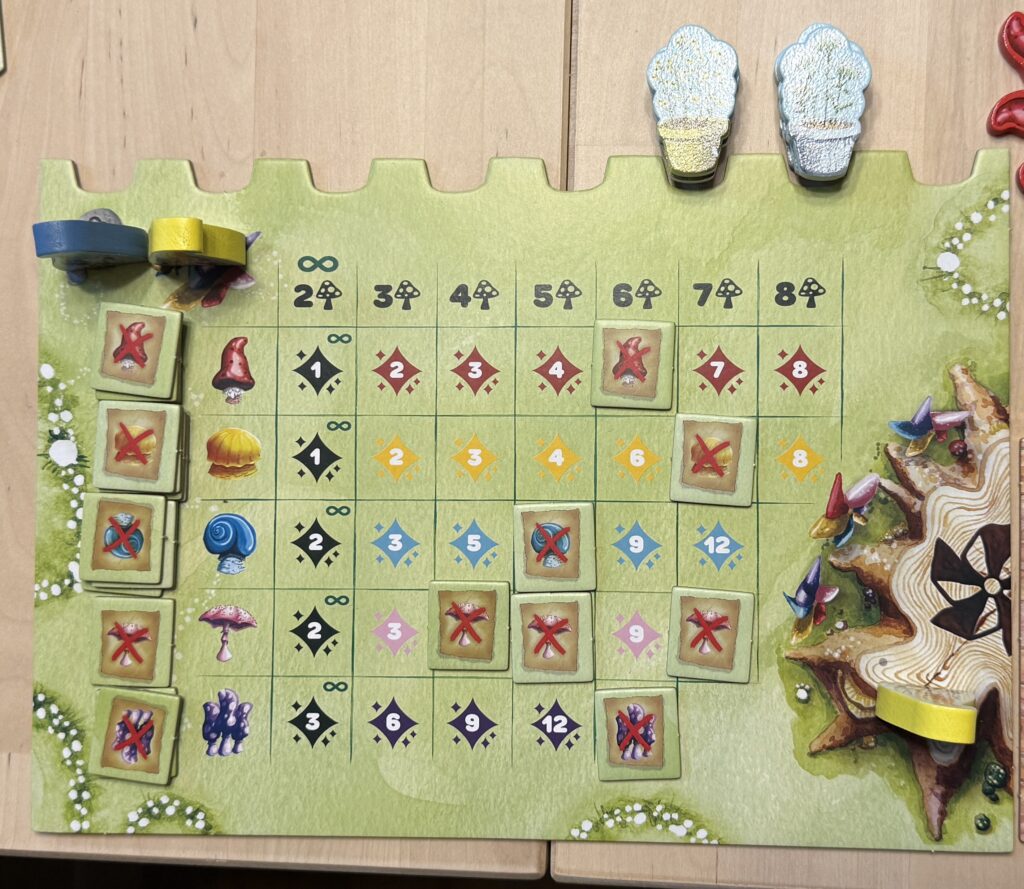
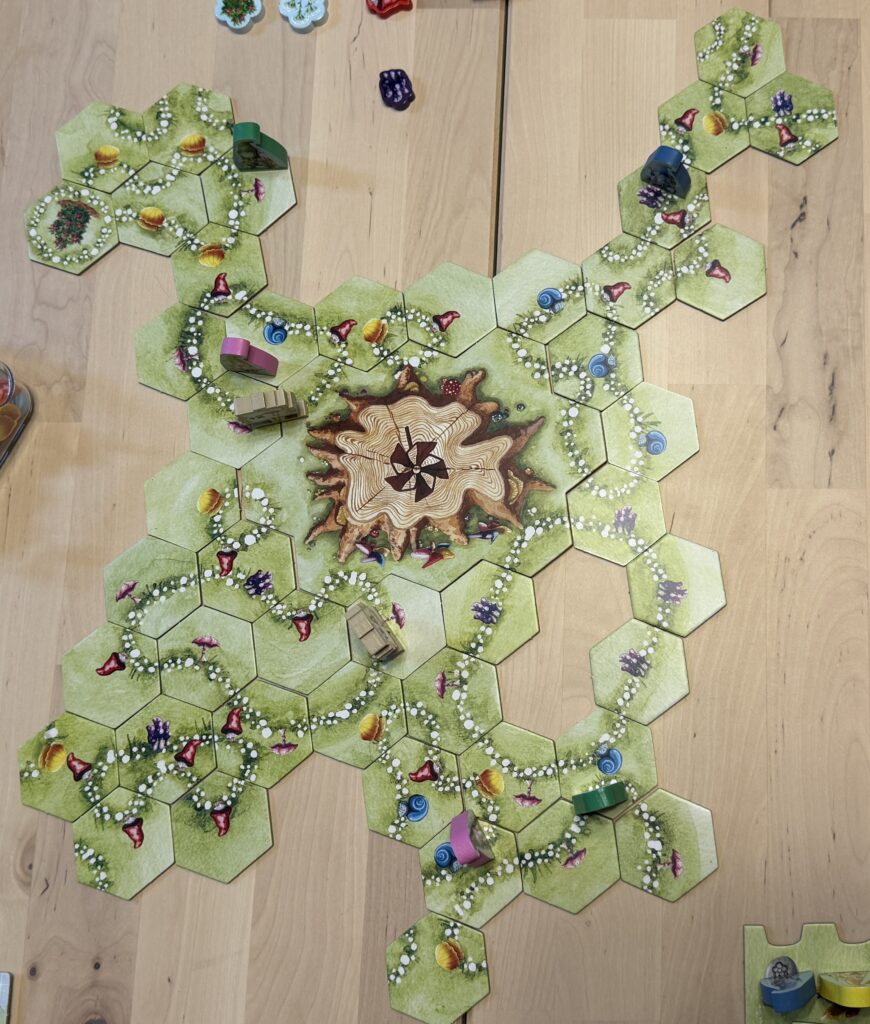
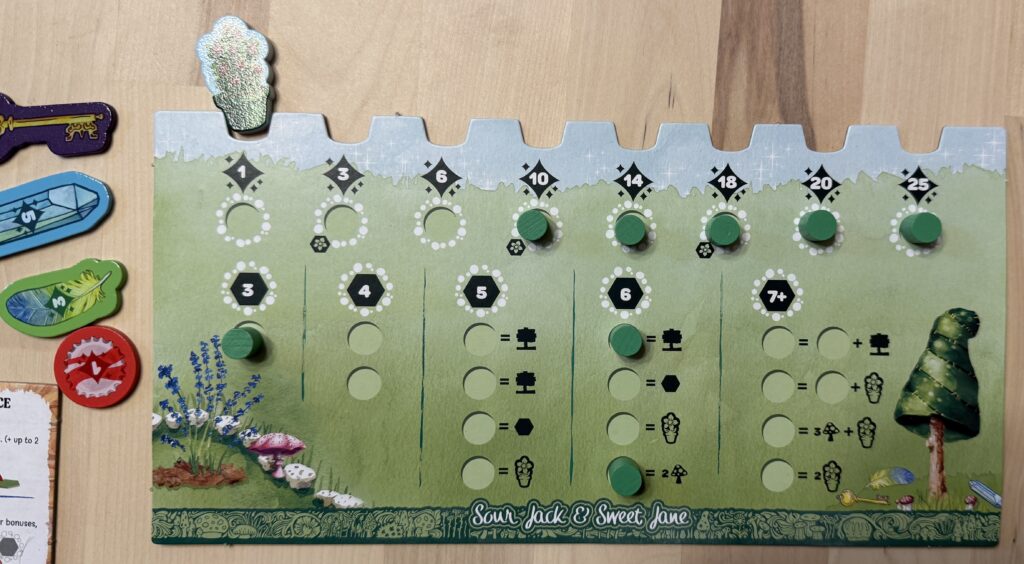
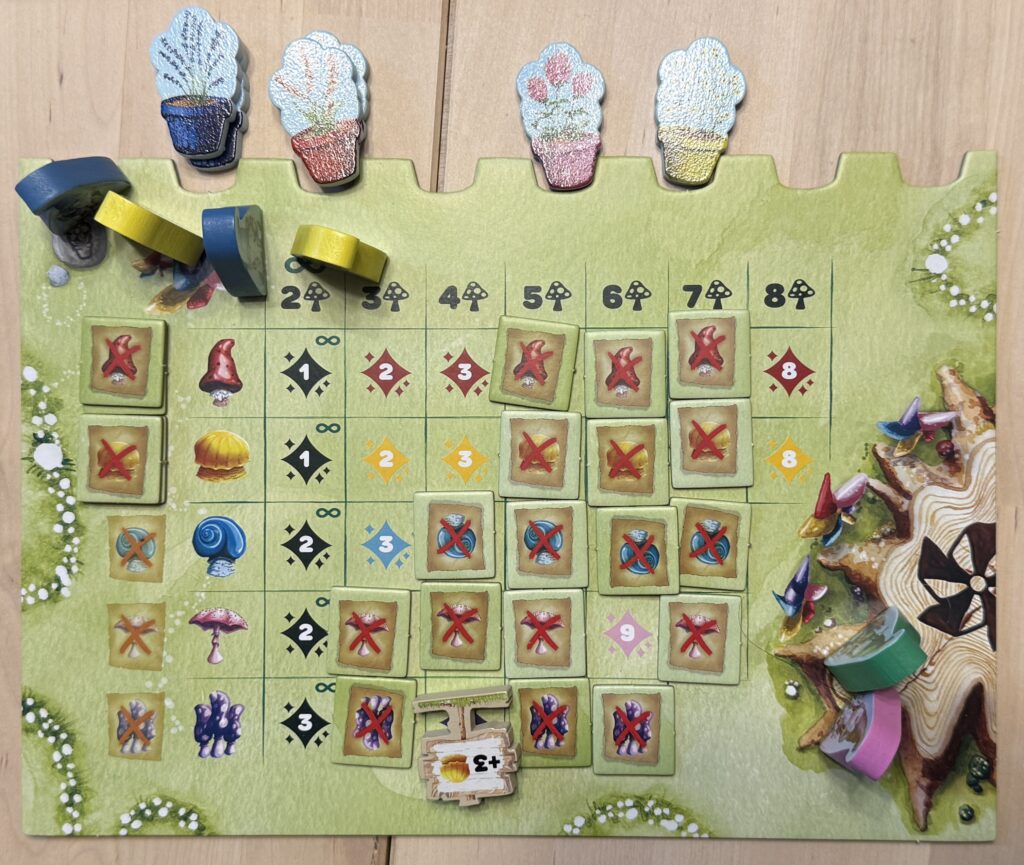
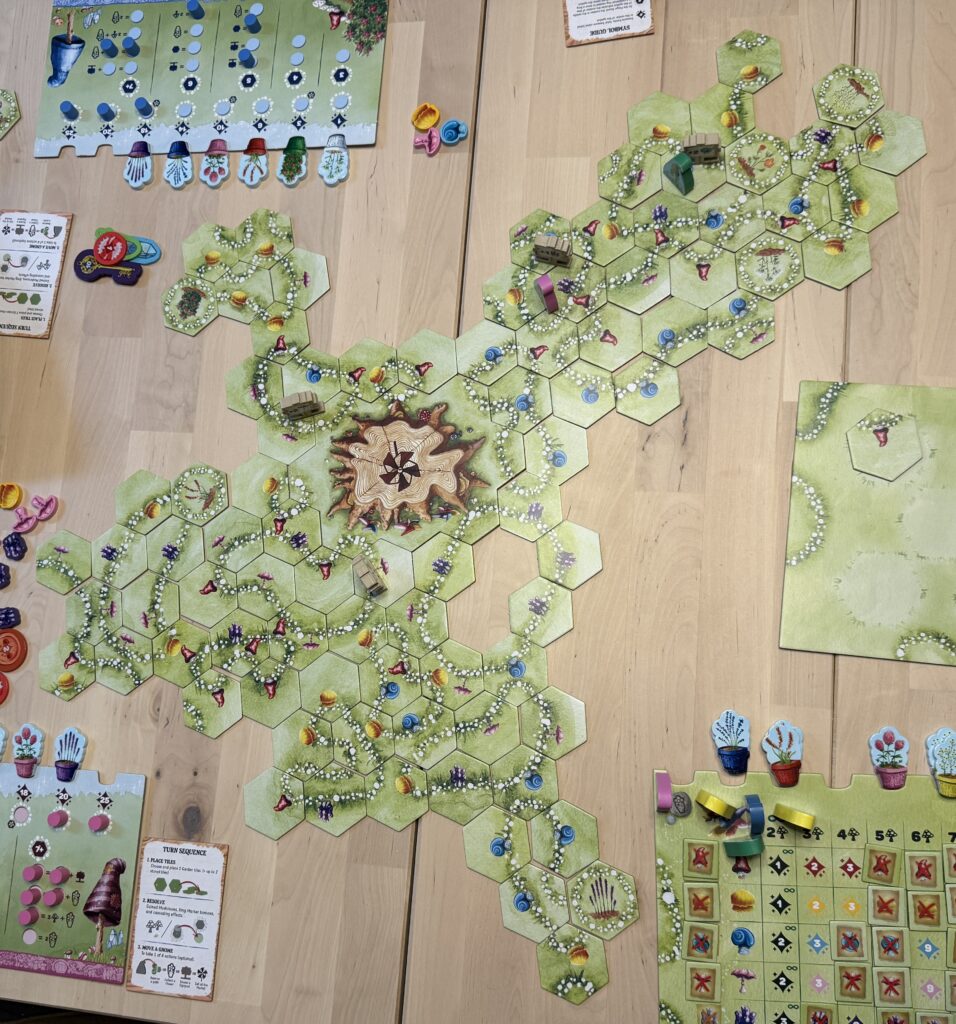
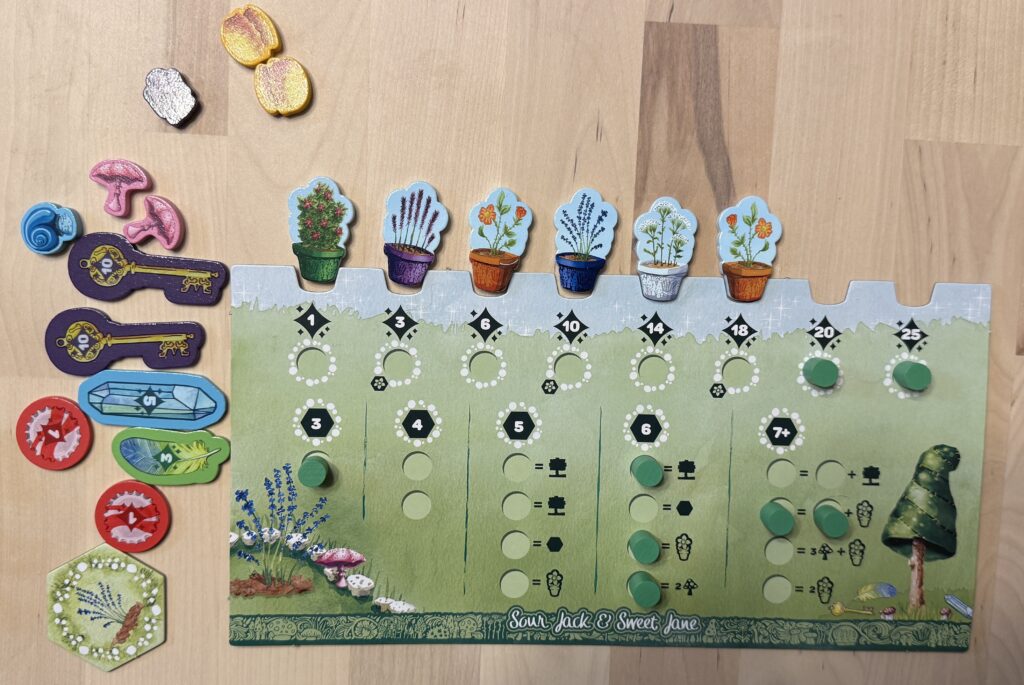
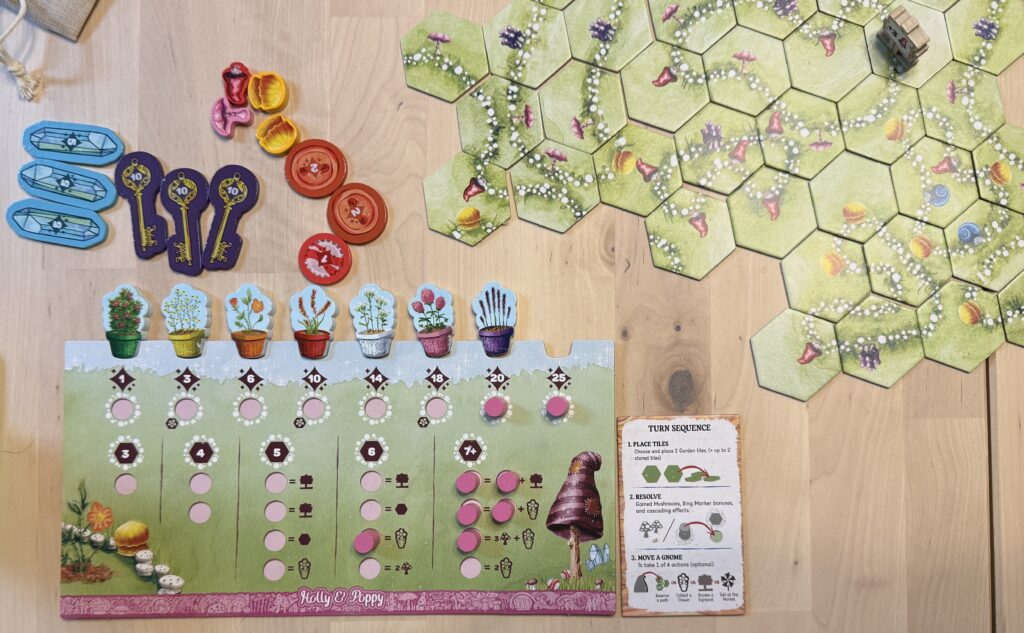
As the box cover suggests, you play as a couple of gnomes building mushroom circles.This stump is the core of the hollow. We’ll be adding tiles to it during the course of the game.The available tiles come from this board. You’re trying to position the mushroom paths to complete connected curves and gain points. Among other benefits, when you do this you get the mushrooms shown on the paths.Another way to gain points is to collect flower pots. There are four pots of each type, and each player can only have one pot of a given type, so we’re not in competition for them. What we do complete for is to be the first to gain a particular type; then you get the “wild card” tile underneath the stack of pots.I mentioned that when you complete a path, you get mushrooms. To get points from those mushrooms, you sell them at the market.My player board at the start of the game. Those cylinder pieces are magnetic; we speculated how the boards were manufactured so that the pieces stuck. When you complete a mushroom circle, you move a piece into the lower part of your board corresponding the number of tiles used to complete the circle. The stars near the top of the board are the end-game points you get for completing circles.Here’s how our hollow looked after only a couple of rounds in the game. Yellow (M) completed a three-tile circle, gaining a yellow and a red mushroom from that particular circle. She then moved her gnome onto a different incomplete circle to “claim” it, so that only she could benefit from the completion of that circle. Green (me) did the same thing. You can see that Blue (A) and Pink (J) chose to start with building larger circles for increased rewards. If you look at the player board above, you’ll see that there’s only one space available for completing a three-tile circle; neither M nor I will bother with such small circles for the rest of the game, since they won’t give us anything.The mushroom market as we continued to play. Once you’ve sold a given number of mushrooms of a given color, that space on the market is locked out; no one can make that particular sale for the rest of the game. There’s also a limit to the number of sales of a particular color of mushroom; note that there can be only one more sale of pink mushrooms for the rest of the game. (That’s not quite true; the black diamonds for sales of two mushrooms can be used repeatedly. But they yield so few points it’s not worth it.)Our hollow grows larger. Once a circle is completed, there’s little reason for anyone to return to it. Those beige pieces (you can see one in the 10 o’clock position next to the stump) are signposts. A player can choose, as part of their circle-completion reward for the larger circles, to place a signpost on a circle; anyone returning to that circle gets the benefit of that signpost. This is not entirely altruistic; the player placing the sign gets the sign’s benefits immediately. Subsequent players have to spend a turn to move a gnome onto that circle.My player board mid-game. So far I’ve built three mushroom circles, one with three tiles and two with six tiles. I’ve also gained a flower pot. As with the circle-completion cylinders, the number of flower pots you gain adds to your end-game score.The mushroom market at the end of our game. We made a mistake (one of many) in the rules: we assumed that there were no limits to the number of times a given color of mushroom could be sold, as long as it was a different number each time. As I said above, in fact that was supposed to be limited by the number of “blocking” tiles in the game. We only discovered our mistake at the end of the game. Since J had planned his end-game strategy on making a sale of four purple mushrooms, we decided it was only fair to let him make that sale; I marked it by placing a left-over signpost on that space. (This would not have affected the overall outcome of the game anyway.)Our hollow at the end of the game. Gnome Hollow requires a lot of table space; I would not recommend it if all you have is a bridge table. If you scan the tiles, you’ll see several instances where the “wild” tiles players receive from gaining flower pots have been used to complete mushroom circles.My player board at the end of the game. If you look at the top of the board, you’ll see that I gained six flower pots, which gave me 18 points, and completed six mushroom circles, which also gave me 18 points. When that’s added to sales from the mushroom market (look at those nice victory-point tokens on the left), my total end-game score was 66 points.Behold the player board of the winner, J, with 88 points. I tried to come up with a reason for the win, explaining to J that I usually did this for my blog post. I suggested that he understood the geometries of the game and how they related to victory-point opportunities. He shrugged and said, “Yeah, sure.” He explained that he just played the best game he could; there was no special analysis or insight.
I enjoyed Gnome Hollow. However, it’s not without its issues. I already mentioned the need for table space, not unlike Leaf. The game is subject to quite a bit of “analysis paralysis”; the box cover says “45 minutes” and we took three hours. That’s an expansion scale of only a factor of four, which is pretty good for us.