Last night was the first time we were all able to get together in about three weeks… and it’s the last time all four of us can meet until late in October. We took advantage by playing a couple of more unusual games from John’s collection.
Both these games incorporated a mechanic called a “cycle draft.” You’ve seen it if you played Settlers of Catan: First player 1 picks something from a pool (a card, a token, etc.), then players 2, 3, 4; then player 4 picks again, followed by players 3, 2, 1.
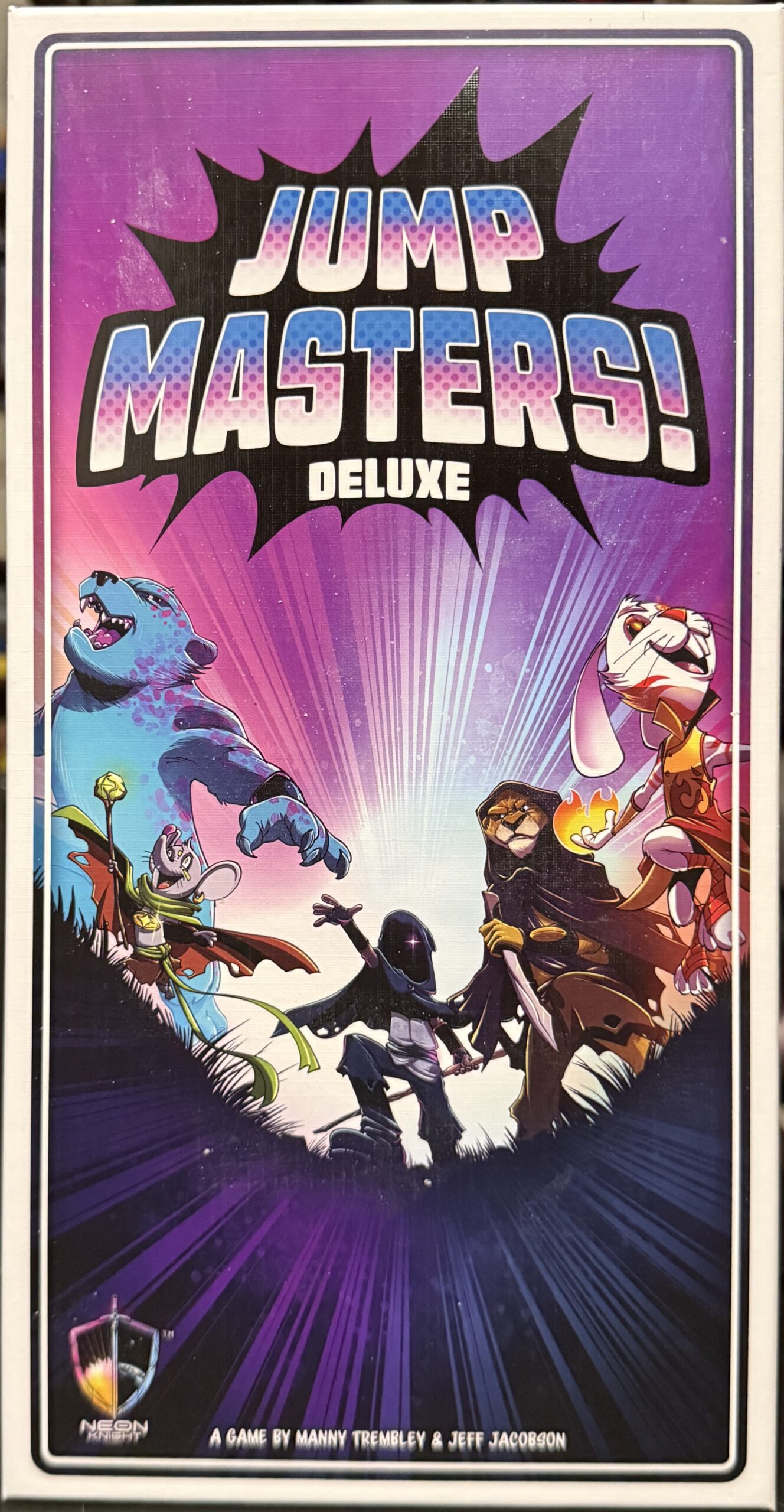
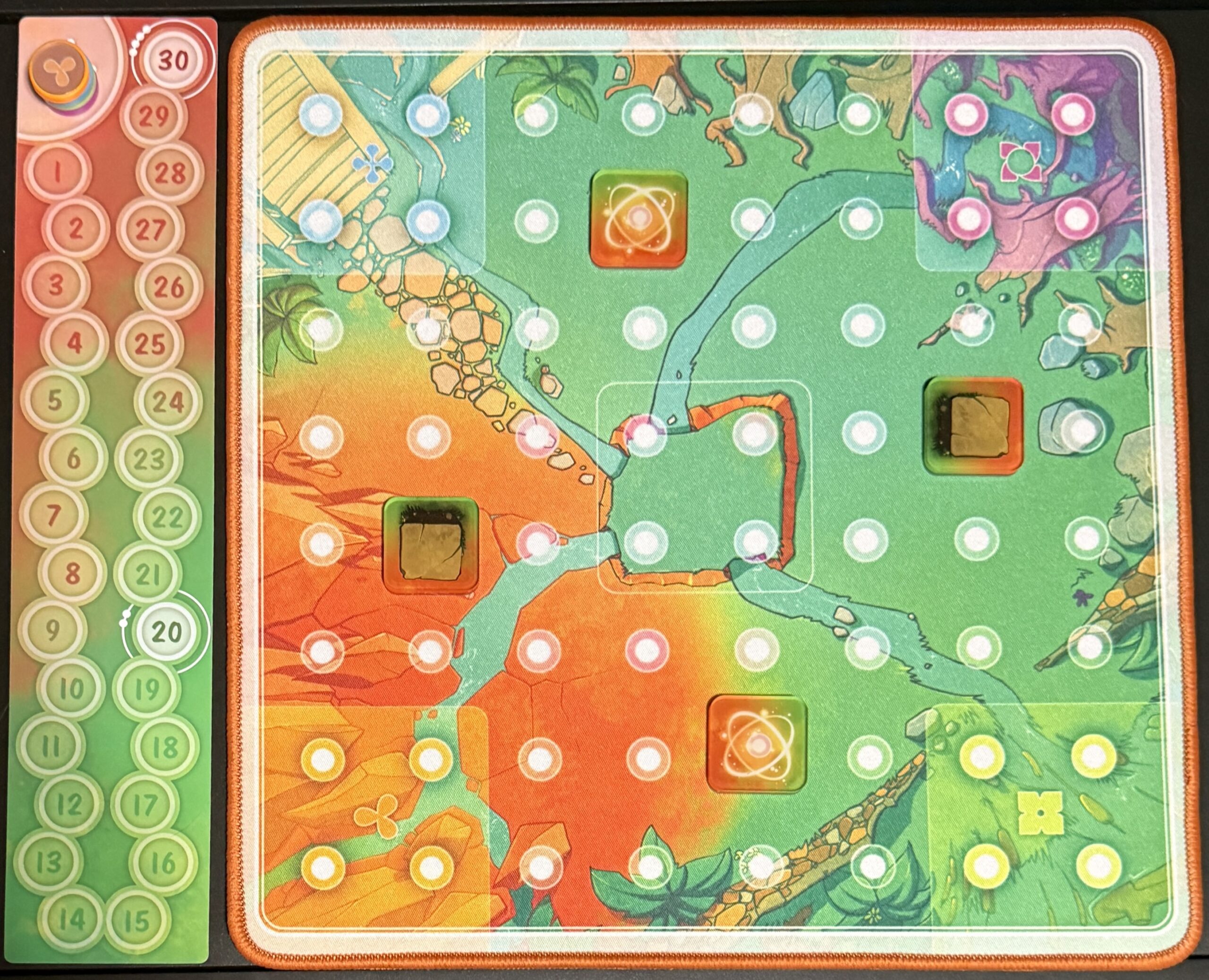
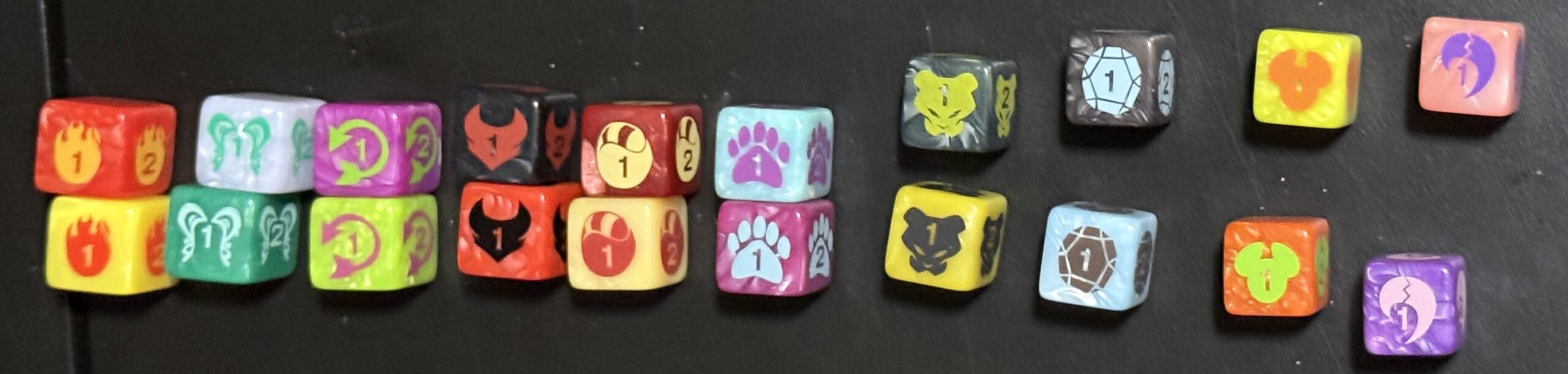
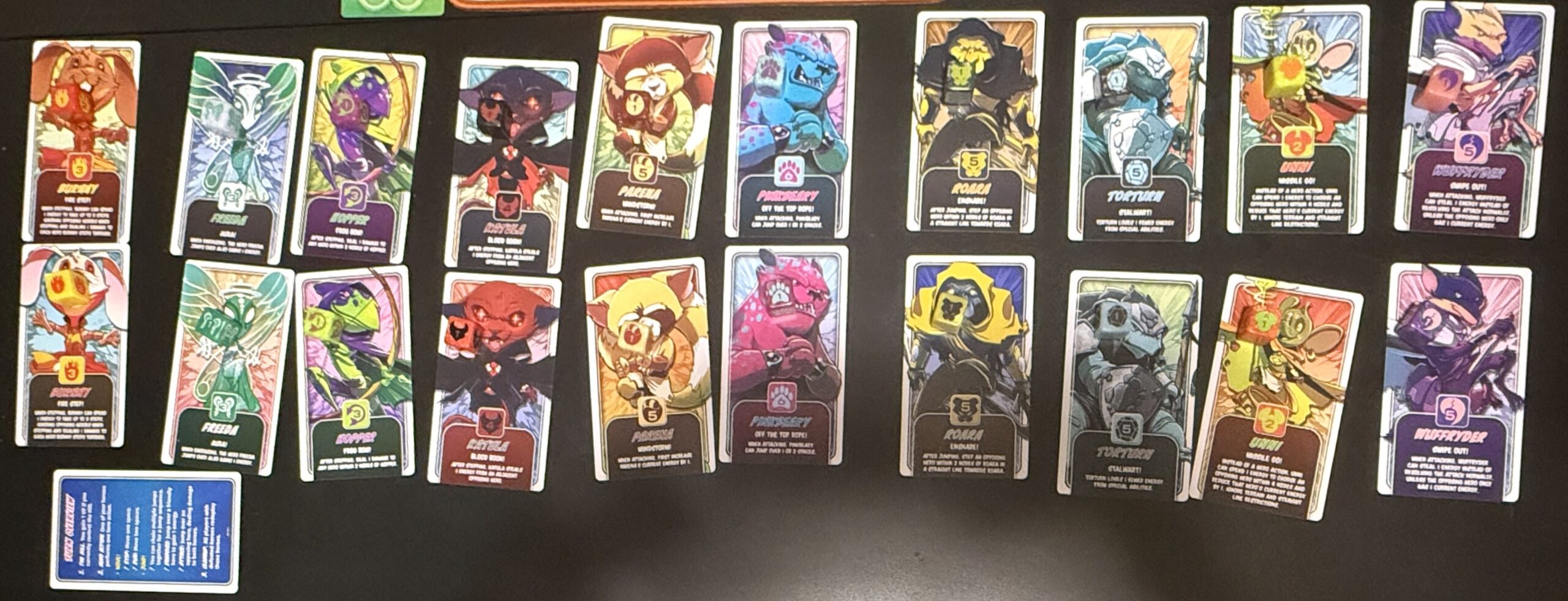
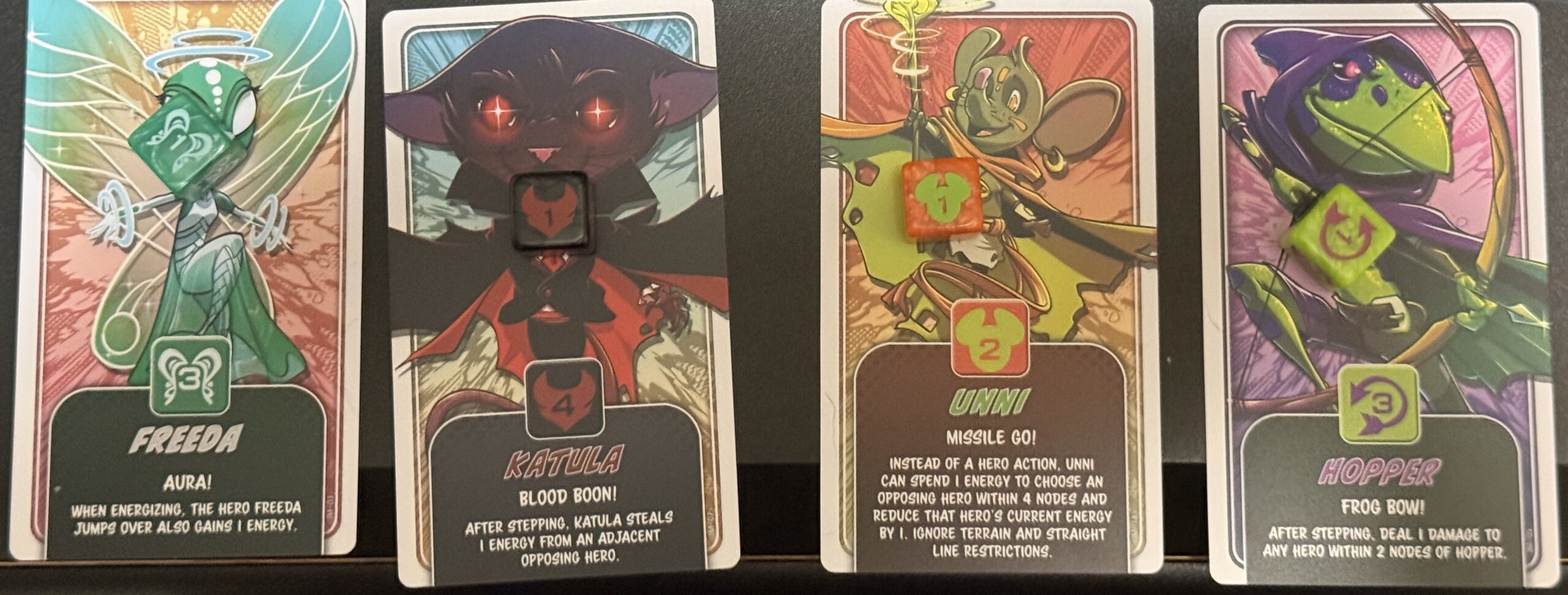
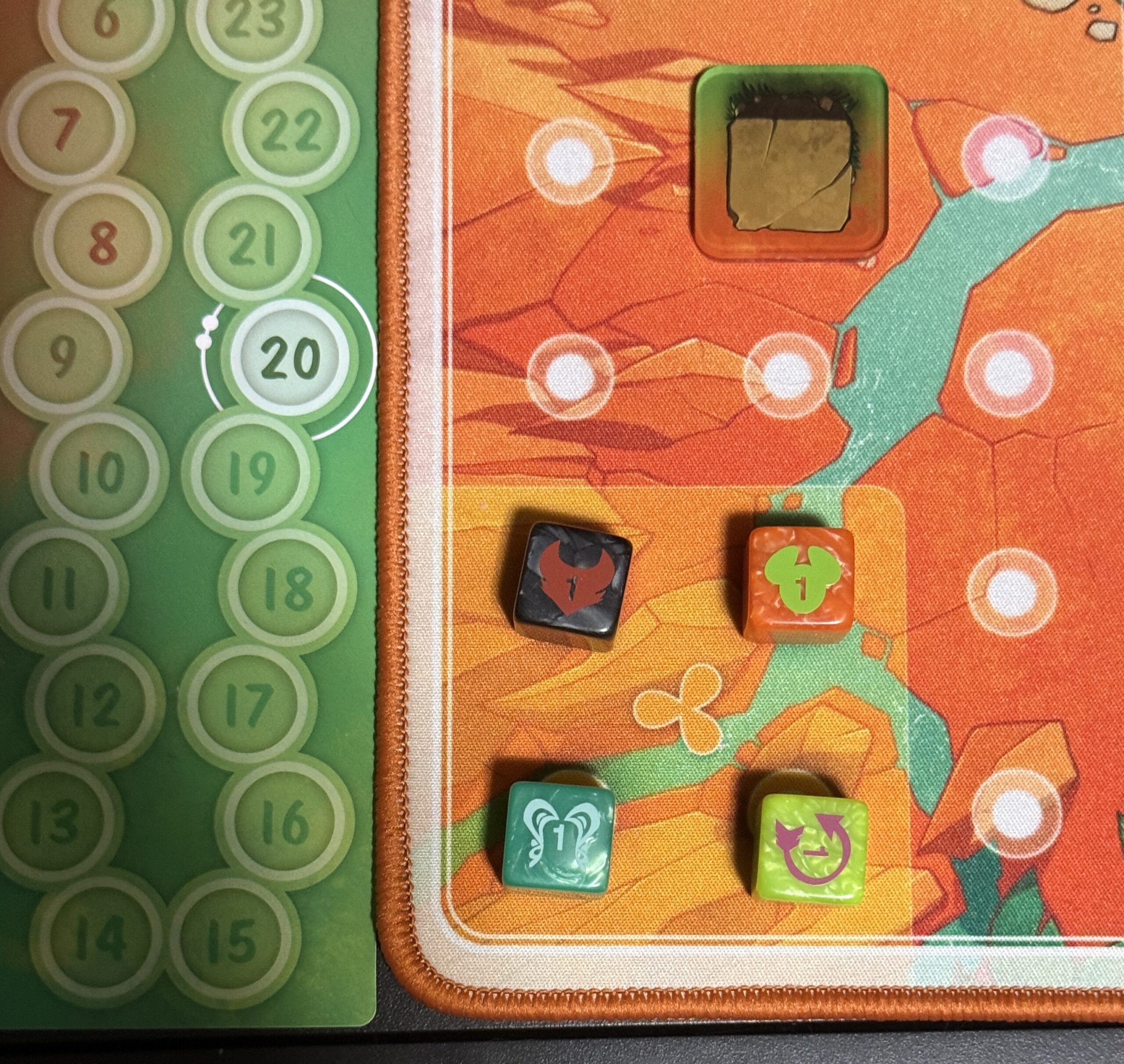
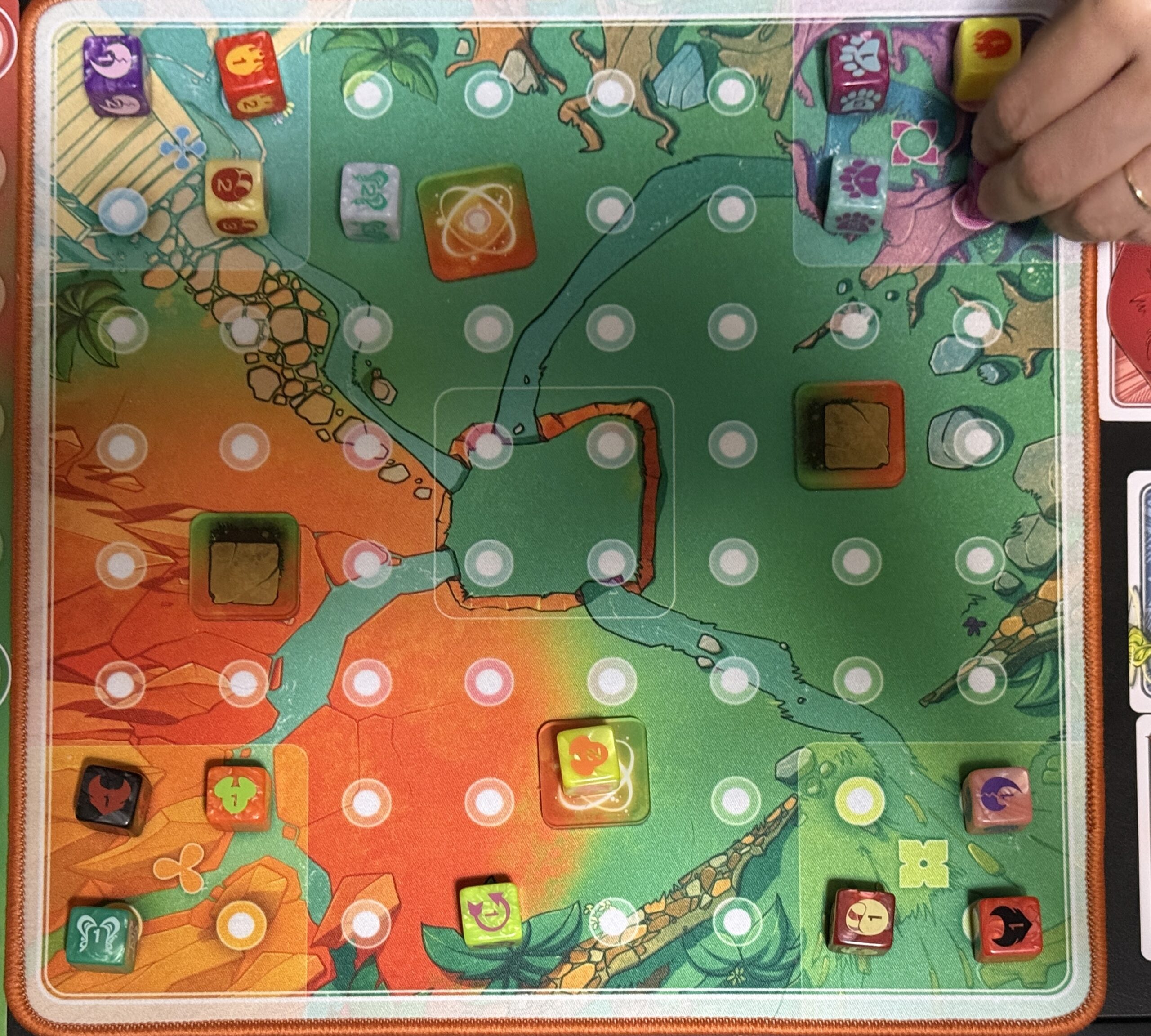
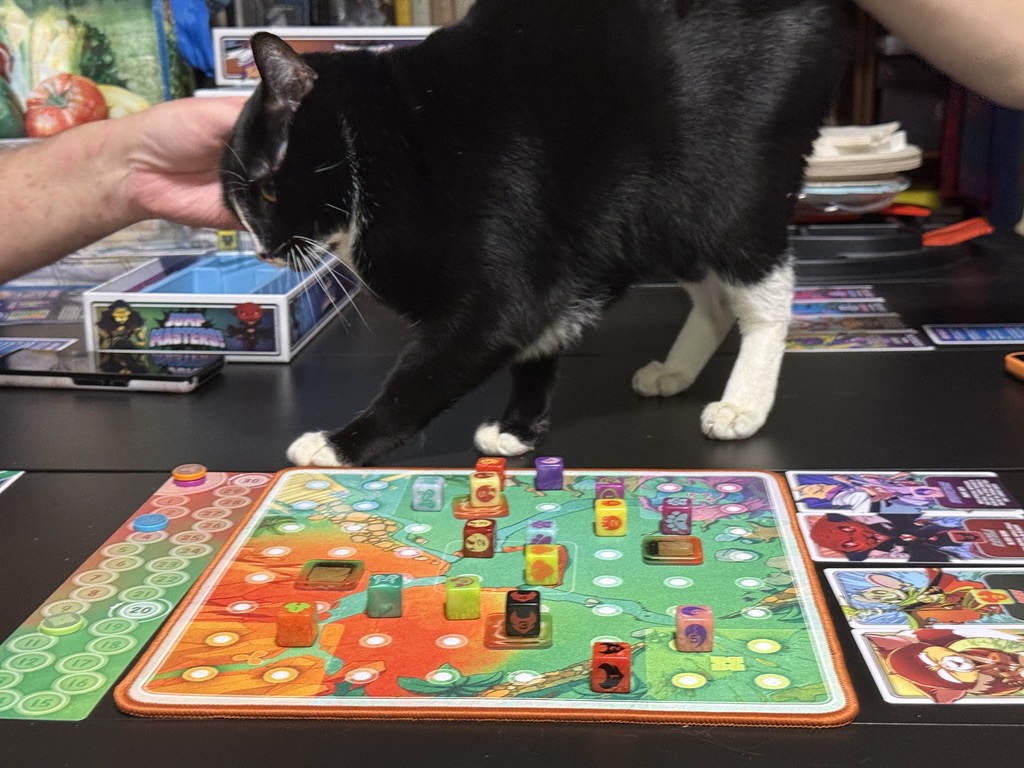
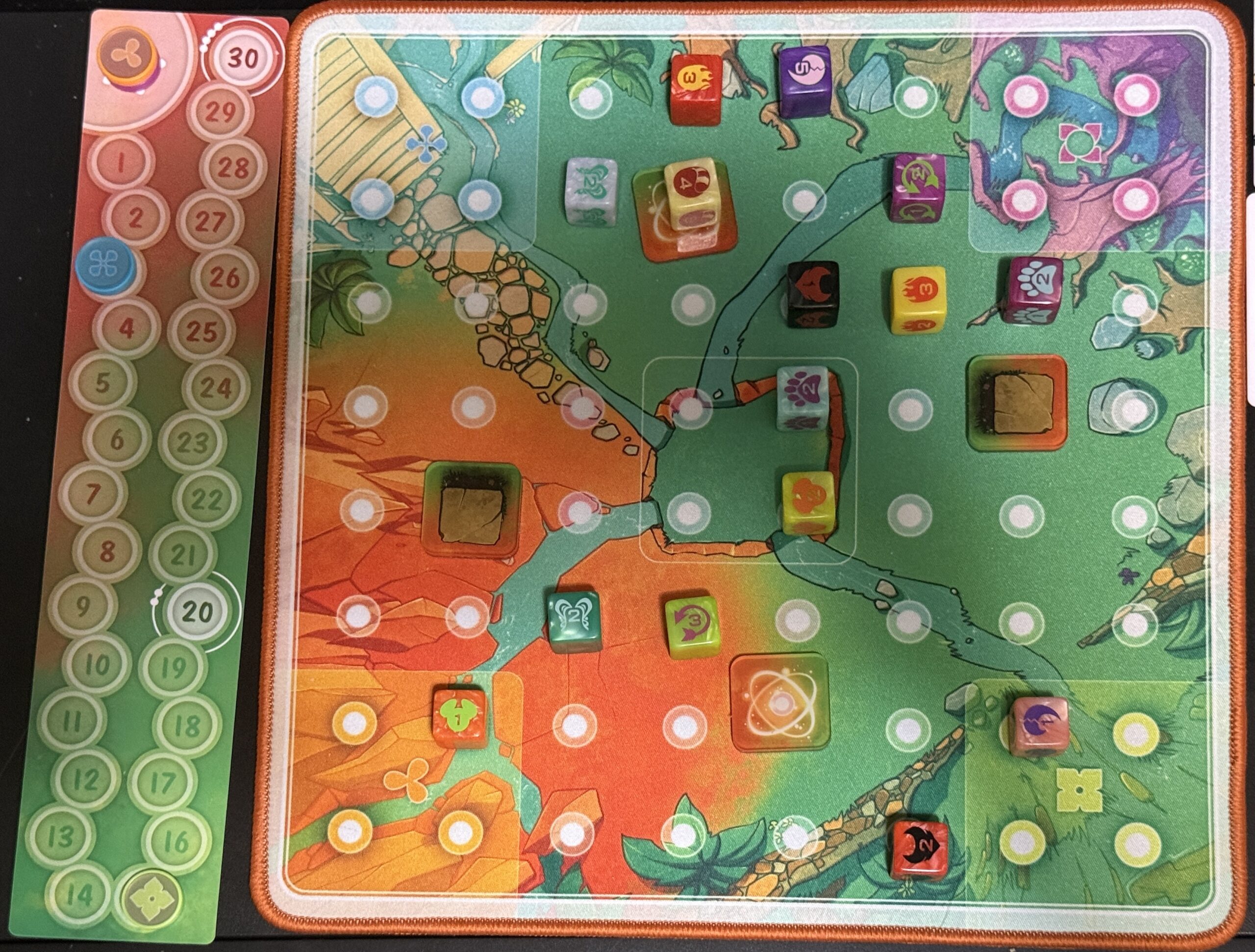
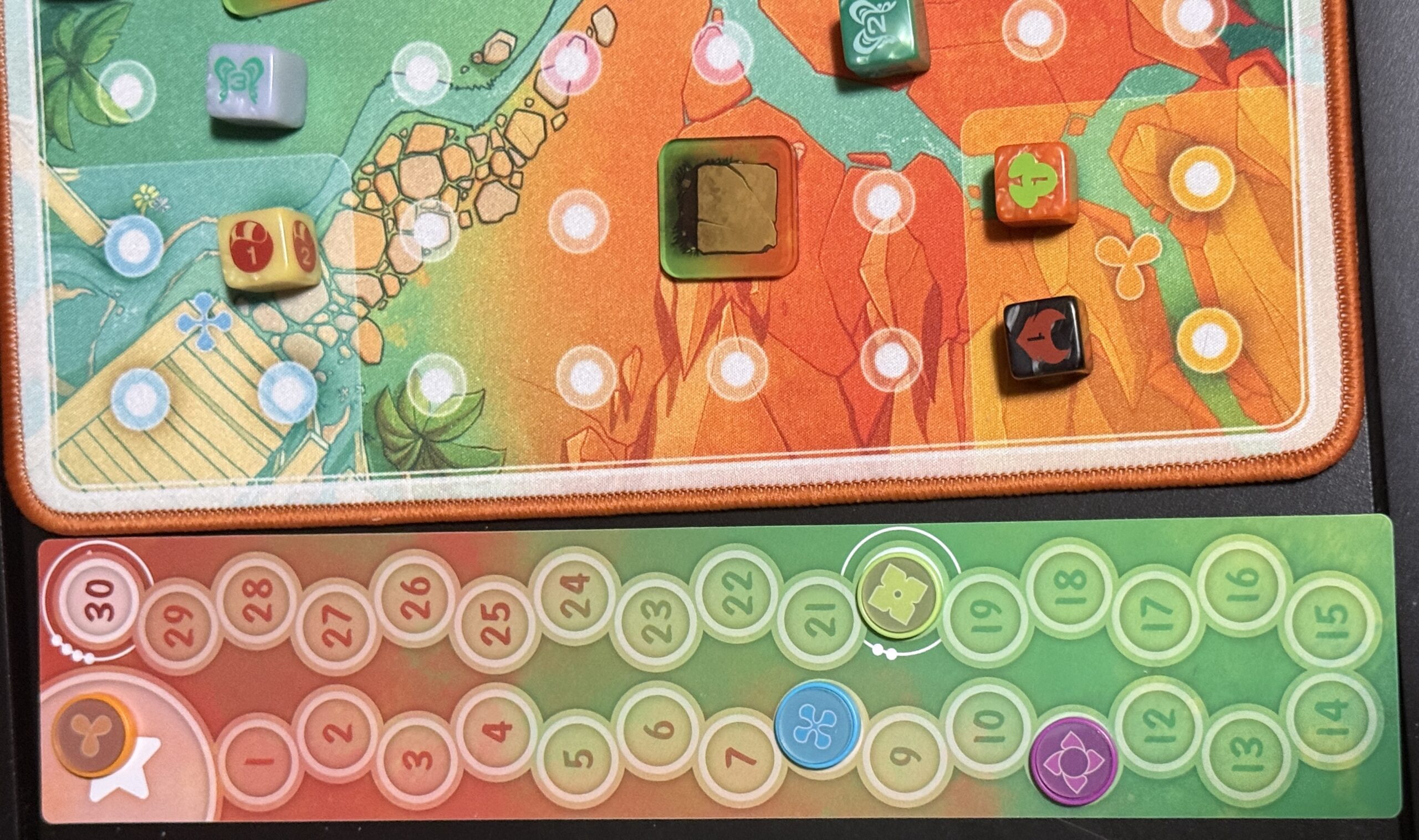
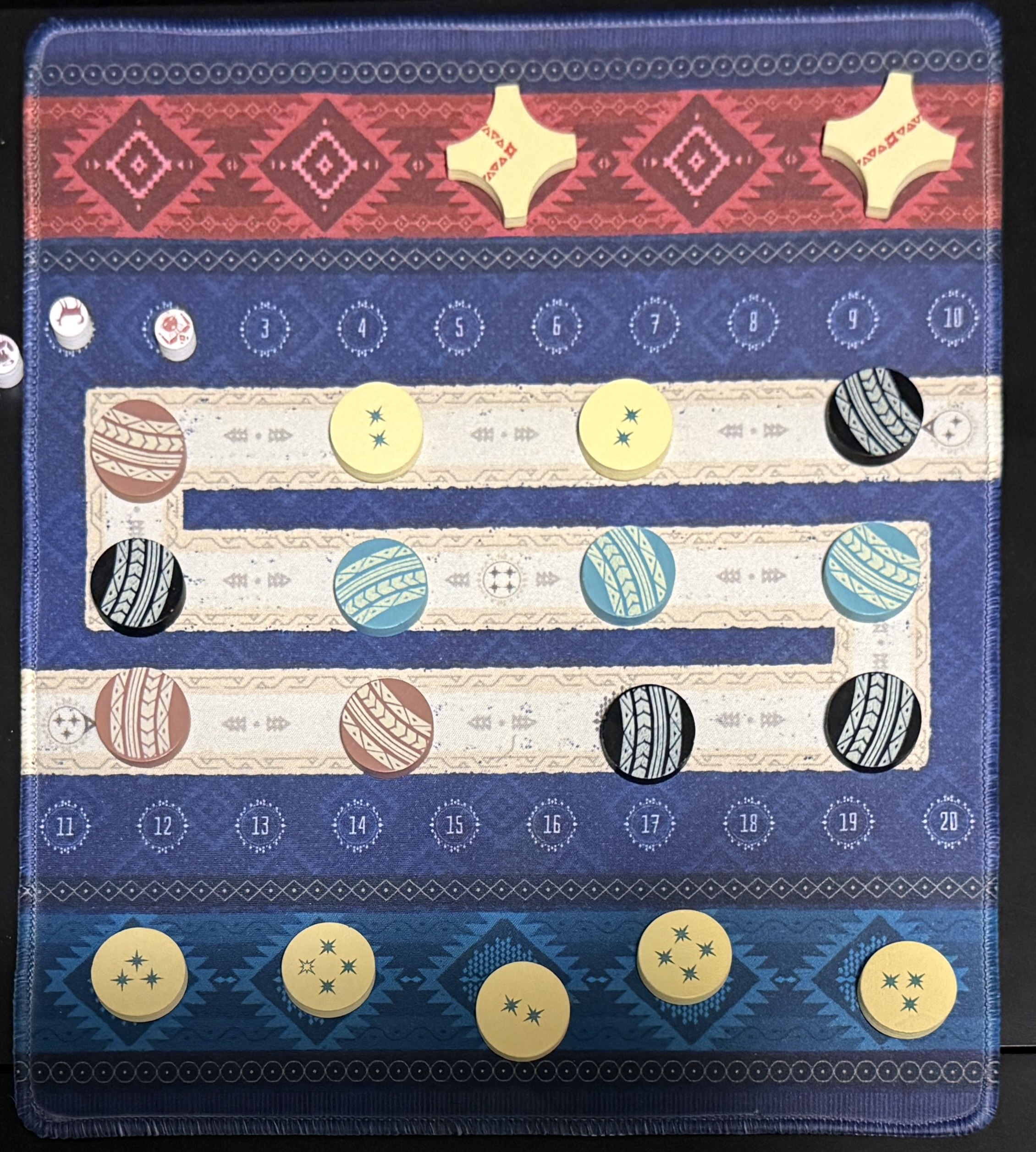
Jump Masters is loosely based on the classic Chinese Checkers.Another thing those two games had in common was the use of flexible mats instead of stiff game boards. Here’s the main play area of Jump Masters. Each player starts with their pieces in one of the four squares in the corners. The game ends when a player reaches 20 points; you can see the scoring track on the left.Players command a team of four heroes. The positions of heroes are shown by dice on the board. These dice are never rolled; their faces are used to show the current strength of the hero. The colors of the dice show which hero it is.This is where the cycle draft comes in. There are twenty hero cards, with ten heroes that are available twice (with different colors). The players each select four heroes out of the pool with repeated cycle drafts.These are my four heroes after the draft. Each hero comes with its corresponding die, initially set to a strength of 1. The value printed on the card is the maximum strength of the hero, which is also the number of victory points a player gets if they defeat that hero (bring it to below 1 strength).Here’s my starting position on the board. There are three potential moves for a hero: Step = move one position (orthogonally or diagonally); Run = move two positions; Jump = jump over another piece. A hero can make multiple jumps in a single turn, just like in Chinese checkers.This is the board state a couple of rounds into the game. At the bottom, you can see Andrew (lower right) has used Run to move a hero on top of an energy source, increasing its strength to 2. In the upper left, John used Jump on the grey/green hero; jumping increases the strength of a hero by 1. That particular hero has an ability that increases the strength of the friendly hero that it jumps over by 1 as well.Shuba had only one criticism of the game (apart from us not letting him play with the cat toys on the board). As you look at the dice, there’s no obvious visual clue as to which die is associated with which player. You’ve got your hero cards in front of you so you can always match them up, but it can still be confusing.The primary way to get victory points is to defeat the heroes of the other players; you also get a victory point if you have the strongest hero on the “Hill” (the square in the board’s center). When a hero Jumps over an opponent’s hero, both of their strengths are lowered by 1. If it’s decreased to below 1, the die is returned to the player’s starting area and the opponent gets the victory points.The game ends when a player reaches 20 victory points. Behold the scoring track when a player reached that goal: the green player, namely me.
I’d love to claim that superior gamesmanship led to me to victory. Honesty compels to me say that this was the first game for all of us. The heroes’ powers make a big difference in the game, especially in the way they combine together. If we’d understood the powers better, we probably would have made better drafting choices and the competition would have been more intense.
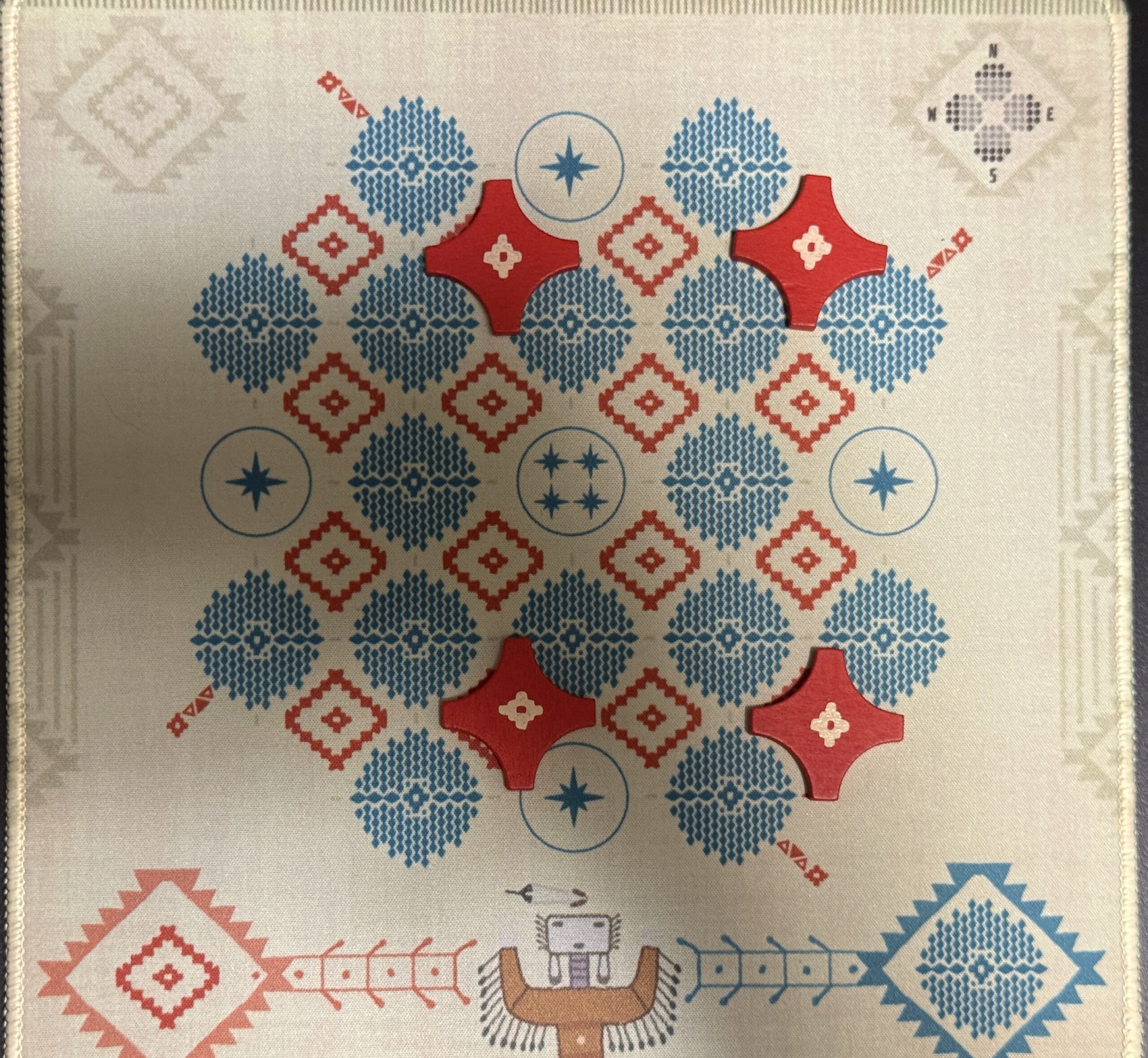
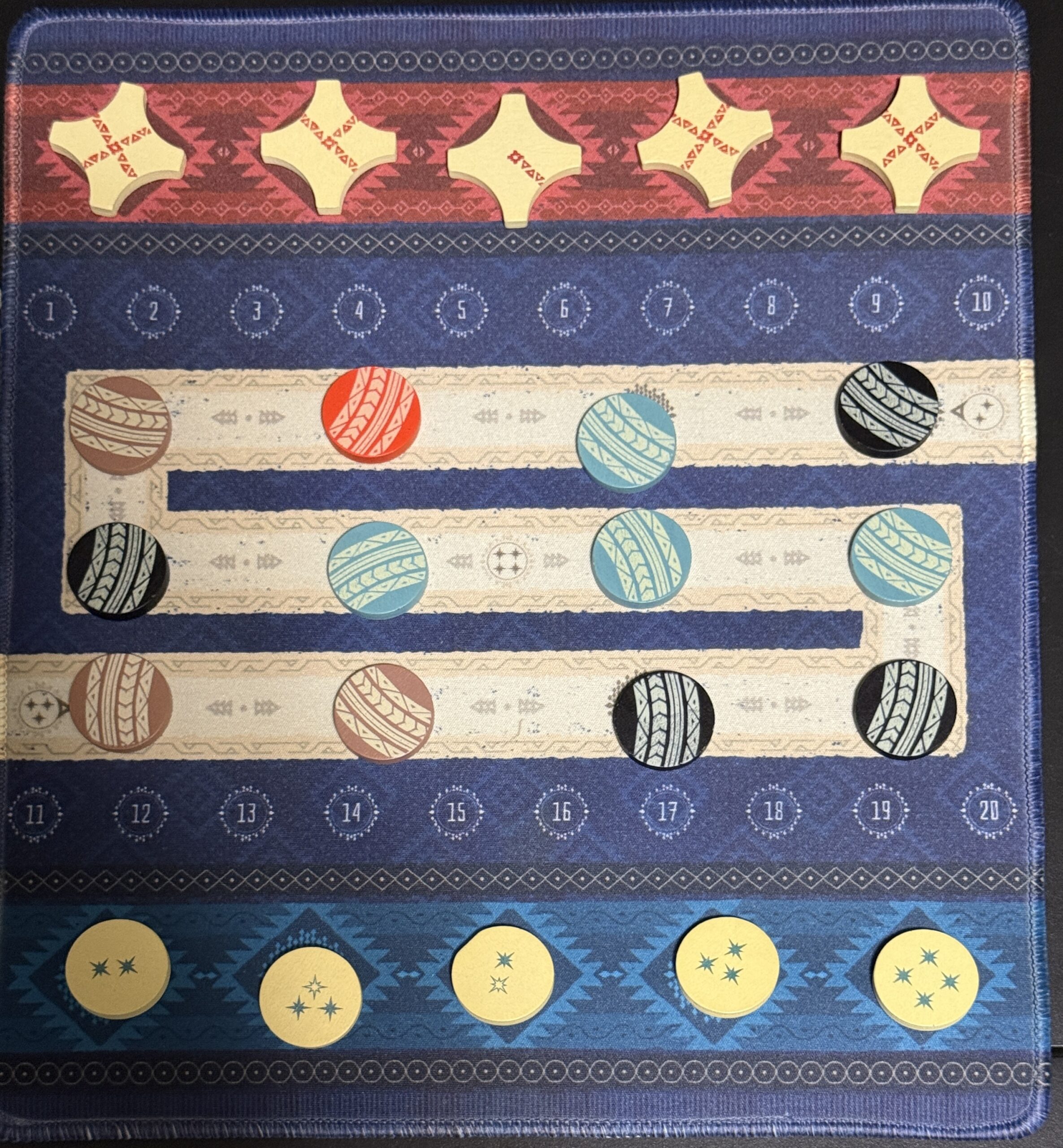
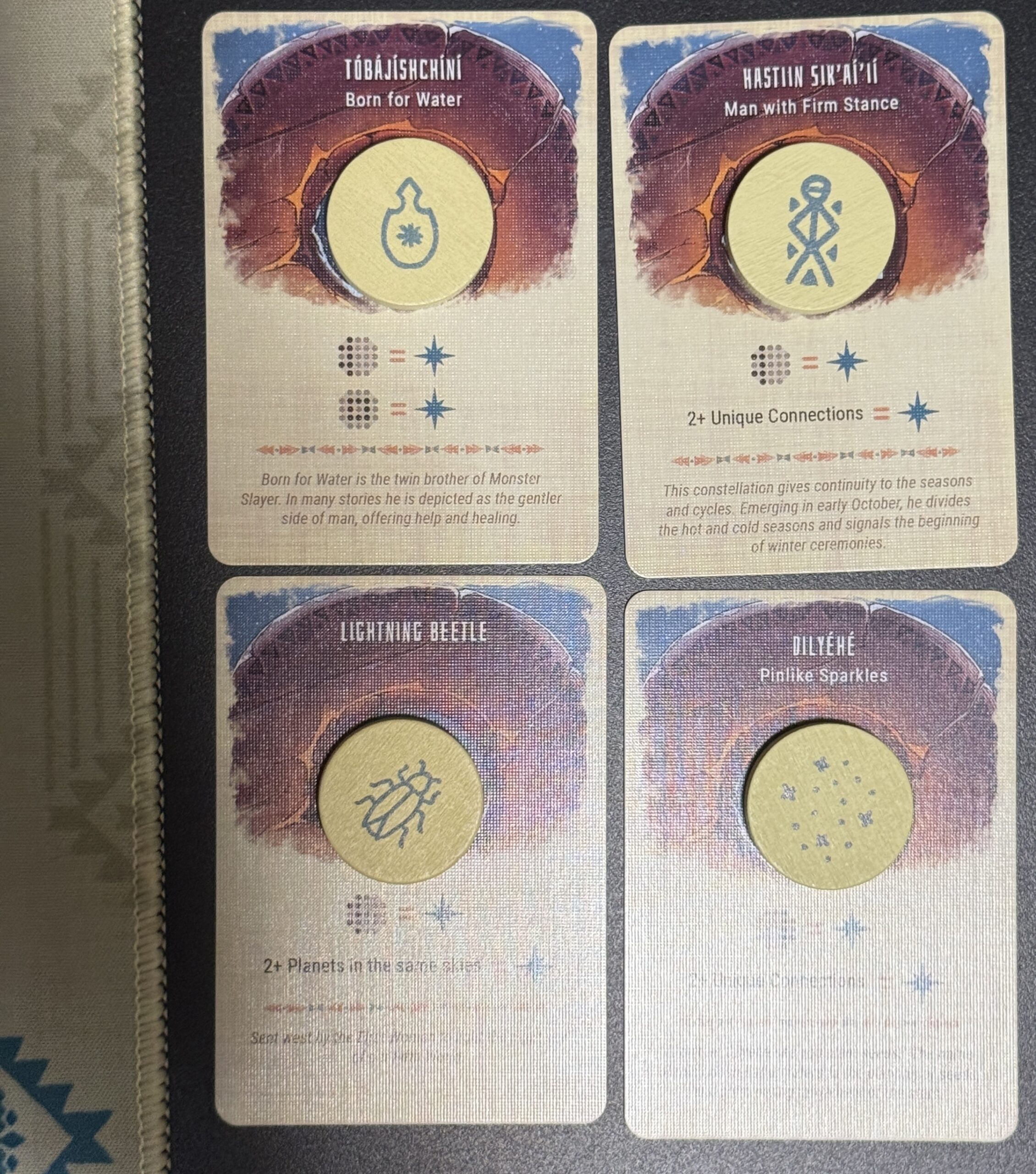
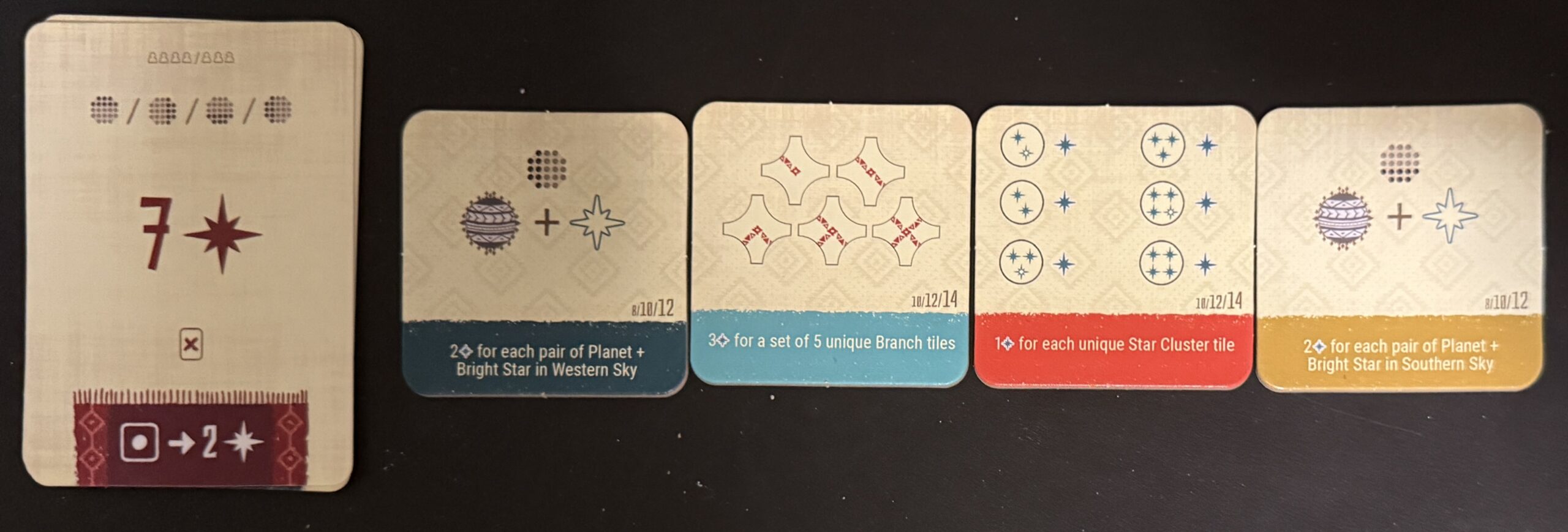
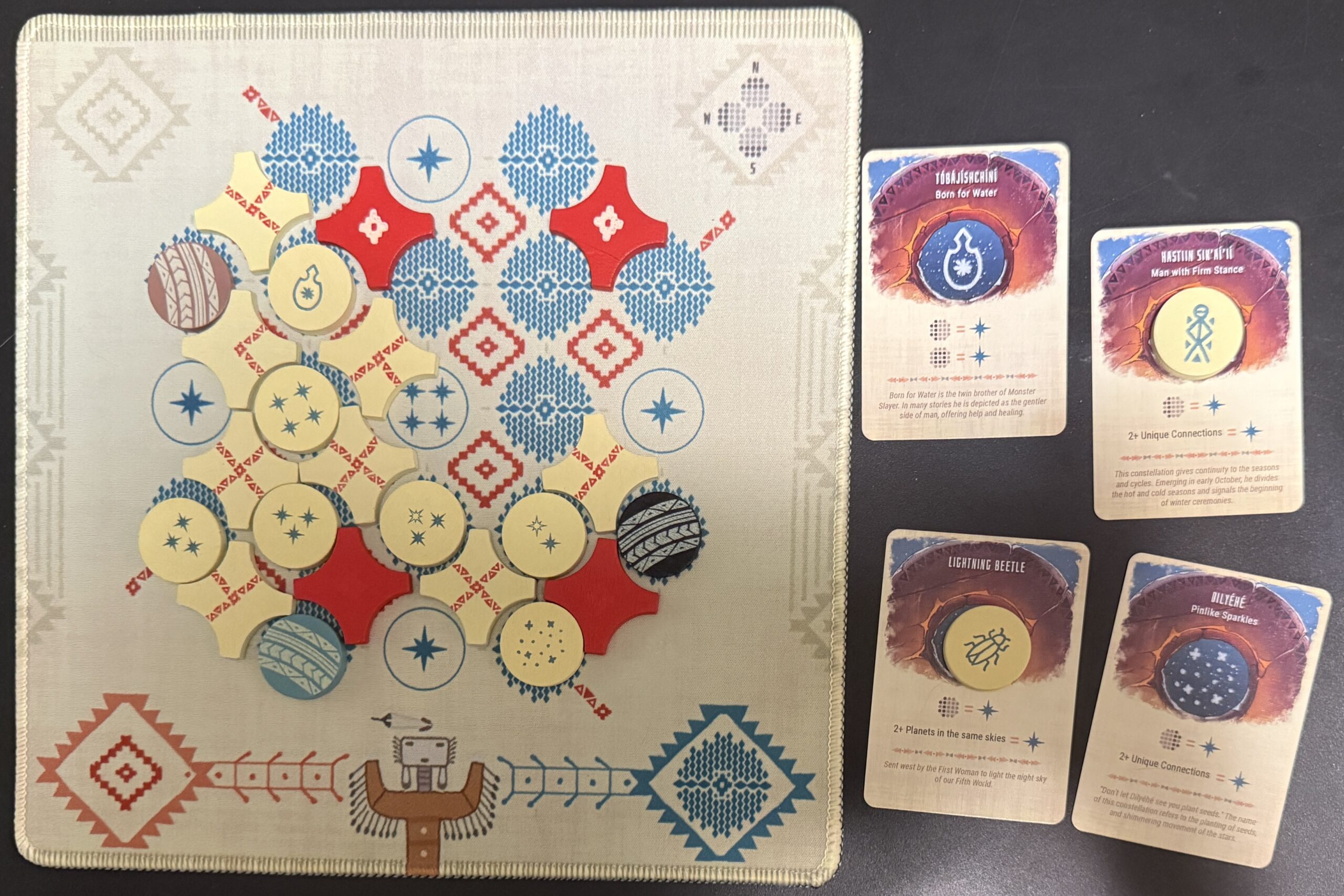
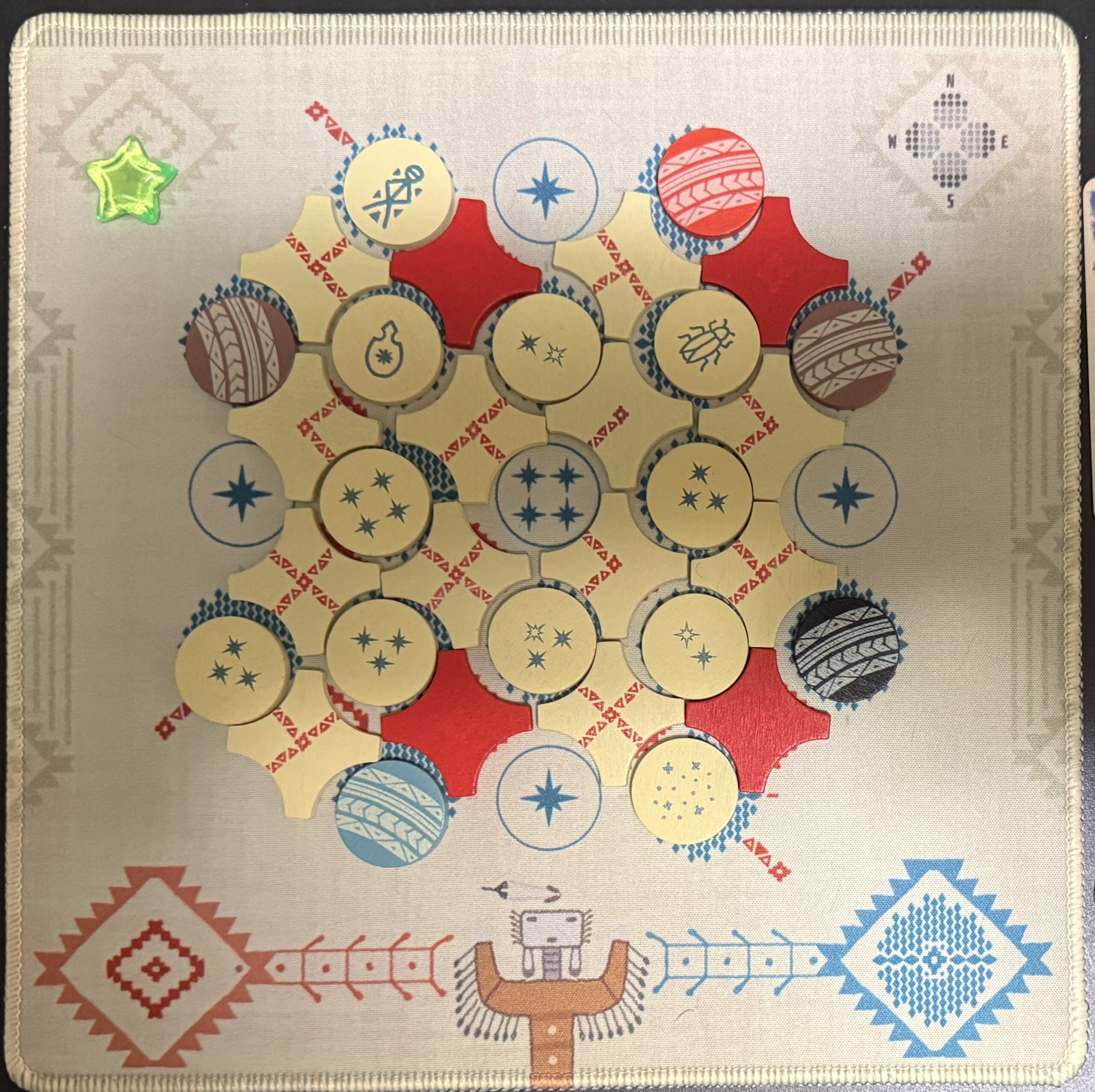
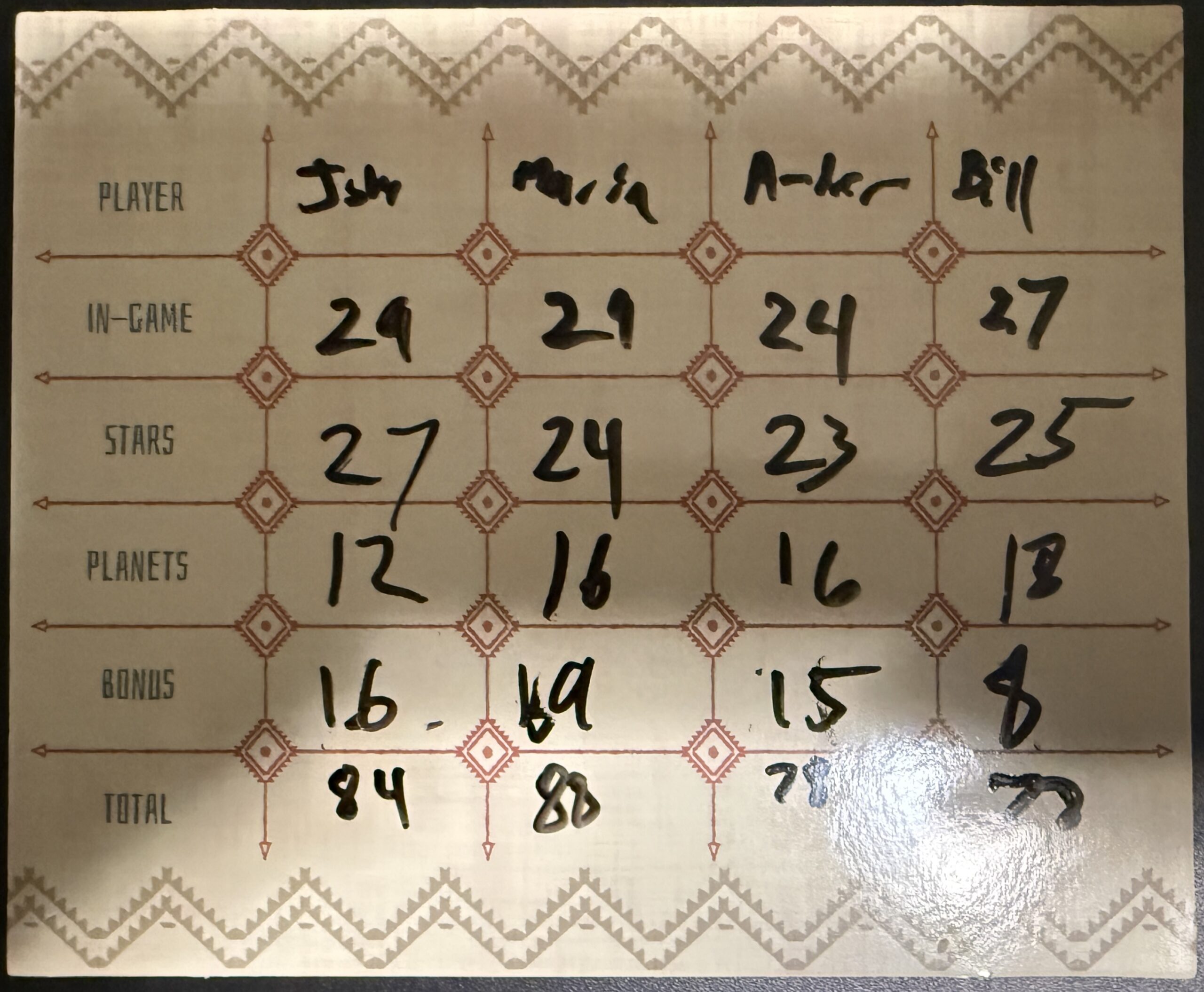
Our second game for the night was Solani. It’s an abstract tile layout game.Each player gets a cloth map on which to lay out tiles. While the cloth maps are identical between the players, the initial locations of those solid red crosses (connection blockers) are different for each player’s map. The circular regions are for the placement of stars, planets, and constellations. The diamond regions are for the placement of connections between them.This is the central board area, which is the source of the tiles to be laid out. The first player in a round decides whether the cycle draft will begin with stars or connections. Once all the players have picked a tile of that type, the reverse cycle picks the tiles of the other type.Each player receives four constellation cards and their corresponding disks. These are worth extra victory points (the solid blue stars) if the disk’s placement fulfills the conditions on the card. For example, TÓBÁJÍSHCHÍNÍ earns a victory point if it’s placed in one of the corresponding highlighted spots shown on the map. If the disk’s placement fulfills both conditions, the player earns both victory points.Another way to earn victory points is fill in a given region of the map before any other player; in the examle above, the first player to fill any of the North/East/West/South areas gets 7 victory points. (That player was me; we’ll see if that strategy was successful.) The other tiles indicate randomly-chosen additional end-game victory points; for example, the light-blue tile gives 3 victory points for each complete set of connection tiles on your map.The basic way to earn victory points is through tile placement on your map. The star disks earn as many victory points as the number of stars on the disk, but only if the number of connections (reddish lines) touching the disk’s edge exactly matches the number of stars on it. Note that some disks and connections are pre-printed on the map.When you draft a star disc, you can choose to swap that disk for a planet if the number of stars on that disk is close to the number of stars on a pre-printed or previously-place disk near that planet. Planets are worth more end-game victory points if more planets of different colors are in N/E/W/S map regions.My star map at the end of the game. The rules guarantee that the end-game star map will have all its spaces filled. It’s the placement of the markers that generates points. For example, consider the disk in the middle of the second column on the right. It has three stars on it, but only two connections, so it scores nothing.Behold the final score, revealing that Maria was the winner. She paid more attention to the placement of her planets, and to the end-game scoring bonuses. Congratulations, Maria!
The final end-of-night results: I won one game, Maria won another, and Shuba got laid. It was a good night all around.