While Baldur’s Gate 3 is still the video game that currently commands most of my attention, there’s another game I’ve played occasionally since 2016: No Man’s Sky.
I’ve spent about 650 hours in NMS over the past decade. It comes in third in terms of the amount of time I’ve spent in a single video game, behind BG3 (about 3000 hours over the past 2.5 years) and World of Warcraft (I played it for 15 years, but didn’t record the number of hours).
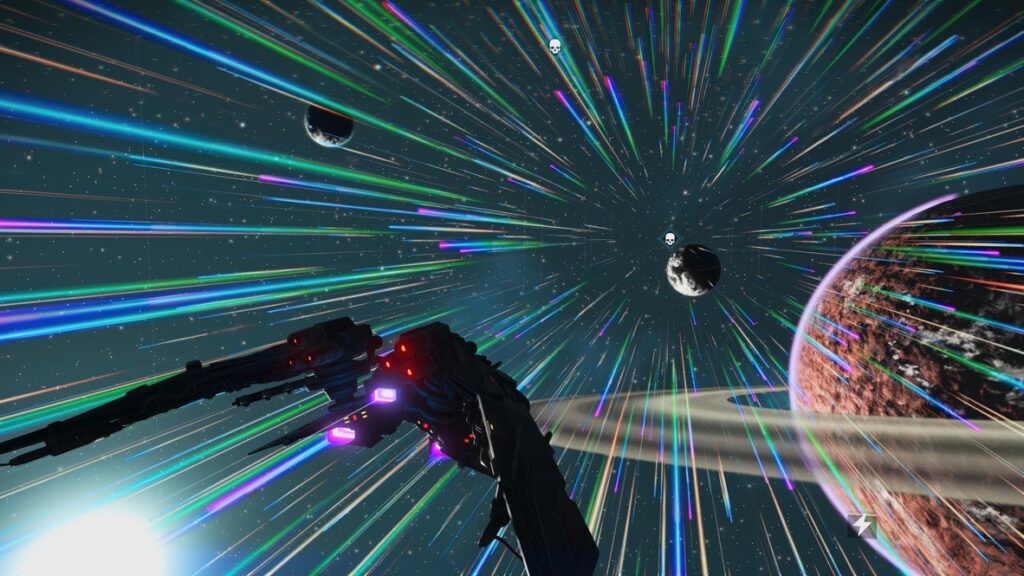
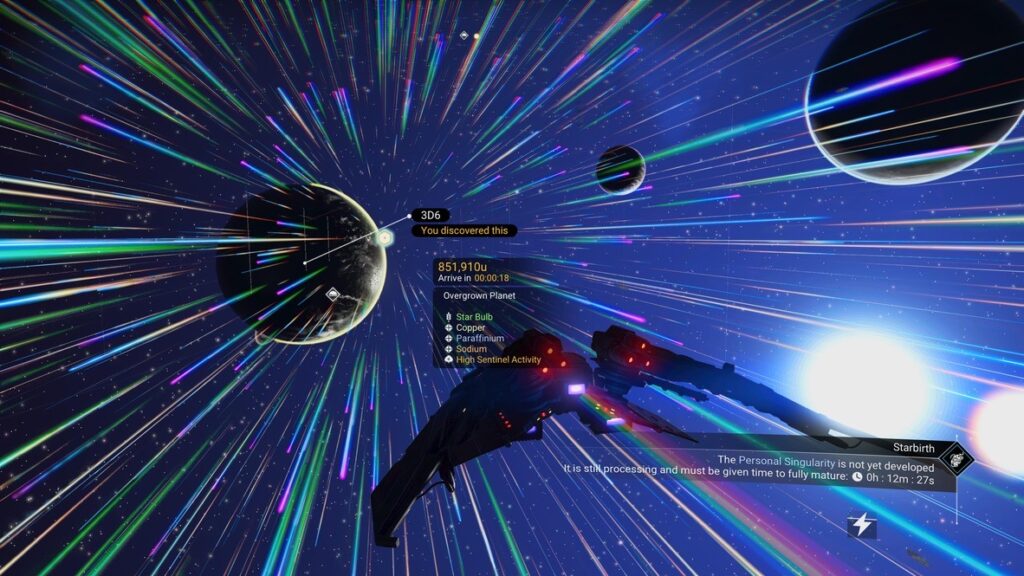
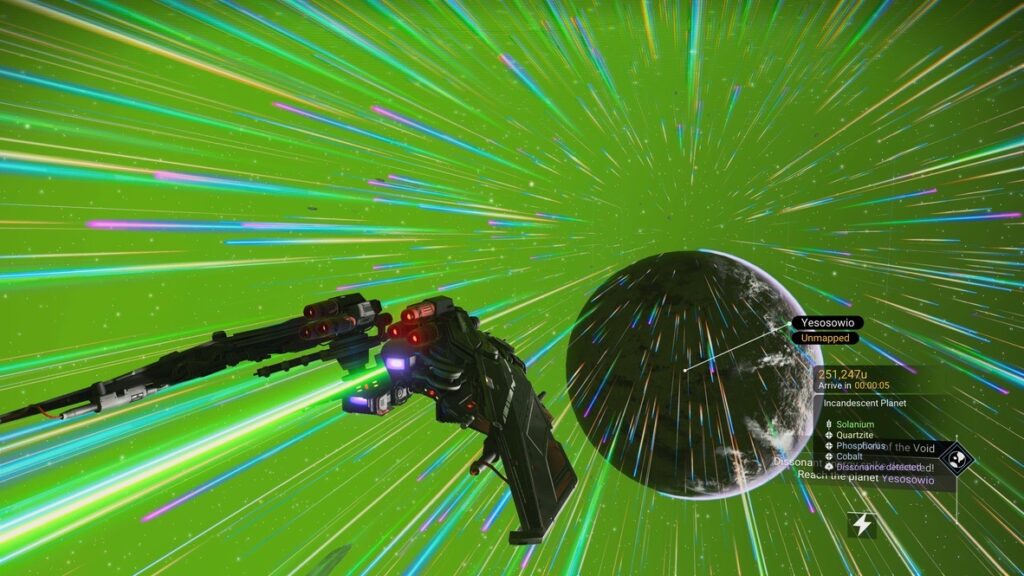
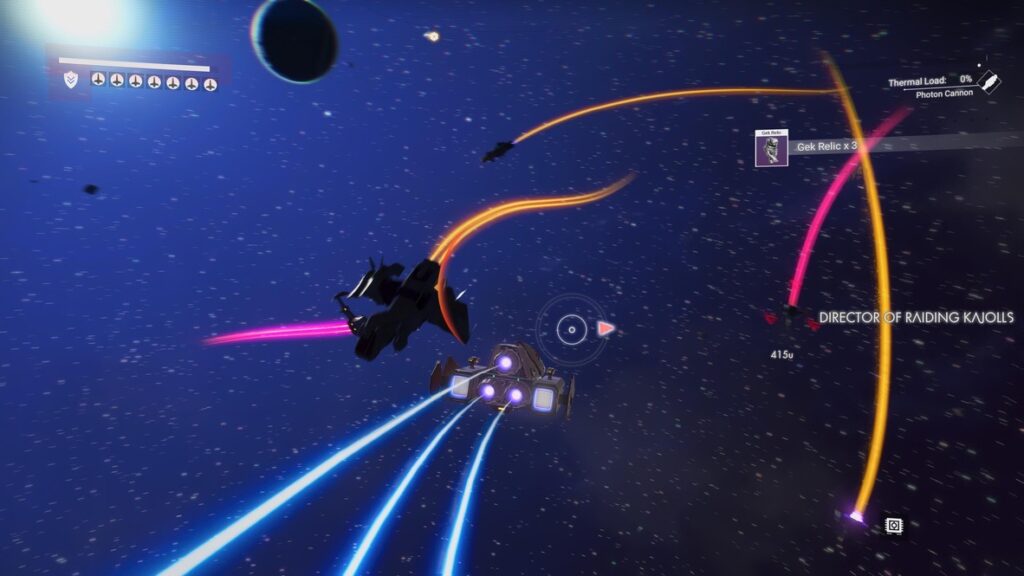
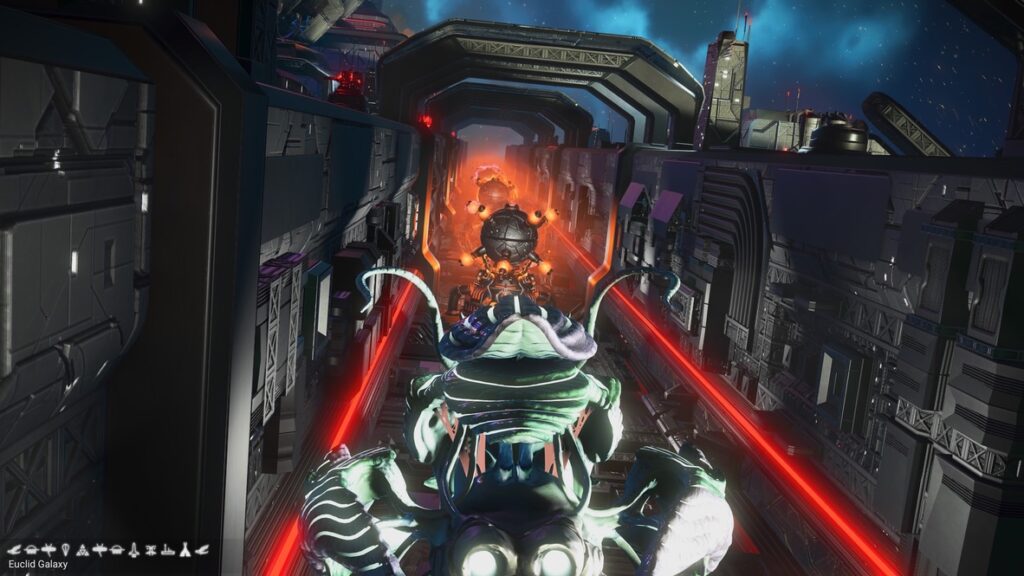
I use my ship’s Pulse Drive to rush to the site of a pirate attack, indicated by the small skull icon.
These are some scattered thoughts I have about the game. Perhaps it will give some insight as to why I seem to return to the game for brief periods over the course of years.
When NMS was released in in 2016, there were well-publicized issues with features that were promised but not included; multiplayer gaming in particular. However, in the years since, Hello Games has added those features. They’ve continued to release additions to the gameplay, usually introducing them in the form of expeditions.
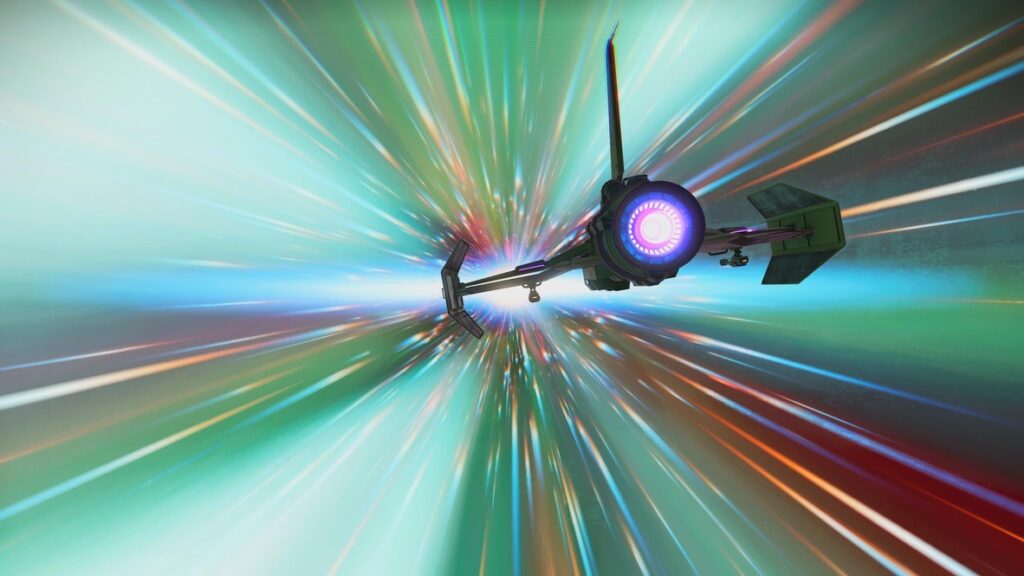
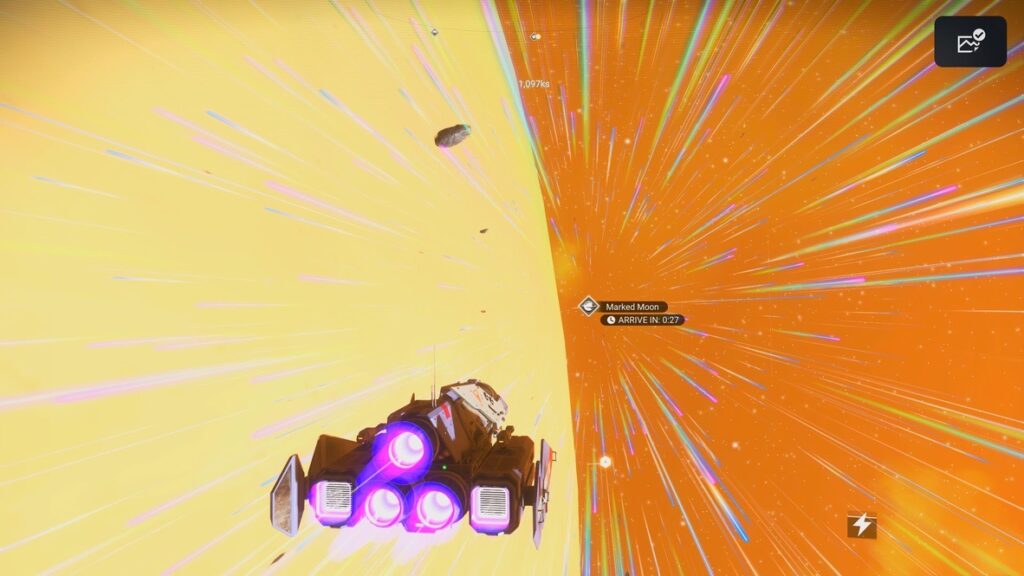
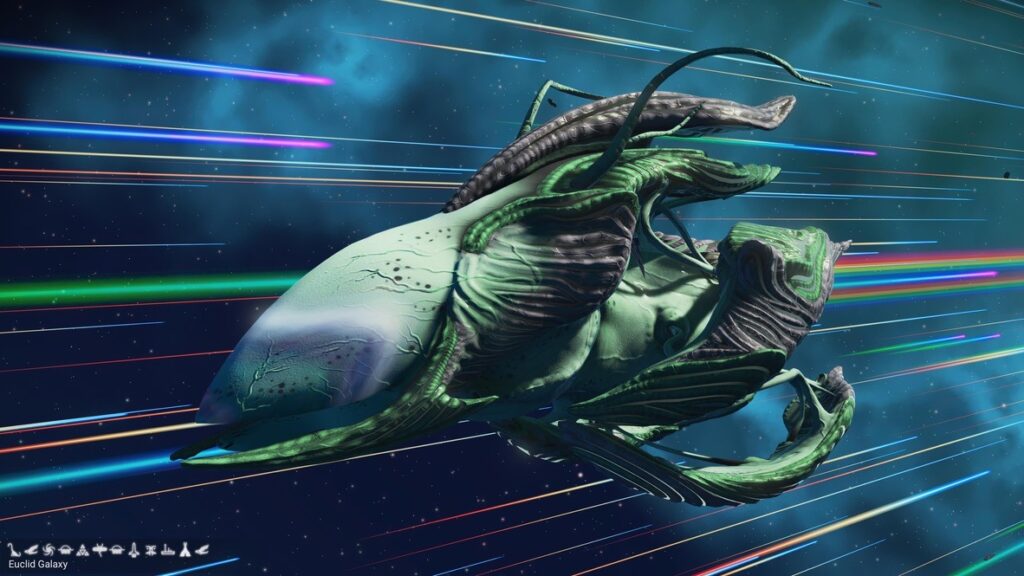
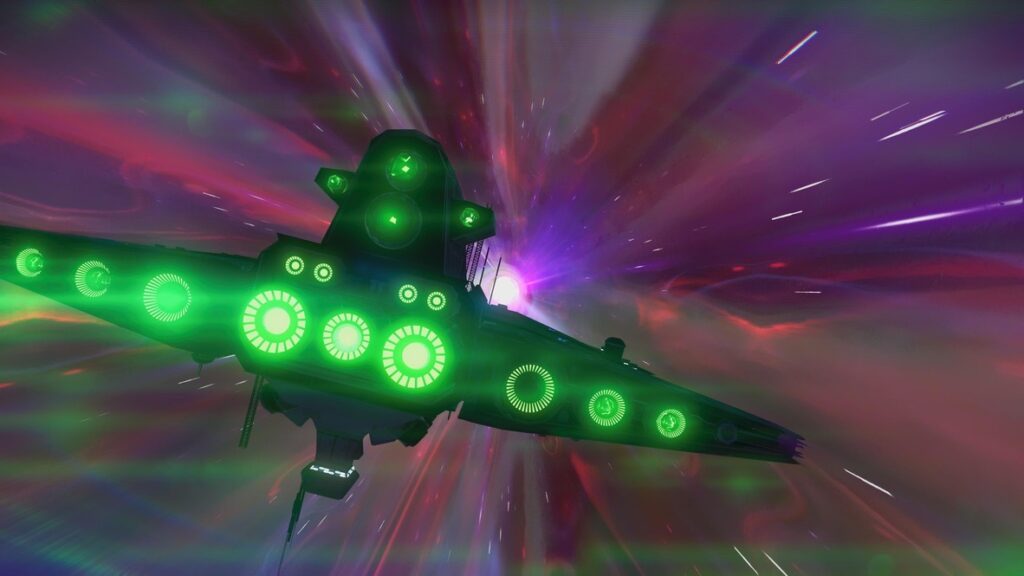
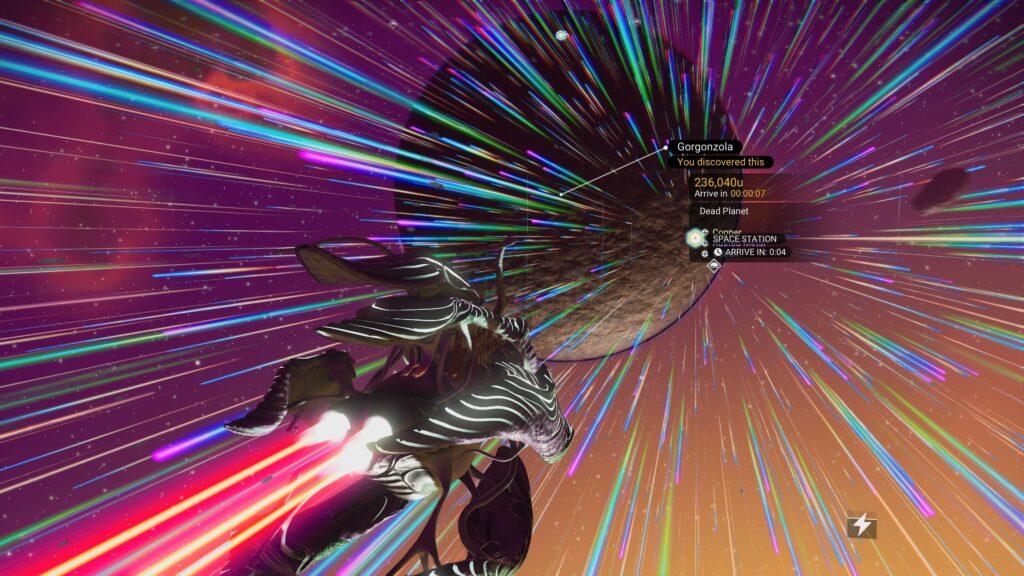
To go from one stellar system to another, you travel through hyperspace.
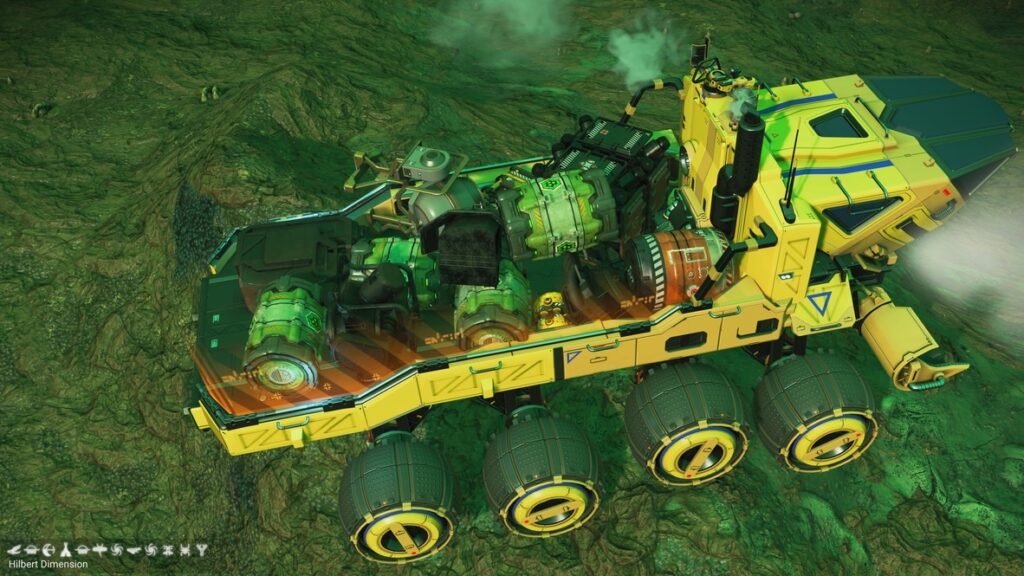
Indeed, I was motivated to write this essay due to the release of the latest expedition. Remnant. I’m not impressed with Remnant itself; I find the new mechanic, that of transporting waste containers in a trip that lasts tens of minutes, to be a mix of tedium and frustration. However, I’ve meant to write about NMS for some time. At least Remnant got me to put my fingers to keyboard.
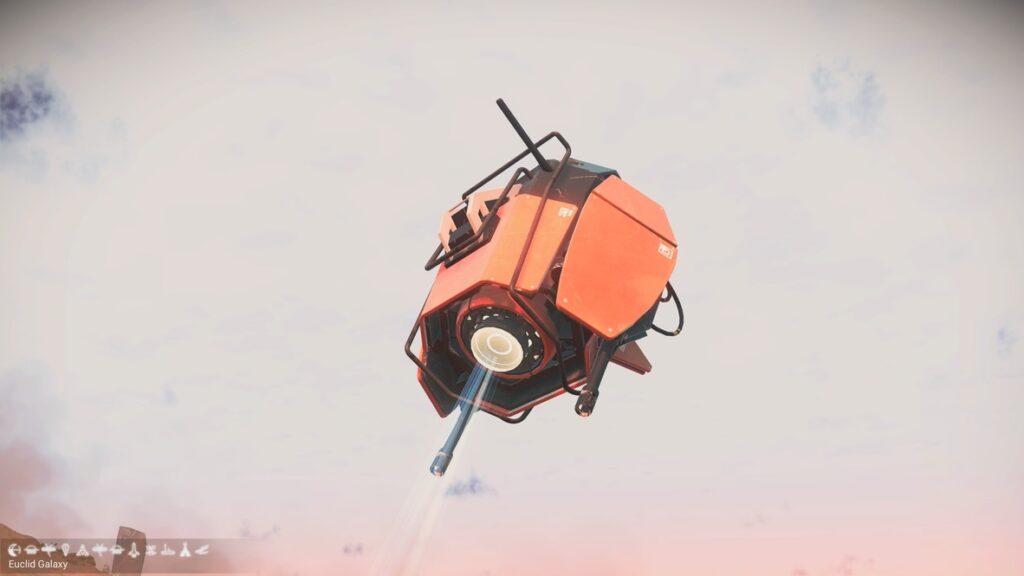
Hauling pieces of waste across a bumpy landscape in a flatbed vehicle is even less exciting than it sounds. Fortunately, other expeditions have introduced more interesting features.
In other articles on the web, I see that NMS is most often compared to Minecraft. Since I’ve never played that game, the closest analogy I have is Stardew Valley: You start off “small,” with beginning resource management. Eventually you’re able to interact with the wider world around you, pursuing different goals in the game as suits you.
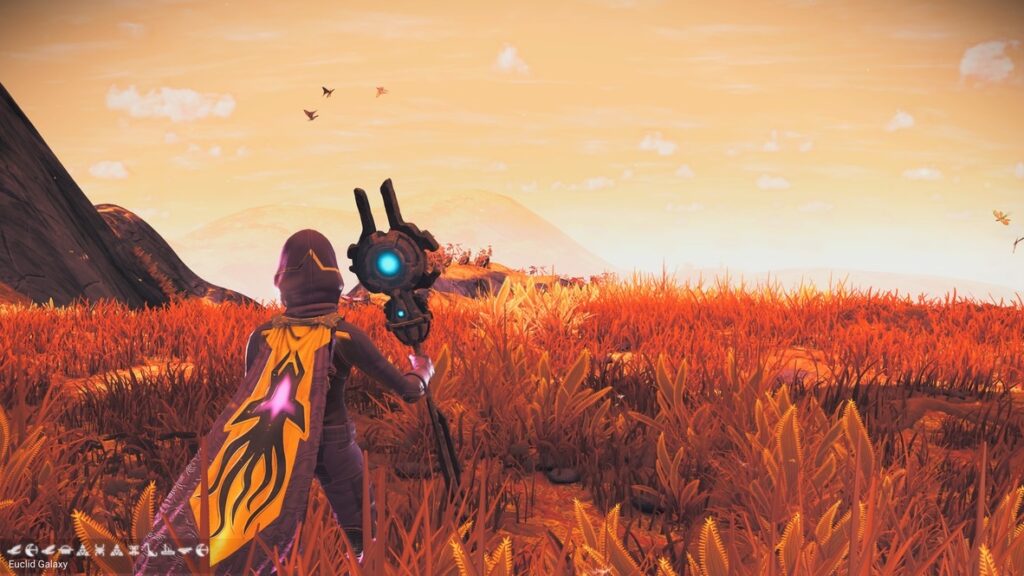
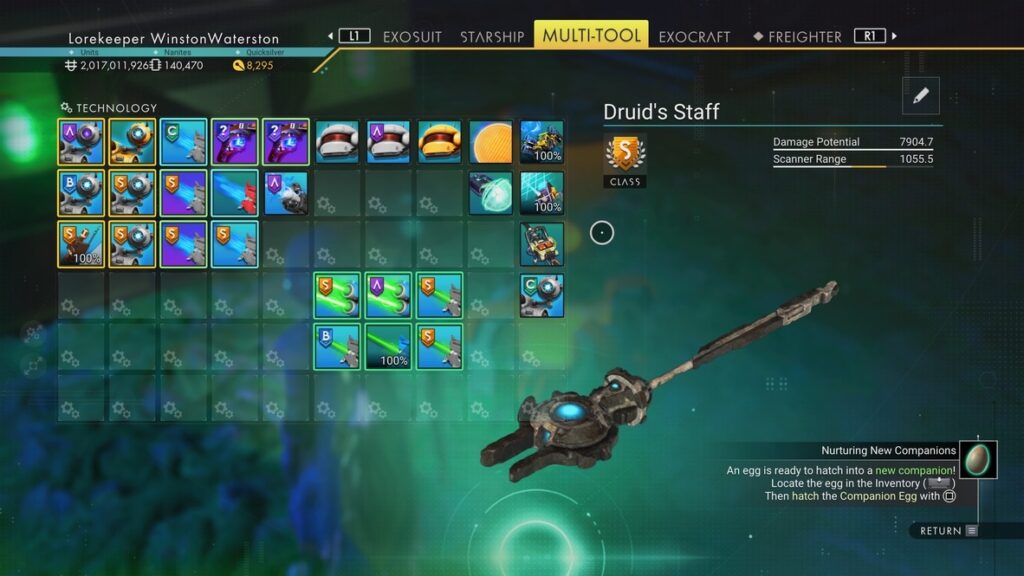
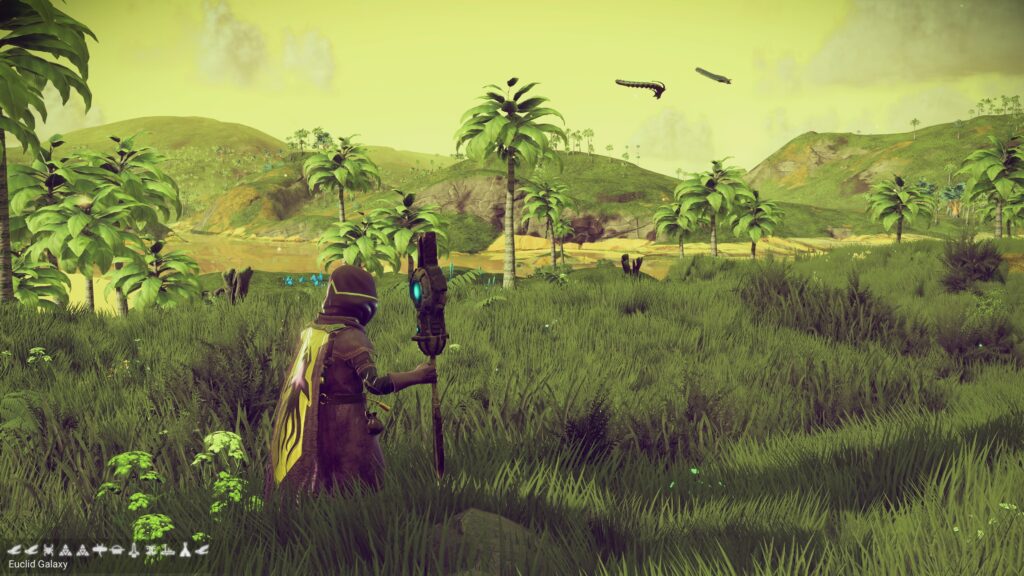
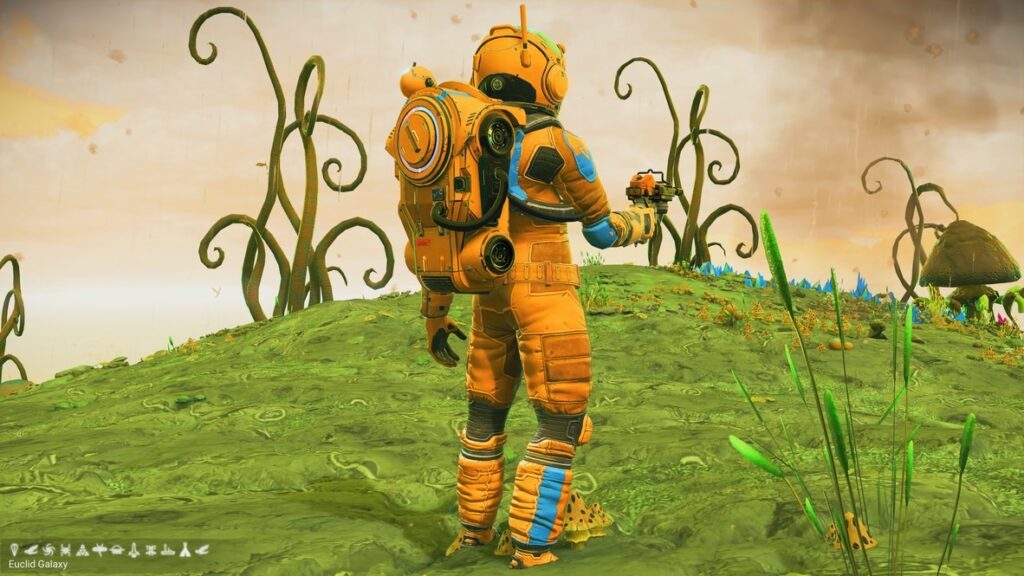
I was among the first group of players to venture into NMS in 2016. At first, it was a matter of survival. My character probably looked something like this, with a bulky exosuit and a simple multi-tool.Your first task in the game, apart from just “survival,” is to gather enough resources to repair your initital spaceship. Then you can start flying around the galaxy… or at least the stellar system you start in.As the name suggests, a “multi-tool” is a hand-held device that has a variety of functions: scanner, weapon, mining, shield, even fishing. Multi-tools differ in appearance and in maximum upgrade capabilities; since I play in the easiest difficulty mode, these differences don’t matter much to me. This is my character’s current multi-tool. The design is available as a reward from one of the expeditions.
When I started playing NMS, it was rough going, as it is for all “survival”-type games. I gradually acquired improvements to my suit, my multi-tool, and my ship. For that last one, it was more about locating crashed ships on planets and seeing if any of them were improvements on the ship I had.
I didn’t care much about multi-player. Frankly, I didn’t want a repeat of my World of Warcraft experience, in which my poor gaming performance would make me a pariah in any group. I also had (and still have) even less interest in PvP, in which I’d inevitably be the n00b that everyone else would pwn.
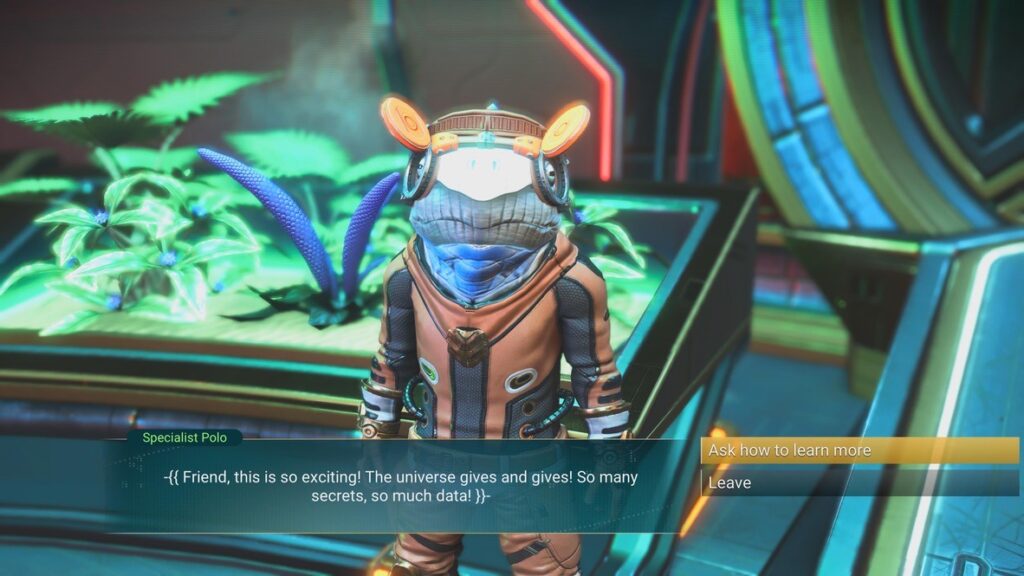
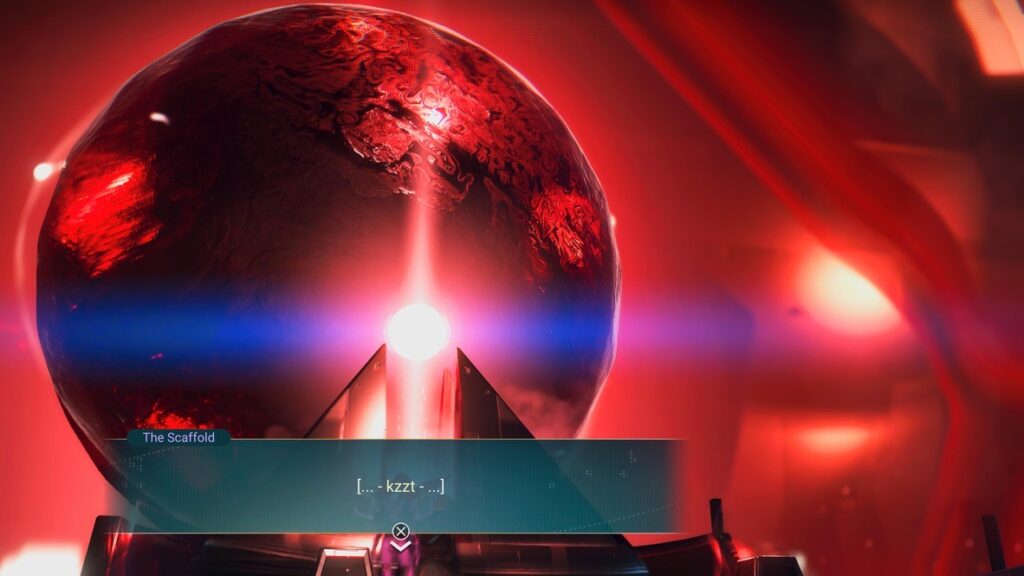
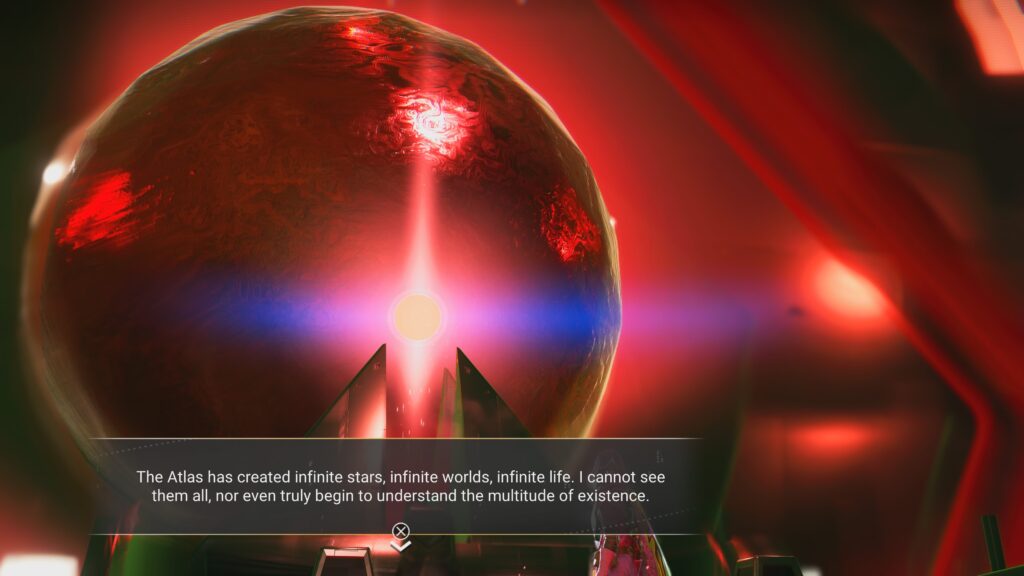
I met this fellow, who is one the few senior NPCs in the game.I also had the initial introduction to this enigmatic entity. Both it and Specialist Polo are part of the game’s overall story, such as it is.
Because I spent most of my time struggling to survive and gather resources, the story seemed irrelevant. There also only seemed to be one goal: get to the center of galaxy. This was a lengthy grind and took lots of resources. I lost interest.
I don’t remember why, but I dipped my toe into the game a few years later. It had vastly improved.
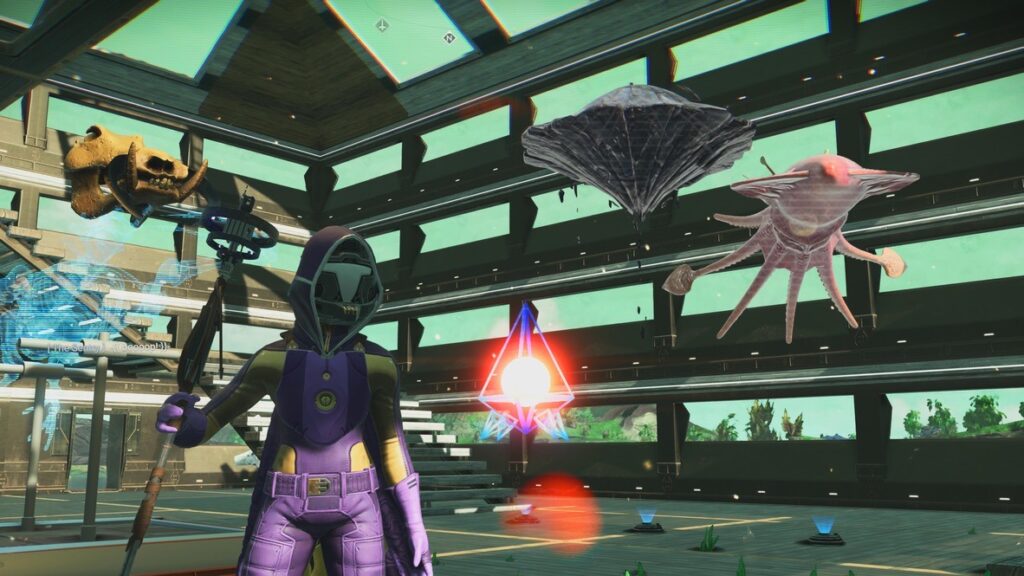
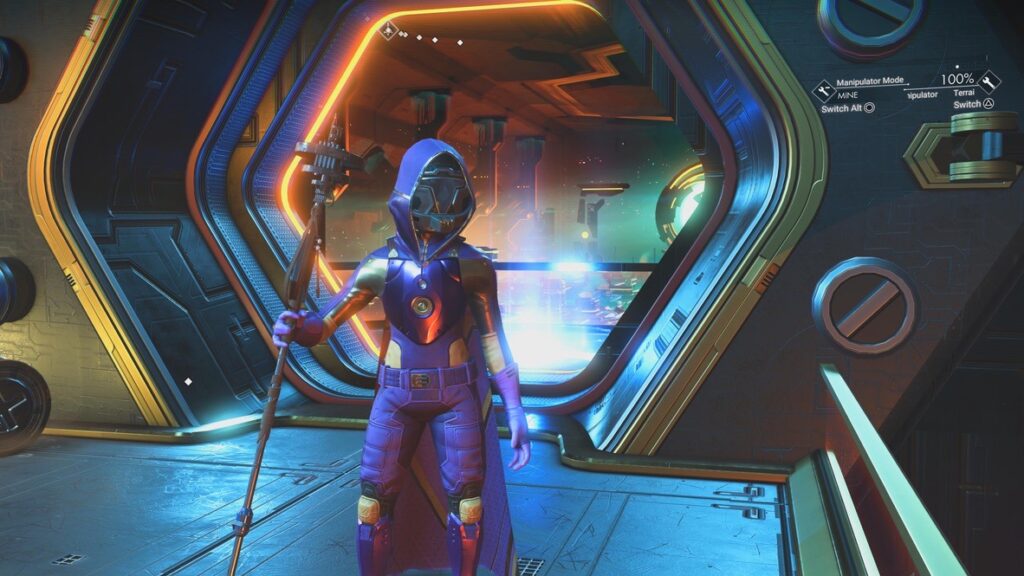
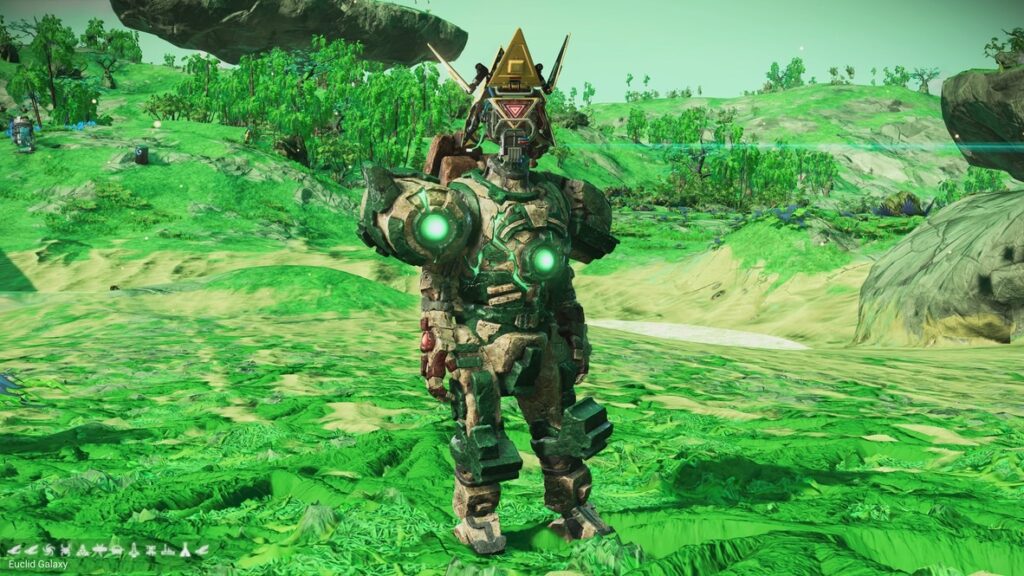
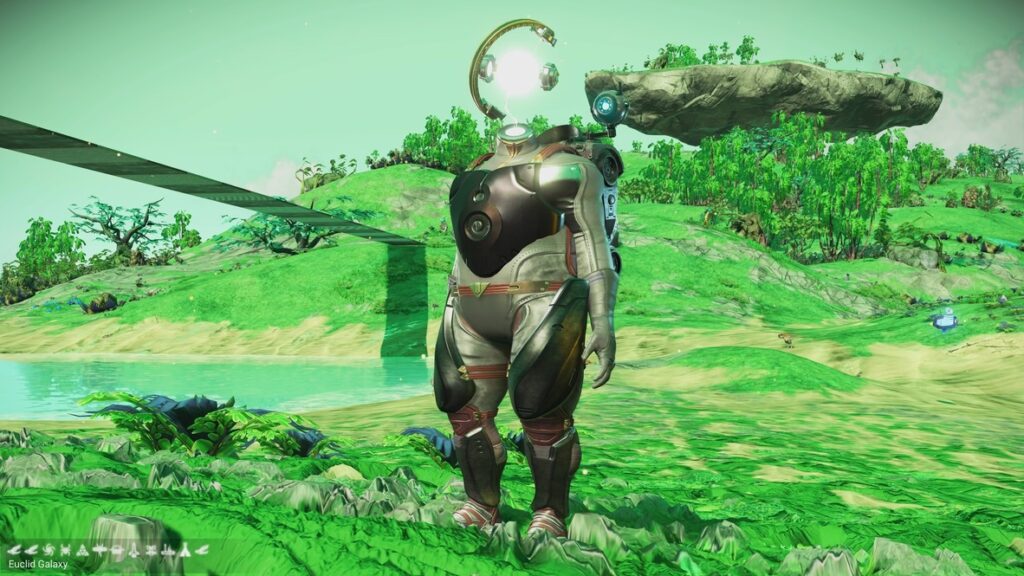
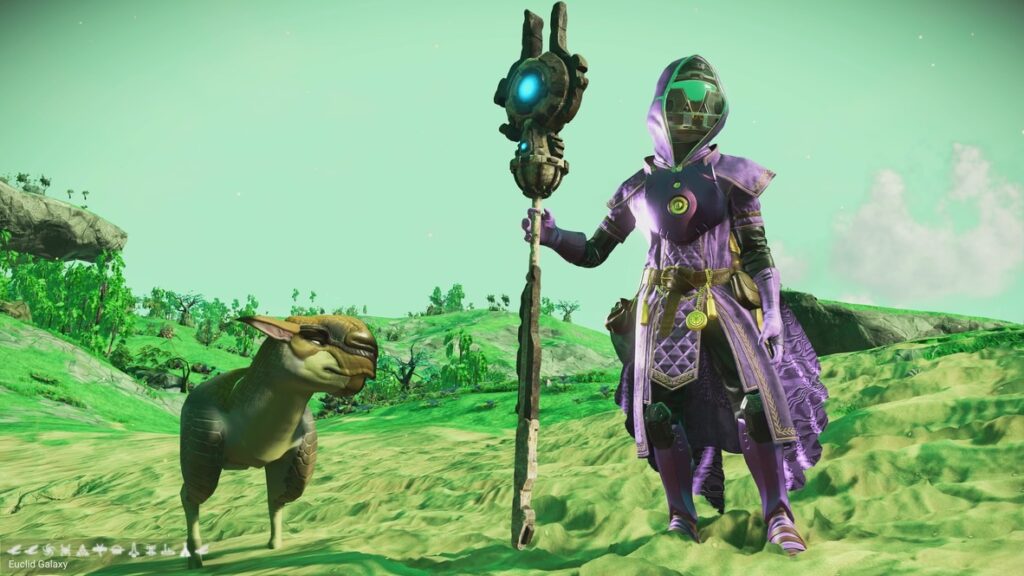
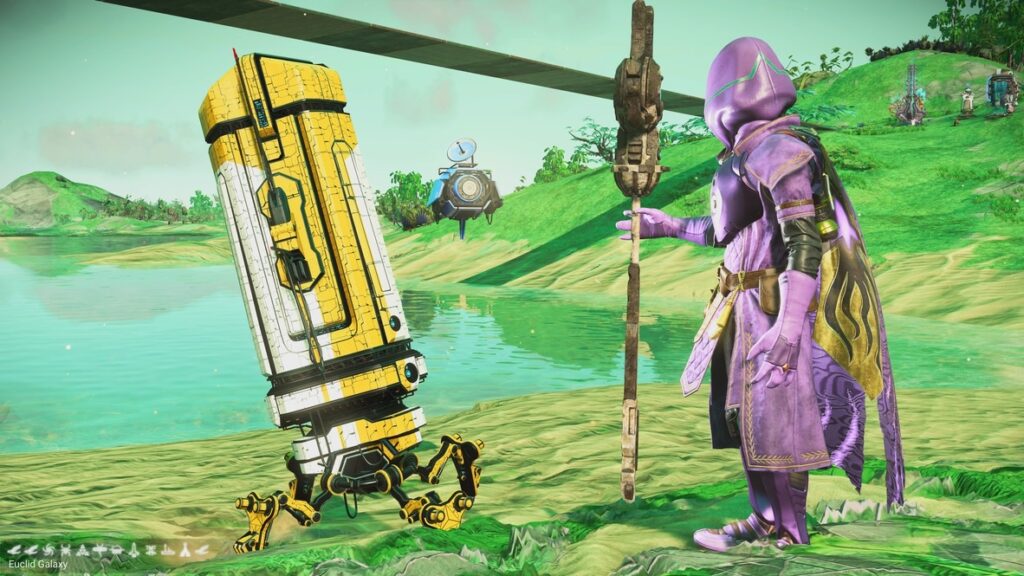
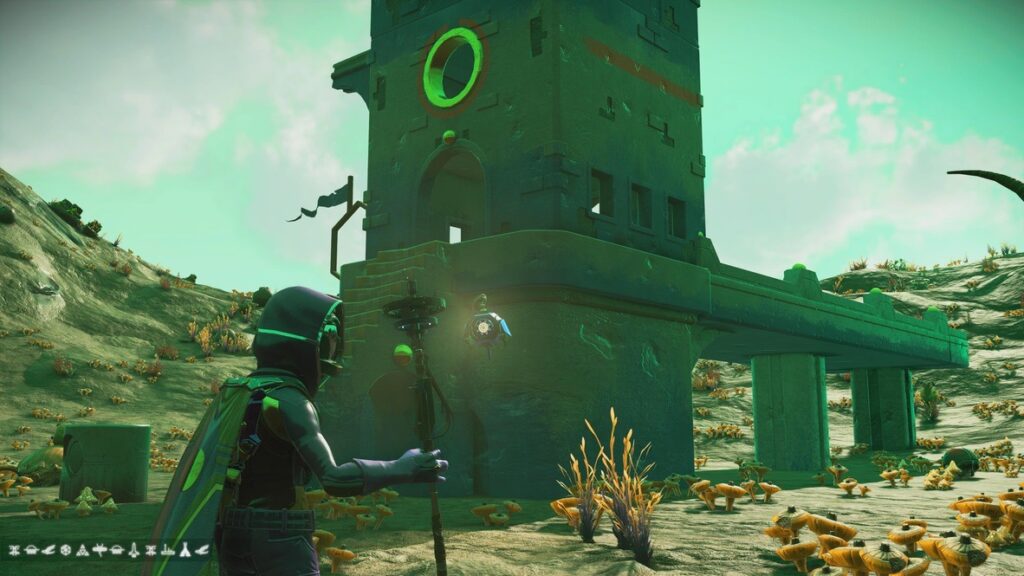
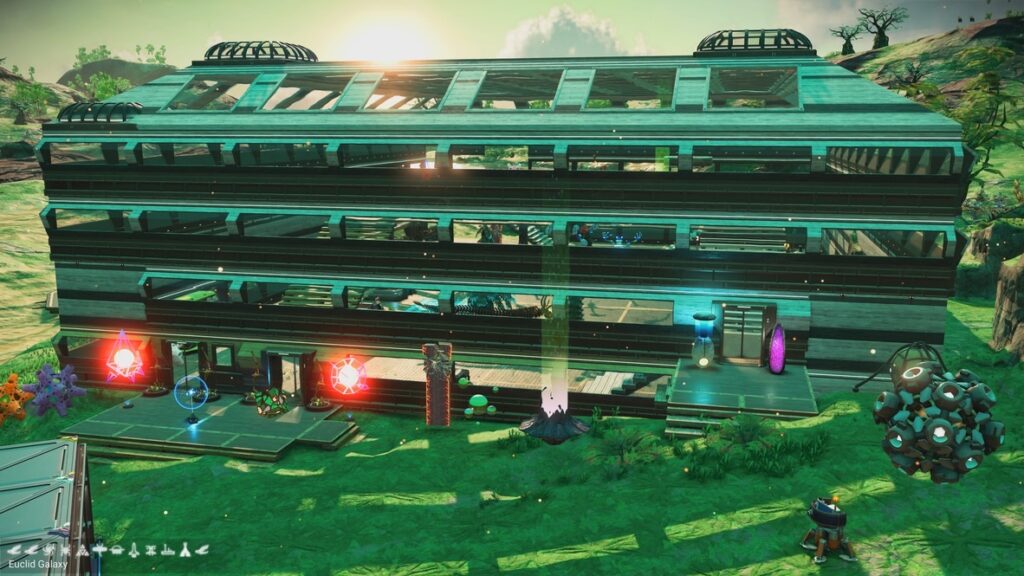
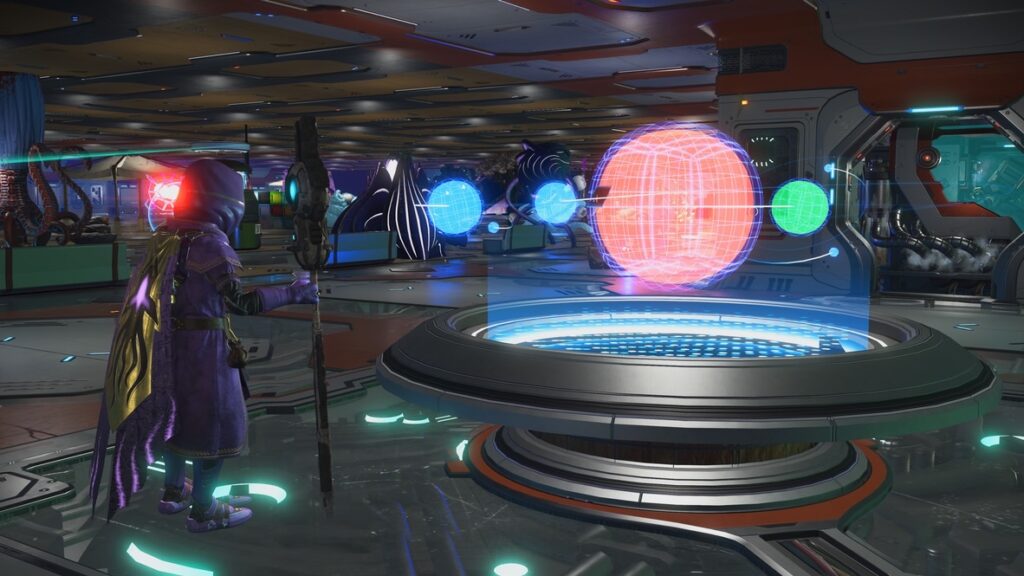
For example, it was now possible (or at least easier) to build bases. This is the central building of my main base, Ramazith’s Museum. It may look impressive, but it’s nothing compared to the beautiful bases built by players who know far more about architecture and the game’s construction mechanics than I do.Ramazith’s Museum contains mementos of my character’s travels.On display are holographic images of lifeforms I’ve discovered. I favor energy and mechanical beings.Over time, and by getting rewards from expeditions, I was able to acquire suit and multi-tool modifications to get this look. I call it my “Wizard outfit.”Lots of outfit possibilities are available. You’re not stuck looking like a space-suited traveler. Here I’ve put on an outfit that makes me look like a rock creature with a robot head.Another outfit example. In the picture, you can’t see that the head portion is constantly rotating.This my character’s current look. I call this a “Warlock outfit.” I’m standing next to one of the native creatures of the planet on which my base is located.The creature in the previous photo is not a pet (though I could make her so), but both of these critters are. The yellow one is from an exotic planet where the animals are mechanical. The floating blue mechanoid is a Sentry, who’s available as a companion if you get far enough in the game’s story. Unlike the digital pets of World of Warcraft or the familiars of Baldur’s Gate 3, NMS pets are transient and vanish when you go to a new location (including when you board your spaceship).
There are three main races in the game. You can change your appearance to look like one of them if you choose, but you’re a fourth type of being: a Traveler.
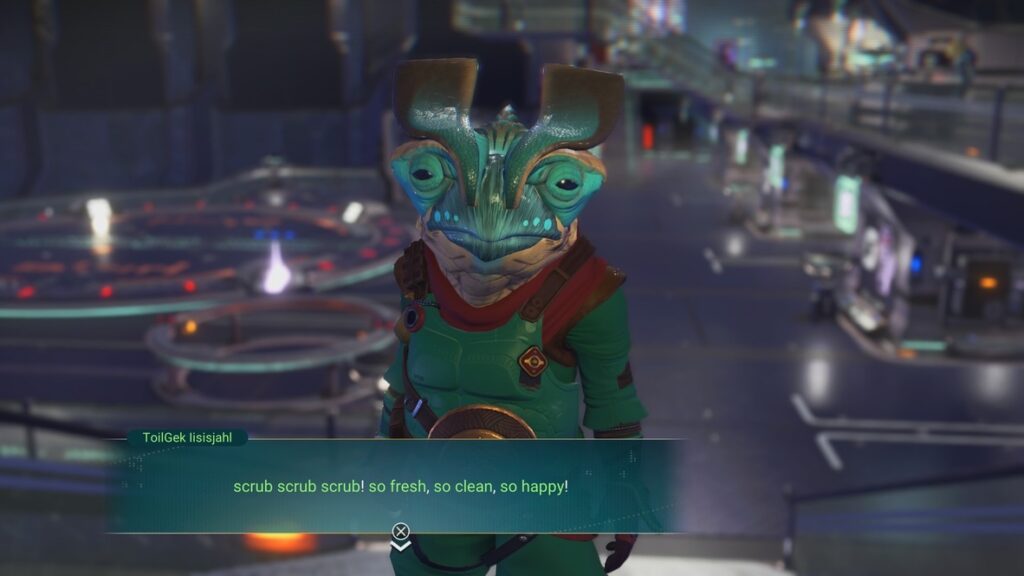
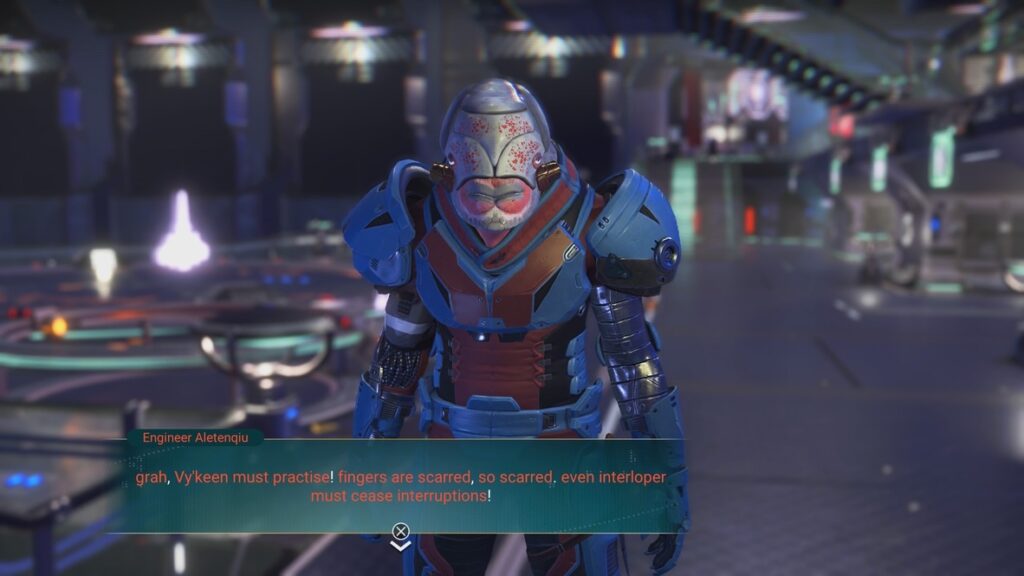
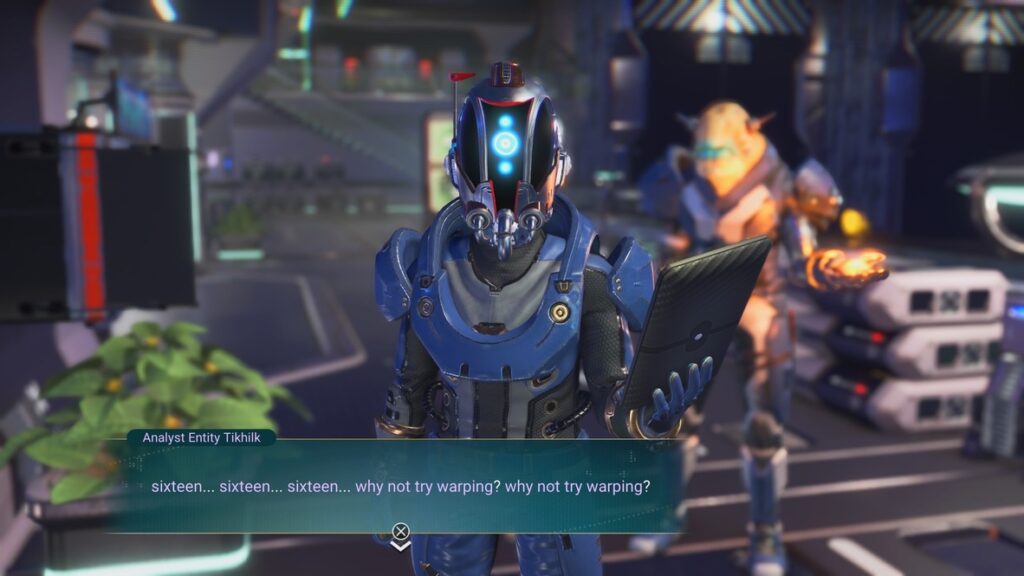
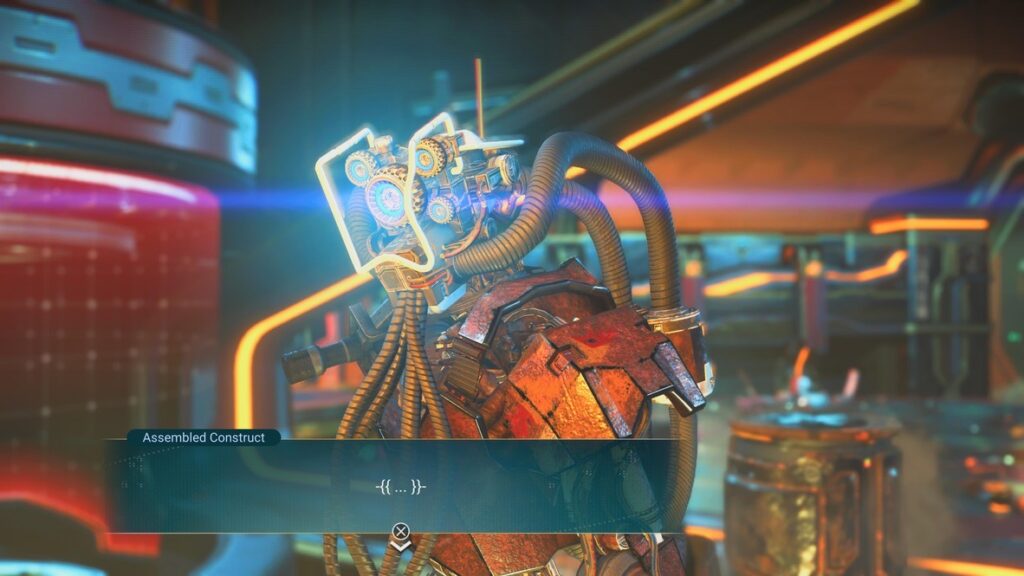
This is a Gek. It’s one of the minor NPCs in the game, randomly generated and named. They’re a race of traders… perhaps.This is a Vy’keen NPC. They are a warlike race. No, you don’t get involved with battles with them in particular.This NPC is a Korvax, a race composed of computational nanites. Part of the story is learning why so many of the Korvax are focused on the number sixteen.
One of the features of NMS is that its universe is procedurally and algorithmically generated. Superficially, it looks as though things are random:
one example I gave above: the names of the minor NPCs;
the stellar systems and their characteristics, such as spectral type and names;
the nature of the planets (hot, cold, acid, watery, etc.) and their names;
the creatures on the planets are generated according to general rules of evolution, but their exact forms are individual;
the types and resources that can be gathered from minerals and plants
… and much more.
Although all this looks random, it’s not. The “dice” are pre-rolled. The universe of NMS is vast and detailed, but it’s not stored on your computer. Instead, the game uses an algorithm to re-generate everything, from the positions of the stars in your region of the galaxy to the position of plants on the surface of a planet.
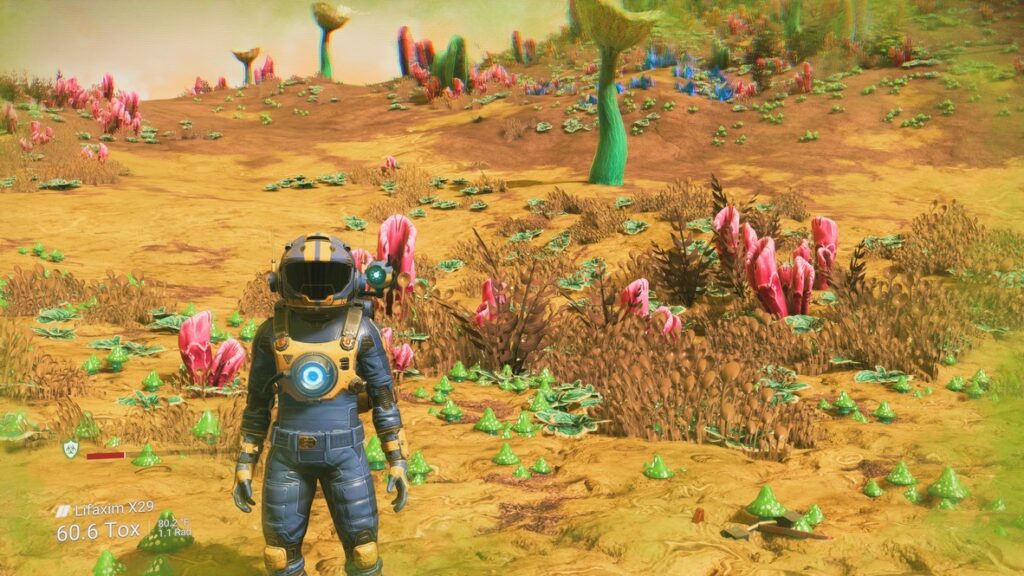
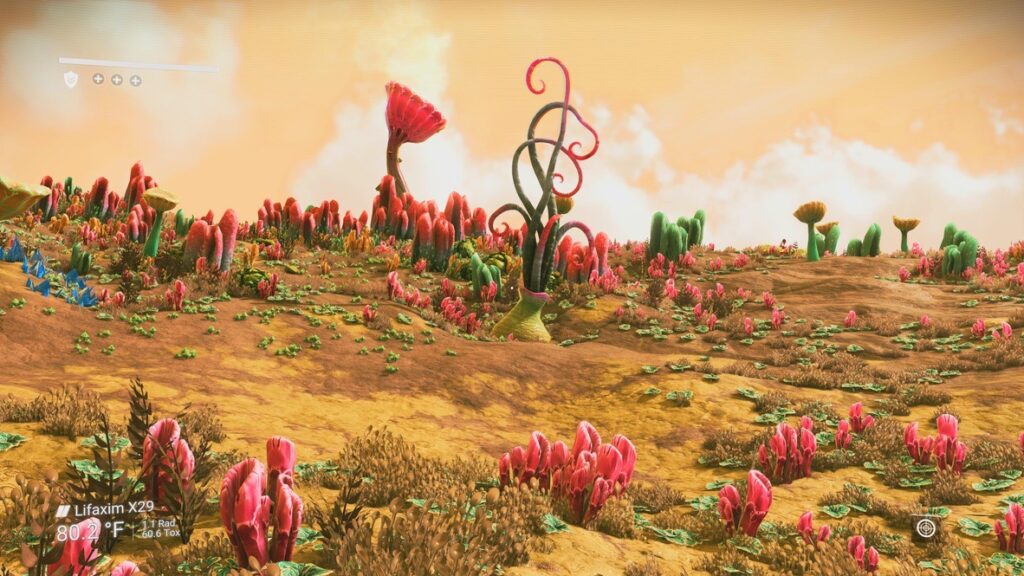
If you were able to visit this spot on Lifaxim X29 (note the “random” name), you’d see the exact same plants and rocks and terrain that I did. It was generated “on the fly” for me using a deterministic procedure. The same would happen for you if you could return here.
The scope of this process is staggering. There are something like quadrillions of star systems of several planets each, within each of 255 galaxies. Each one of those planets has an environment, geography, resources, minerals scattered about, and flora and fauna if the environment permits it.
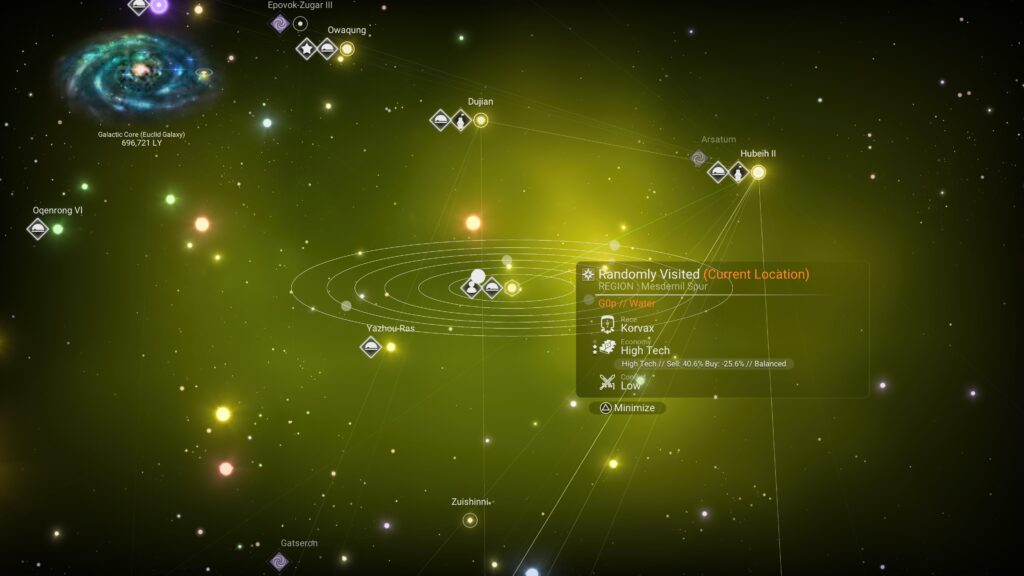
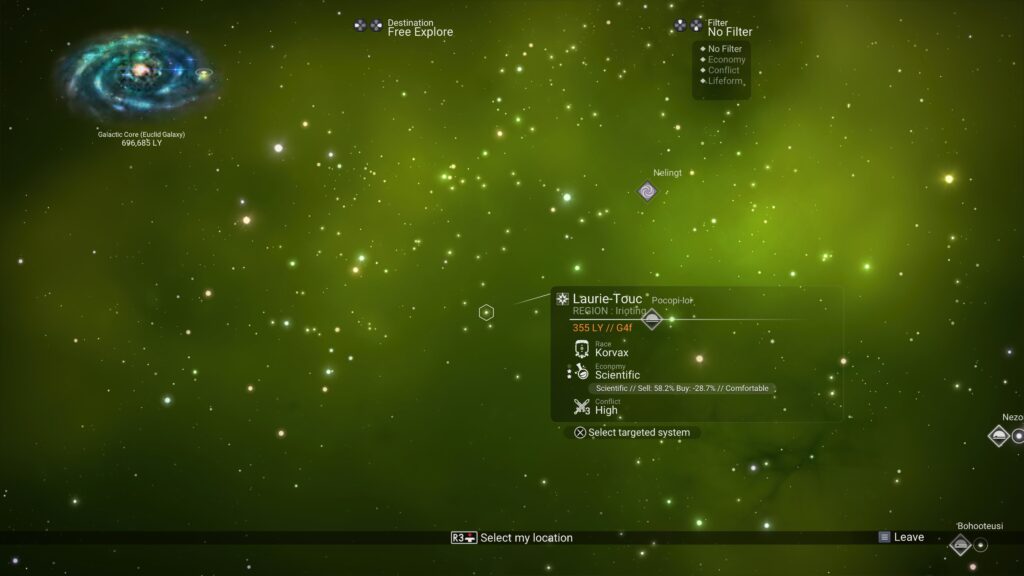
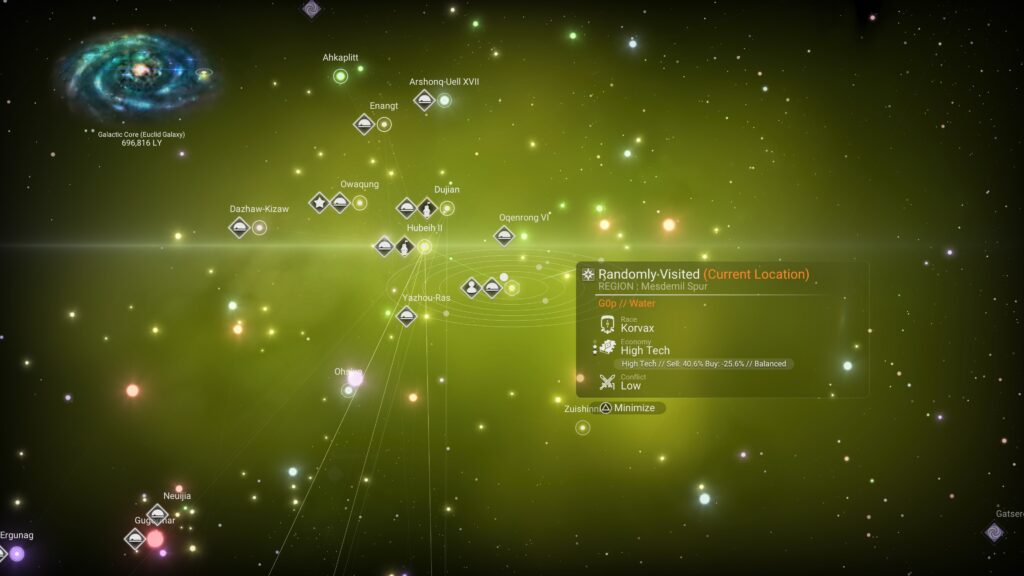
This shows a star map of the general region of space that I explore, at least towards the beginning part of the game. It’s sad that this map does not show the new names I picked for many of these systems; “Hulbeih II” was renamed by me to “Wizard’s Folly” but that doesn’t show here. It’s where my main base is located.Every one of the stars you see is a potential new system to explore. I’m probably never going to visit the Laurie-Touc system in the Irioting region, but it’s nice to know that it’s there. You can’t tell from my 2D screenshot, but this is a 3D map.One of the game’s “randomly” generated star systems. Although the creation of all these systems is deterministic, from the human perspective it looks like “recreatable” random numbers. The name of this planet, 3D6, is not random; I gave it that name.
In the current version of No Man’s Sky, there’s lots you can do. What follows is not meant to be an exhaustive list.
Story
There is a story within the game. It has some interesting elements in it, but I wouldn’t play NMS just for that.
Here is another picture of Atlas, a being that has to do with the story.
What I only began to appreciate a few months ago is that, in order to gain access to some nice benefits in the game, it’s a good idea to complete the story.
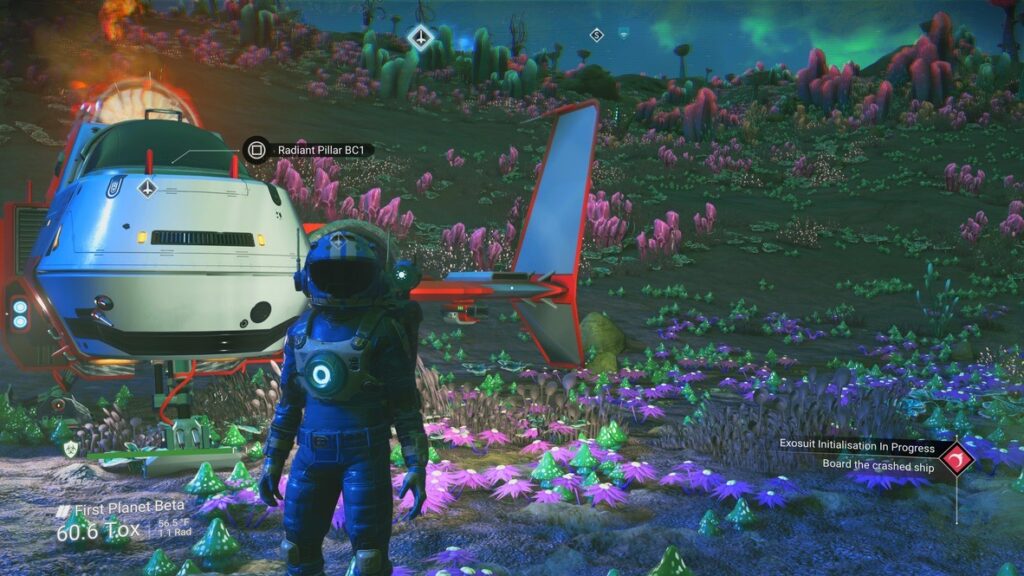
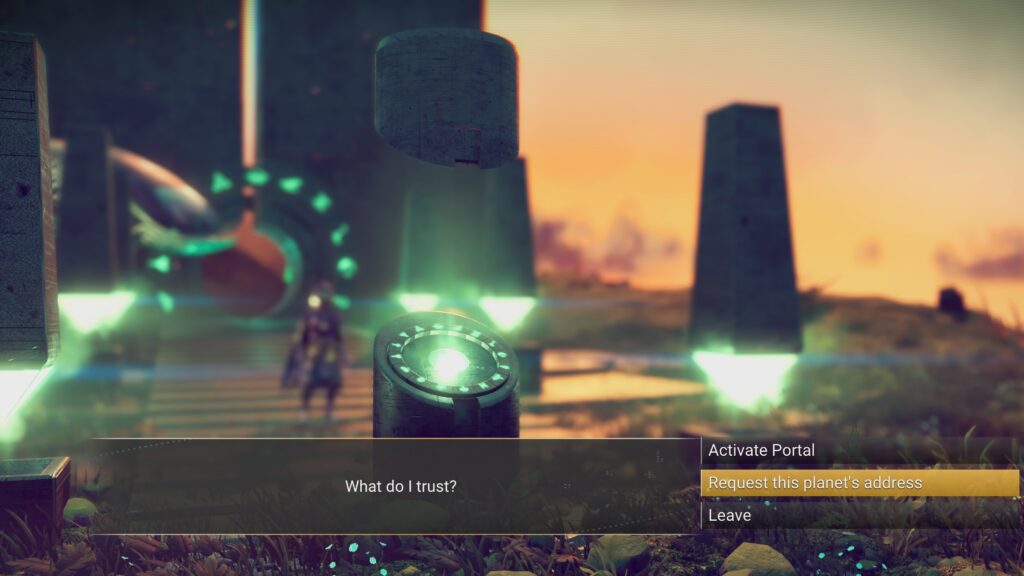
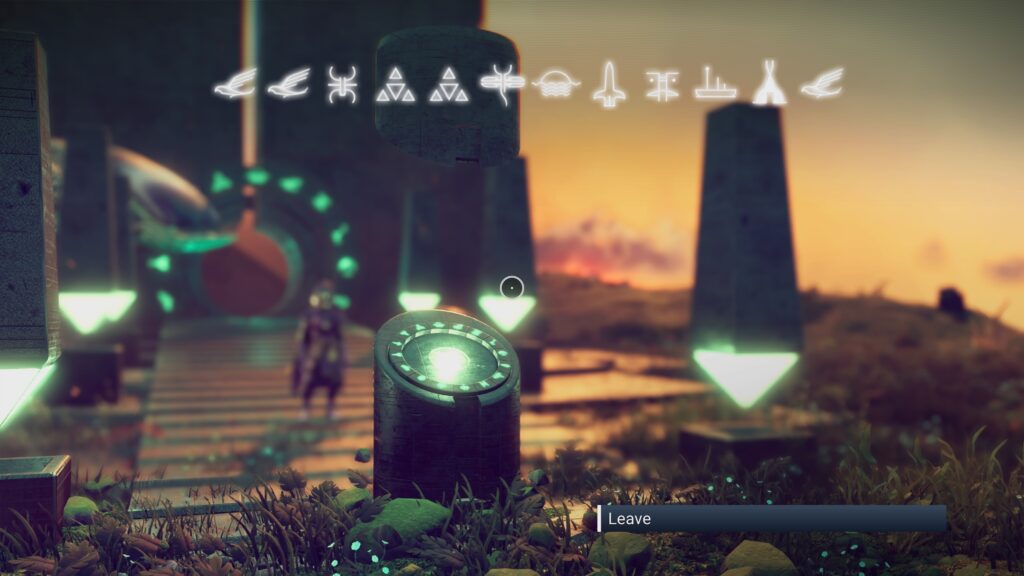
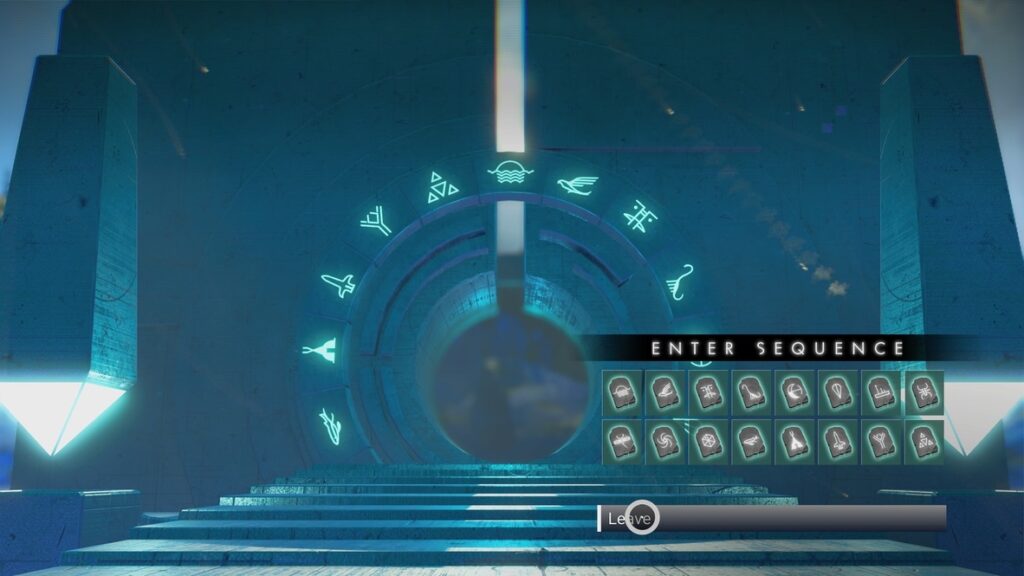
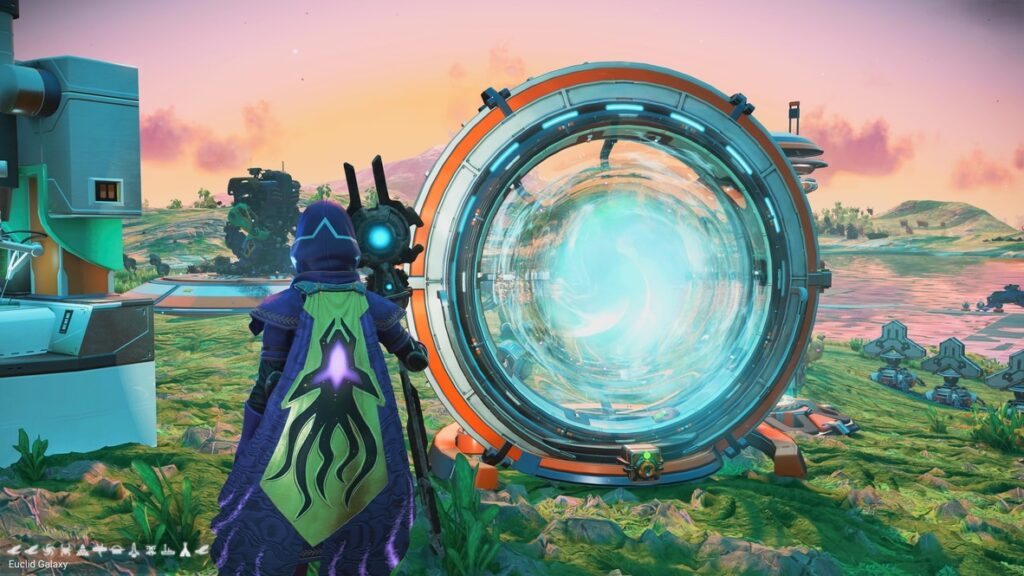
Here’s an example. This is the first planet I ever saw in NMS. Would you like to visit it too? (There’s nothing special about the place, and I don’t say this is something you should do.)When you get far enough into the game’s story, you’re able to unlock a Portal that can be found on every planet.I asked the Portal to display the planet’s address. If you learn how to use Portals, you could enter that address and be transported to this planet.If I’d chosen to enter an address, I’d see this display. I could click on the symbols and be taken to any system whose address I know.You can also see a system’s address in the lower left of any picture taken using NMS’ photo mode. However, I’m guessing that this is pretty hard to see in a blog post, even if you zoom the image.
Again, teleporting to known locations (an important ability if you want to rendezvous with someone among several quadrillion locations) is just one benefit of following the story. There are resources you can only gather and gear you can only construct through completing the tale.
Exploration
It’s a beautiful game. There’s lots of variety. There have been times when I’ve just gone from planet to planet and looked around.
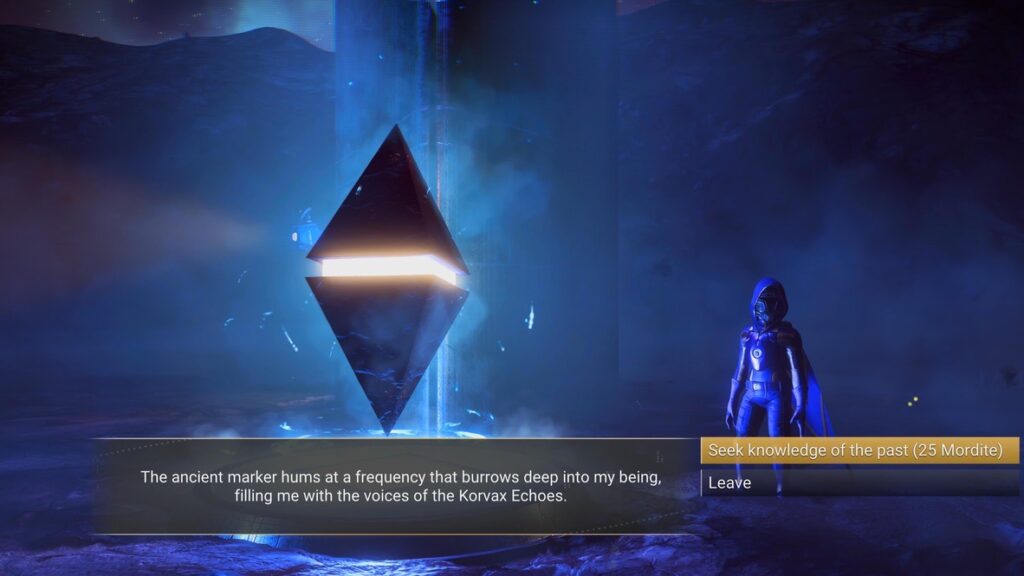
There are ruins, outposts, research stations, and all sort of things scattered about every planet.What does this do? I hope I have 25 Mordite so I can find out!What’s on Yesosowio? What does it mean to be an Incandescent Planet? Is this a good place to mine Phosphorus? Let’s go see!
Building things
I mentioned building bases before. A “base” can just be a single marker, or it can become more elaborate.
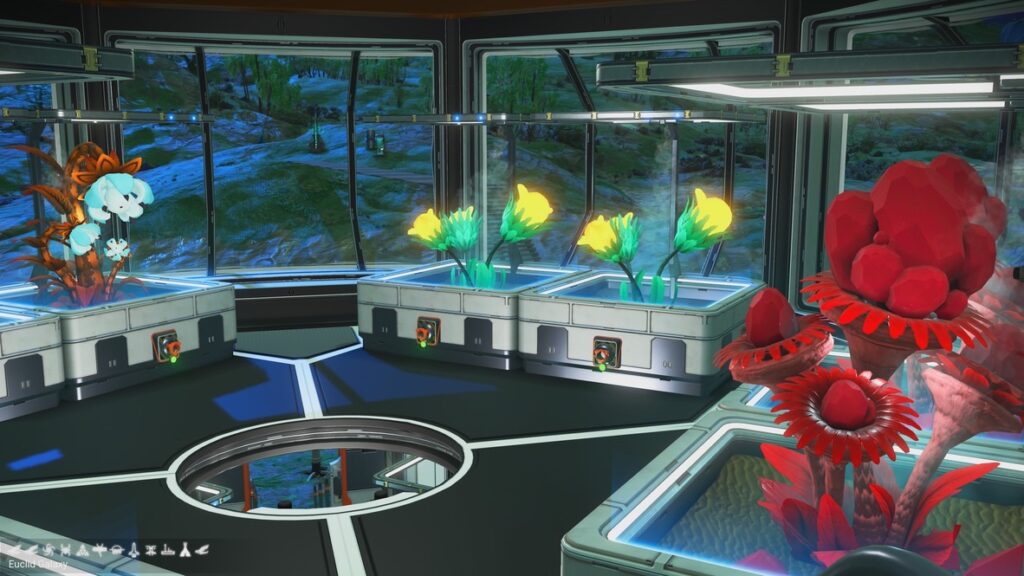
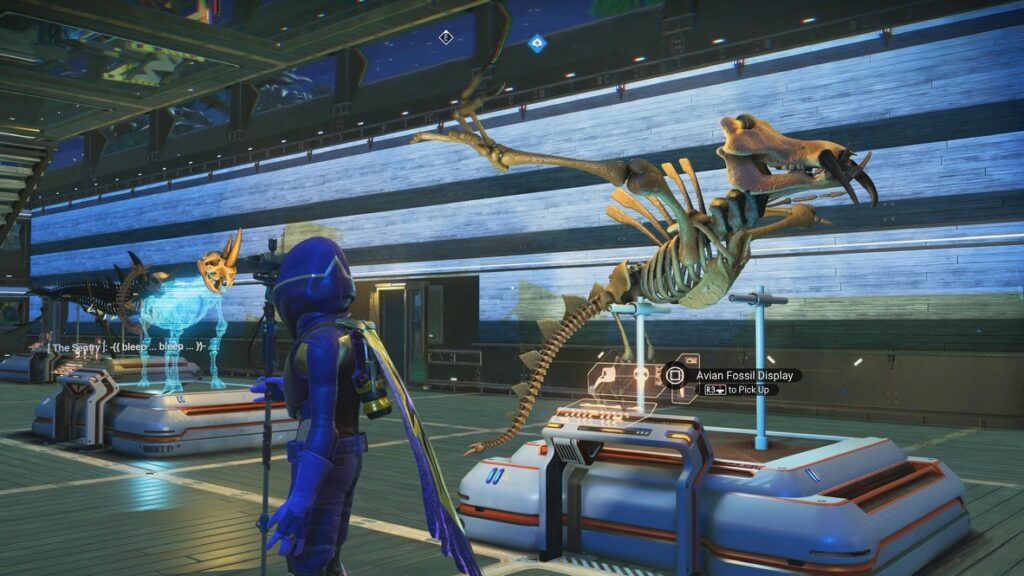
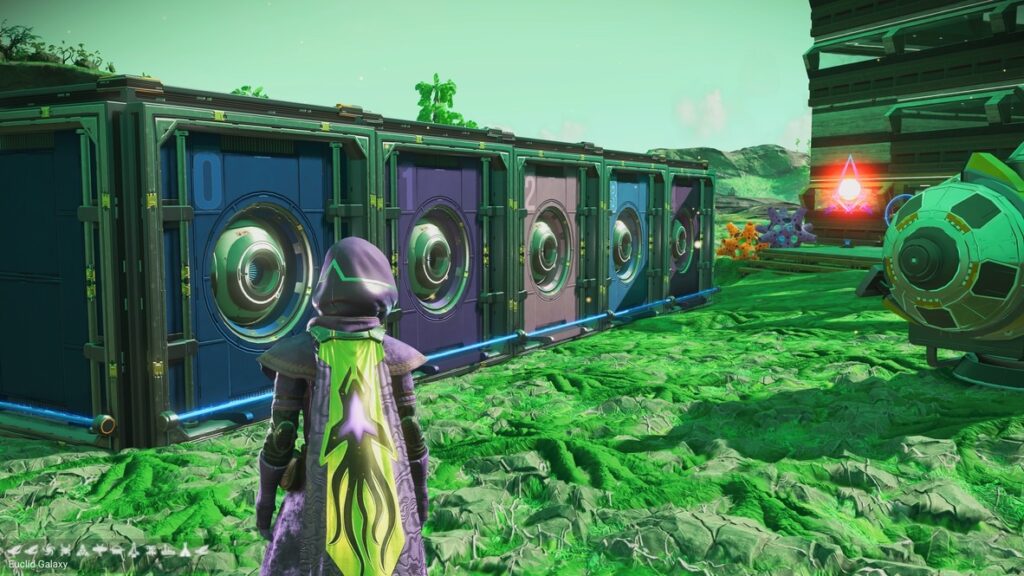
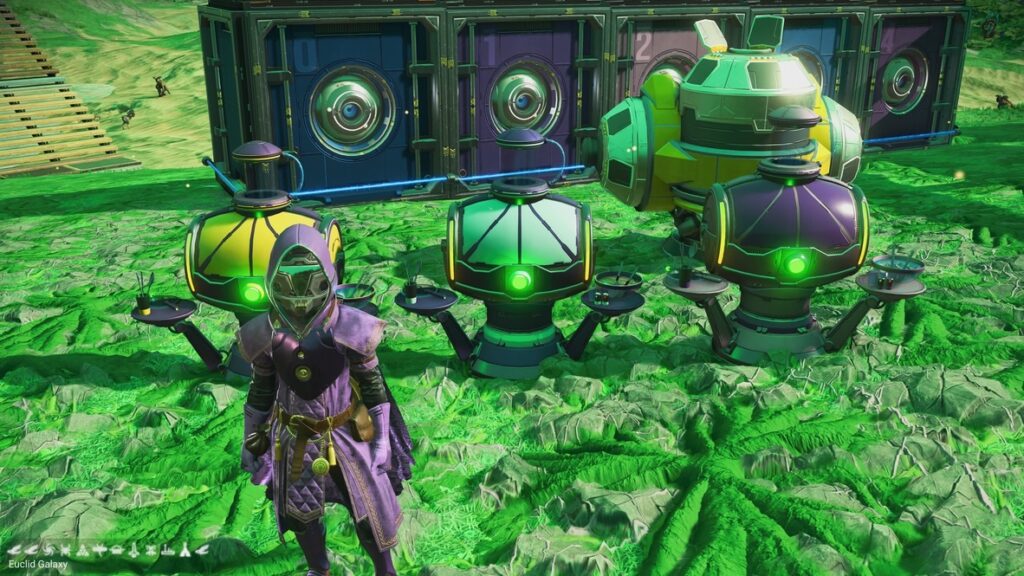
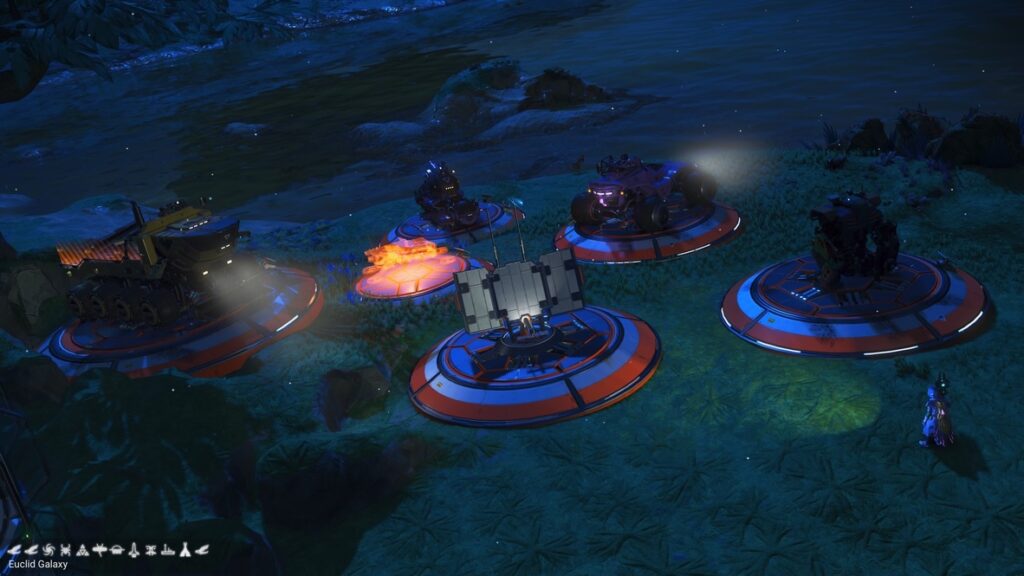
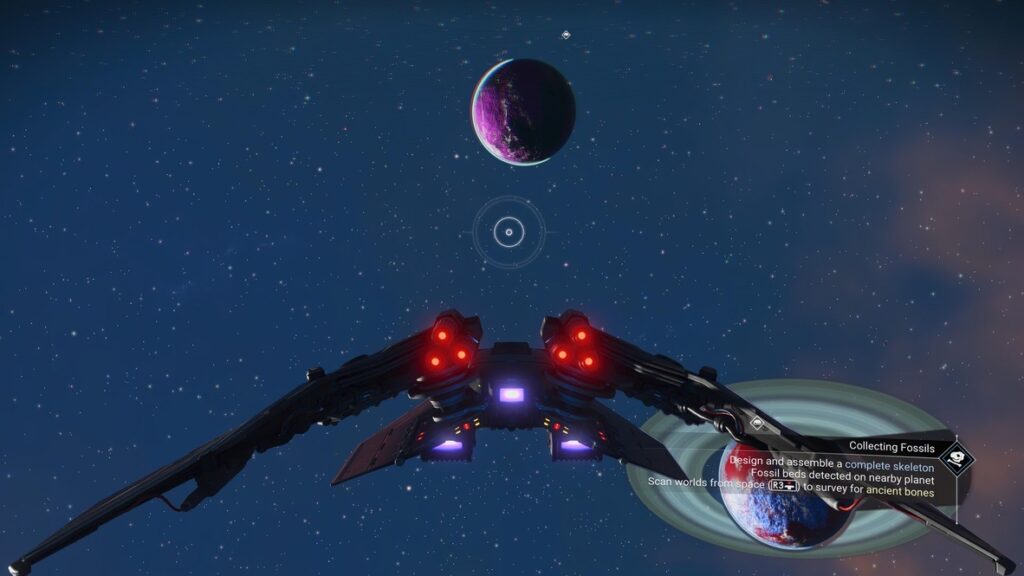
Here’s Ramazith’s museum again. I’ve also decorated the outside with strange items I’ve gathered in my travels.Gathering resources like herbs are part of the game. After a while, you can learn how to grow your own. I never have to search for Gamma Root again!One of the expeditions added fossil collecting. You can dig up skeleton parts and arrange them in displays, or sell them, as you choose. Here you can see an Avian Fossil that’s a permanent part of the exhibit in Ramazith’s Museum, along with a partially-assembled skeleton in the background.You can build Teleporters that connect you to any other Teleporter that you’ve built or visited. This is a handy way to zoom across the galaxy, or even between galaxies.You can construct vaults to handle your inventory. I’ve given each vault a different color, because why not?These three devices directly behind my character are Nutrient Processors. In other words, they cook stuff. The bulkier device behind them and to the right is a Refiner. They can transform resources into ones that are more useful… or more profitable.Spaceships are great for traveling between planets, but they’re not so good for surface travel. These are geobays for managing my Exocraft, including a truck and a motorcyle. (In retrospect, I shouldn’t have taken this picture during planetary night.)
There are also settlements. These offer much less flexibility than a base, in that the game allocates the building locations and types for you. Your control mainly comes in the form of choosing which buildings to upgrade, and some management of the resources generated by them.
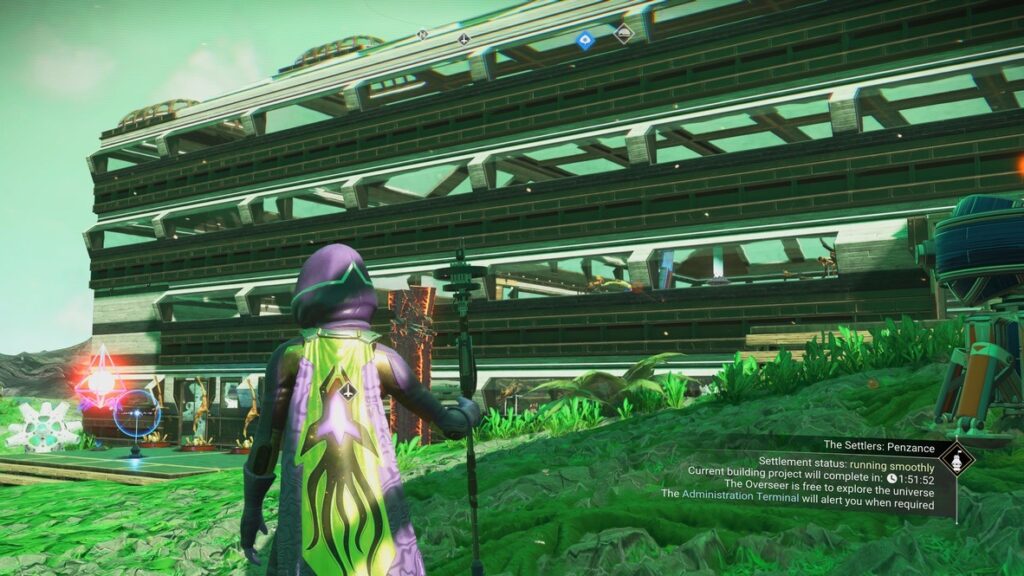
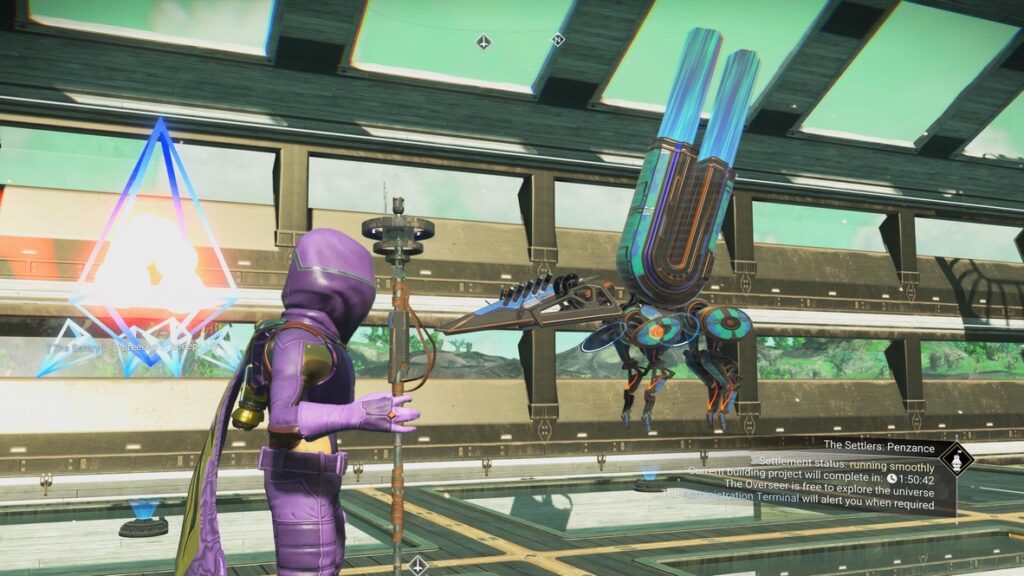
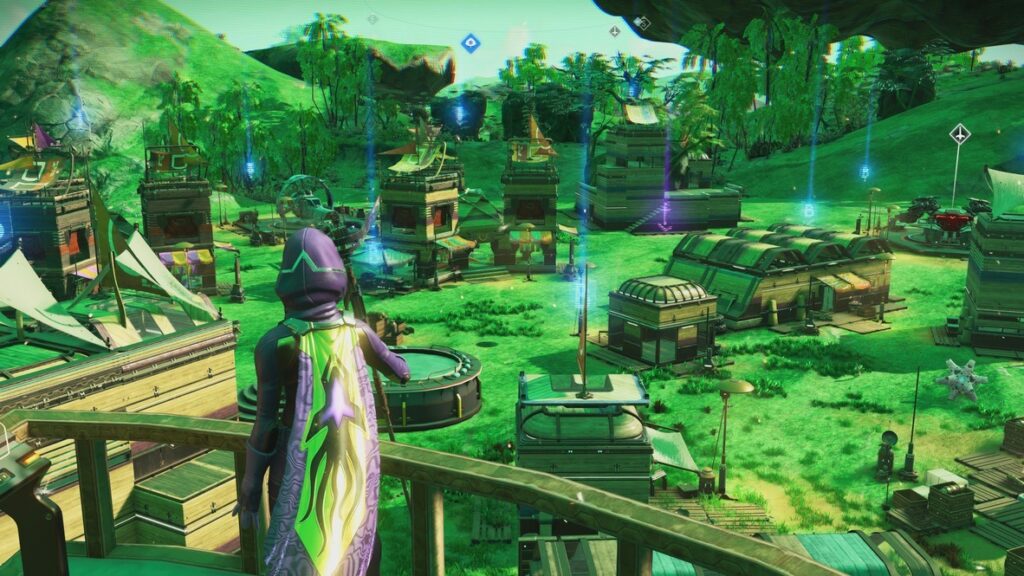
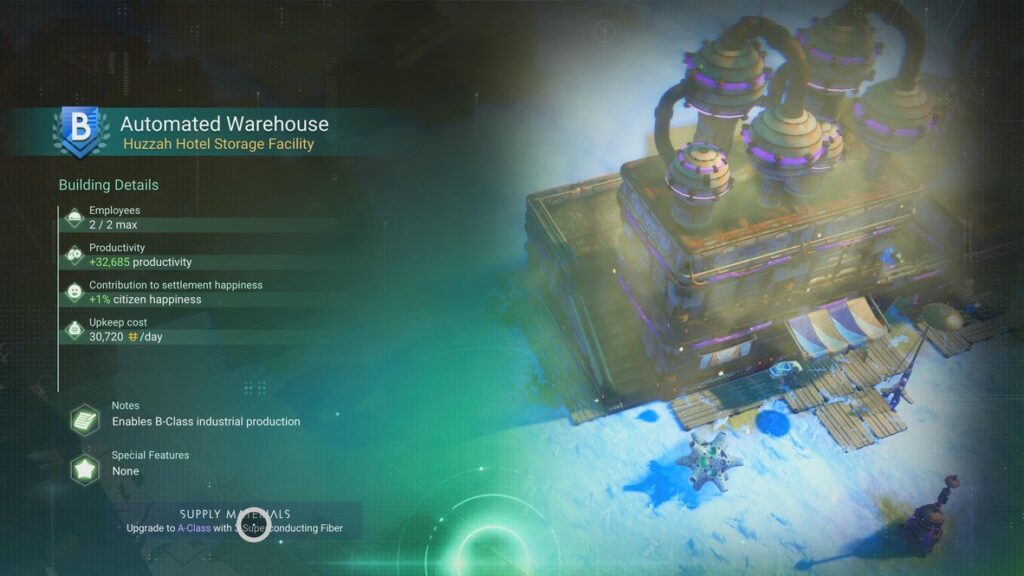
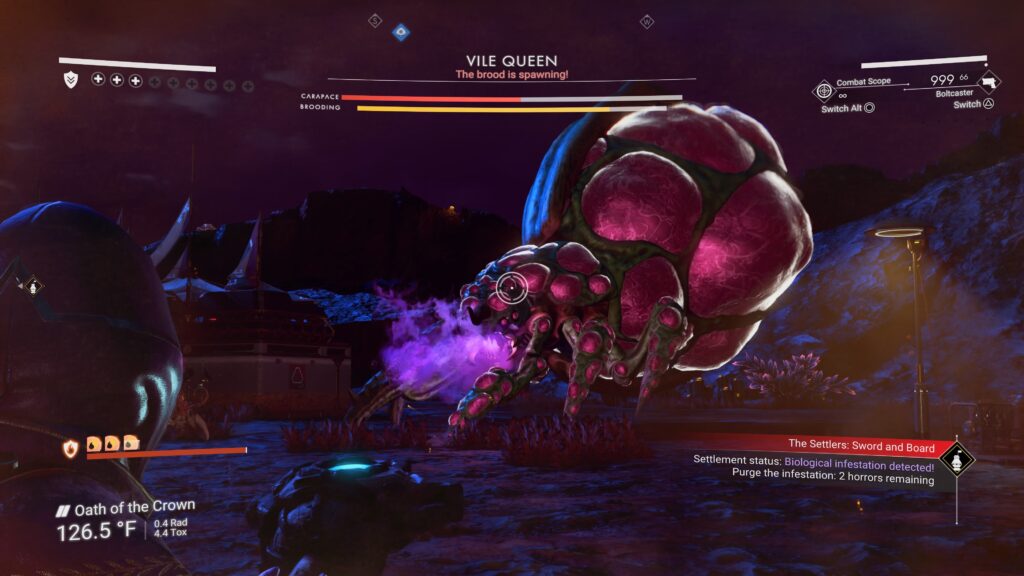
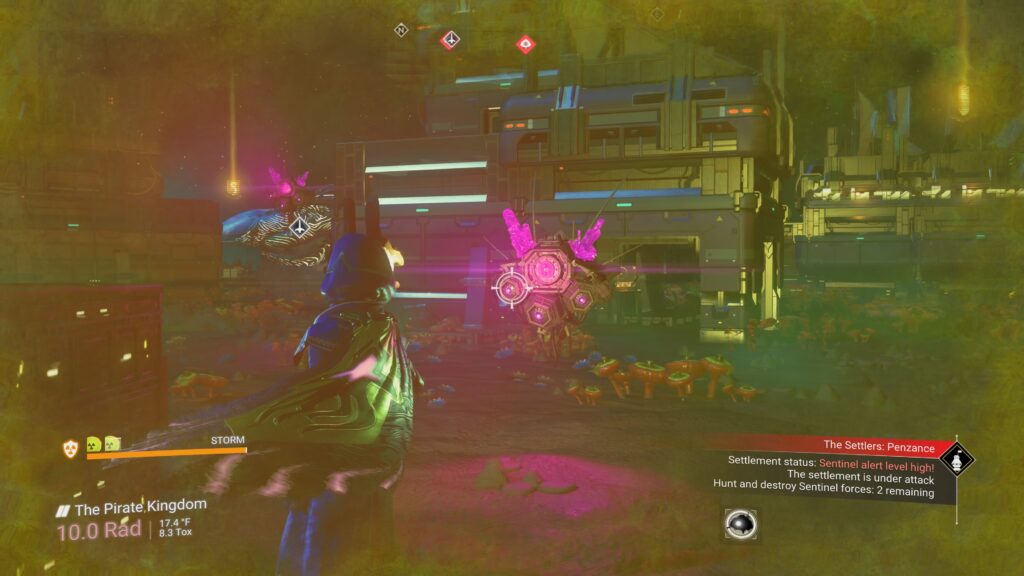
This is Oldtown. As the name suggests, it’s the oldest of my settlements, and it’s located on the same planet on which I’ve built my main base. I’ve fully upgraded all the buildings. It generates a small but steady income.One of the buildings in my settlement Huzzah Hotel, on the planet Anon, in the RenFaire system. Since I took this picture, the building has been fully updated.Occasionally a settlement needs your help to defend itself from Sentinels and other invaders. Here we see that a Vile Queen has invaded my settlement Sword and Board on the planet Oath of the Crown. This is one of my most productive settlements, so I have an incentive to dispatch this creature swiftly.Here I defend another of my settlements, Penzance on planet The Pirate Kingdom in the Gilbert-Sullivan system, against a Corrupted Sentinel attack while in the middle of a radiation storm. Hey, no one ever said that managing a settlement was easy!
The universe of NMS is procedure-generated on the fly. What’s stored on the players’ computers and on the game’s servers are changes to that universe. For example, when you leave a base and then return, the game regenerates the terrain then includes the base parts you’ve added. The same applies for other ways you can sculpt the universe.
Naming things
The general rule is: If you’re the first to see it, you get to name it.
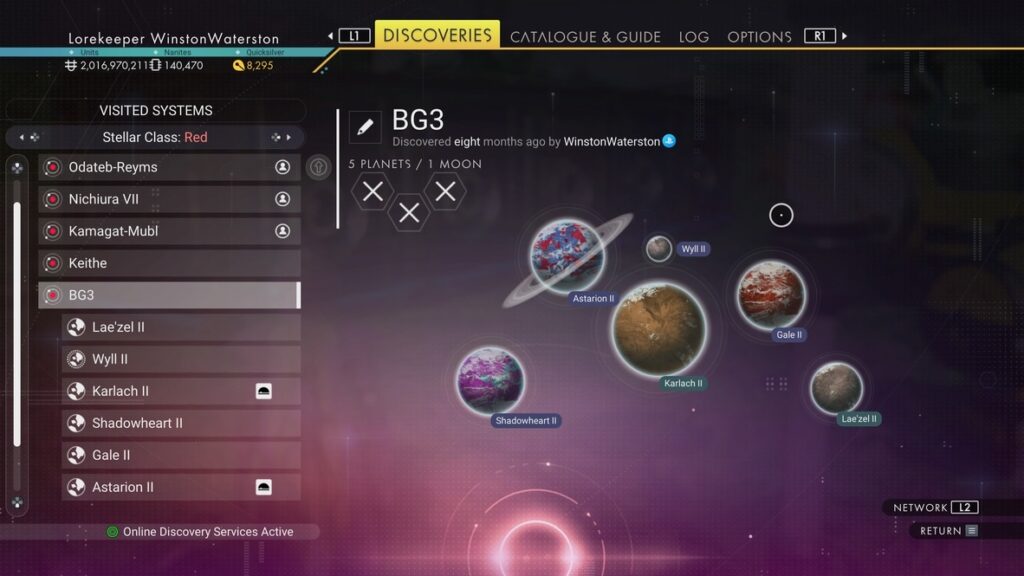
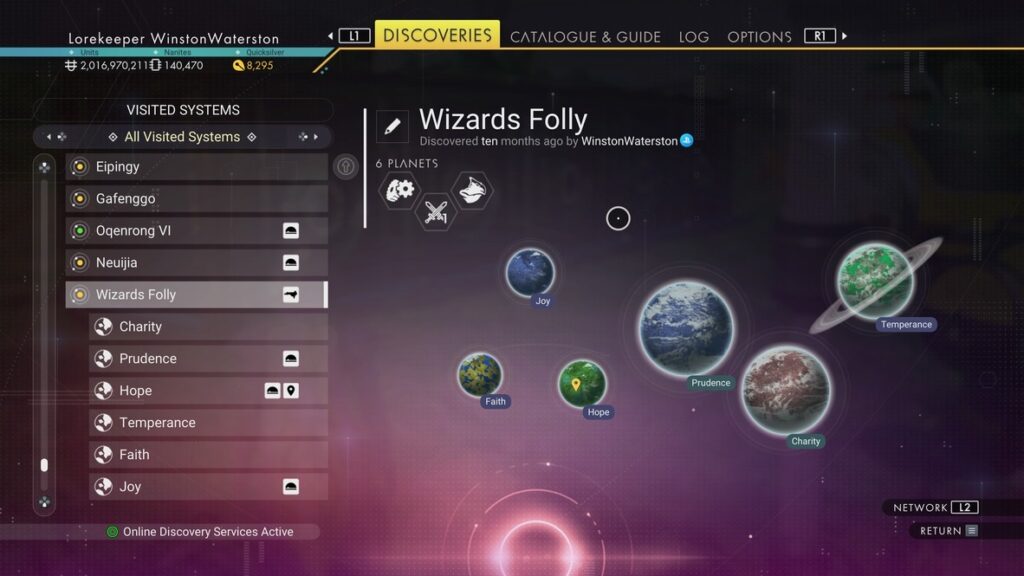
For example, I was the first one to visit this particular stellar system. Since I was the first to explore it, I changed the random names the game assigned to the system and its planets.
After you move out of the general area of the galaxy in which you start, it’s likely that you’ll be first to visit any given star system. When I do encounter a system that another player discovered first, I usually see that they haven’t renamed anything, since the process is a bit tedious and they just want to move on. I like to leave my footprint, as you can see.
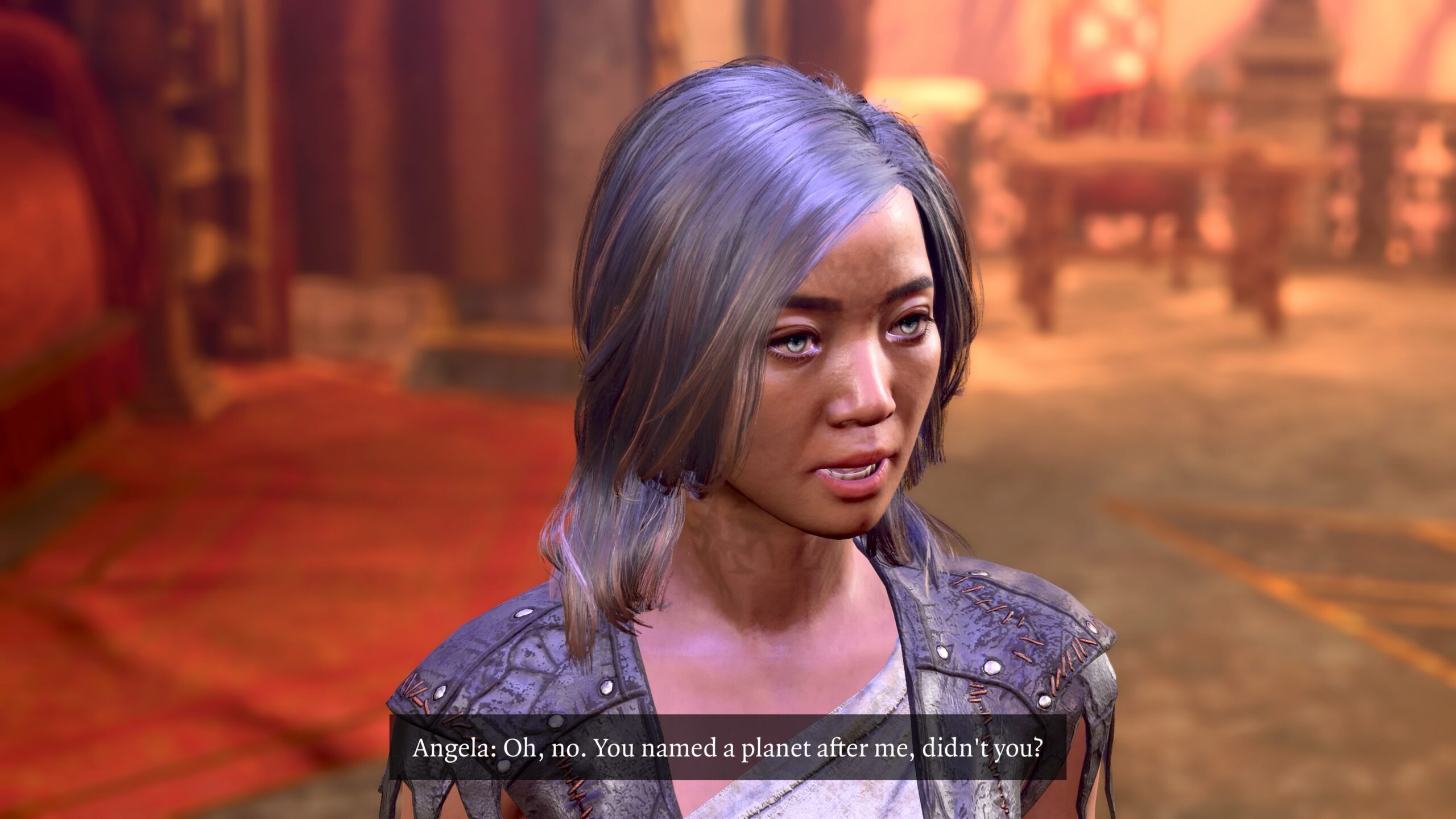
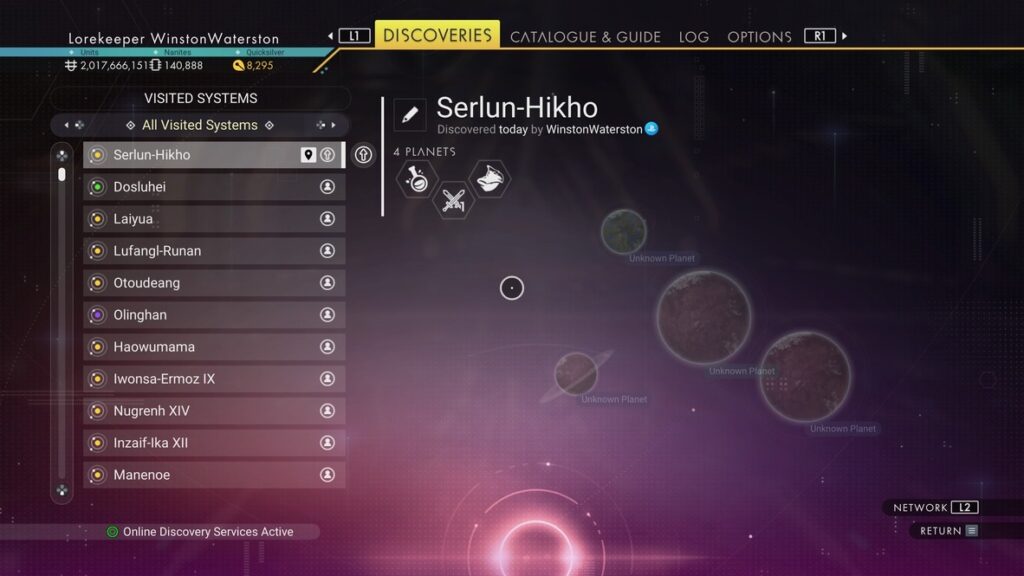
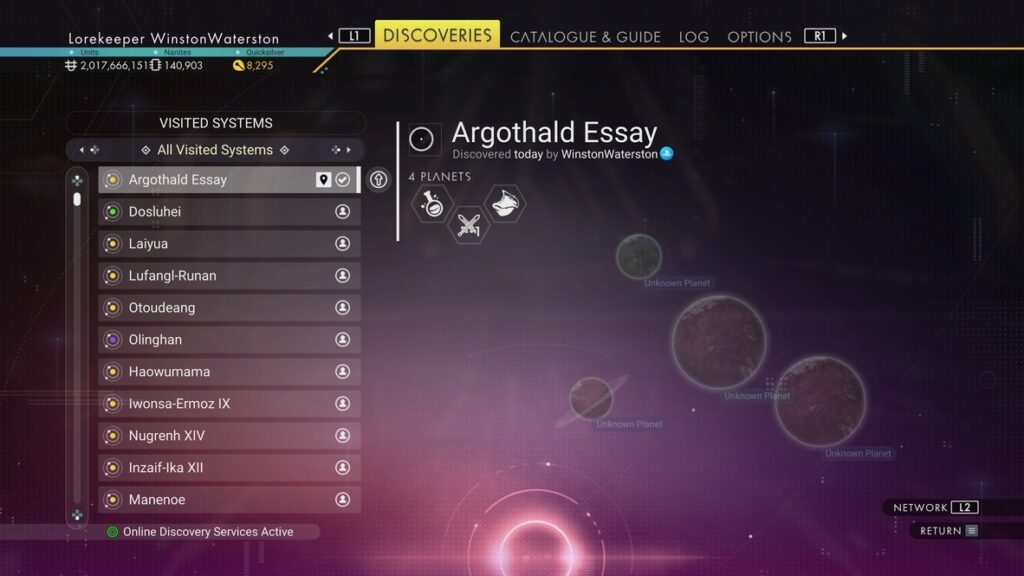
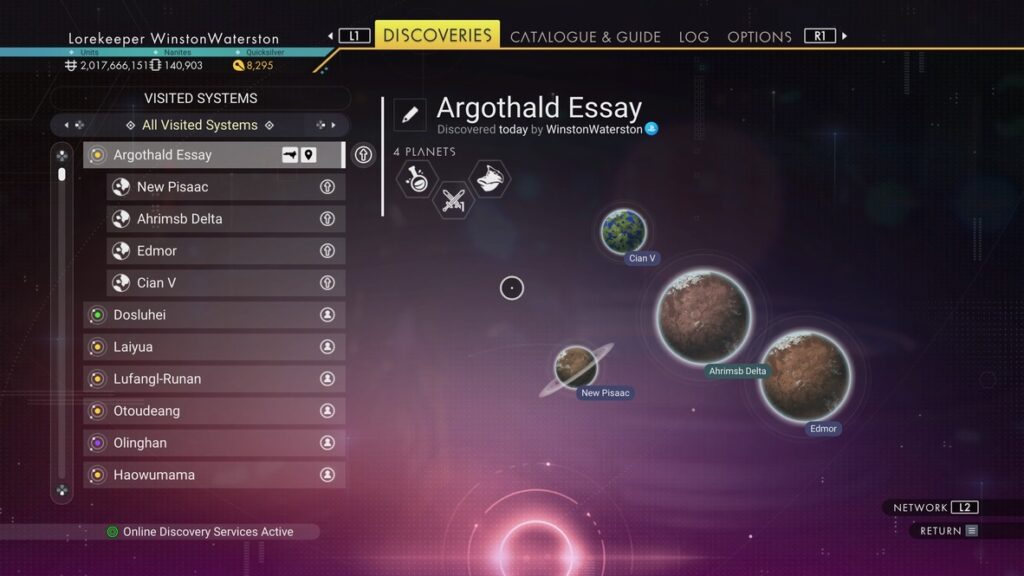
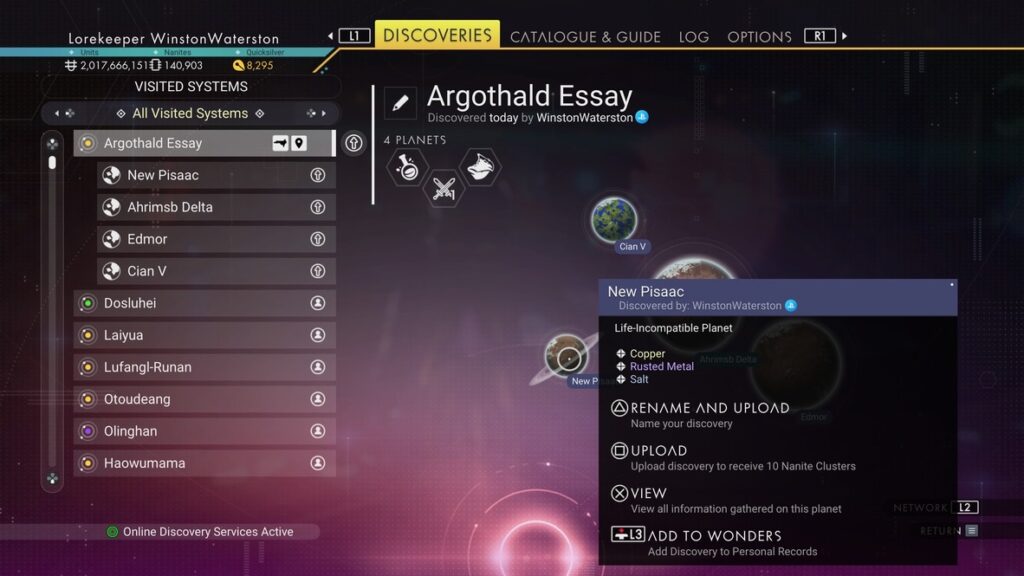
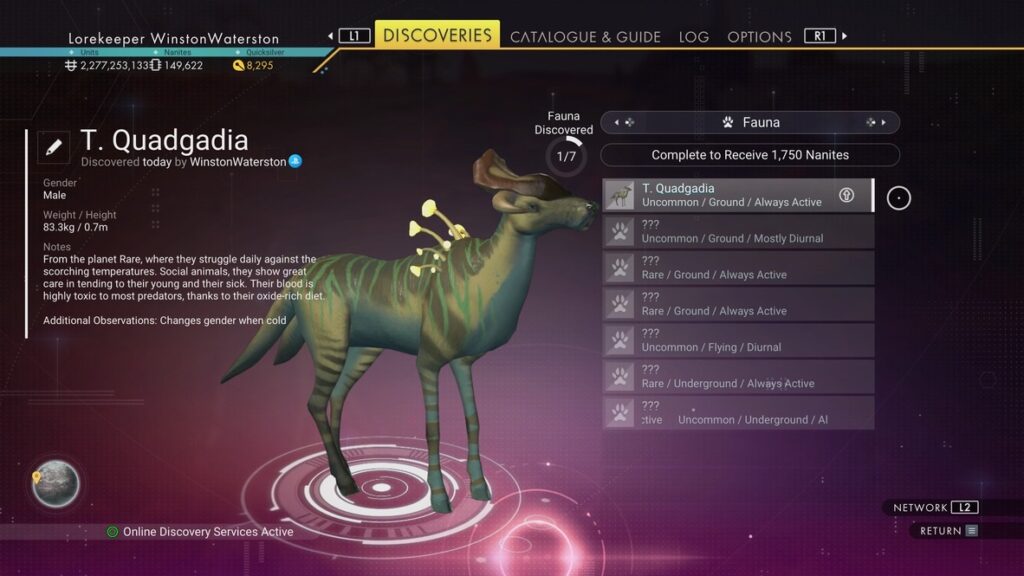
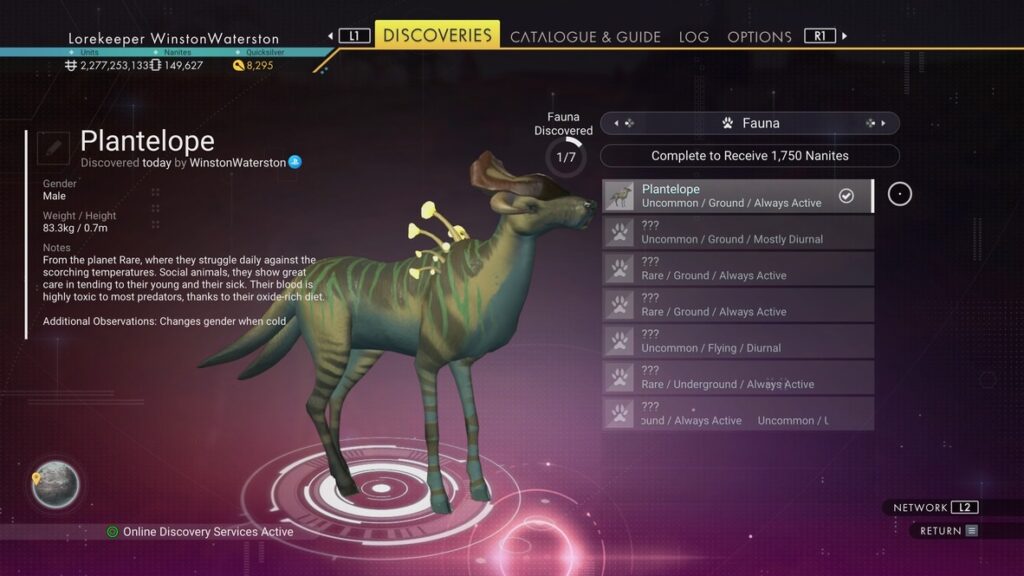
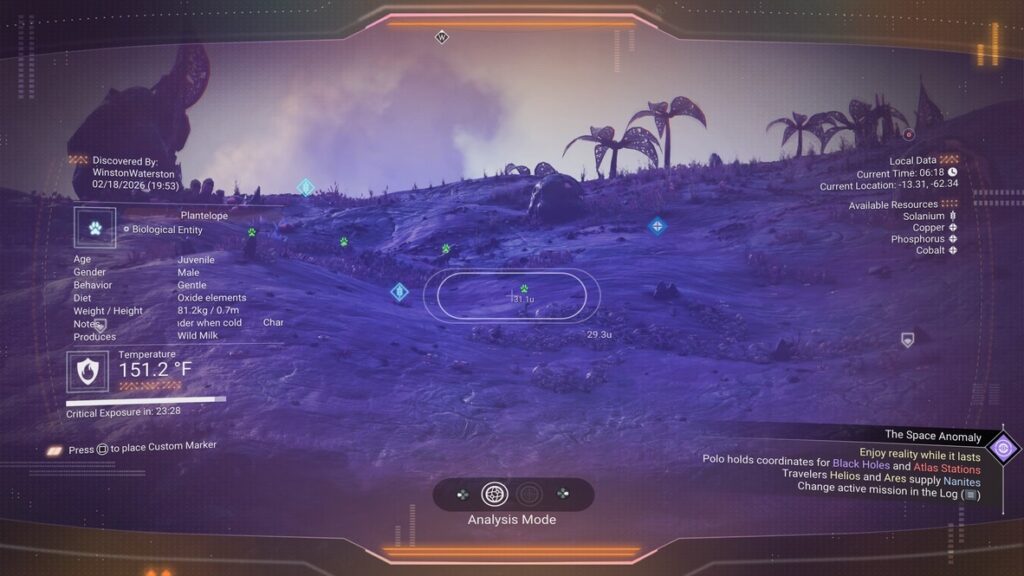
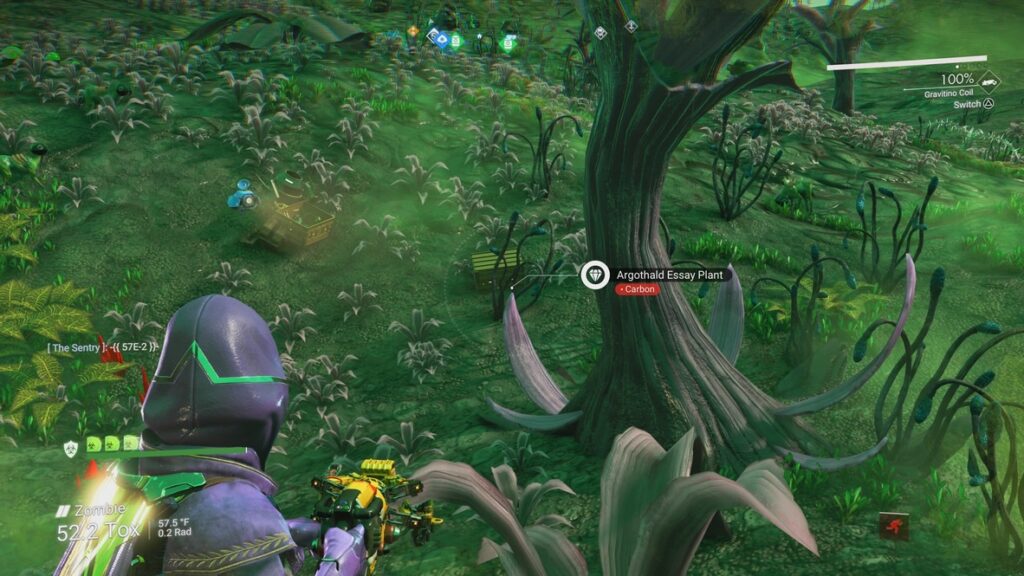
This is the system in which my main base is located. As you can see, not everthing in my life is BG3-related.Here’s how it works. For this essay, I visited an arbitrary system. Its random name is Serlo-Hikho.I changed the system’s name for this essay.I scanned the system to learn the names assigned to the planets, but chose not to change them.Scanning planets in this way lets me inspect their basic properties. Here we see that New Pisaac has no lifeforms, which made it a poor candidate for the next photos I wanted to take.I visited a different planet named Rare. (By a wild coincidence, the game gave it a name with a meaning in English.) I scanned a lifeform there, which the game named T. Quadgadia.Such a dull name! Let’s call it a Plantelope.If anyone else would happen to visit that planet and scanned its lifeforms, they’d see that I was the first to discover the Plantelope.I did the same to name a particular plant for this essay.
You can do something similar to almost everything in the game, from spaceships to minerals, as long as you’re the first to discover it.
Spaceships
You start the game with a broken starship. Your first task is to gather materials to repair it.Gradually you improve your ship. You can either get better components for it, discover crashed ships and repair them, or trade up.This picture and the next show some alternative ship designs. These aren’t mine, but ships that belong to other players.
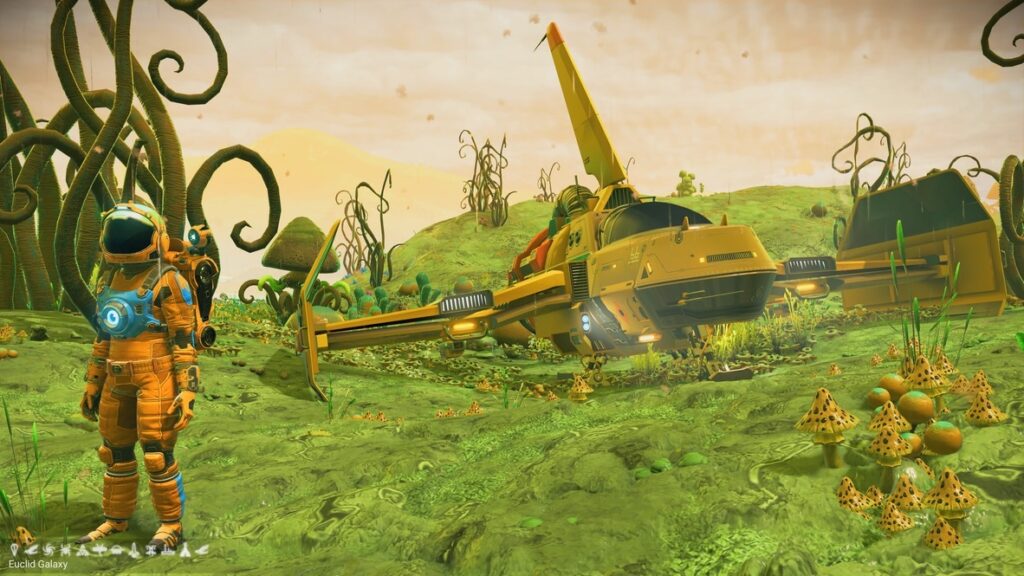
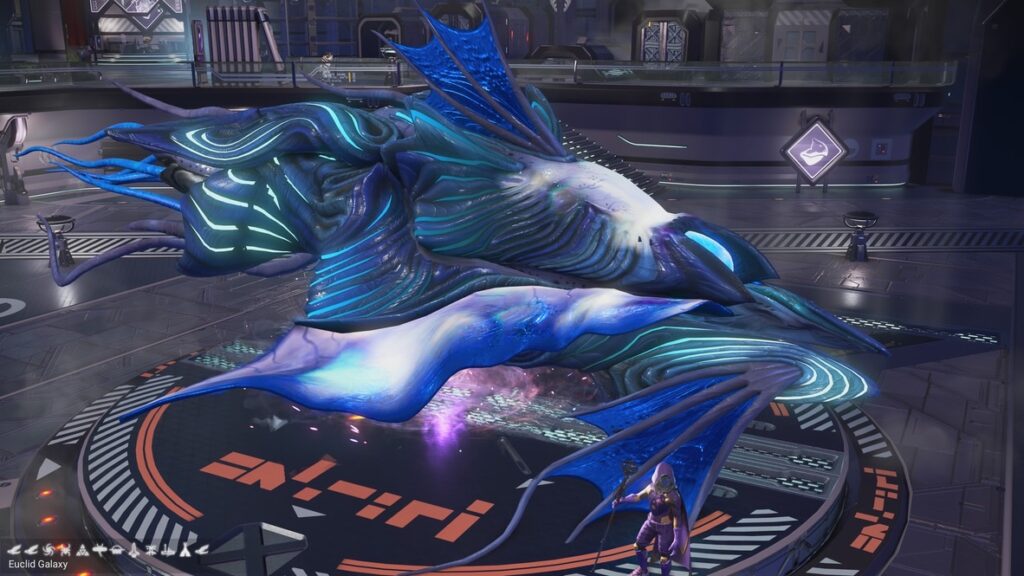
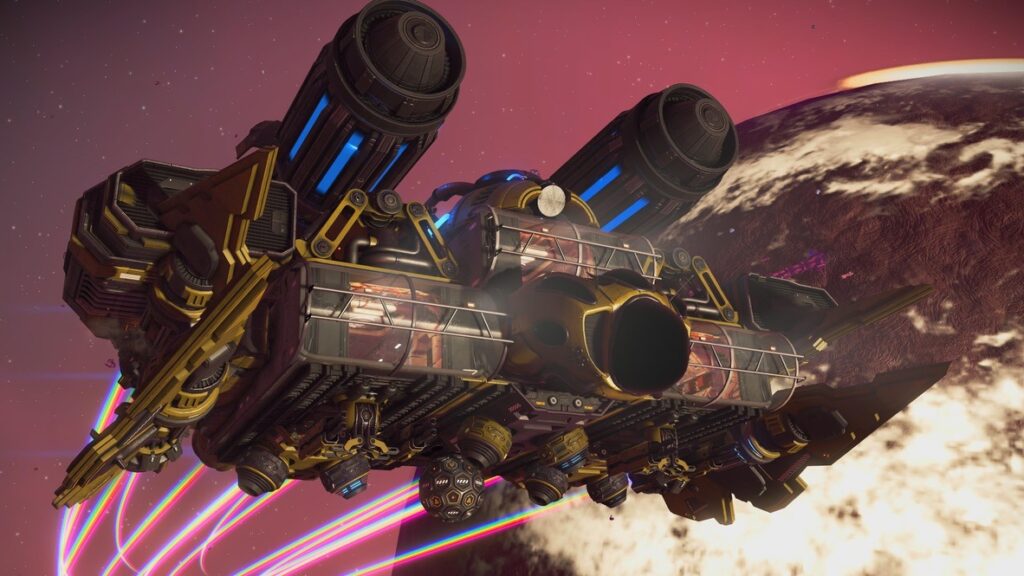
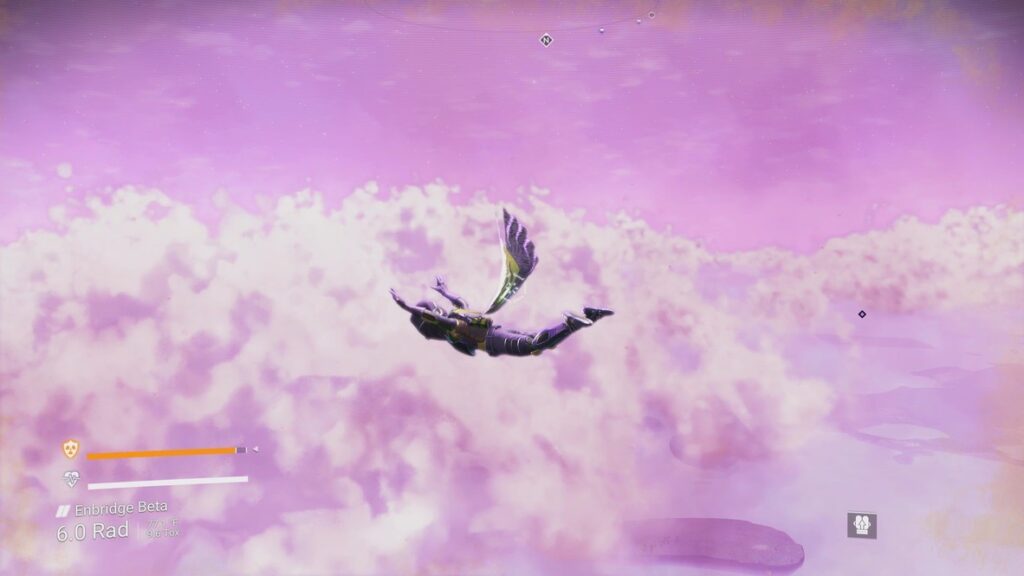
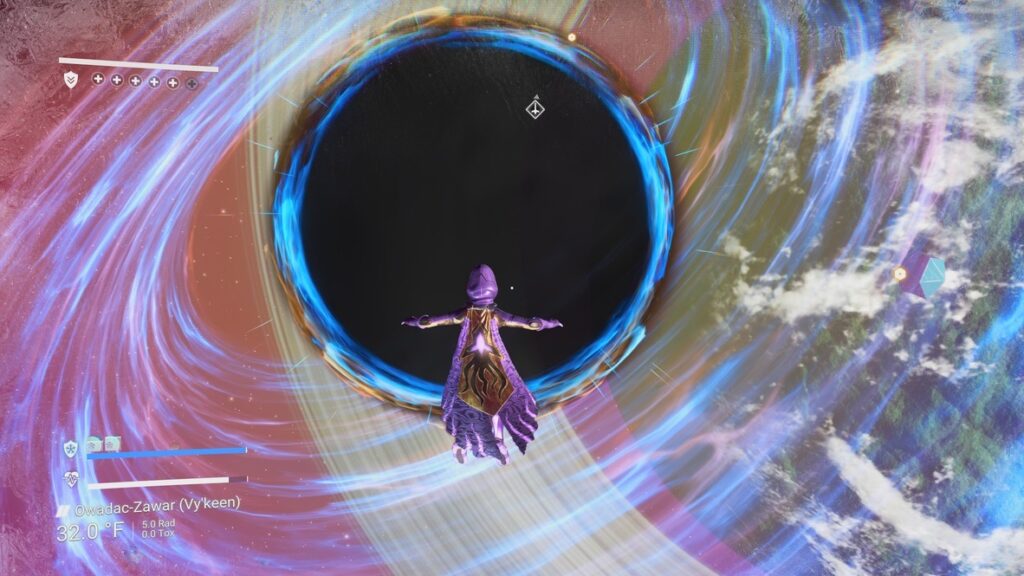
After a time, I found a ship that originally belonged to an exotic alien race that I liked better than any of the other ships I’d seen thus far. This is The Wizard’s Guild. A feature of this ship is that the wings fold up during landings.That ship served me well for years. Then learned about organic spaceships. It takes a while, but eventually you can earn the ability to recruit one. This is The Owlbear Cub. It’s my favorite ship in my collection.I gained a bigger organic starship through an expedition. The Mage’s Guild is larger than The Owbear Cub and I even like its color scheme better. But there’s more to a favorite than size and color.In the past year, the game introduced the ability to build your own ship from parts. This is my corvette The Druid’s Grove. I designed it specifically to have lots of engines to create pretty star trails. Corvettes have features that standard starships don’t have.For example, you can exit from a corvette while in space. From there, you can fly around, inspect some vessels for salvage, even fall to the surface of a planet.You can also jump into a black hole, if that’s your thing. (No, this doesn’t kill you. I never said this game was scientifically accurate.)Those other ships are nice, but I always return to The Owlbear Cub.
Some players maintain different ships for different functions: trading, combat, exploration, etc. I haven’t needed to do that, mainly because I play the game at its easiest difficulty level. The fully upgraded The Owlbear Cub can do all these tasks for me.
Combat
Speaking of combat…
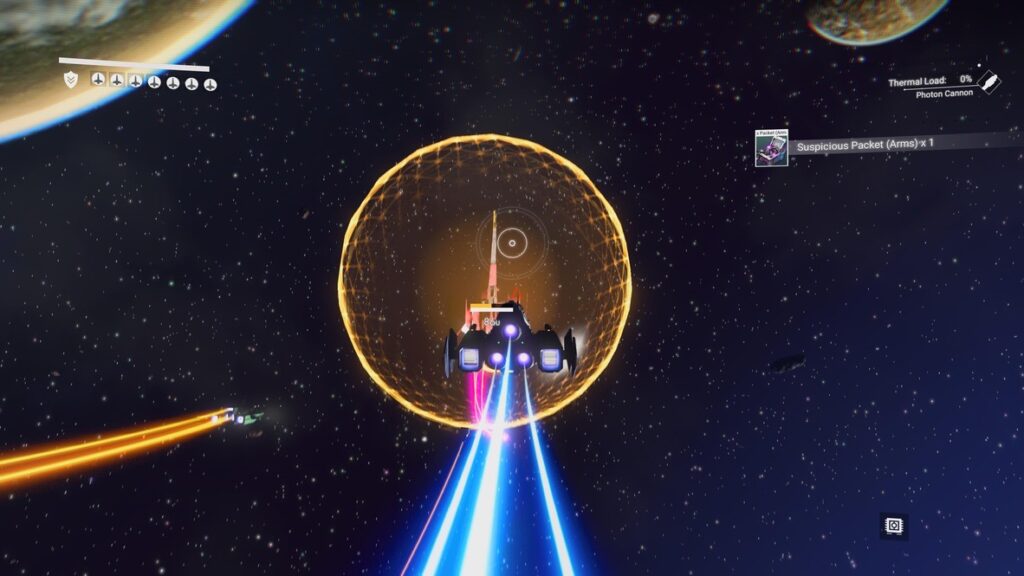
There’s space combat. It’s all real time. If you’ve read my other essays, you can correctly guess that I was bad at it. In this pair of images, I’m able to hold my own against an attack only because I’d upgraded my weapons and shields to their maximum.
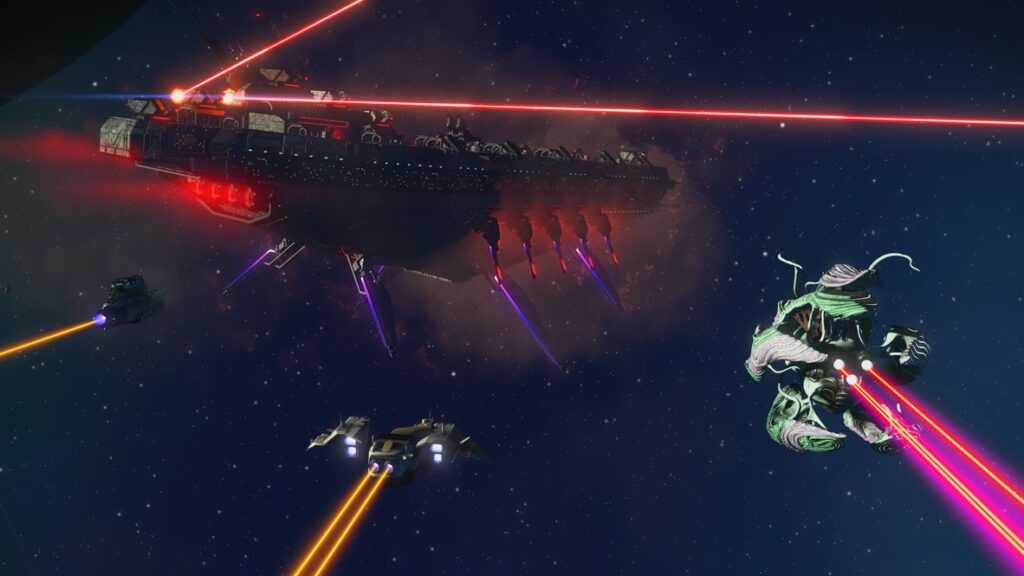
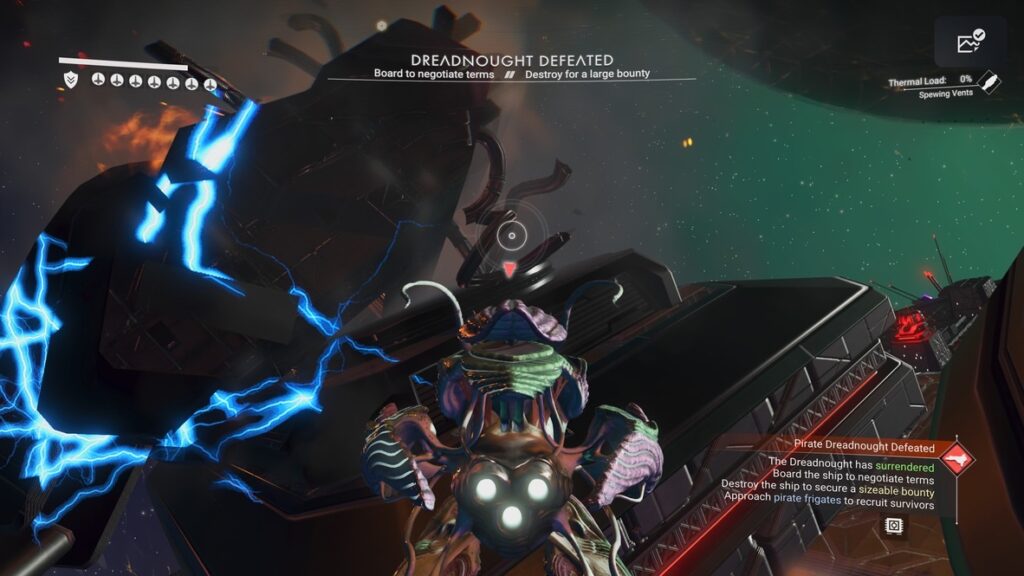
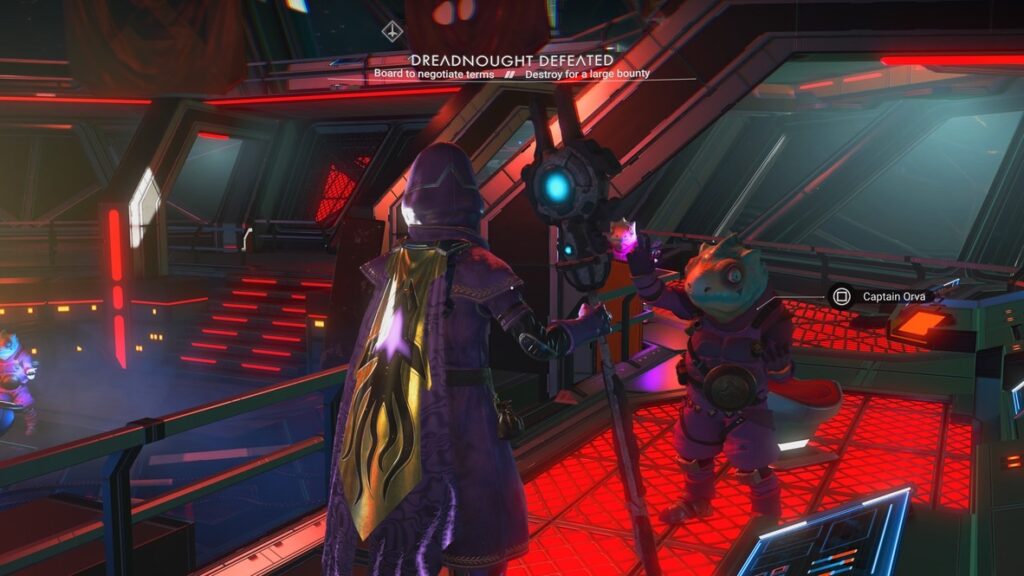
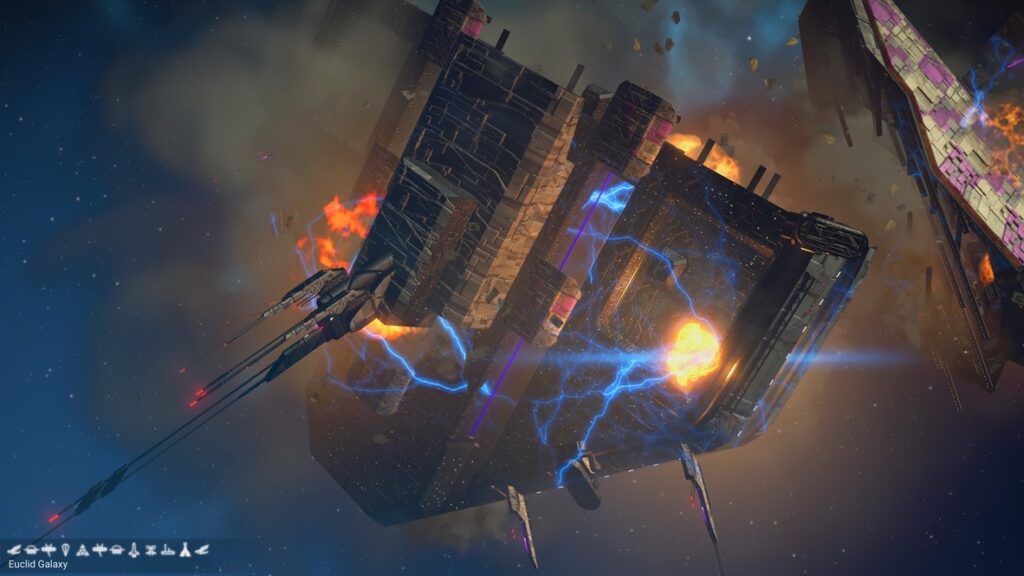
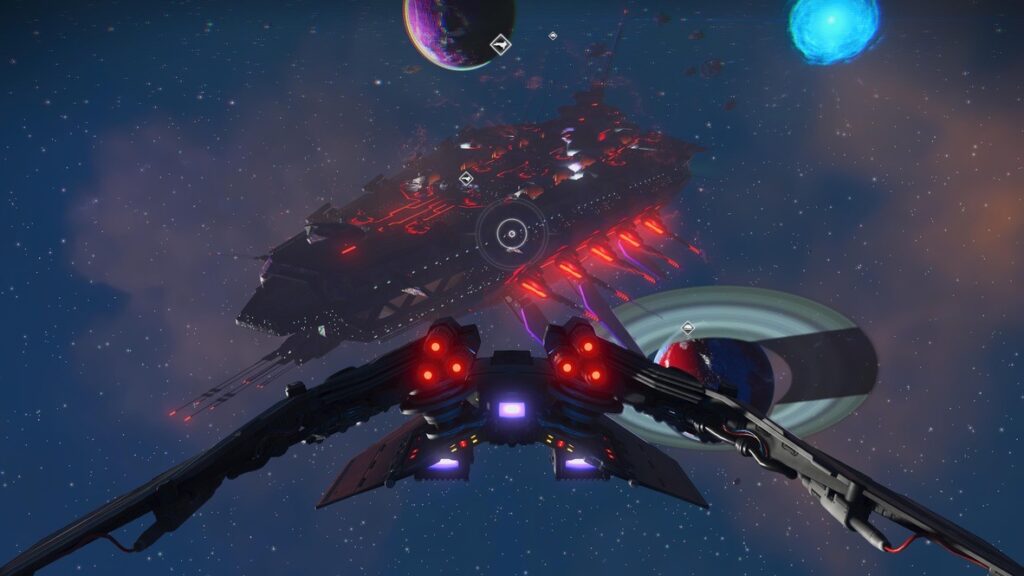
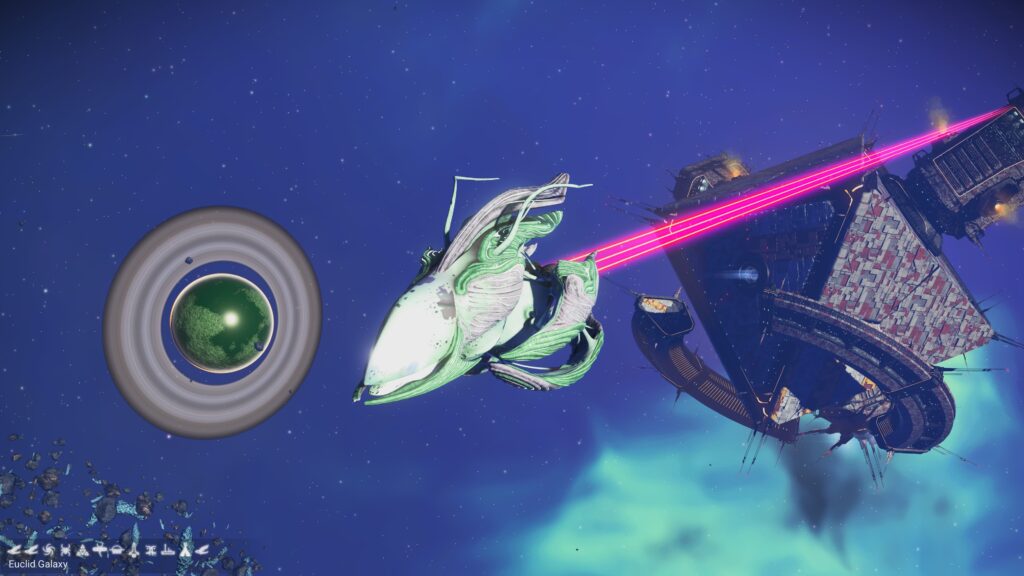
By the time I acquired The Owlbear Cub, I had access to even better equipment and ship upgrades. I’d also learned a couple of things about space combat. Here you see The Owlbear Cub about to go toe-to-toe with a Pirate Dreadnaught that’s attacking a civilian frieghter.I didn’t ask for this battle. I warped into a system and found myself in the middle of it. I didn’t start it, but I knew how to end it.Normally, I board a defeated freighter ask for a simple payment. But the game glitched somehow, and Captain Orva wouldn’t talk to me.So I went back outside and took out the Dreadnaught shield generators.Ka-boom.
Space combat does not have much interest for me. Also, at this point in the game, the rewards I get for defeating enemy ships don’t really compensate me for the time it takes. But if you’re looking to blast away at space pirates, NMS has got you covered.
Not shown: You can also choose to become a pirate and blast away at civilian ships to get their freight. You do you.
In addition to space pirates, another persistent foe are the Sentinels. Their goal is to prevent changes to the environment. This particular Sentinel is passive at the moment, but if it sees me mining resources it will summon lots of fellow Sentinels who’ll attack in waves. In my early days playing the game these were a problem. Now, with maximum multi-tool and exosuit upgrades, they’re merely annoying.
Fleet
When you defeat a capital ship like a Dreadnaught, you can choose to claim command of the ship. That ship now acts as a Freighter, the central headquarters for a fleet of ships.
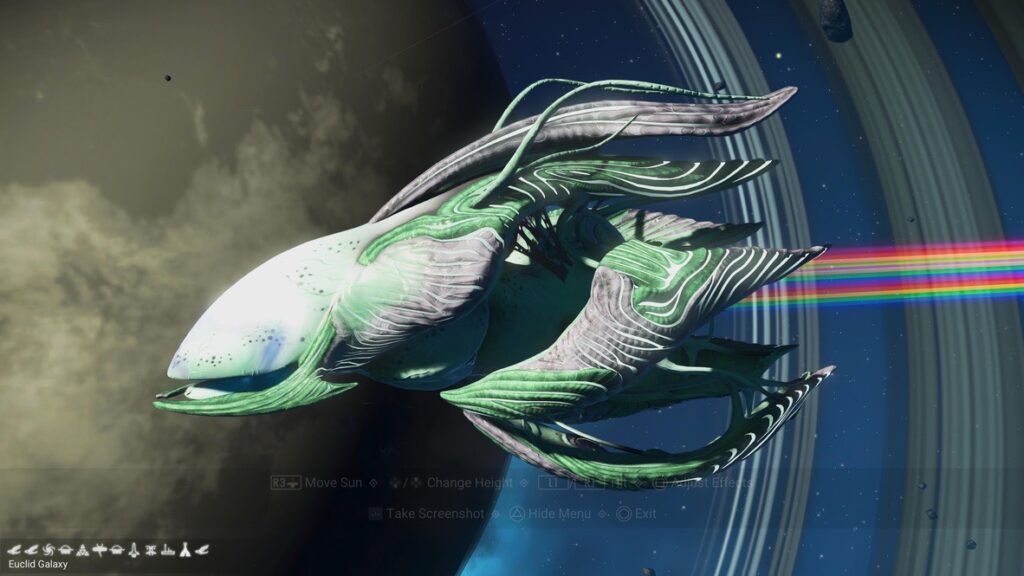
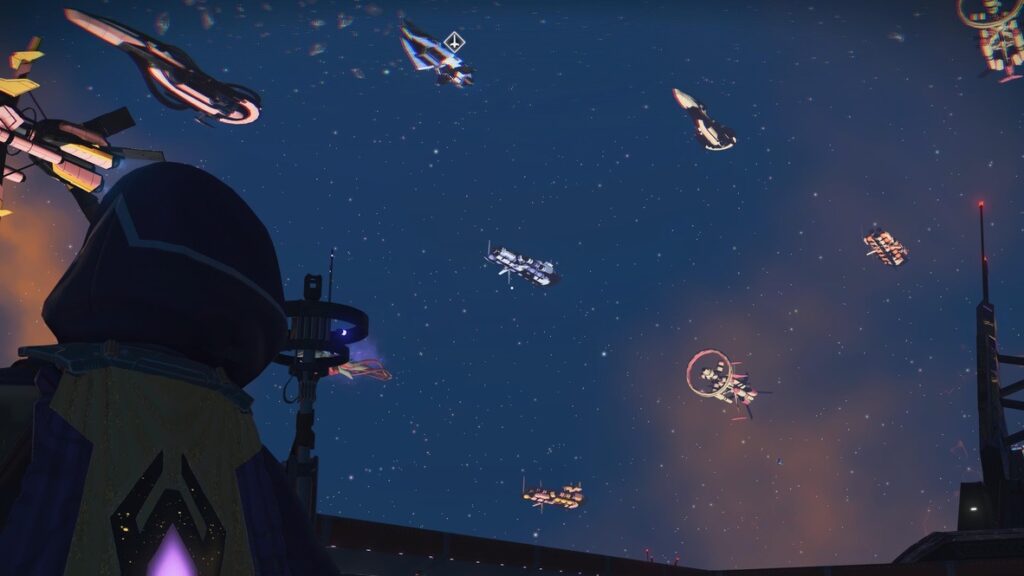
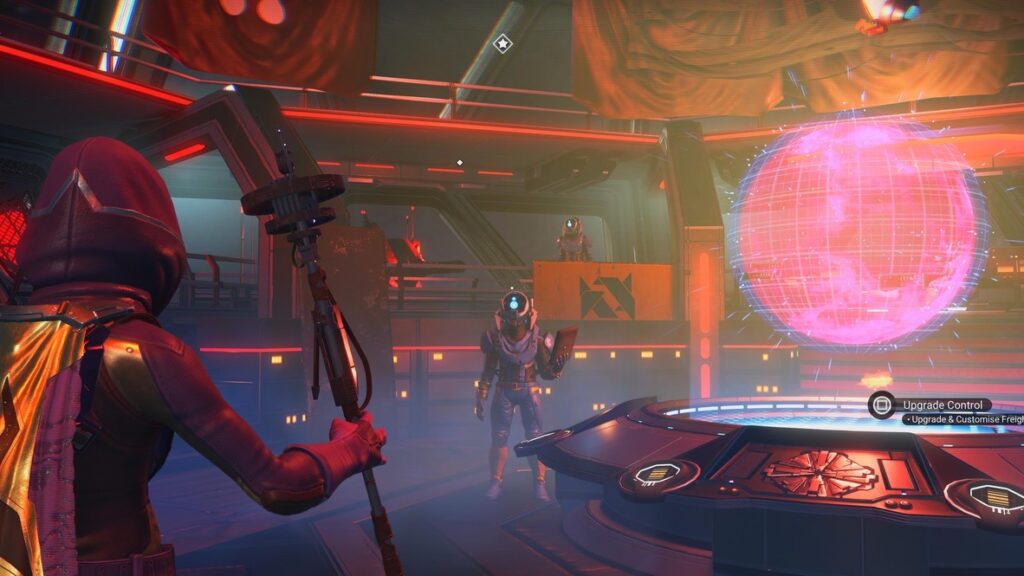
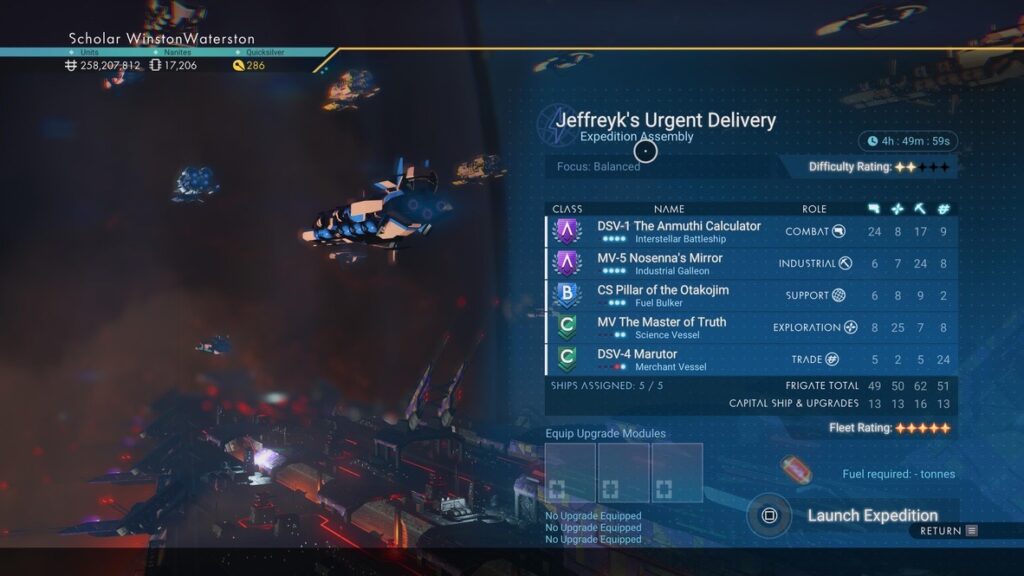
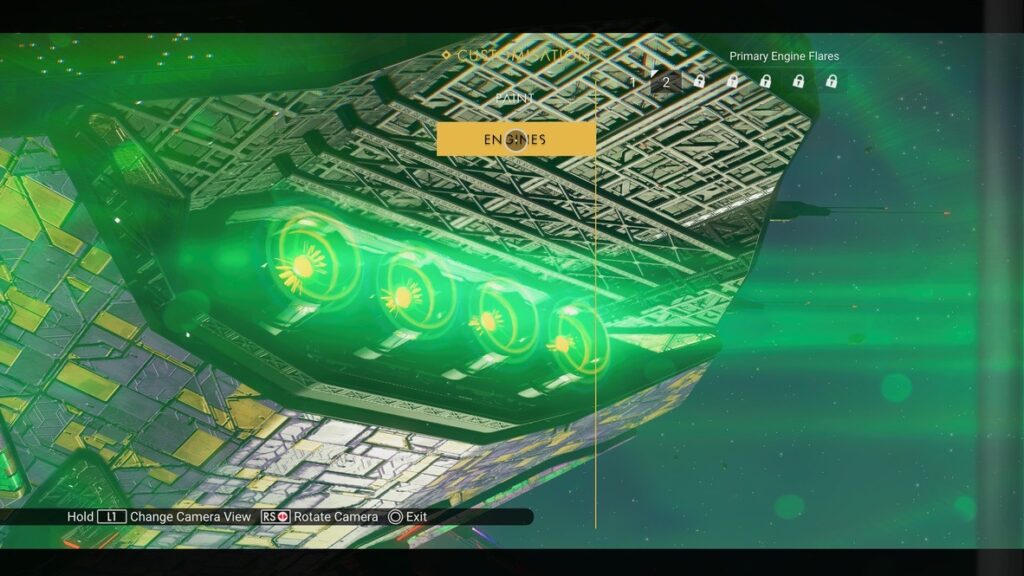
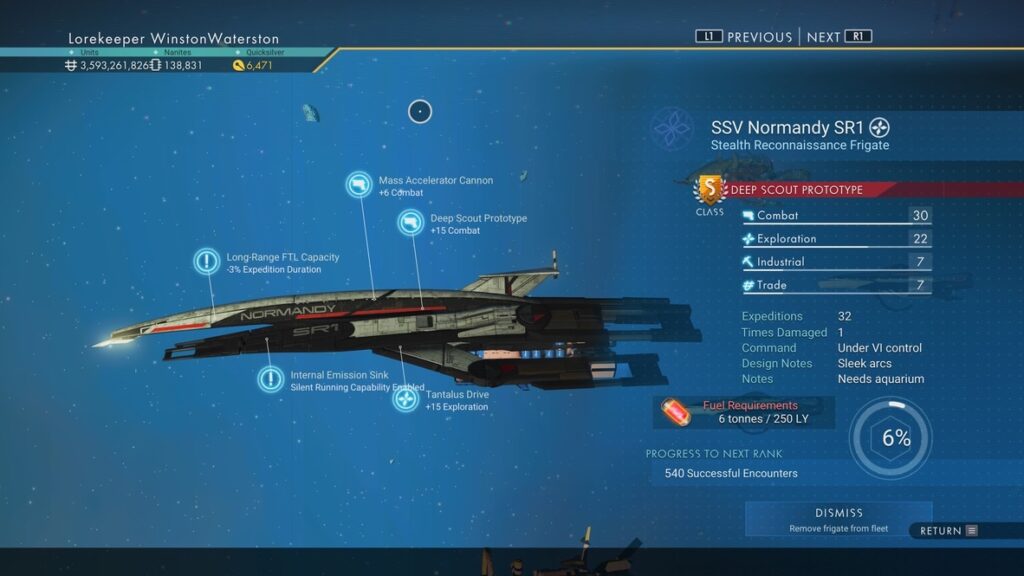
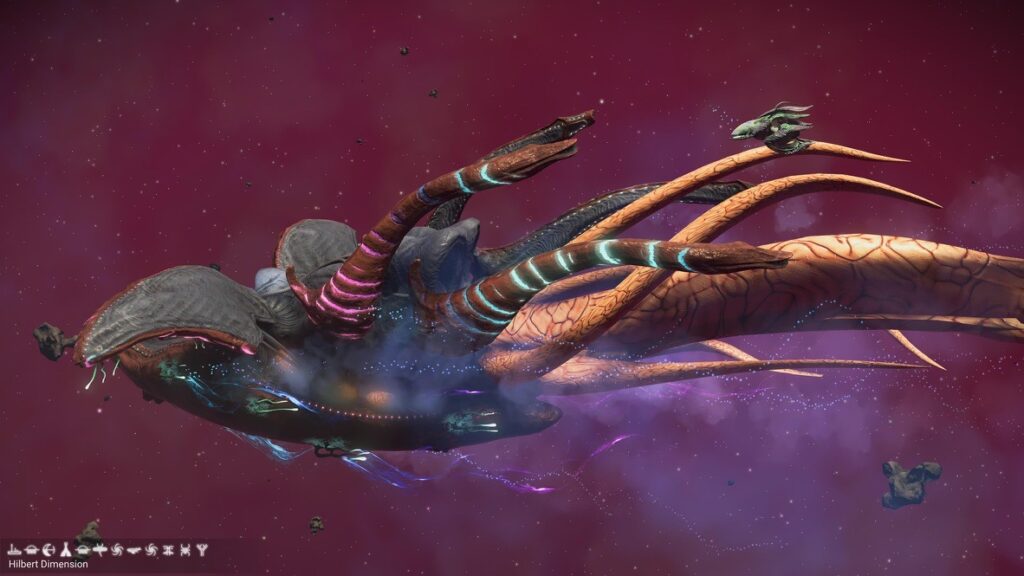
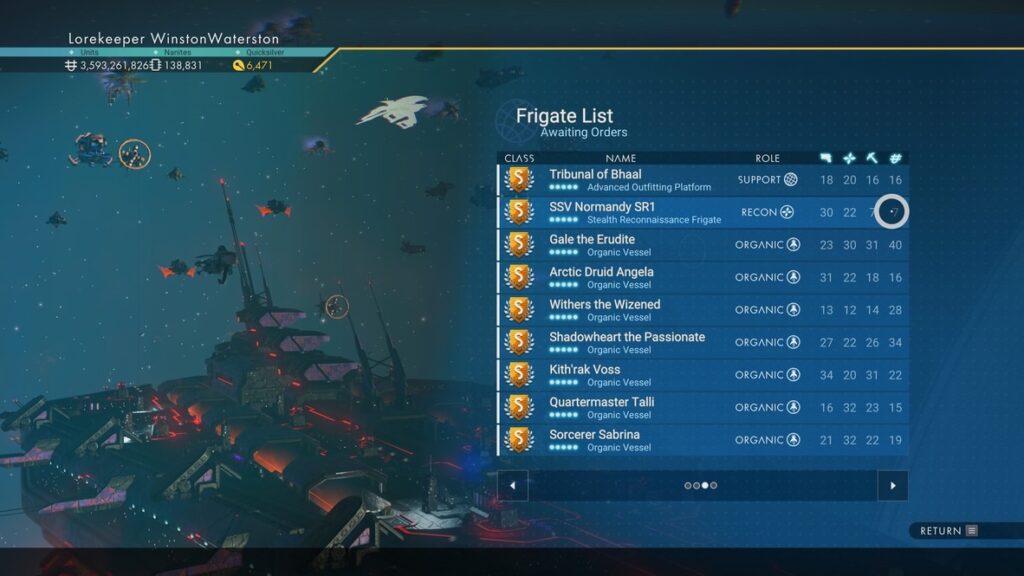
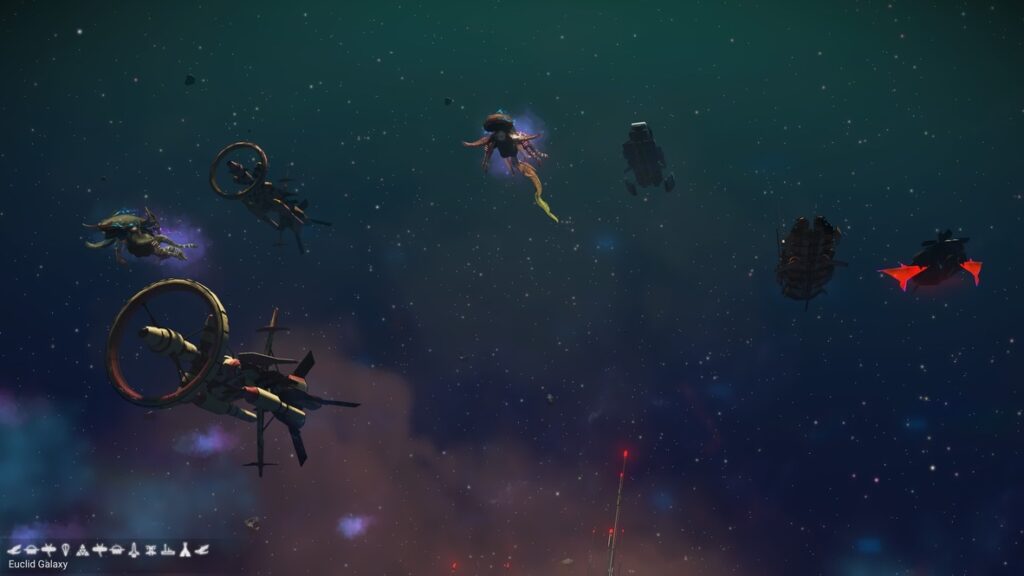
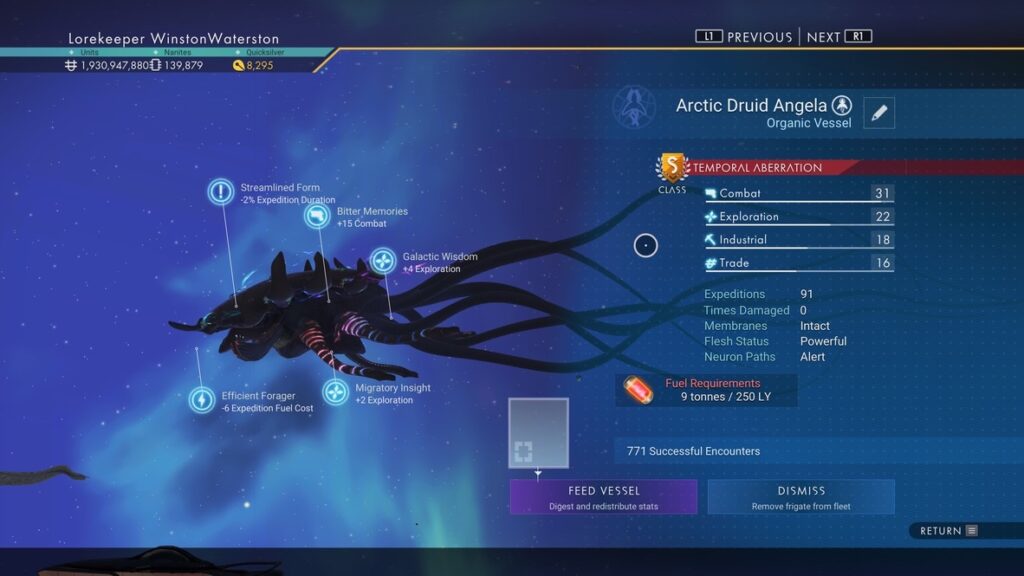
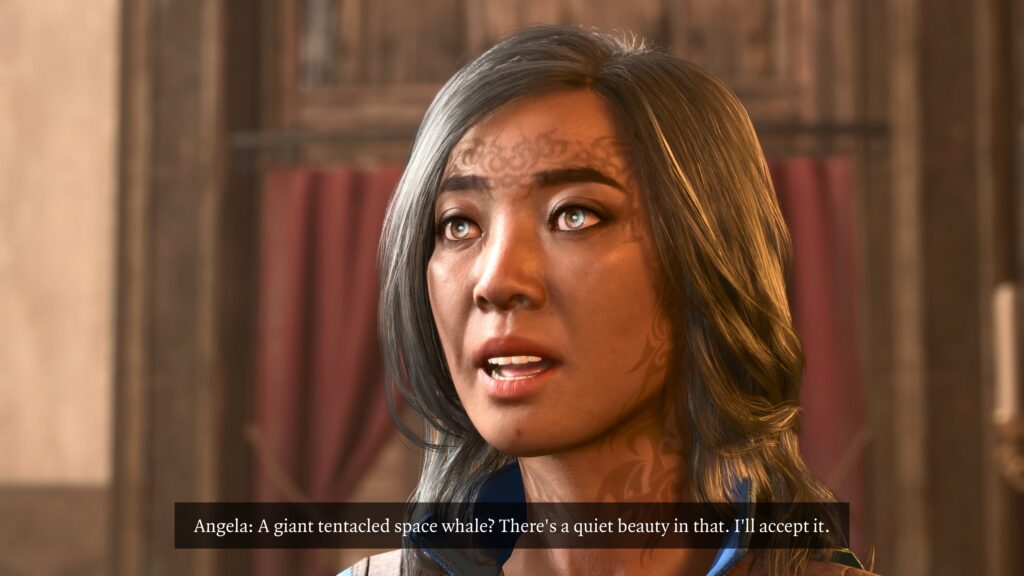
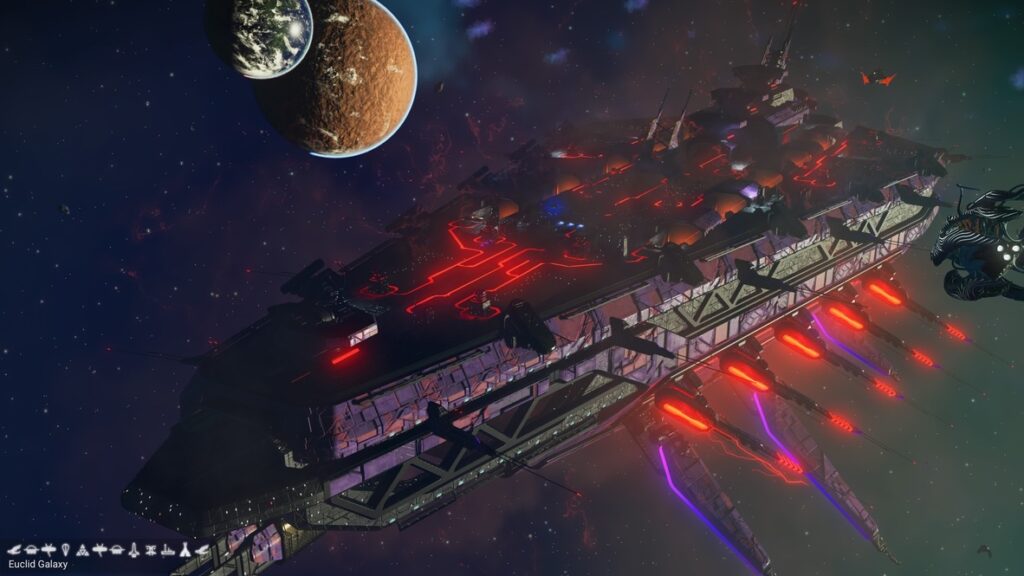
The Wizard’s Guild inspects my Fleet Command Ship, the Sorcerous Sundries. It looks much like the Pirate Dreadnaught from the space battle above. That’s because at one time it was a Pirate Dreadnaught, before it surrendered to me.If I stand atop the Sorcerous Sundries, I can view some of the vessels I’ve recruited into my Fleet. I can recruit frigates from the pirates I’ve defeated, and from civilian fleets which can be found in almost every stellar system.The Fleet Command Center on the Sorcerous Sundries. The Korvax you see at the center is the dispatcher, offering missions and letting me choose which ships go on them.This picture is from my early days as a Fleet Commander, with low-quality ships whose names I didn’t know I could change.When you’re a Fleet Commander, you can pick the color of your Command ship. I prefer purple with gold highlights, with engines that glow green.As an expedition reward, you can add the SSV Normandy from Mass Effect to your fleet. (Aside: Before BG3, Mass Effect was Real Angela‘s favorite game series.)I mentioned you can recruit typical mechanical frigates for your fleet. But after some story events, you can recruit organic space-whales. For scale, note The Owlbear Cub in the upper right.As you continue sending your fleet on missions, the ships will slowly improve.At this point almost all my ships are as powerful as they can be. About a third of my fleet consists of organic ships. If an organic ship goes on a mission, it has a good chance of bringing back an improvement for The Owlbear Cub.However, it takes some effort to recruit an organic ship, which is why not all my fleet is organic.
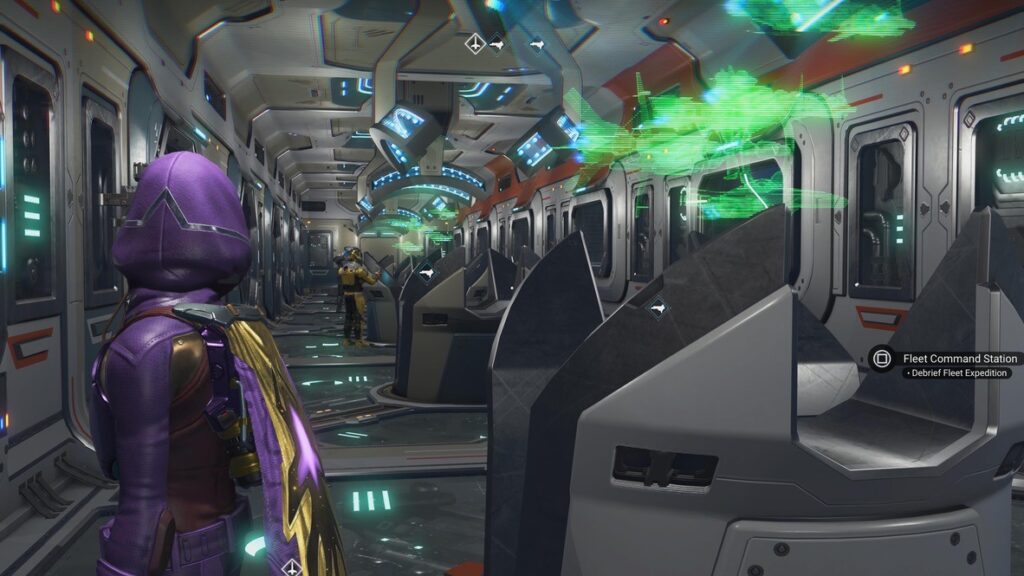
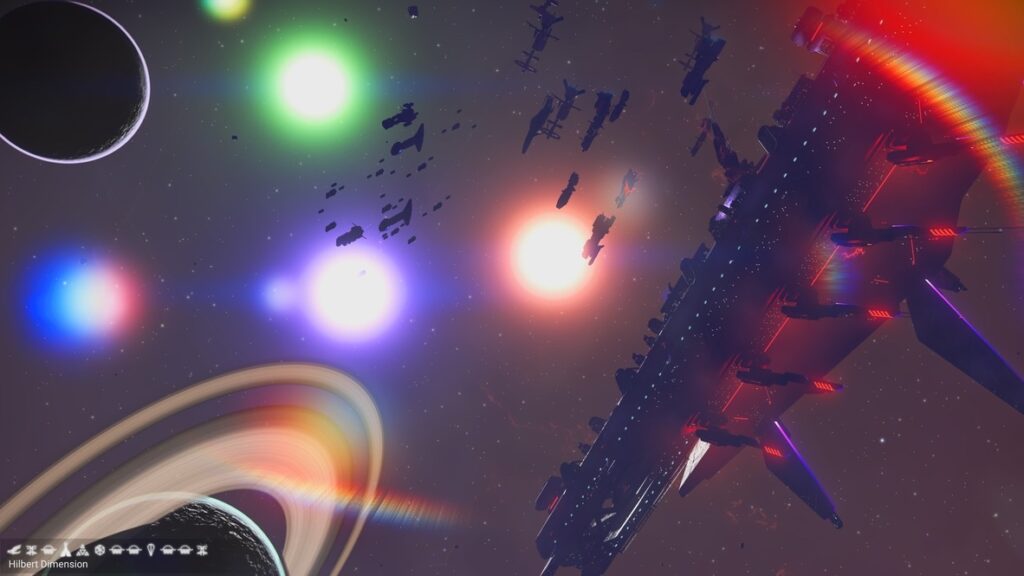
The Fleet Command ship is not just a mission hub. You can build a base within it, with custom features such as this planetary scanner. In the background you can see another museum within within the Sorcerous Sundries with more trophies from my trips.This is the area in which I can monitor and debrief the Fleet missions. A Fleet Command ship comes with one of the Command Stations you see. I built the others as I expanded the base within the ship.At this point, the bulk of my income in the game comes from Fleet missions. I should add that this is relatively simple for me because I play at the easiest difficulty level. At the harder difficulty levels, the mission economics become more complex.When I want to travel between systems, I mostly use The Owlbear Cub. But sometimes it’s more convenient to make the hyperspace jump in the comfort of my Command Ship.The Sorcerous Sundries and its fleet arrives in a system with three suns (plus lens flares). In background center you can see another fleet. I’m full up on ships and have no reason to approach them.
Space Stations
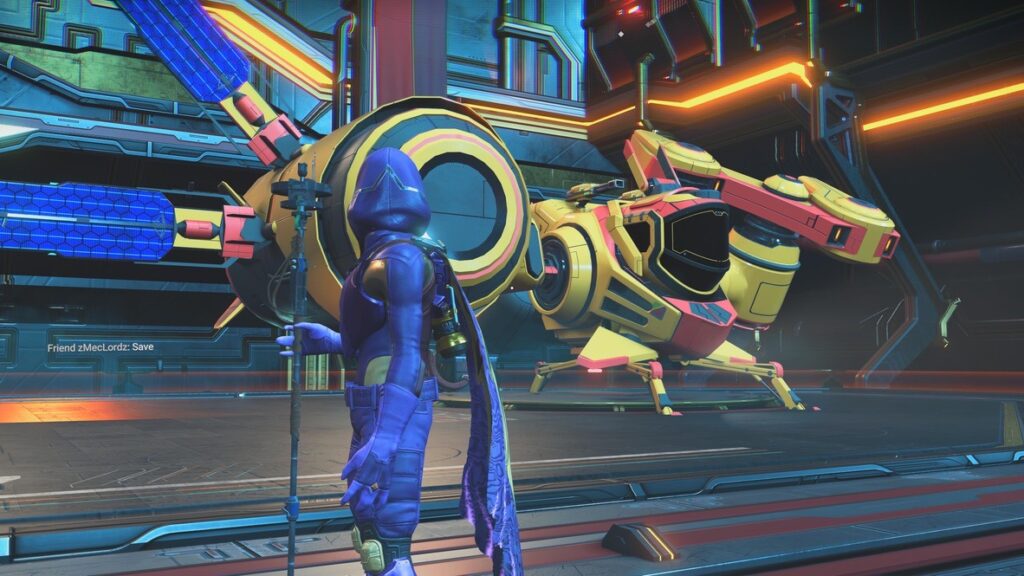
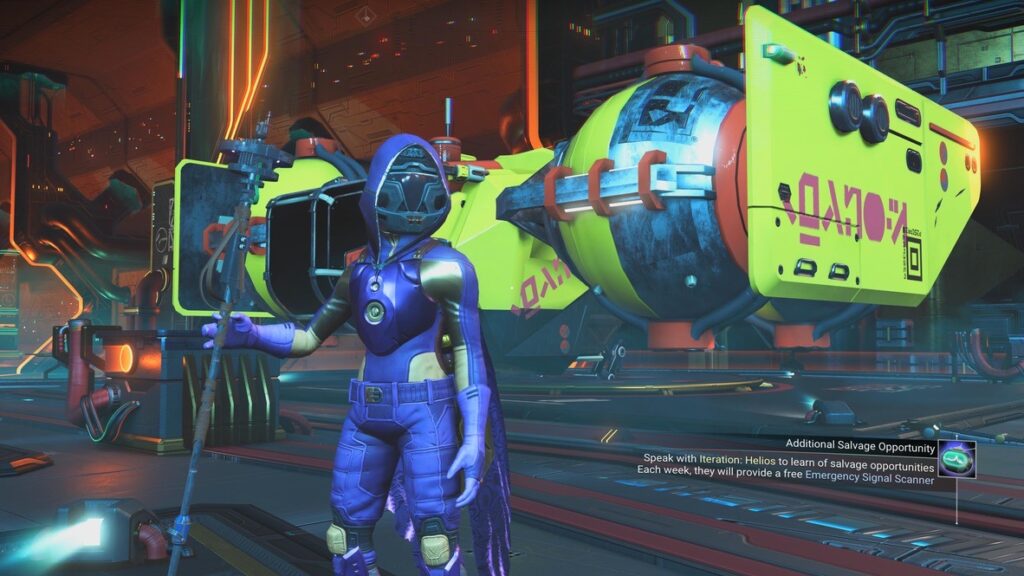
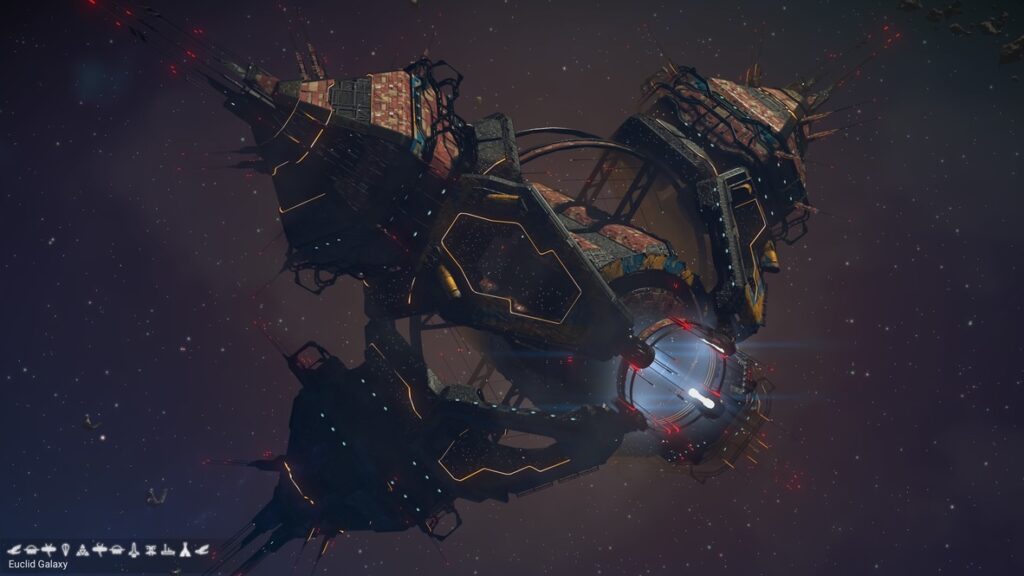
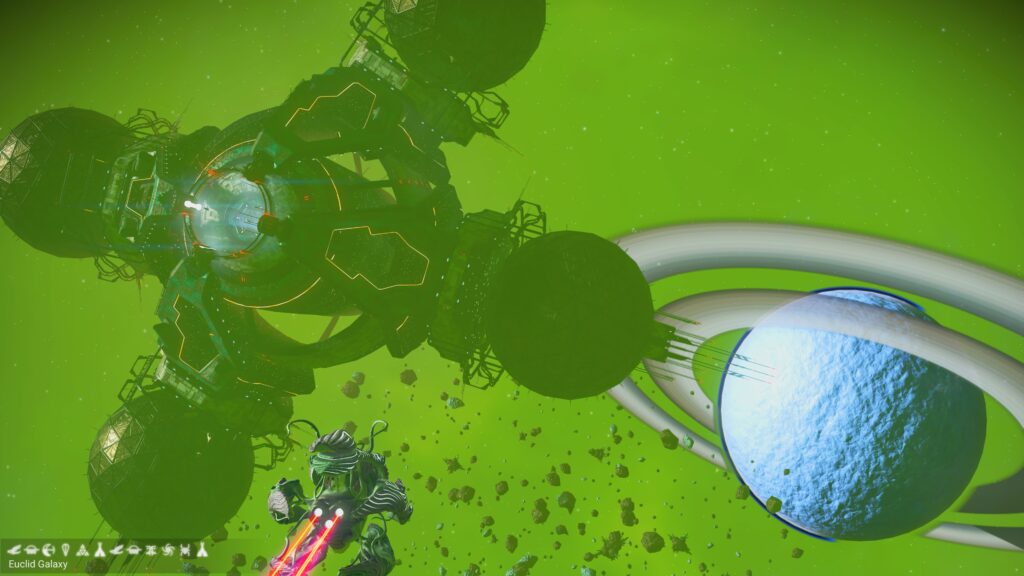
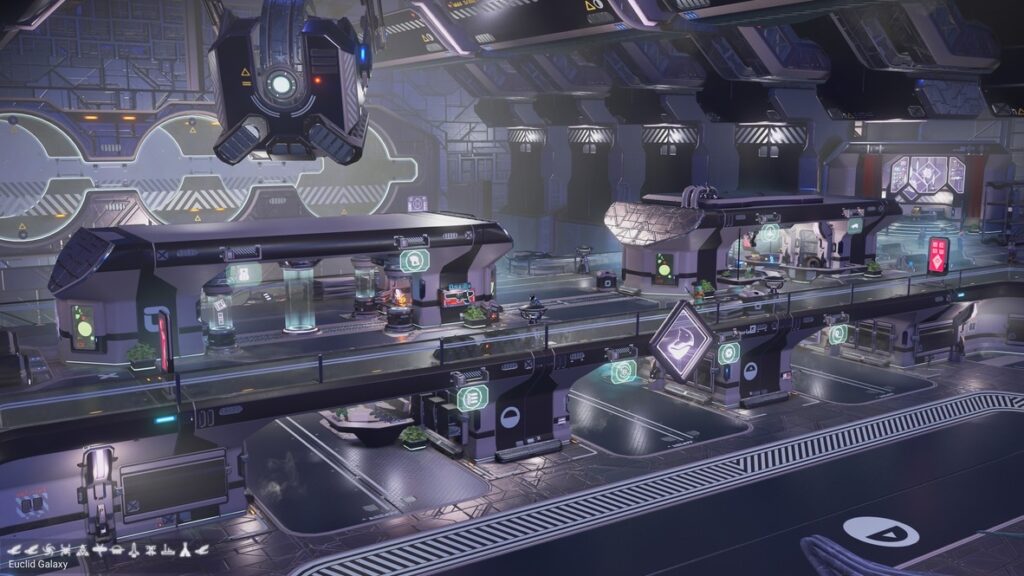
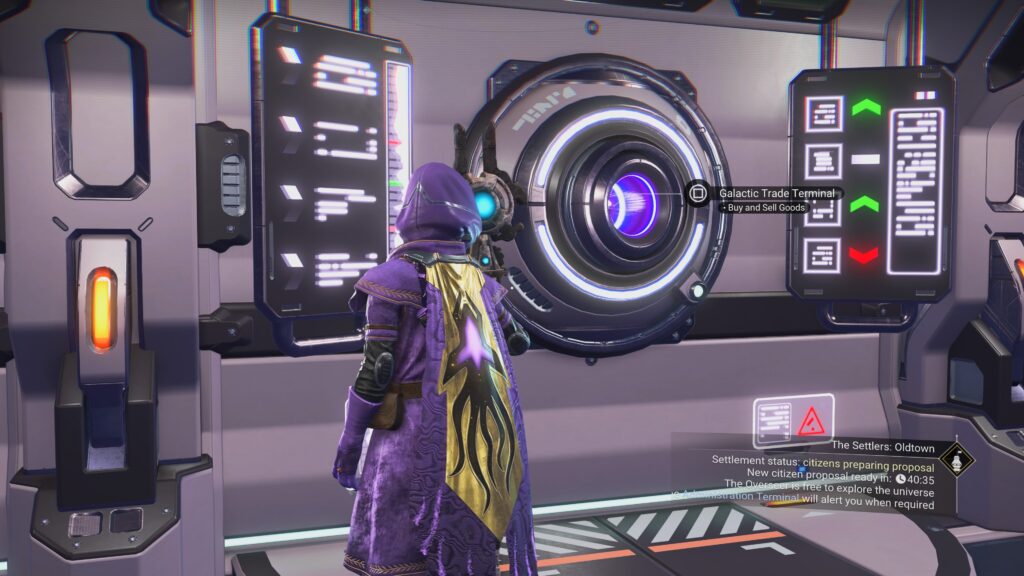
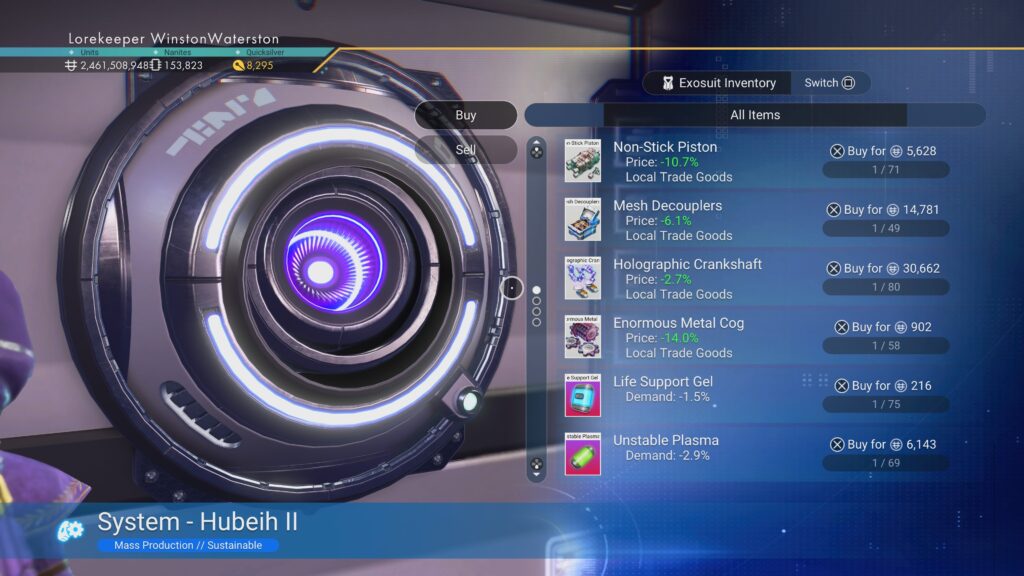
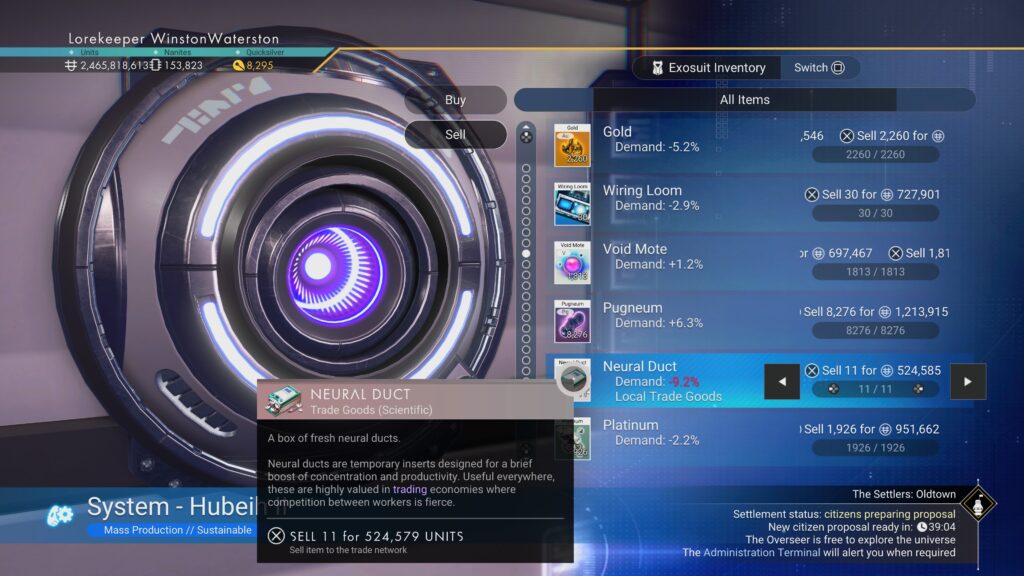
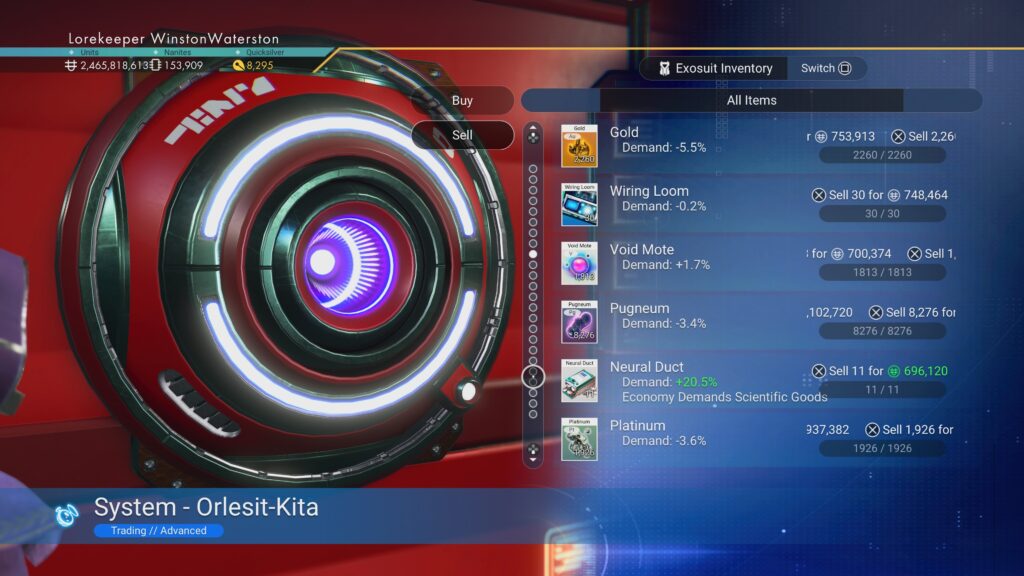
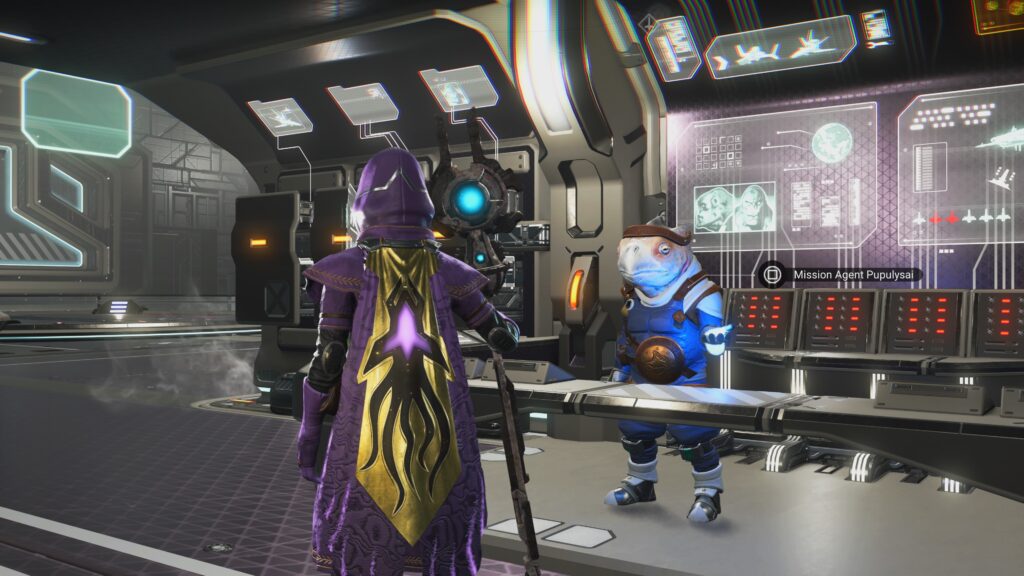
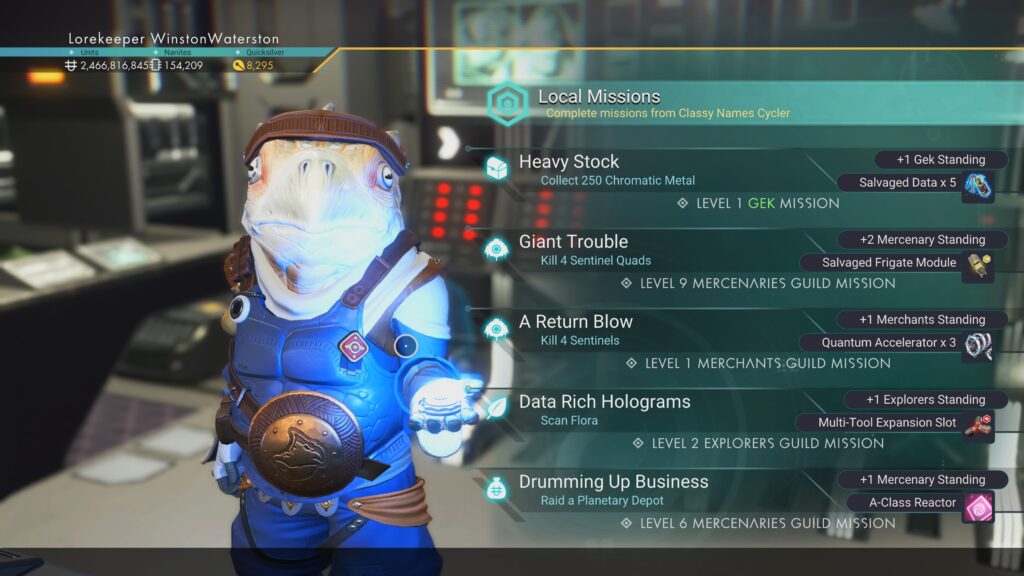
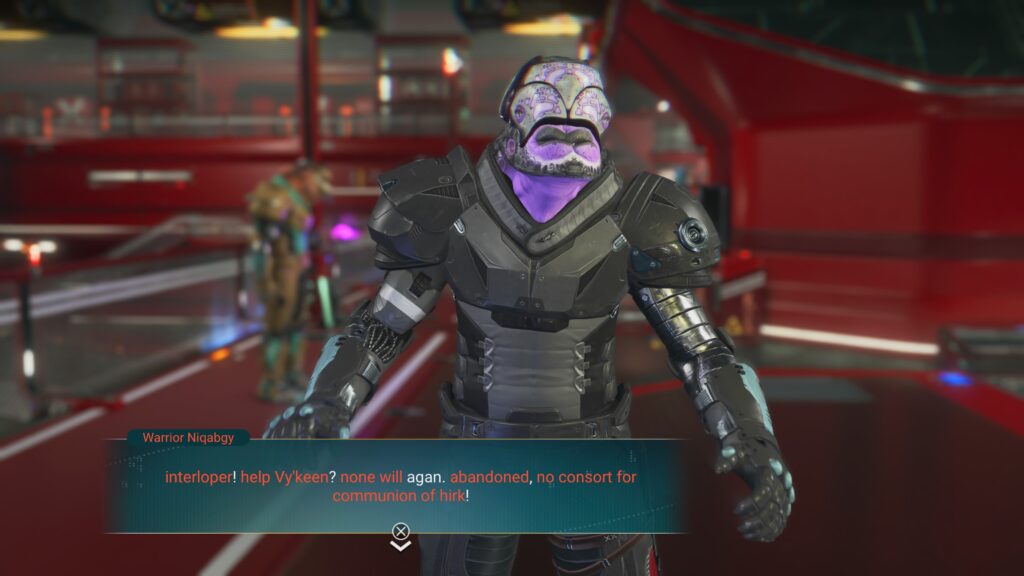
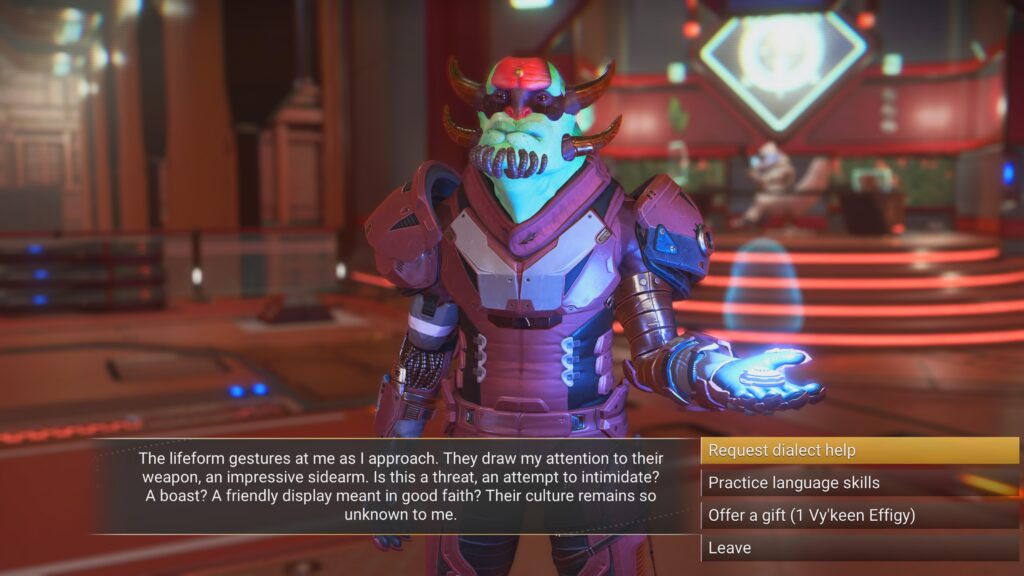
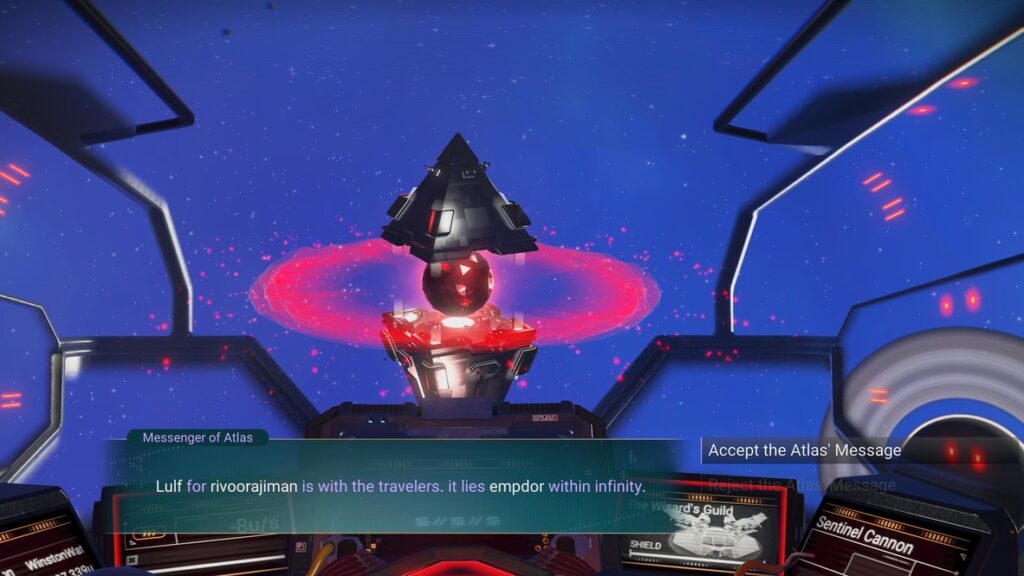
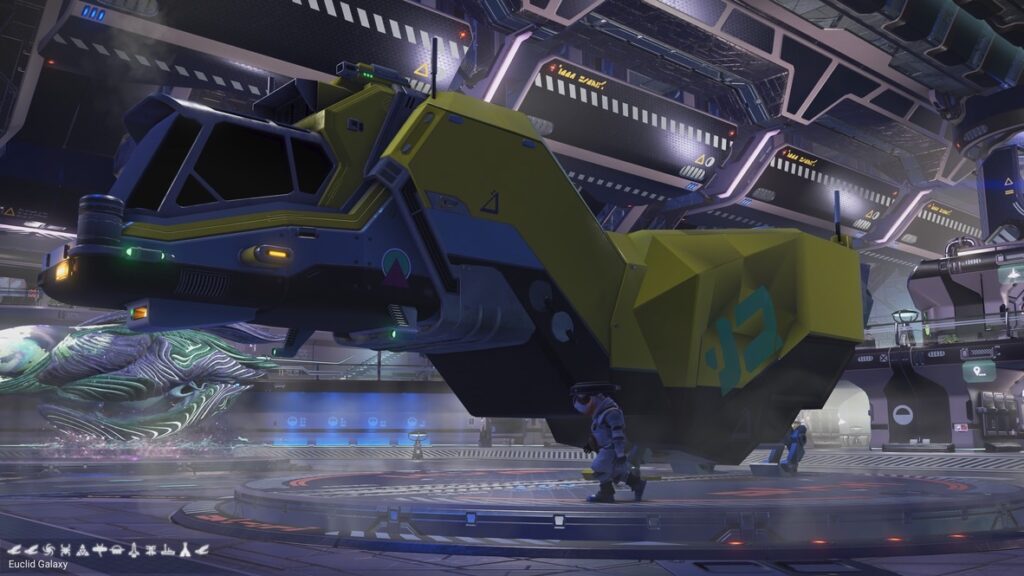
Almost every system has a space station. It’s a hub for trading and interactions with the game’s races.Their exterior shapes are procedurally generated. No two stations look the same from the outside.While they look different on the outside, the interior layout of each station looks the same. At least their color scheme varies from station to station.You can find Galactic Trade Terminals in many places; for example, you can build them in your base, on board your Fleet Command ship, and find them in your fully-upgraded settlement.It’s the terminals on the space stations that offer the greatest potential for profit. Here we see that, at this station, we can purchase Enormous Metal Cogs at a 14% discount.We can also sell goods. I’ve got some Neural Ducts that I got from a Fleet mission. But the demand on this station is low, and and I won’t get as much for them.However, if I travel to a space station in another system……I can sell the Neural Ducts at a substantial profit. I don’t “work the trade routes” anymore. In the early part of the game, learning to buy low and sell high can yield quite a bit of units for ship upgrades and the like.Space stations have Mission Agents. They offer tasks you can do……to gain resources and earn reputation with various factions. I don’t do these missions anymore, but they were invaluable in the early game.Another thing that I like to do on stations is talk to the NPCs there. In the examples I showed above, all their words were translated. Here we see that there’s one word in Vy’keen that my character has not yet learned.You learn words by asking for dialect help. It takes a while, but gradually your vocabulary builds up.This is an example of what you see when you don’t fully know a language. Each of the alien races has its own language. Also, the word substitutions are randomly generated for each player; instead of empdor, you’d see a different word if you were to see this phrase. Unless, of course, you studied more of the Atlas language than I have!Random ships pass through space stations. This particular one is piloted by the Gek NPC you see walking in the lower center. You can trade with their pilots for some things that aren’t sold on the Galactic Trade terminals. You can also recruit the pilots to fight with you in space battles (through they never do much damage). You can even offer to purchase their ship, if it’s better than yours and you have a lot of spare cash.
Much more…
These are tidbits for which I didn’t make a series of pictures.
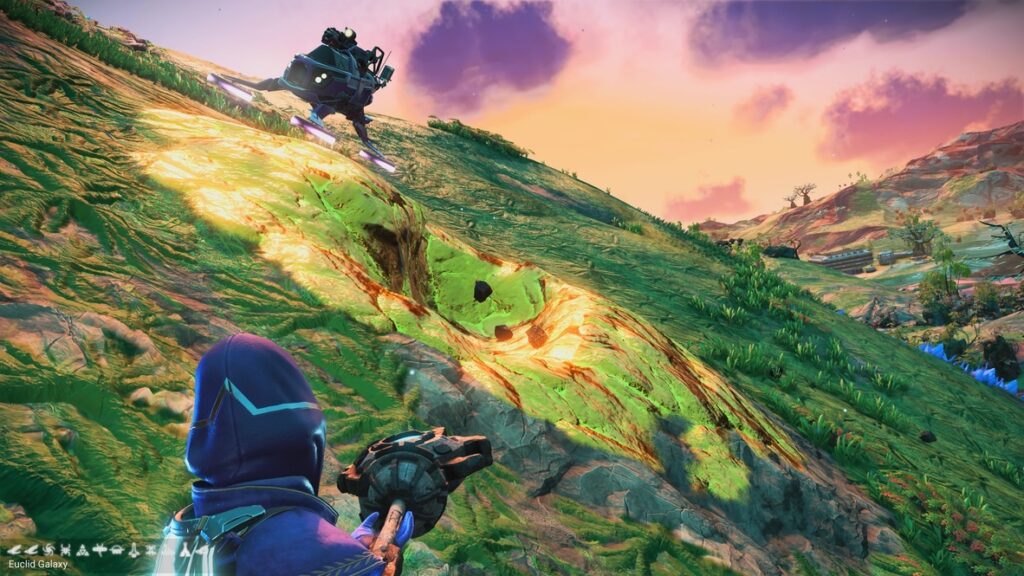
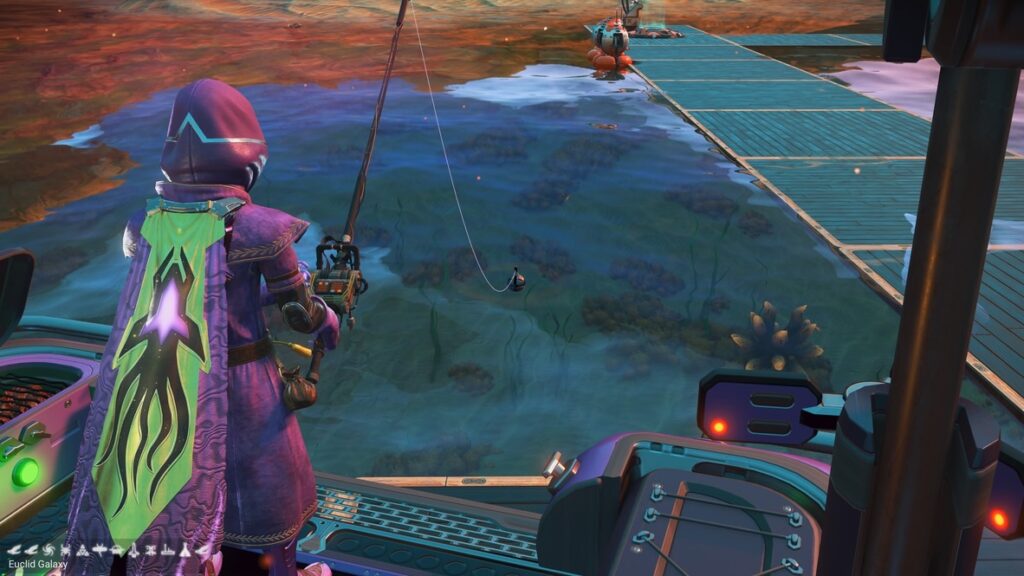
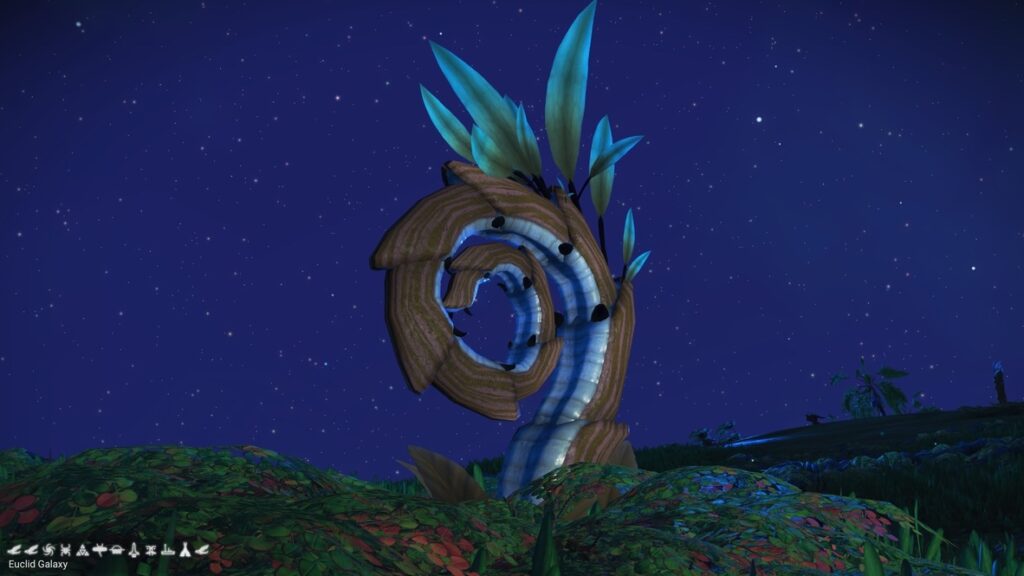
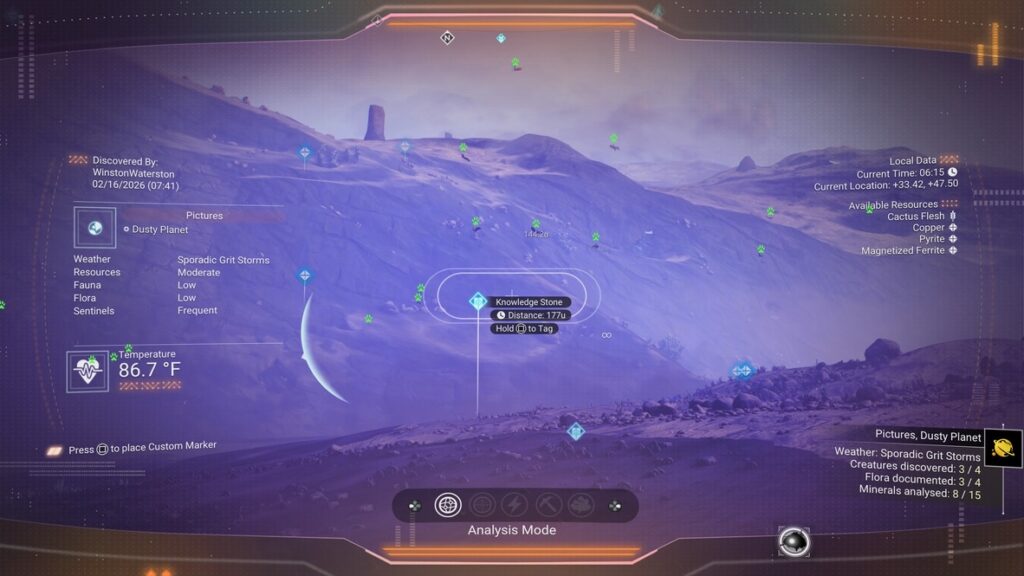
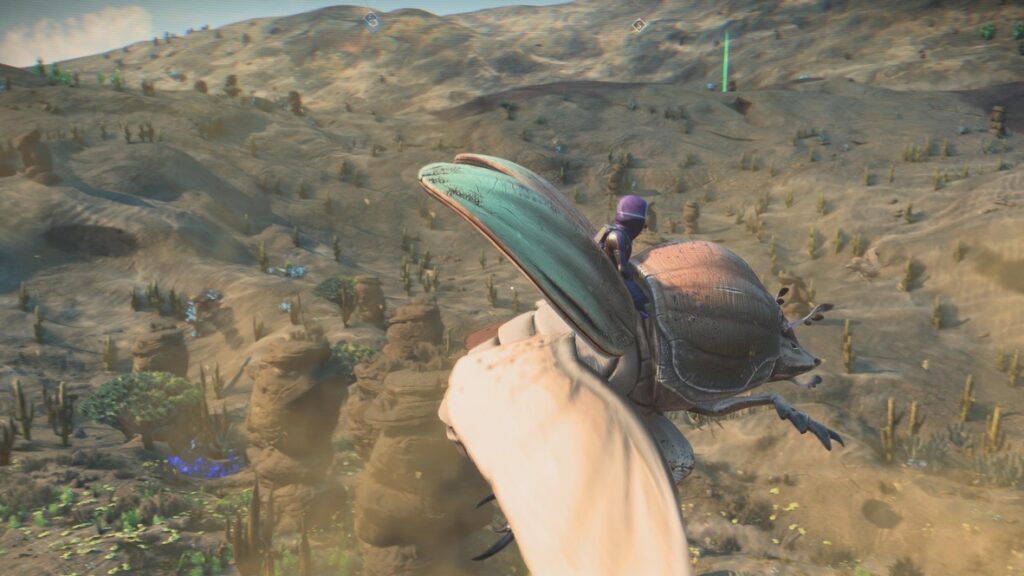
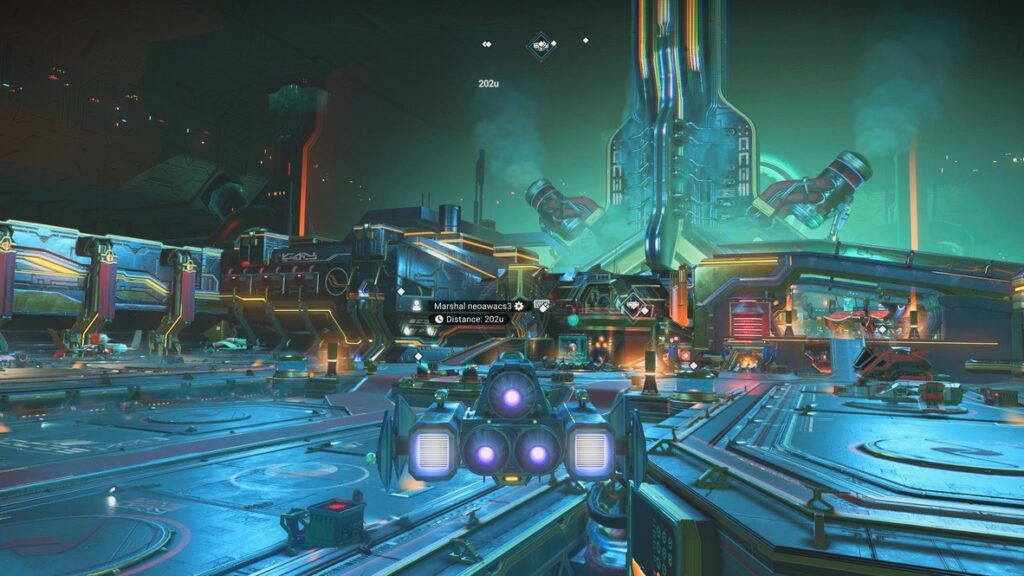
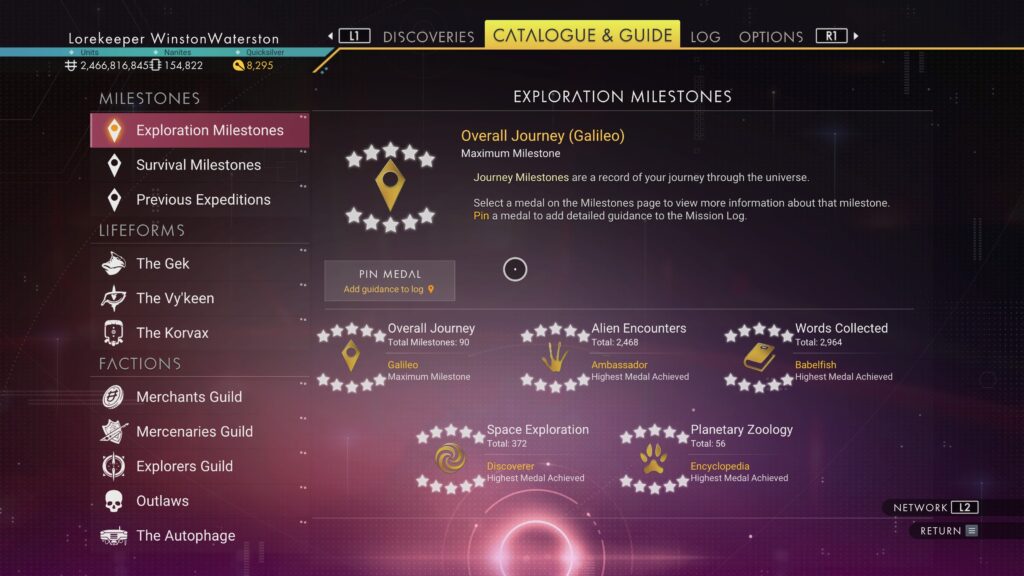
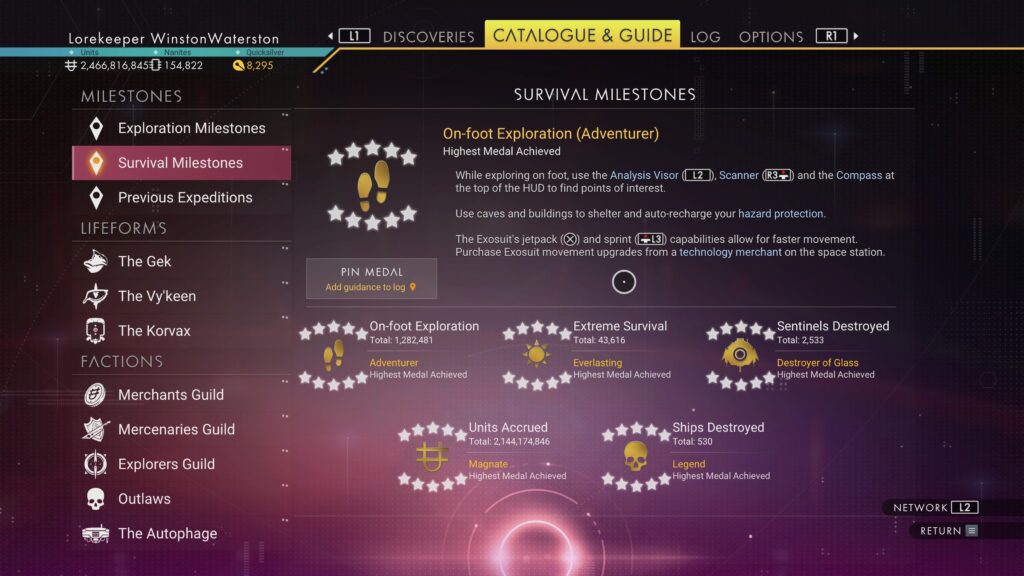
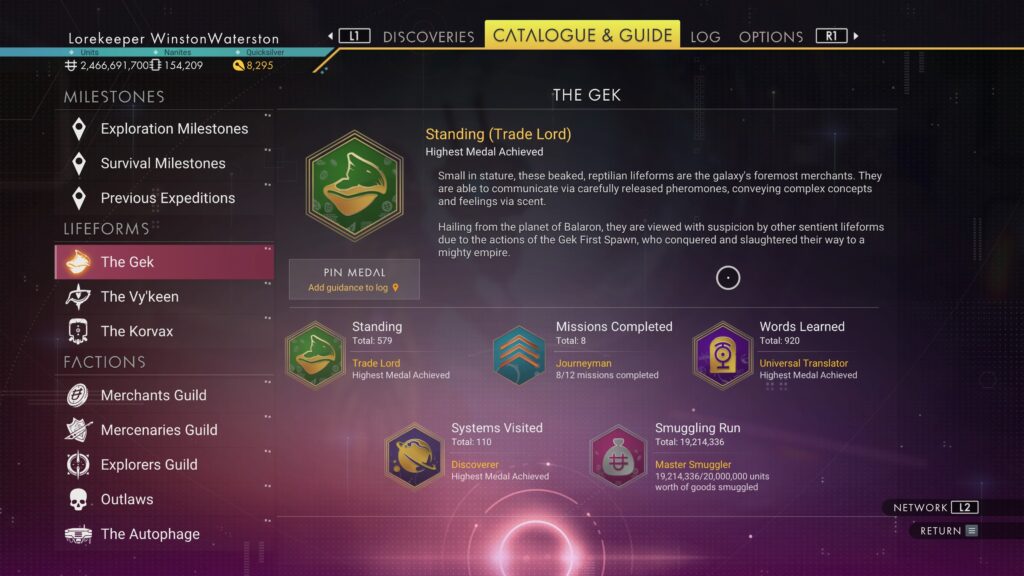
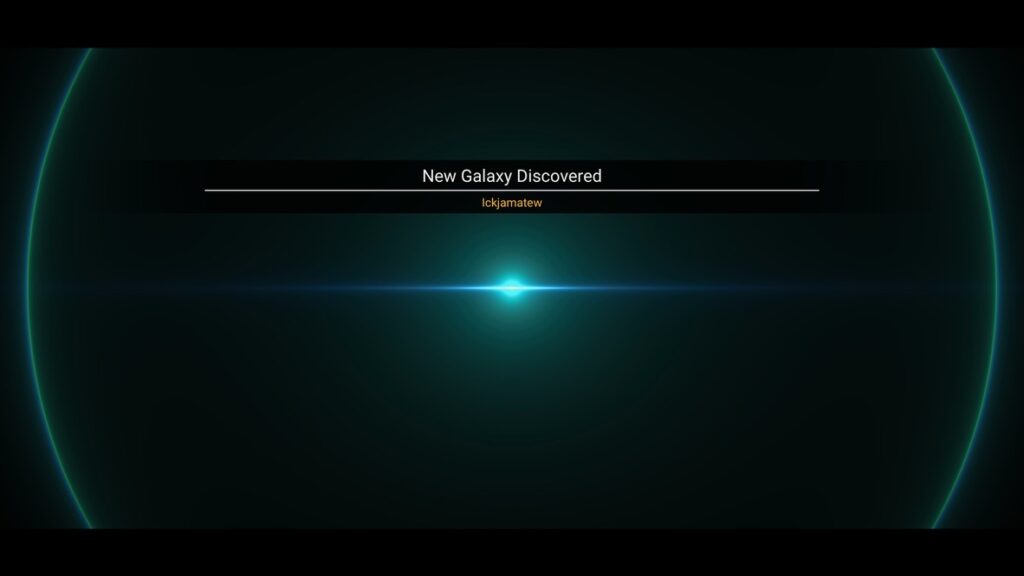
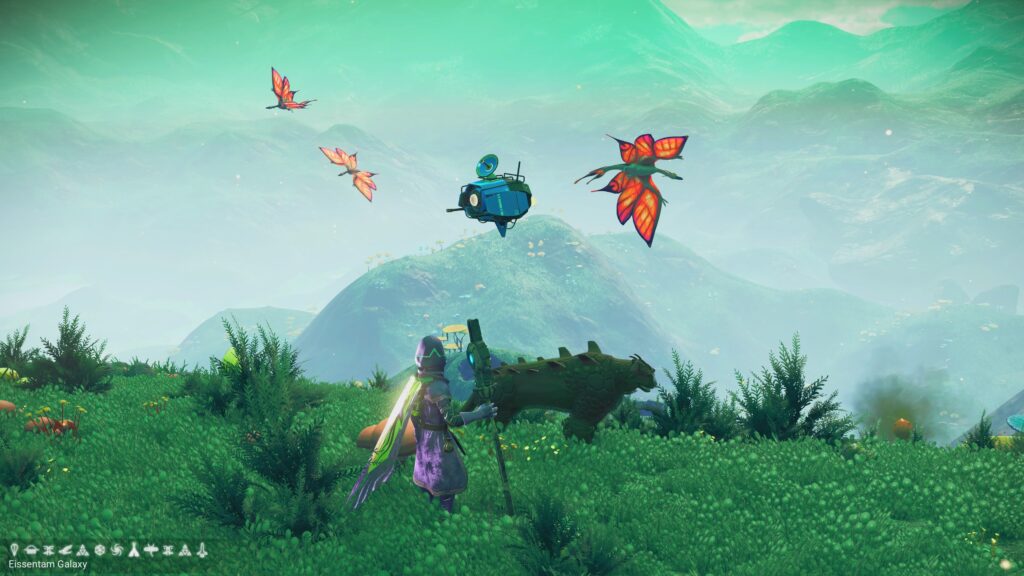
Mining is an important part of the game. Even after years of play, there are times when I need something like ammonia and have to mine for it.What world simulation game is complete without fishing?It looks pretty, doesn’t it? This is one of the many varieties of hostile plants. They’re on every planet, even lifeless ones. You may grow to hate them as much as I do.I haven’t mentioned my favorite thing to do when visiting a planet, which is to scan for new lifeforms. At first, it was because there’s a bonus reward for scanning all the types of fauna on a planet. Now it’s for the fun of “catching them all.” The green pawprints mark members of species I’ve identified (and, perhaps renamed).If you feed the animals, they may let you ride them. If the animal can fly, it can make for a fun screenshot.This location is the Anomaly, which figures heavily in the game’s story. It’s also a place where you’re most likely to see other players, such as Marshal neoawacs3 in the center background. I don’t bother much with multiplayer, but I’ll acknowledge that the few interactions I’ve had have generally been positive.I didn’t play NMS for the trophies. However, at this point I’ve got most of those that I’d care to earn, just by playing normally. These are my Exploration awards.I’ve survived for a long time on planetary surfaces. It’s hard for me to believe that I’ve walked over a million kilometers. (I’d be a lot healthier if I did that in real life.)My standing with all the races and guilds is similarly high. There are still a few medals that I might earn, such as completing missions for the Gek, but I’m not motivated to pursue 100% award completion.In a galaxy with a quadrillion planets, why would you ever want to travel to a new one? Because it’s there.The actual answer to that question is that different galaxies have their own statistical spread of planets created by the procedural generator. For example, the Eissentam galaxy has a greater number of potentially Earth-like planets.
Criticisms
I’ve got two major ones.
Sameness
The breadth of the procedural generation is impressive. However, eventually you become aware of the underlying limits within the range of possibilities.
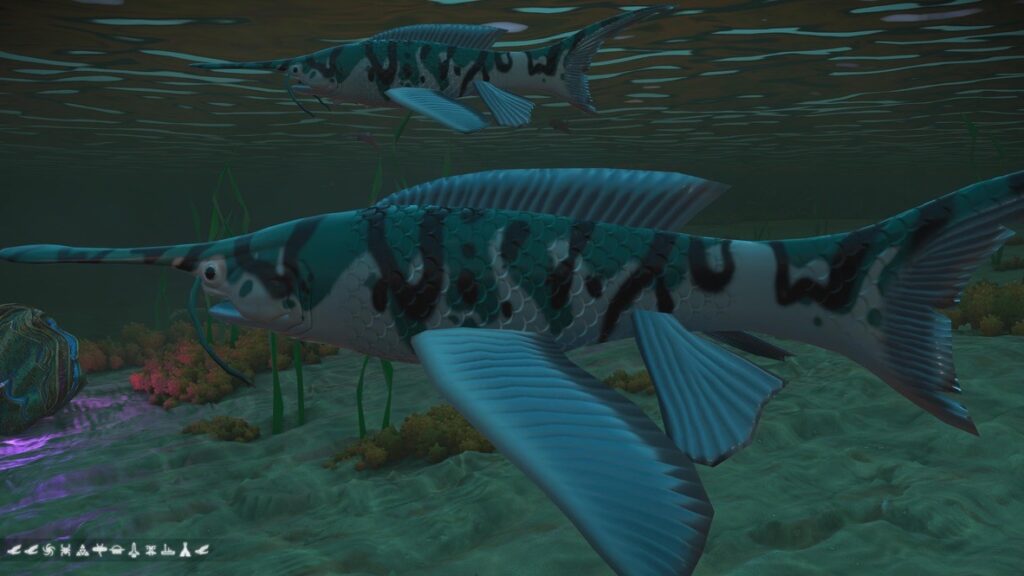
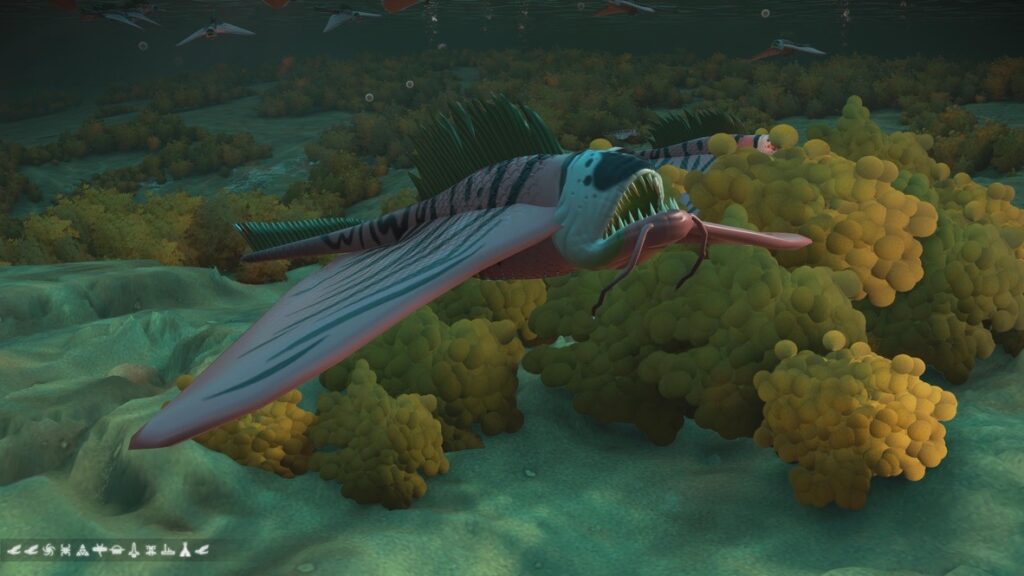
It’s a fish.It’s another fish.
No two animals, plants, minerals, space stations, planets, etc. look exactly the same. However, a fish with different stripes is still a fish… or a dinosaur, or a stilt walker, or an energy being.
To be fair, Hello Games has improved their procedural generation over the years. There’s still new stuff to see. It does become harder to see it.
That’s part of the reason why I play the game for a while, then set it aside. I need some time with Karlach to forget the similarities in the NMS universe.
Web
Since I’ve criticized games like Final Fantasy X and Expedition 33 for this, I should be fair and level the same criticism at No Man’s Sky:
The game basically requires a player to use a web reference, most notably the No Man’s Sky Wiki, to play effectively.
Who is this? How do you meet them? Without the wiki, I wouldn’t have found the answer.
From how to make Cream Fingers, to where to mine Quartzite, to when the next expedition is scheduled: without the wiki, Reddit, and YouTube, one can hit a “wall” and not know what to do next.
I’m more forgiving of this in NMS than I was in those other games because of the kind of game it is. No Man’s Sky is an open-ended exploration game. It’s a sandbox. There’s no “winning” the game. You play for as long as want, maybe take a break and return to it once in a while as I do.
Conclusions
No Man’s Sky has been a tremendous value. I purchased it in 2016. Since then, Hello Games has put in time and effort to address the early defects of the game, and has continued to add new content, all without charging anything more.
Perhaps, one day, I’ll return to a system that I (can you guess?) randomly visited.
There are other open-world space games, such as Starfield. I find that I have no special interest in them, especially after having put so many hours into developing bases, settlements, fleets, etc., in the Euclid Galaxy.
Where else can I find the Dead Planet Gorgonzola?
It’s a big universe. There’s a teeny piece of it that has my name on it.
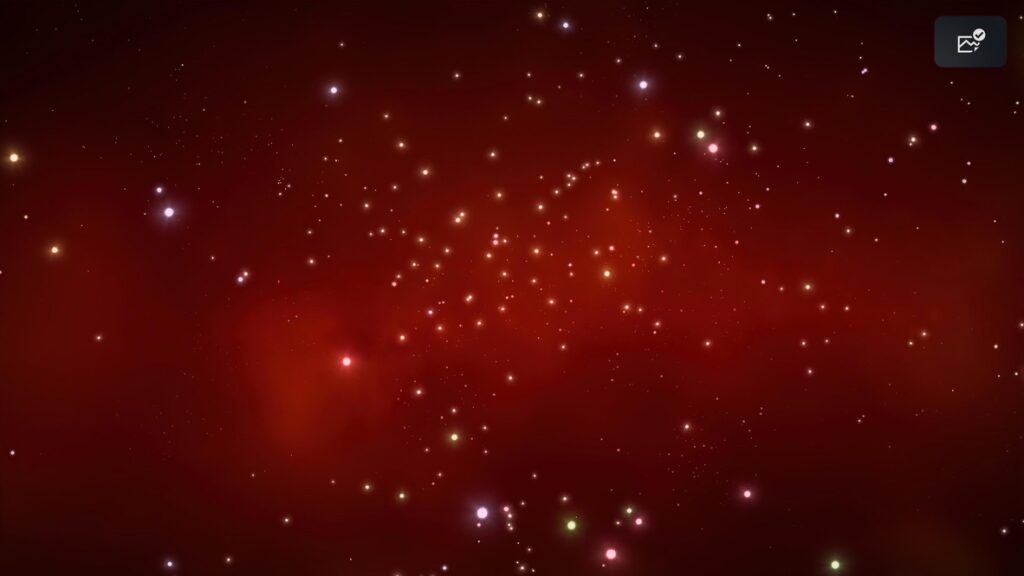
Maybe one of these stars is mine. Probably not, but maybe…