M, J, A, and I had a relatively short game night. That’s because we played two relatively short games relatively quickly (at least for us).
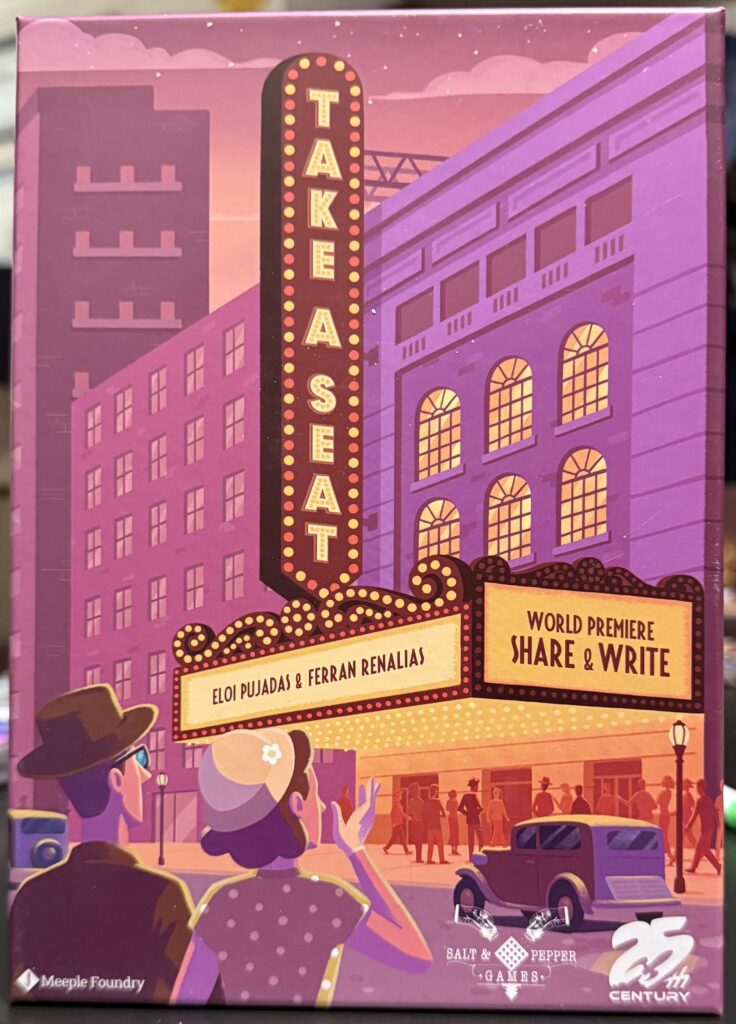
The first game was Take A Seat. Instead of being a “roll and write” game, this is a “share and write” game. It involves writing on dry-erase boards.
Unfortunately, I completely forgot to take any pictures of the game materials until after the game was over and I erased what we’d written on the boards. I can show you pictures of the components, but not our game play.
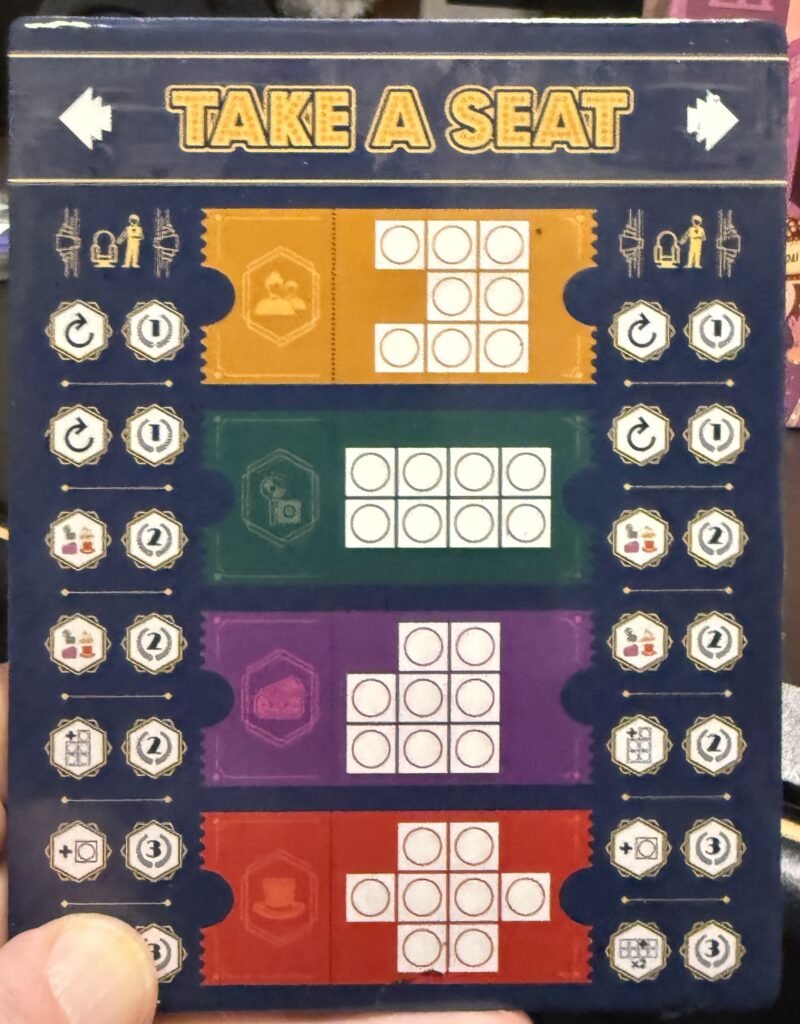
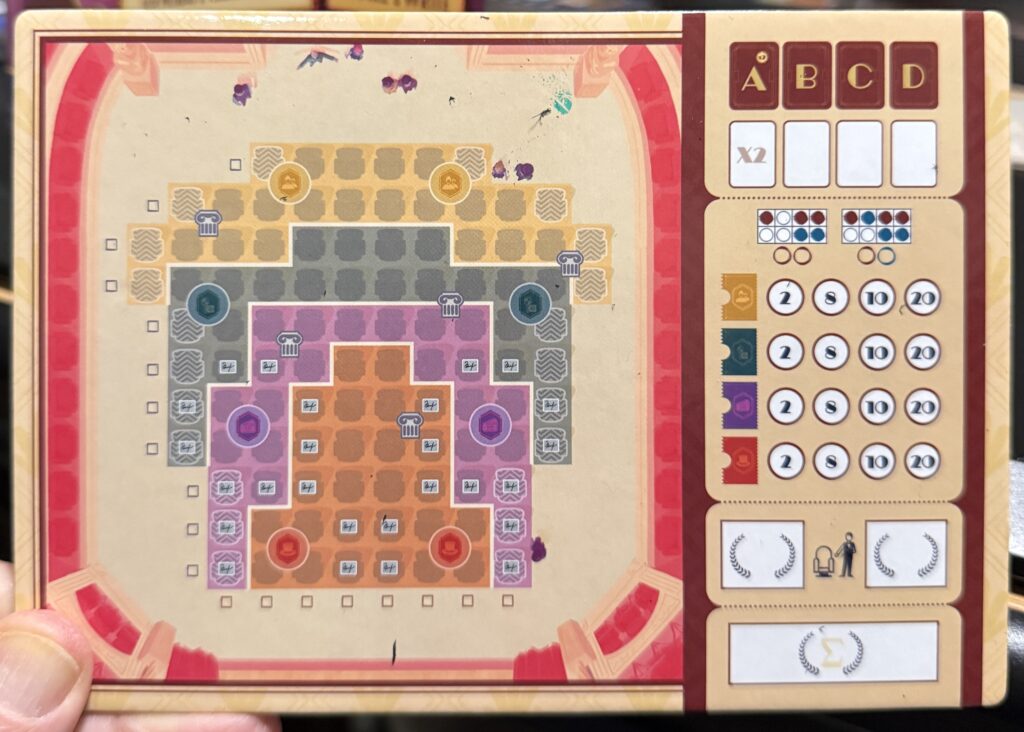
What makes Take A Seat a “share and write” is that there are boards that are shared between players, though not cooperatively as in Between Two Cities.One of the boards that’s between each pair of players. The tickets reflect the pattern of placing patrons in seats. Every round a player reduces the pattern by one seat, so the patterns for the tickets changes during the game. The columns of icons are modifiers for the placements. Every round a player alternates between marking icons and tickets on the board to their right and left.A player’s individual theater board. The player fills in seats according to the pattern on the tickets in the shared board in the previous picture. Scoring is based on randomly-selected goals (the A, B, C, D you see in the upper right); I forgot to take a picture of these. A typical goal might be “fill in all the red seats.”
J won the game. Of course, having forgotten everything else, I didn’t take a picture of his board for my usual “Behold the card of the winner” photo I usually include in this blog series.
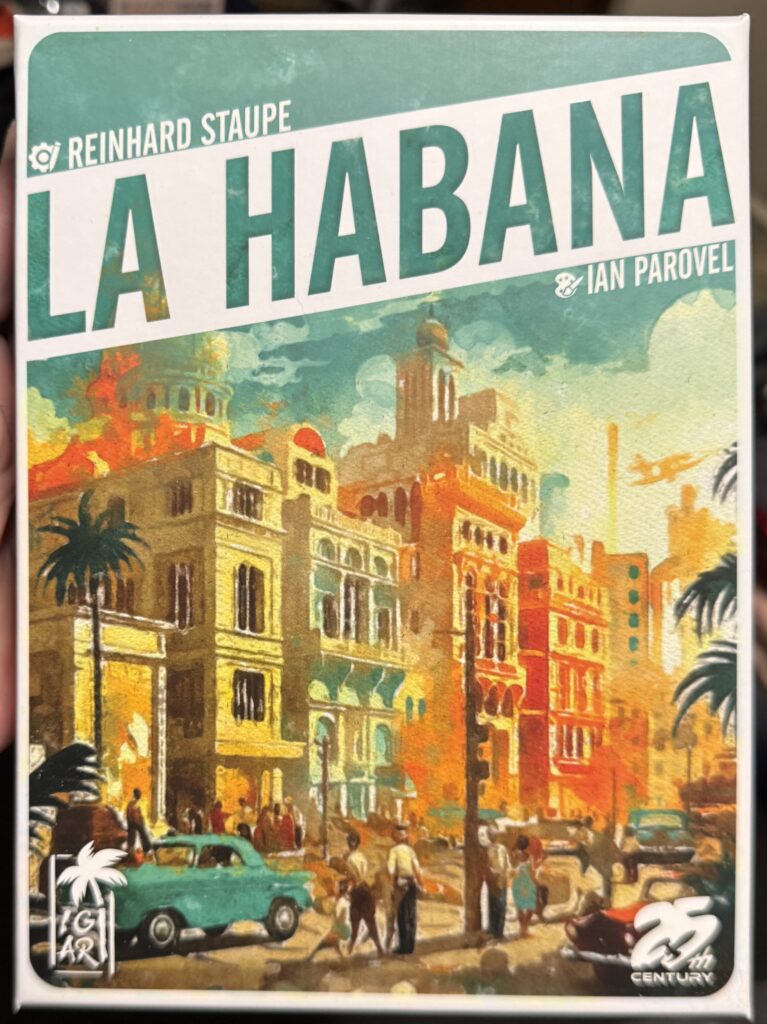
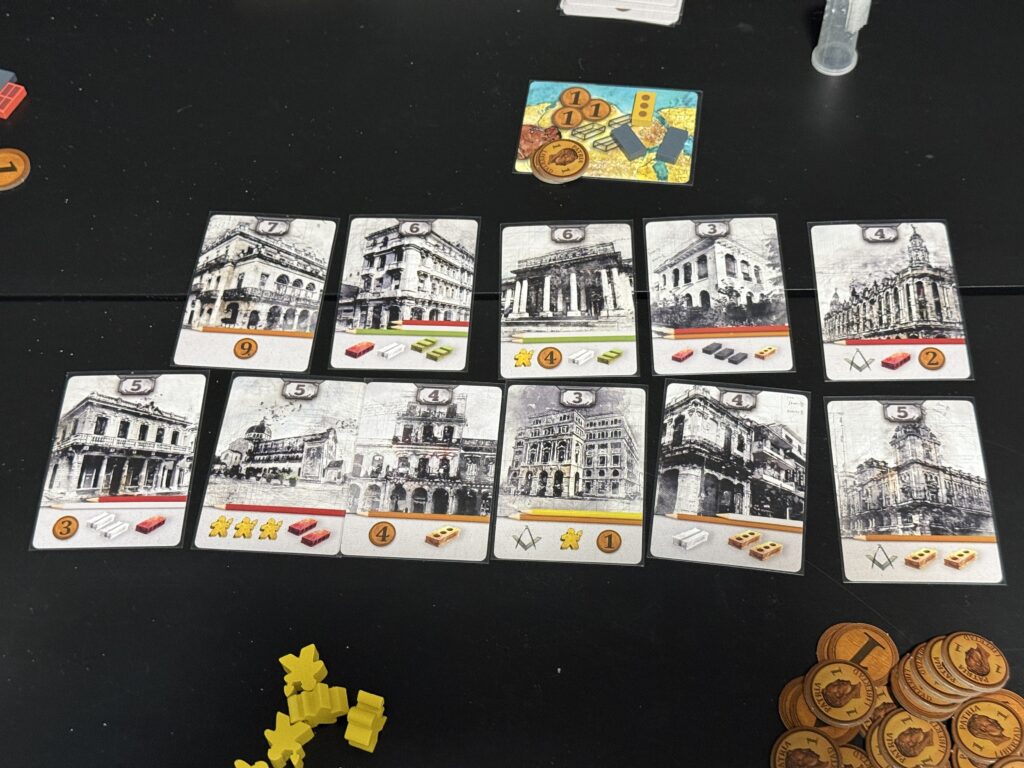
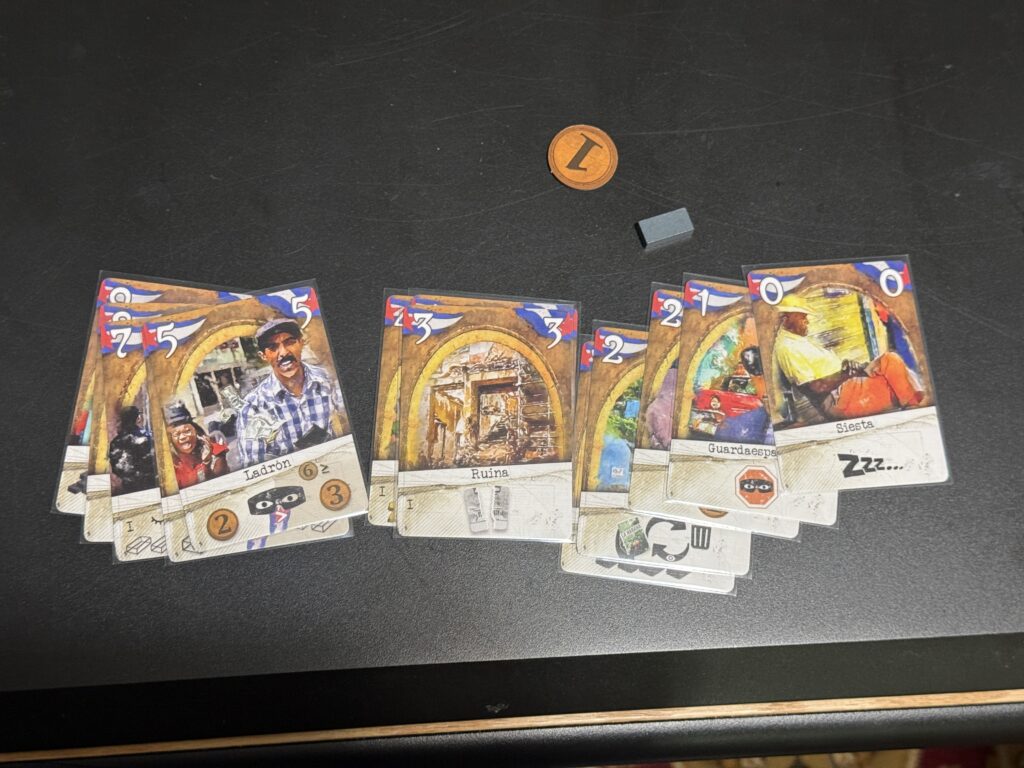
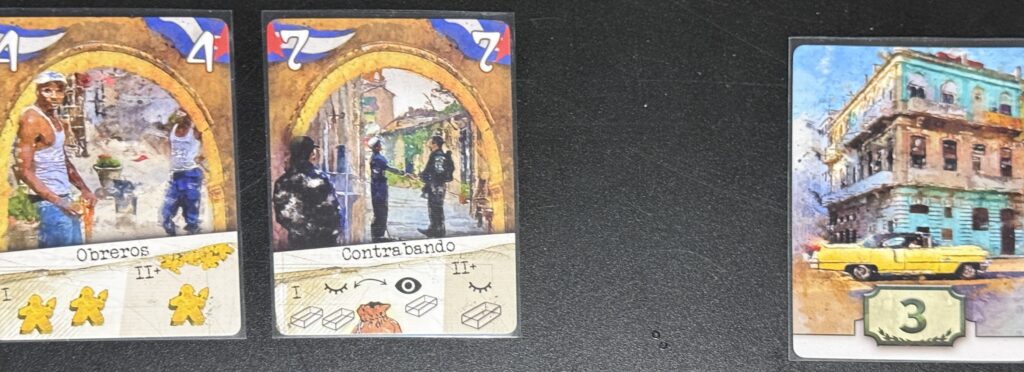
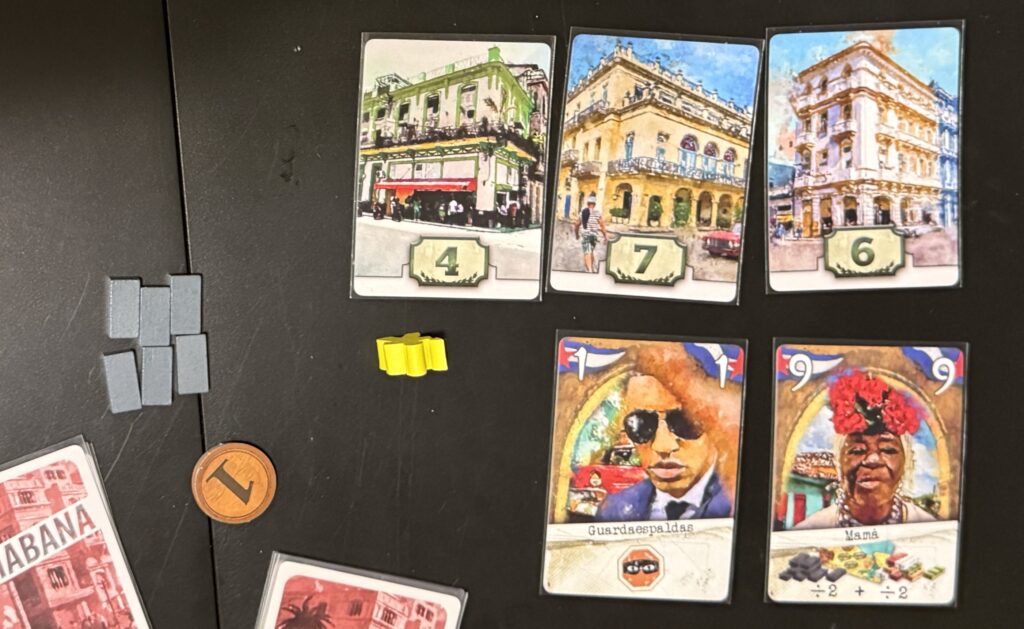
In La Habana, players compete to construct buildings in the early days of Havana, Cuba.Players earn points by purchasing building cards with the materials listed on the card. Only cards at the ends of the two rows can be purchased. The first player to reach 15 points wins.To gain materials, you play cards from your hand. Each player starts out with the same deck of cards. The numbers on the cards represent “initiative”; for example, if you play a 2 and a 7, that’s an initiative of 27, so you’ll go before a player who put down a 4 and a 6 for 46.When it’s your turn within a round, you can use the ability on your cards in either order. Here, the Obreros card will give me two workers if I played Obreros before any other player with the same card; otherwise I’d get only one worker. Similarly, playing Contrabando means that if I’m the first player using that card in a round, I get a choice of picking two bricks randomly from a bag or examining that bag and taking a brick of a specific color; otherwise I just pick one brick at random. On the right, you can see that I’ve managed to build one building worth 3 points.Behold the play area of the winner, A. He figured out the “rhythm” of the game and made it work to his advantage. (As an aside, the Guardsespaldas card prevents another player’s “thief” cards from stealing from you. Someone kept playing thief cards repeatedly. That “someone” was me. It turned out to be a bad strategy.)
I enjoyed Take A Seat more than I did La Habana. I like playing with the colors and patterns in the former, and (unlike A) I couldn’t figure out a strategy in the latter.