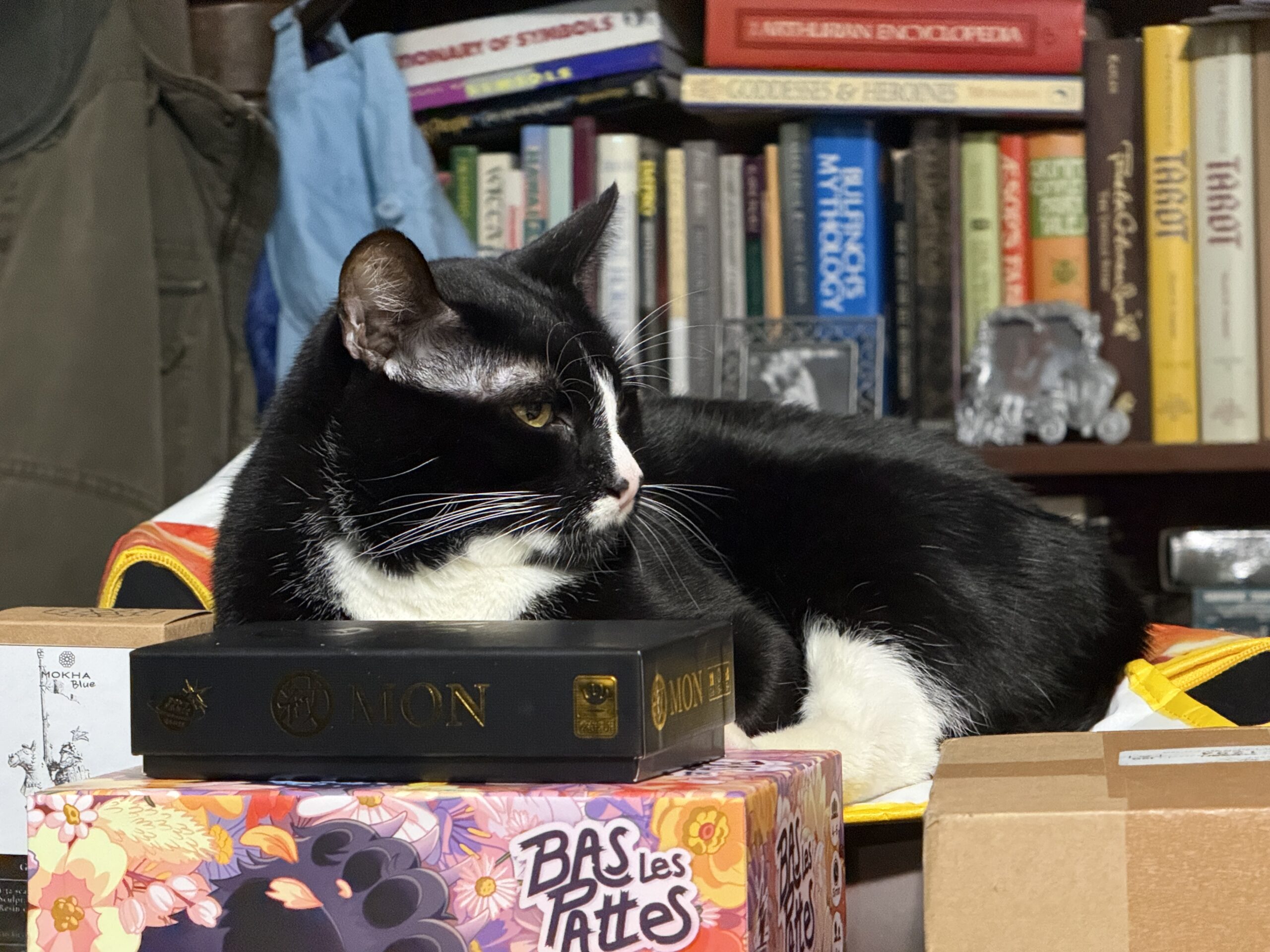
Normally Andrew, John, Maria, and I game on Friday nights, with an occasional Saturday. Due to a rare set of scheduling issues, this time we met on a Sunday evening.
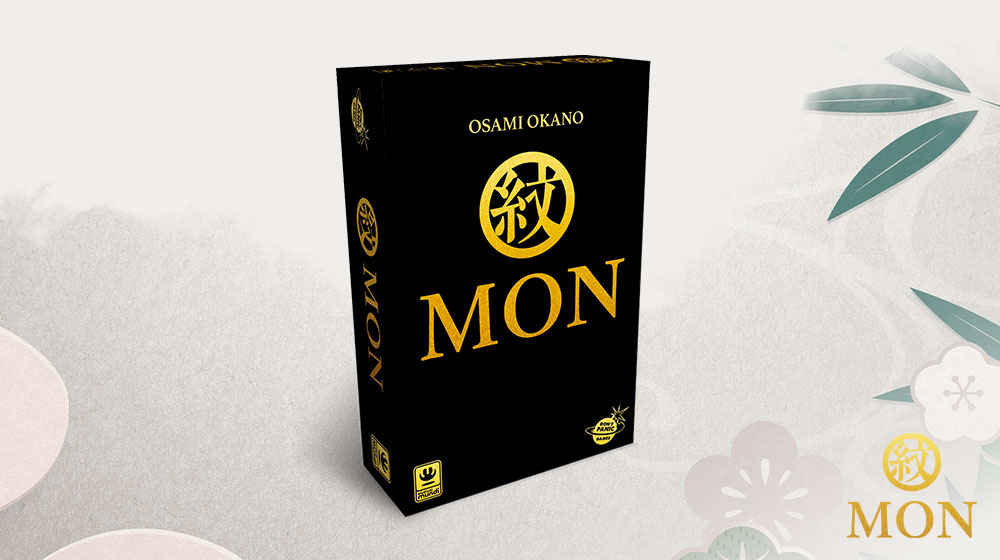
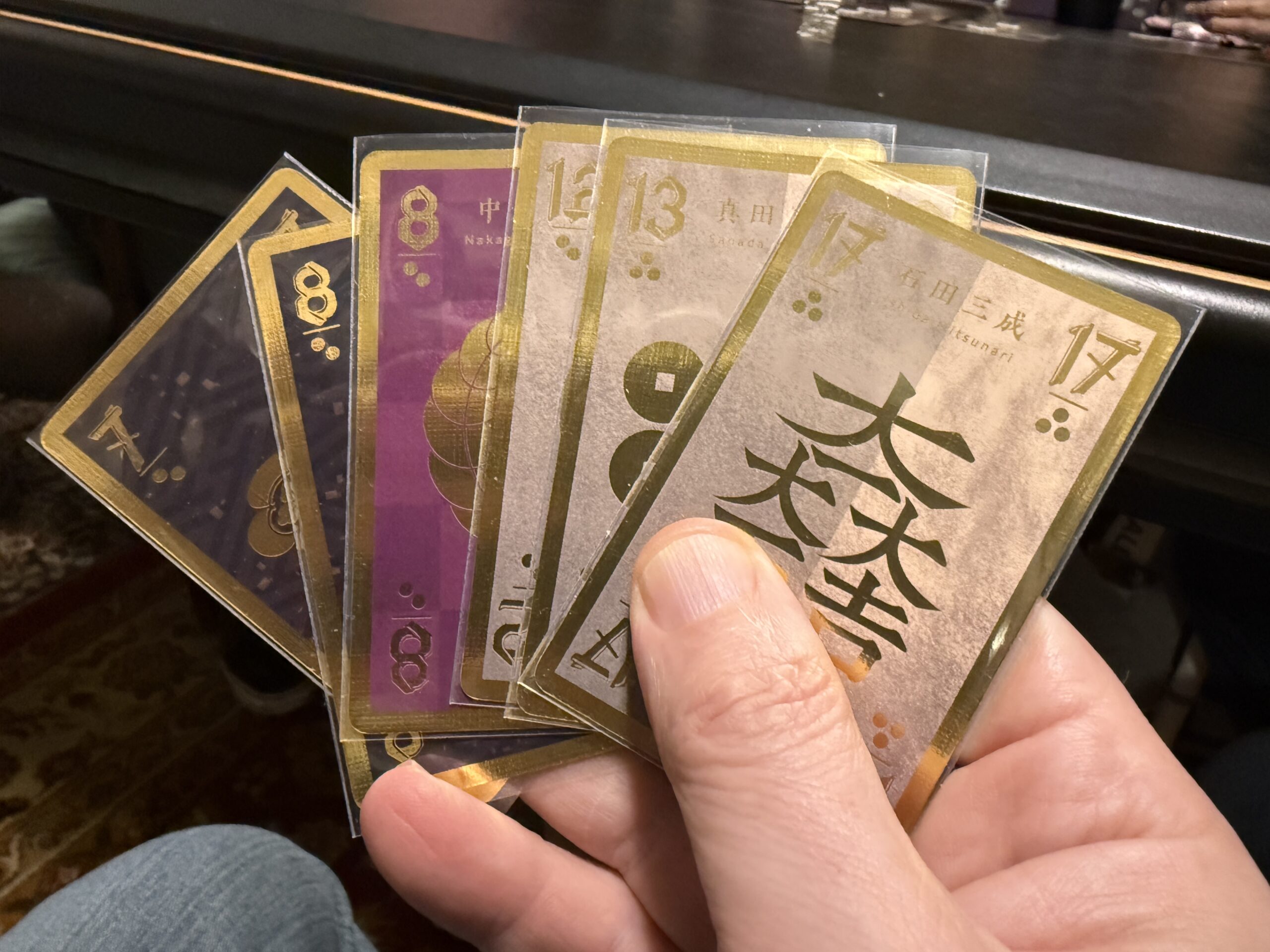
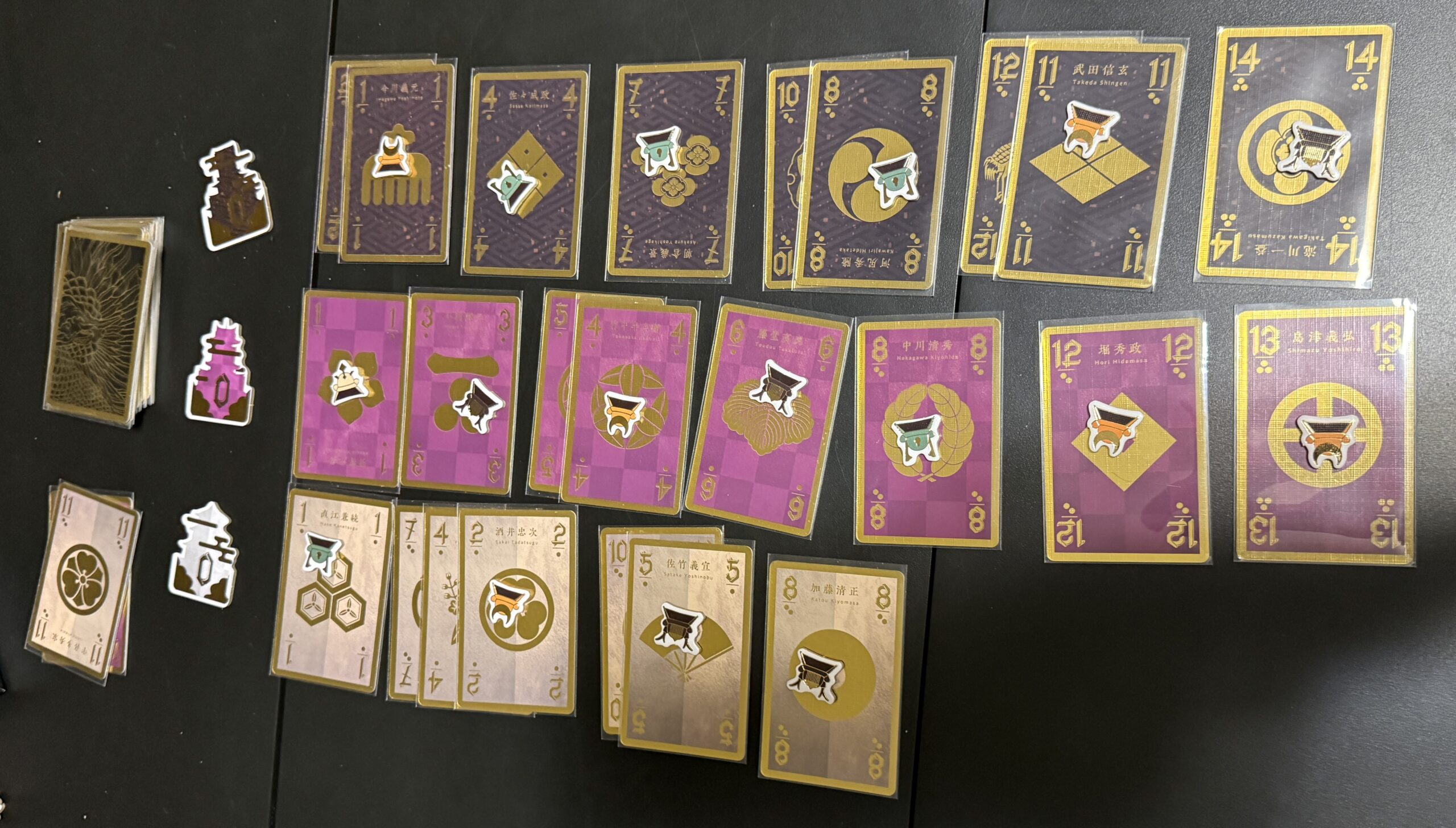
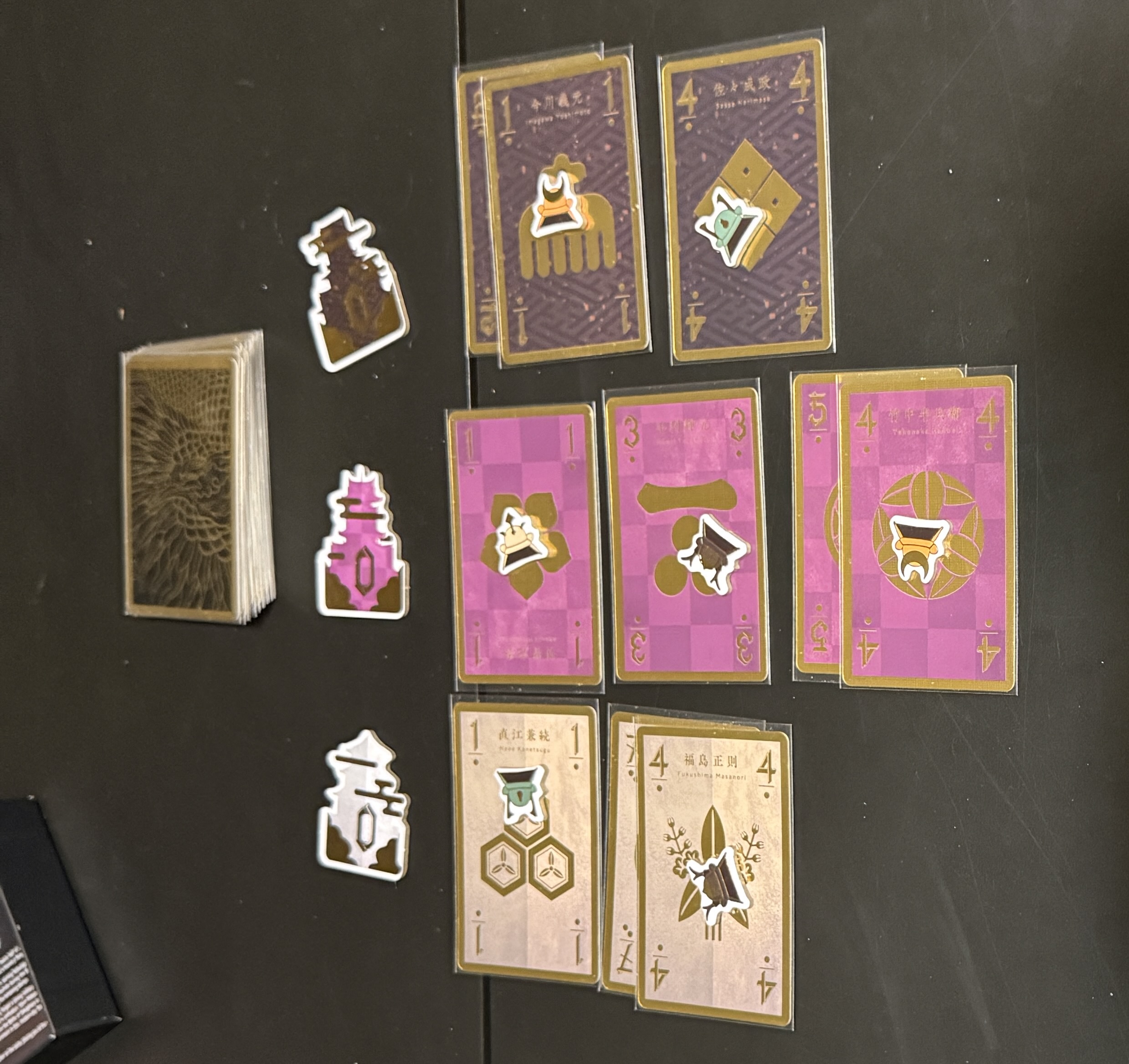
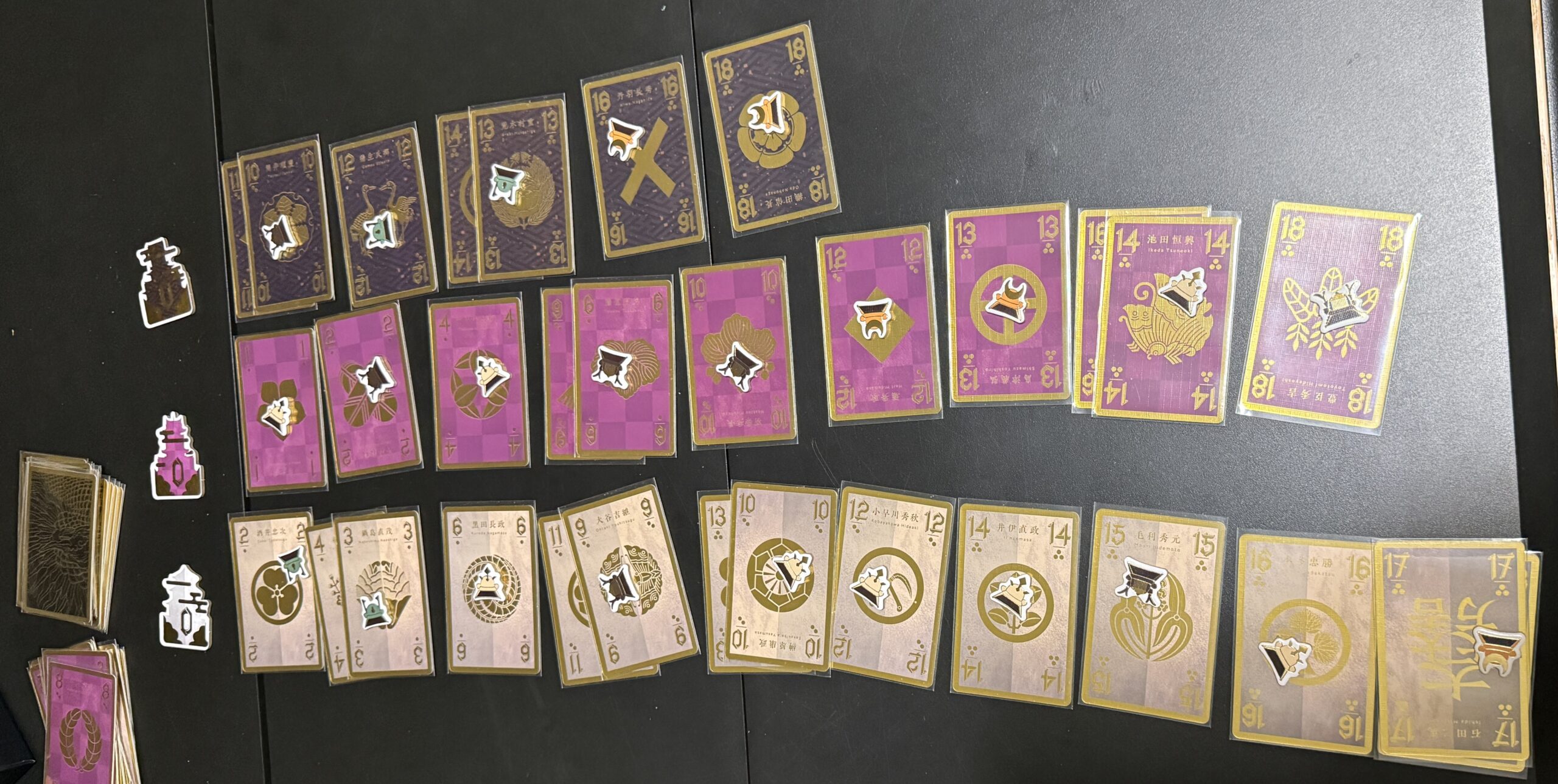
MON: Emblems of Sengoku is a game of Japanese design published by a French game company. Normally I use my own picture of the box cover for this series of articles, but the picture I took was so out-of-focus that I copied this image from the publisher’s web site.Mon is a fast game of card layout. The deck has three suits, each going from 1 to 18. It’s hard to make out in this photo due to light reflecting off the card sleeves (not included), but each card has the name of a historical Samurai on it.When it’s your turn, can do one of three things. Focus on the right end of the middle line of pink cards for a moment. You can put down a card of higher value than the previous card on the line (there’s a virtual “zero” at the head of the line). You place your token on the card. If nothing happens to the card, at the end you’ll score as many points as dots underneath the card’s number. In this particular example, Yellow (Maria) will score two points for having her marker on the pink 12 card. Will she score another three points for having a marker on the 13? Maybe…The second action you can take is called a “retreat”, and it’s the most common maneuver. The retreat rule is that if you can place a card that’s not greater than the card at the end of the line, but is greater than the card that came before it, you can place your card on the end card, displacing its token, and put your card and token on top of the new card. In the pink row, you can see that Maria placed her 4 on top of the 5, because the card just before that 5 card was a 3.Are you having trouble understanding that? Shuba did too.The Mon deck has 54 cards. Each player starts with nine cards, so only part of the deck is distributed at the beginning of the game. This leads to the remaining action: You can discard some number of cards, and get one fewer from the deck. This is for when you’ve got no cards that can be placed. This happened to both Andrew and me a couple of times. This is a photo of the end of the second game. Green (me) scored only seven points.
We played two games of Mon within about an hour, which is amazingly fast for us. Maria won the first game, John the second.
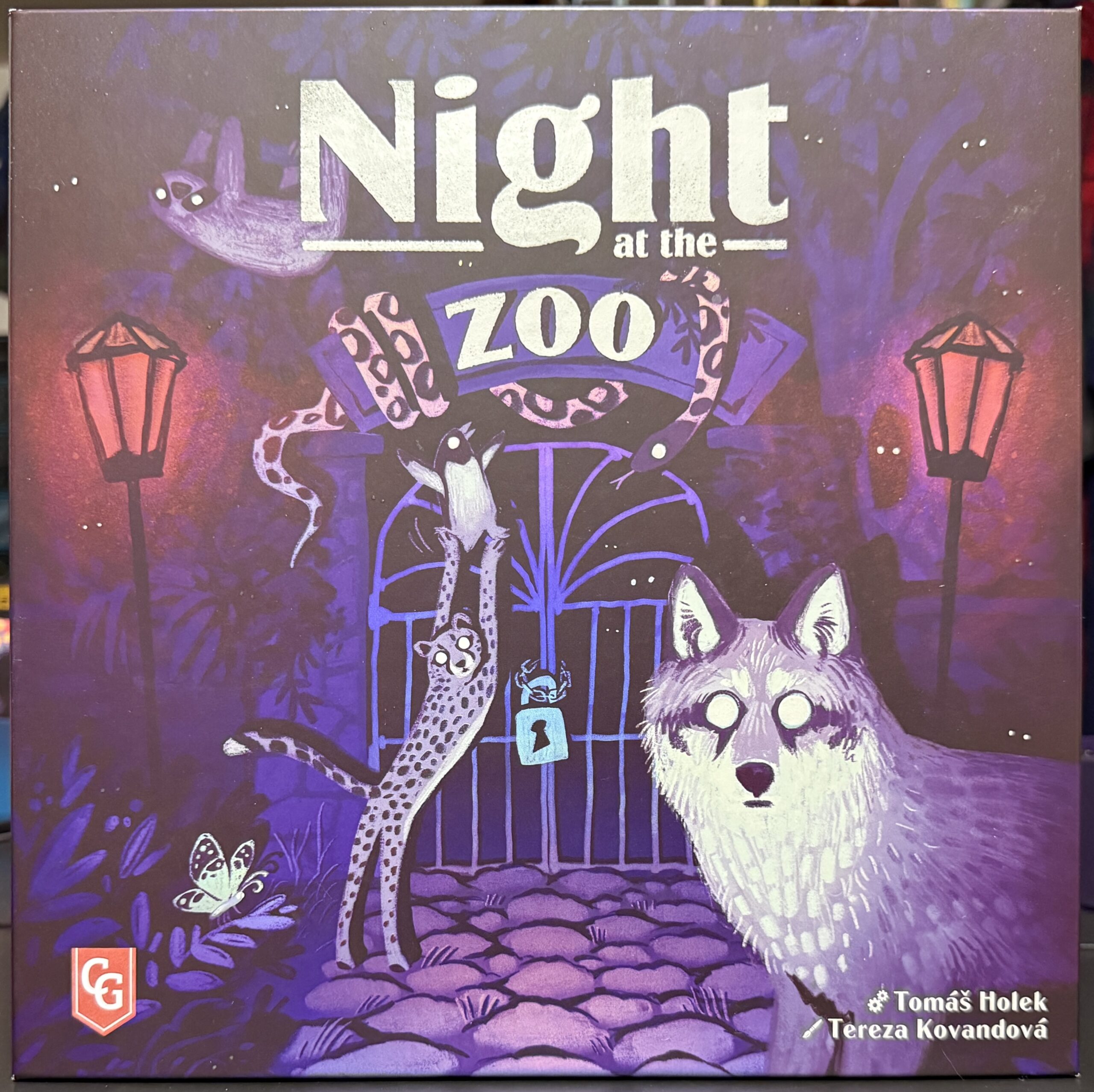
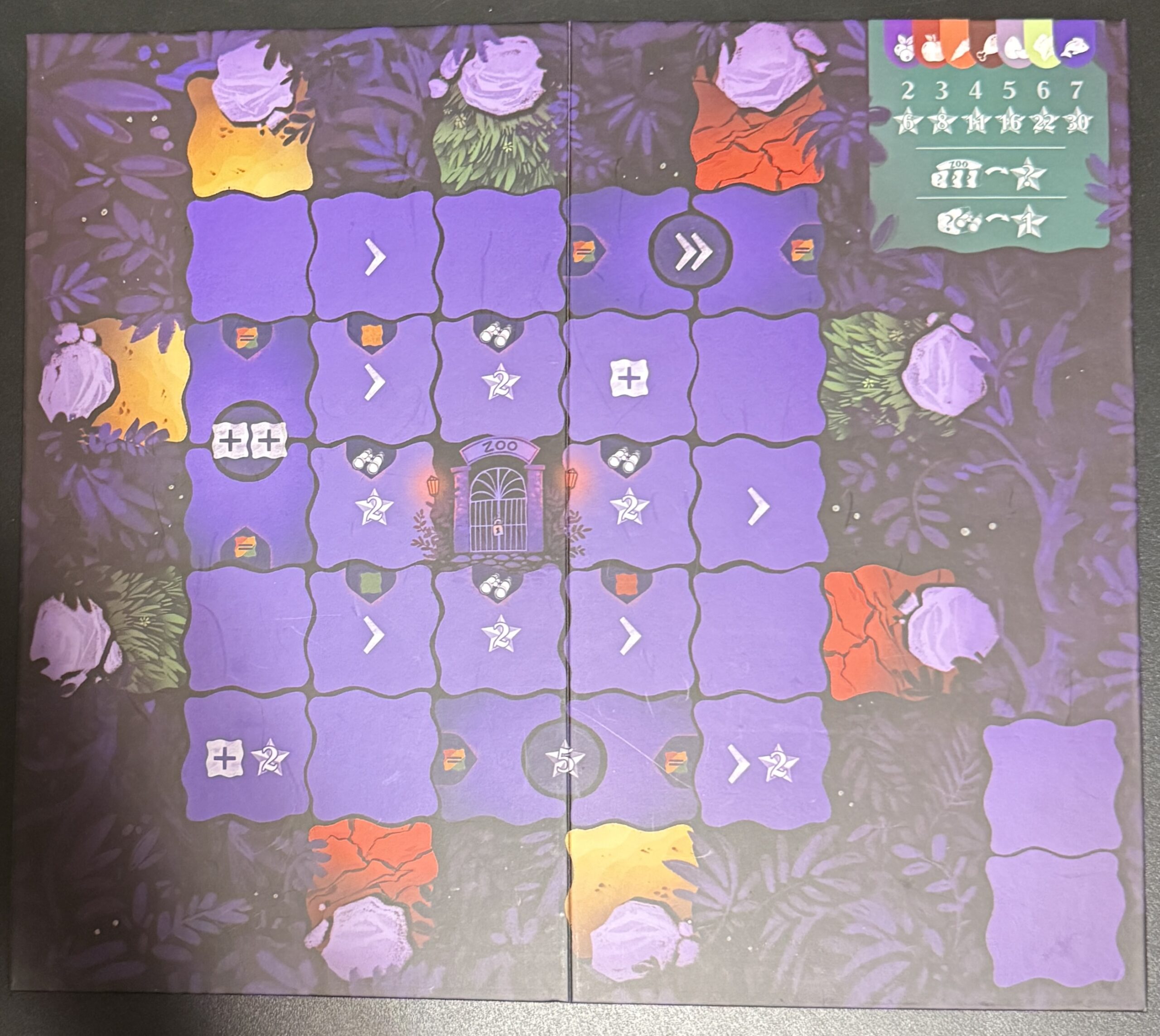
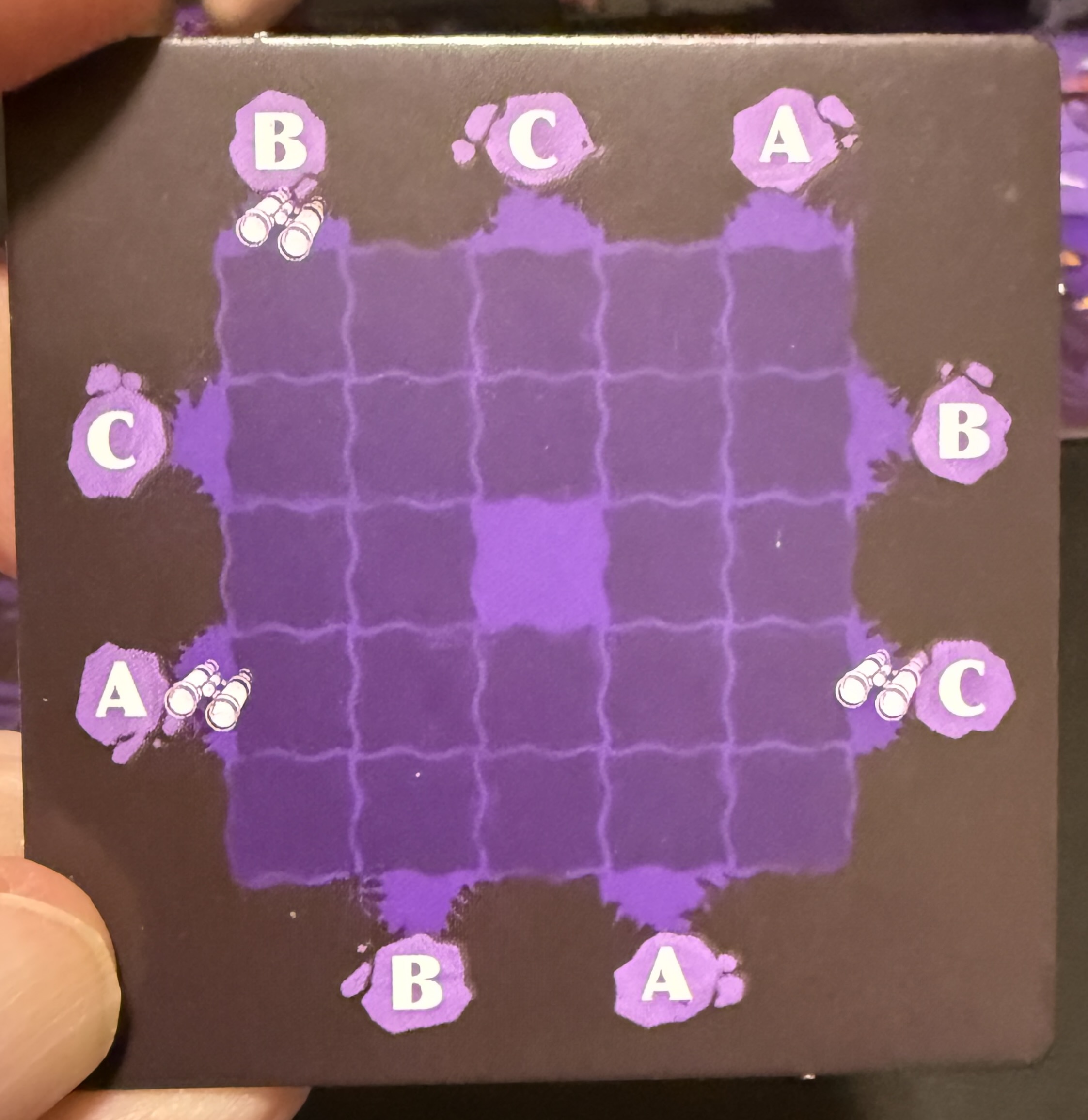
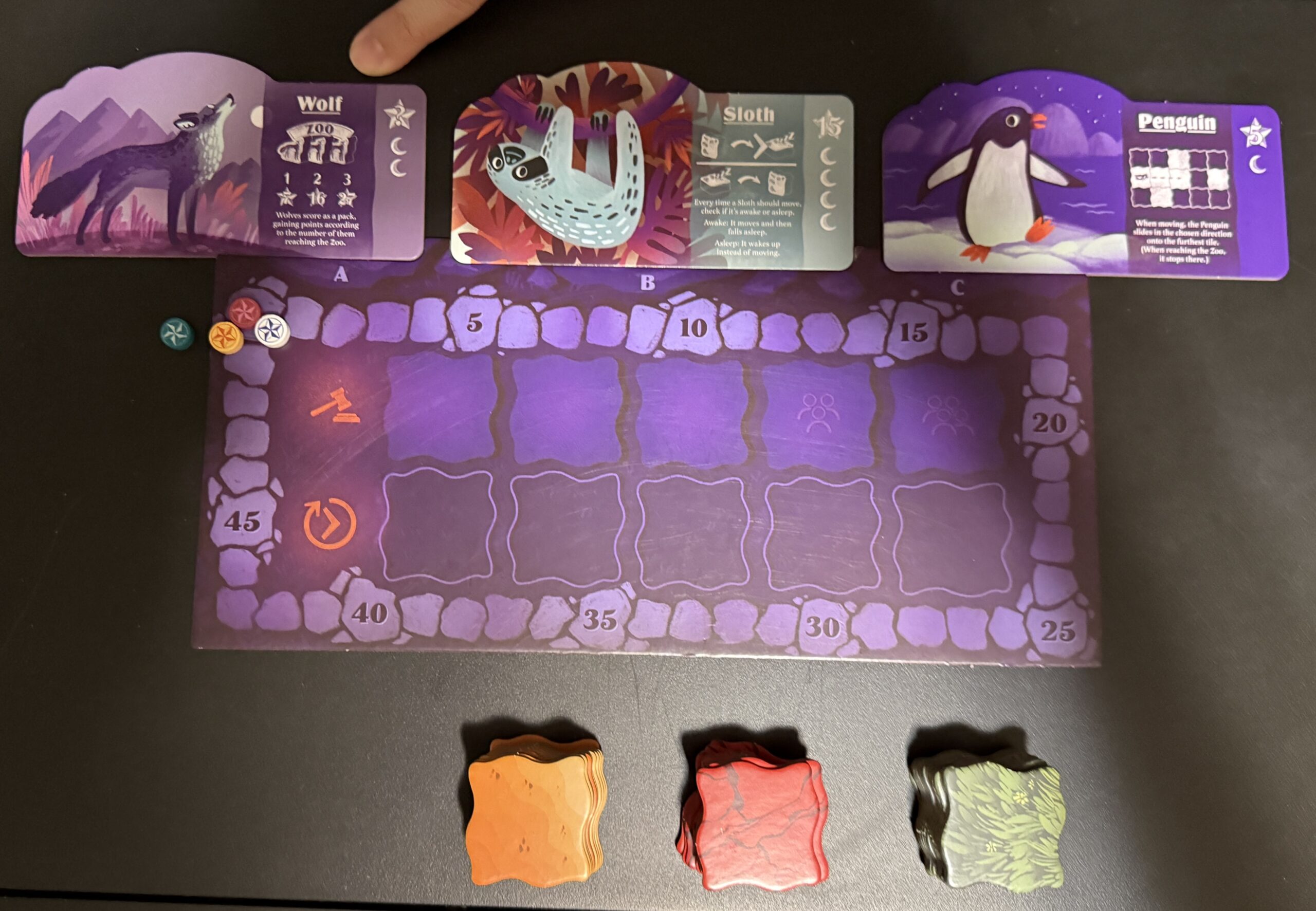
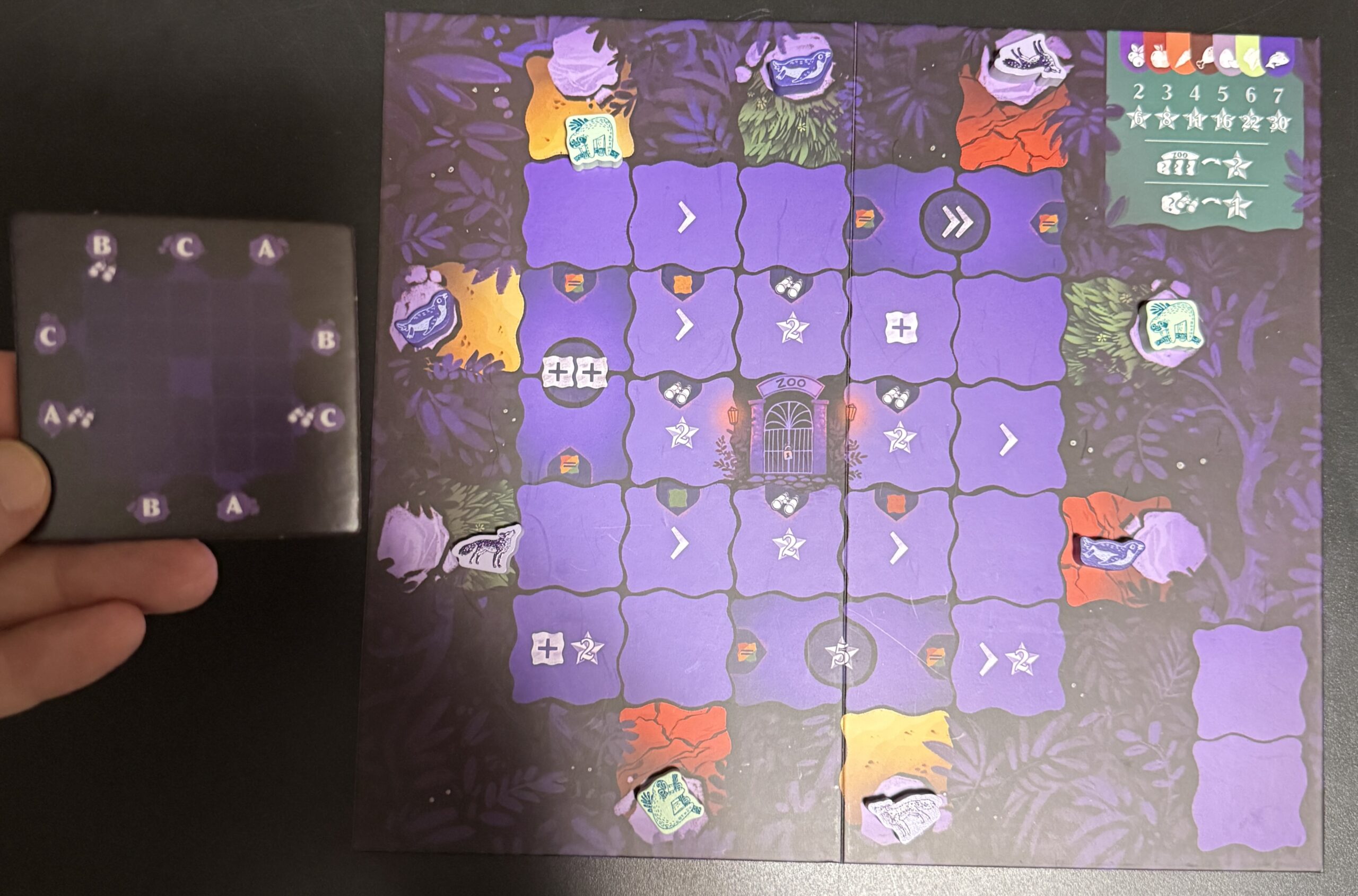
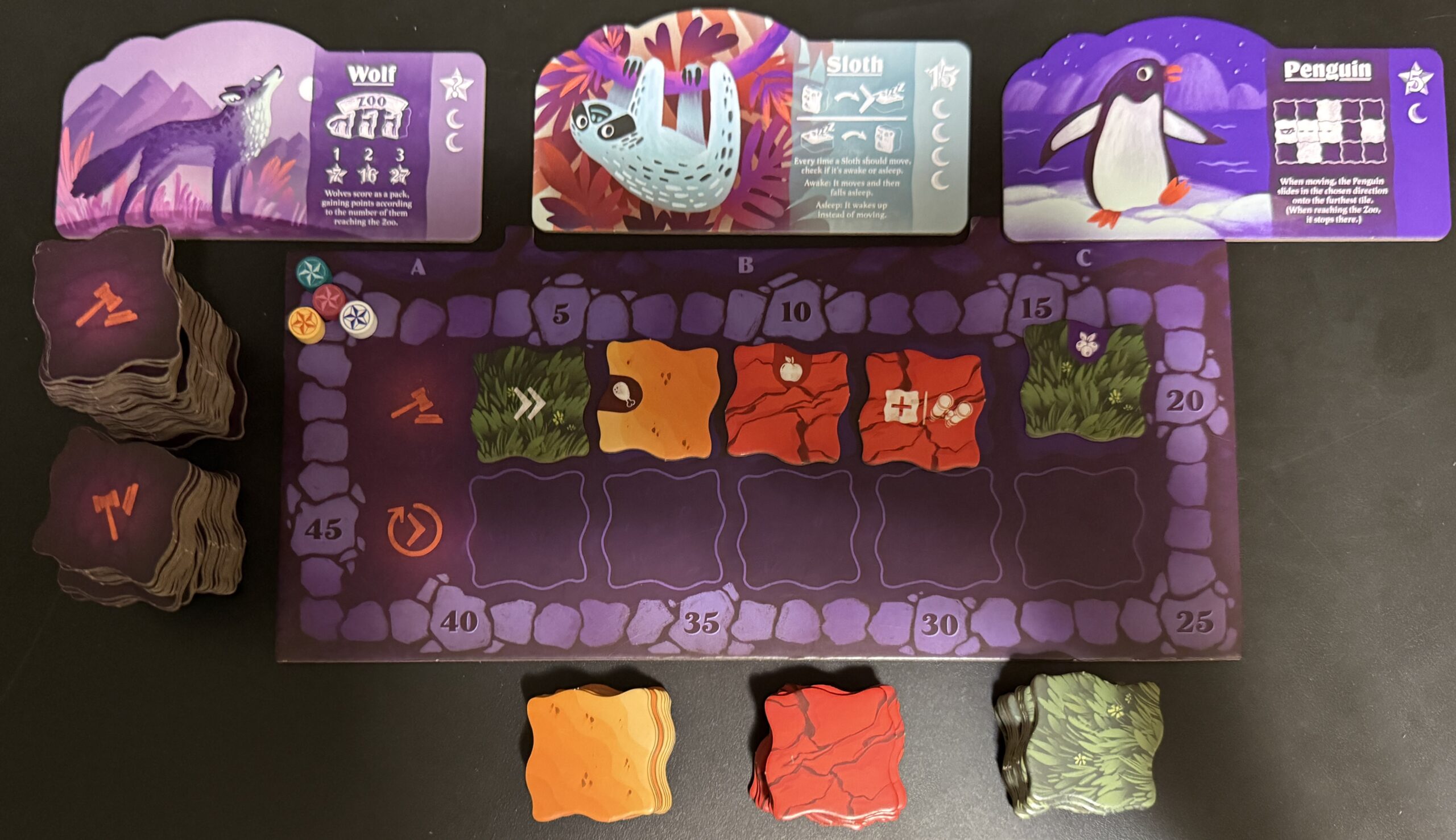
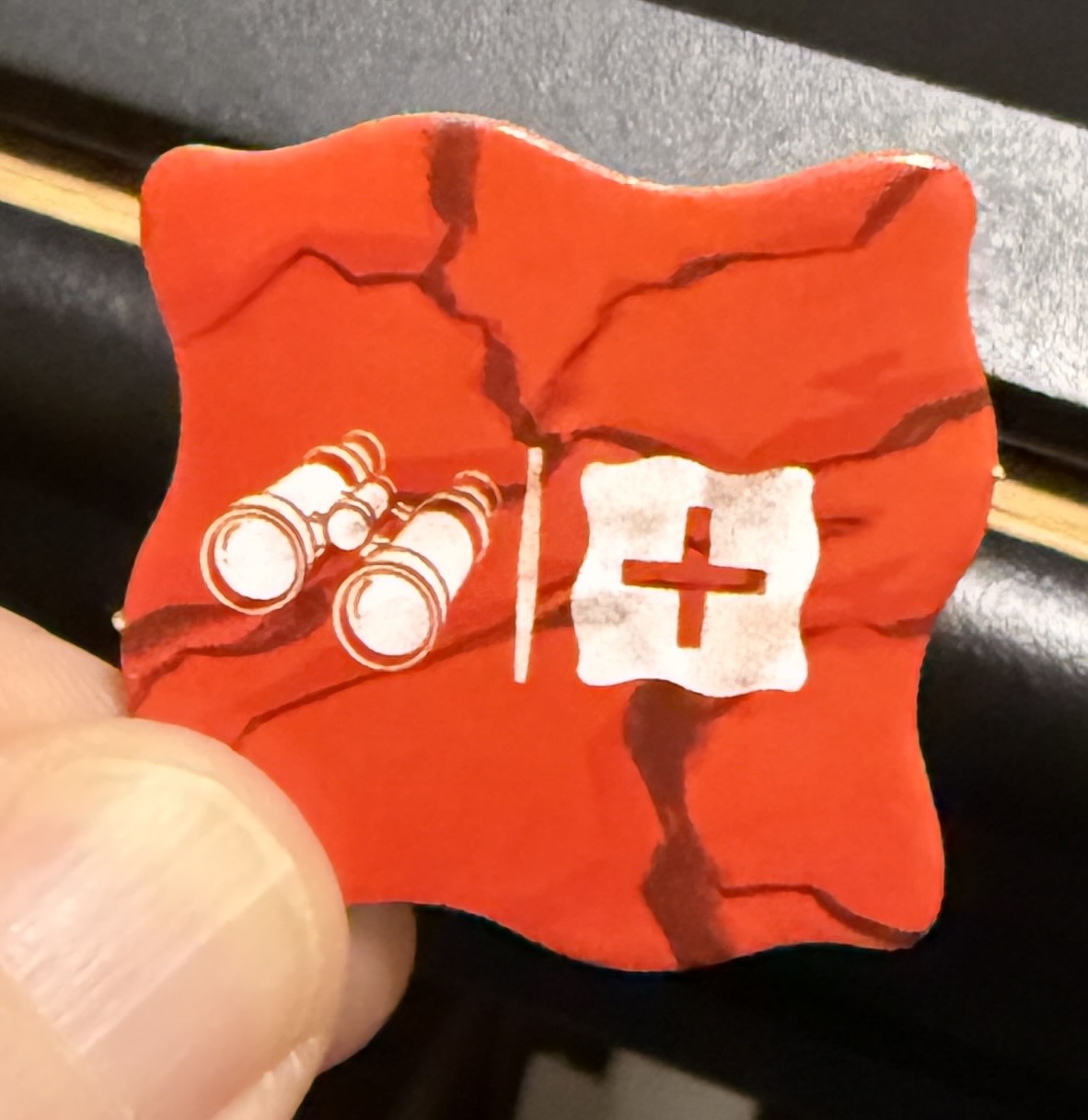
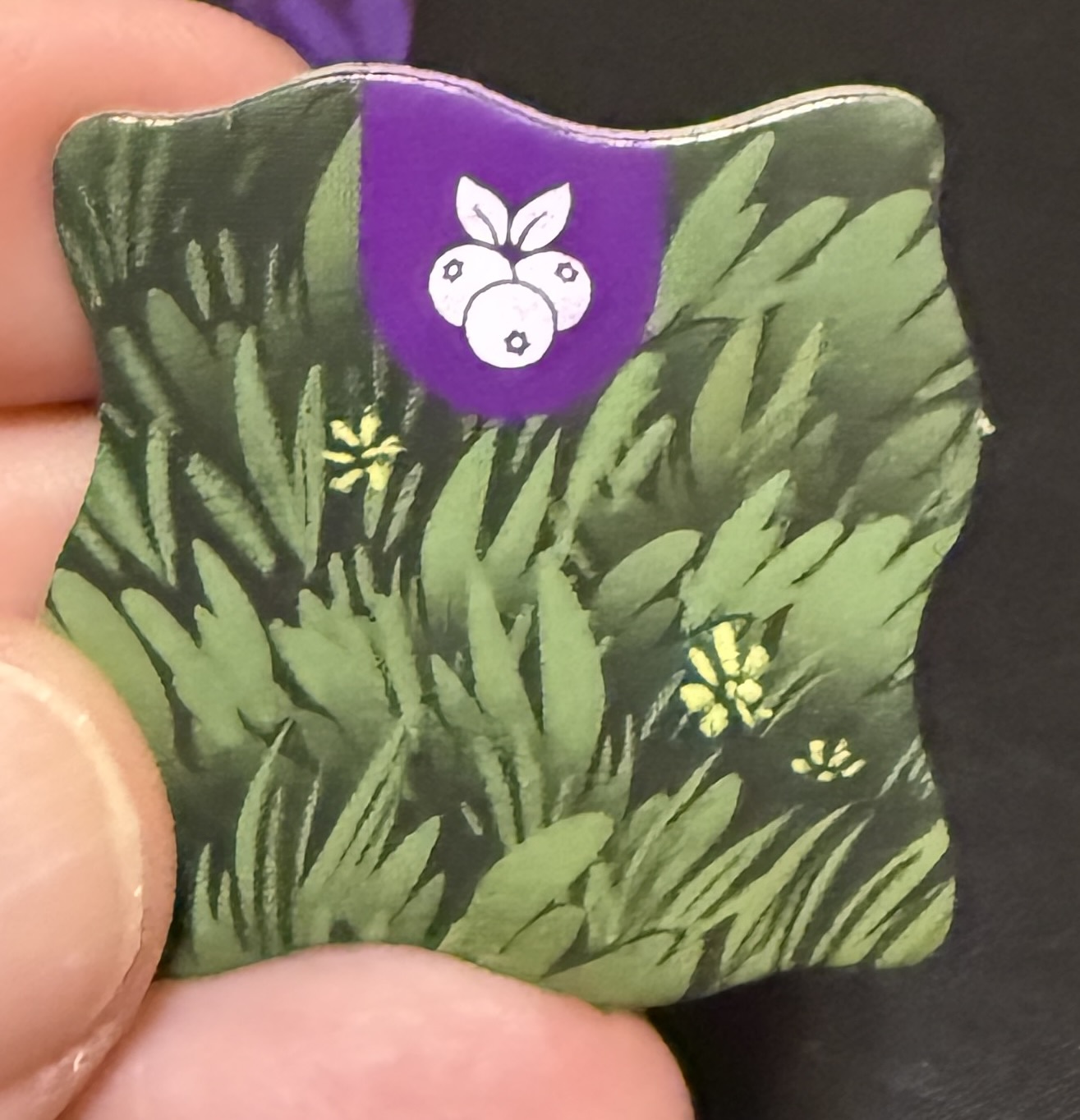
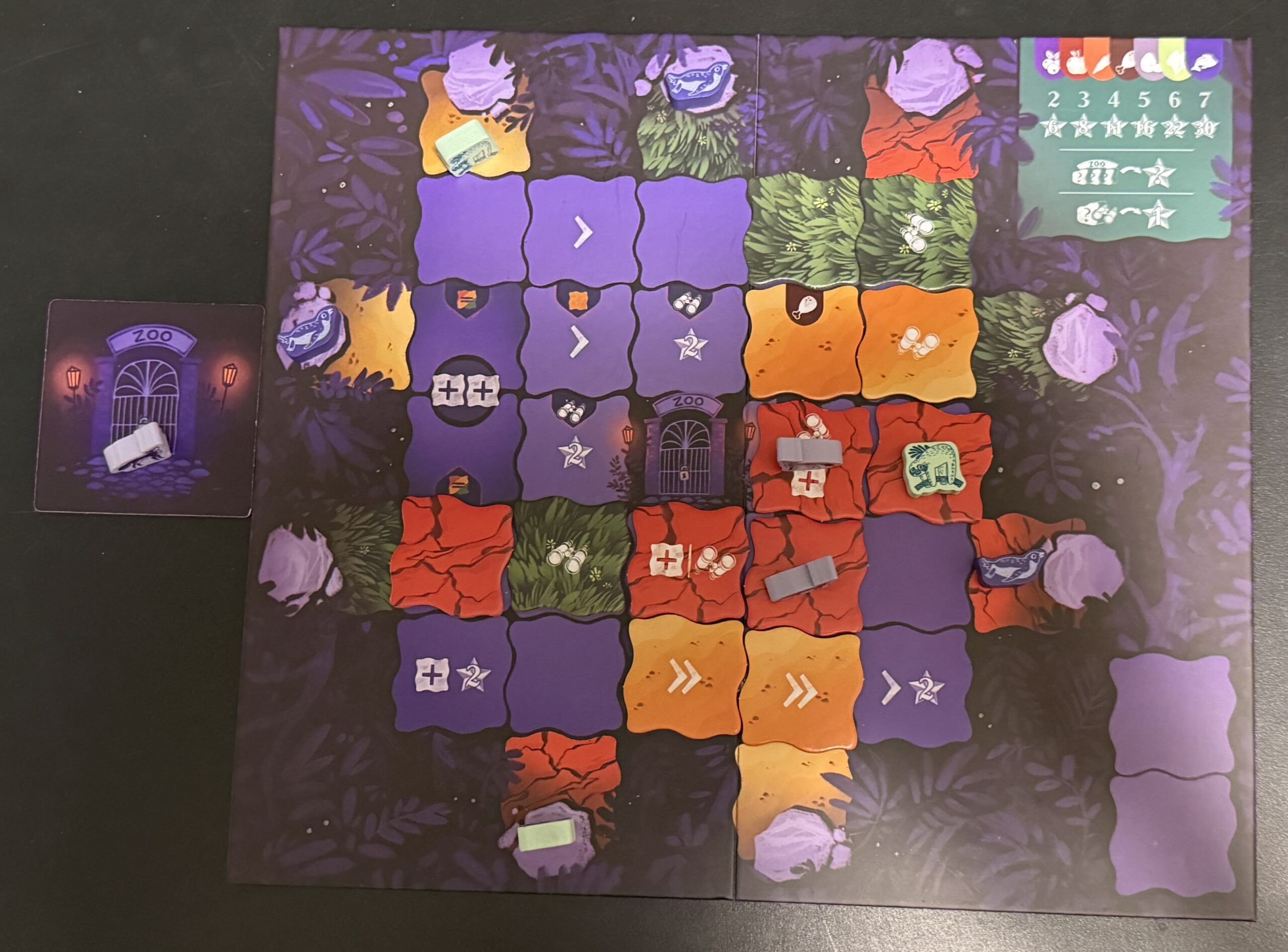
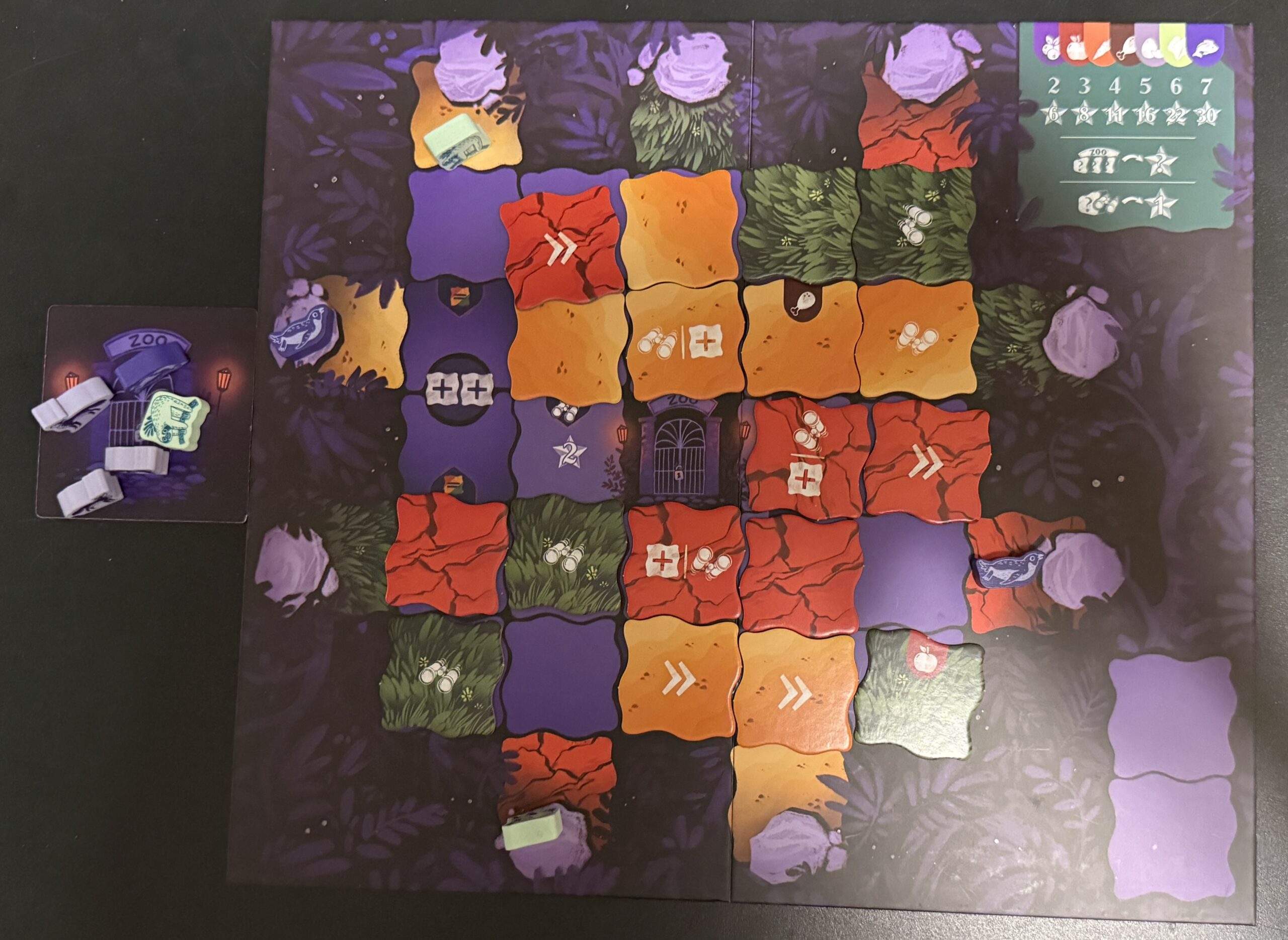
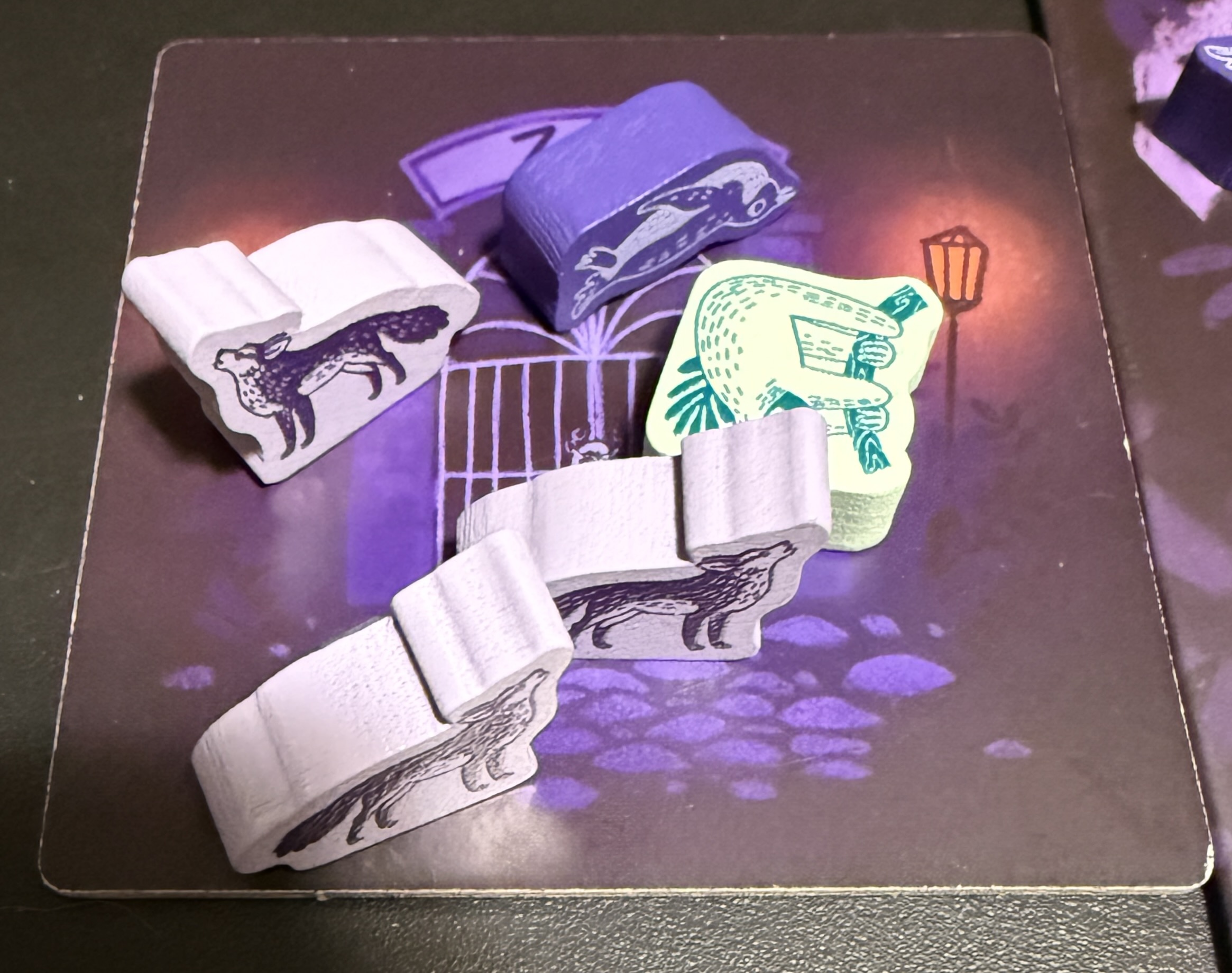
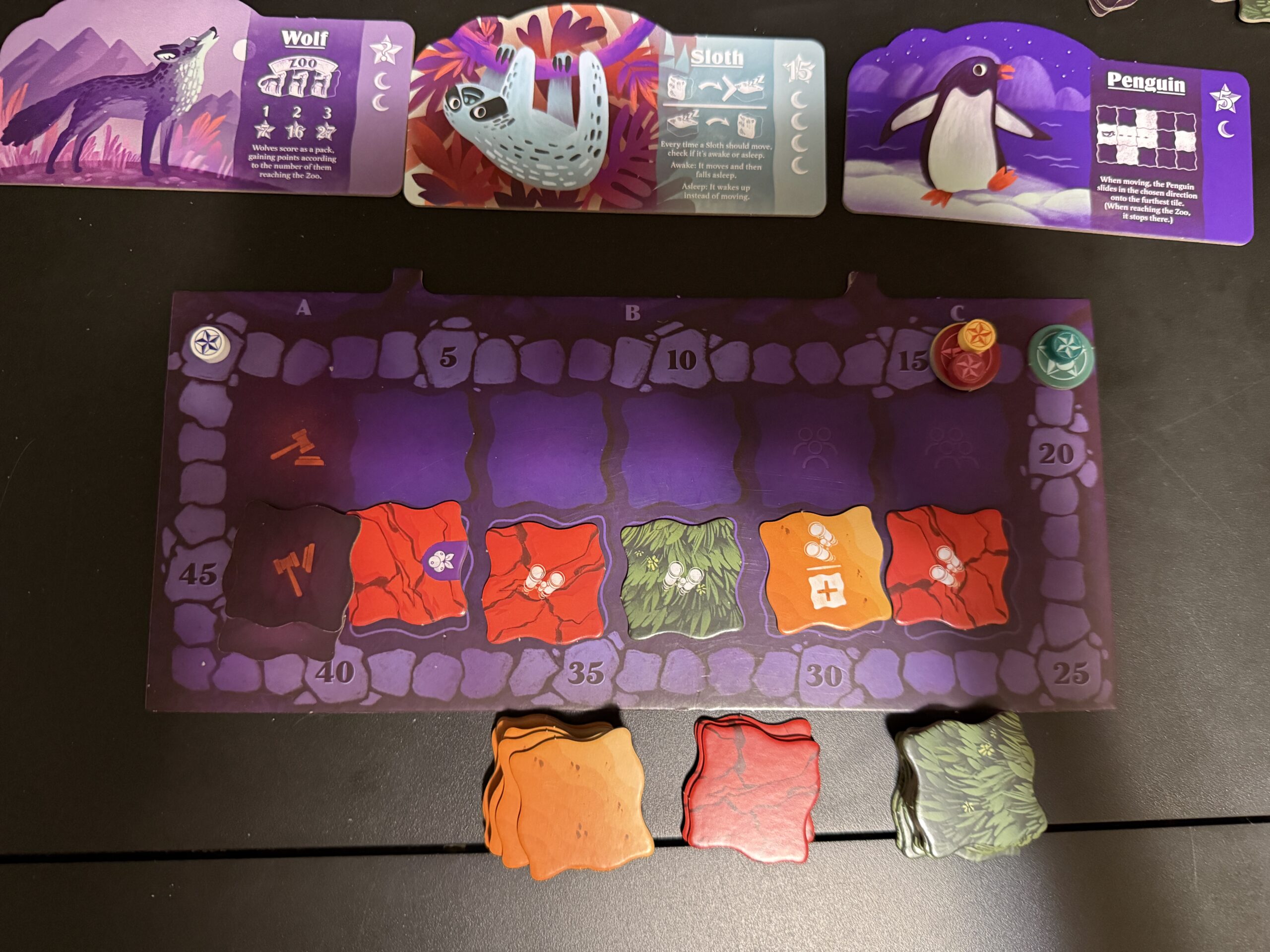
Our next game was Night at the Zoo. The theme is that you’re helping animals sneak back into the zoo.Each player starts with their own board. The boards are different, with game-play elements in different locations. In the upper right you can seeing the scoring for having tiles with icons with different kinds of food, though I don’t think any of us pursued a specific “food strategy.”We also each got our own set-up card, telling us the starting locations for A, B, and C animals. What were those animals?Here we see the animals for this particular game. A is a wolf; they move one tile at a time. B is a sloth, which moves one tile at a time… every other turn, since they keep falling asleep. C is a penguin; when they move, they slide until they reach the last tile in that direction.Here we see my starting board with the animals set up. An animal on a rock cannot move until they’re spotted; that’s the meaning of the binoculars icon. For example, in my case, the “A” on the lower left of my set-up card has that icon, so the wolf in that location on the board has left the rock. However, at the moment, they can’t move anywhere because there’s no tile for them to move onto.You get tiles for your board through drafting them from this central board. When you draft a tile, you get the effects of the icon on the tile, plus the effect of the location on your board where you place it. For example, if I picked the green tile all the way on the left, the effect of that double chevron was that I could move my animal(s) twice.No stupid tile was going to get Shuba to move.Here’s an example of a different tile. When I placed it, I could choose to either move another animal off a rock (binoculars) or I could choose to place another tile from a pool of blank tiles.If I placed this tile, I would (a) get the food icon for end-game scoring, and (b) make a new space on my board available for animals to move onto. Or, when you pick up a tile, you can choose to discard it; the causes all the animals on your board who are on that color of tile to move.Here is my board state at roughly the half-way point of the game. I’ve received the benefits of those tiles I’ve placed, and opened a path for my animals. On the left, you can see that I managed to move a wolf onto the central square of the board, meaning I’ve rescued them and placed them on the Zoo tile. I’ve got two more wolves and a sloth on the move; maybe they’ll be rescued.My board at the end of the game. I managed to get two animals off their rocks (sloth at top left, penguin at bottom right) but no way to get them to the central space. Any such “spotted but not rescued animals” are worth one victory point at the end of the game.The animals I managed to guide home: three wolves (worth 27 points, as it says on the animal card in an earlier photo; one sloth (15 points), and one penguin (5 points). I also gained points through covering certain spaces on my player board, the ones ones with stars on them which you can see in an earlier photo.The winner of the game was Green (me) with 68 points. For a moment it looked like I was tied with John (red) and Maria (yellow). Then I noticed that I had moved two animals off their rocks, for two more points.
Night at the Zoo was fun as well. There were moment of “analysis paralysis,” but the game lends itself to one player placing their tile and adjusting for the results at the same time the next player decides which tile to draft. The game moved at a reasonably brisk pace, and we finished in a couple of hours.
This was the first time we met in a few weeks… and it looks like it will be a couple more weeks before all four of us can meet again. Mon and Night at the Zoo were good choices to play during a lull in our regular gaming sessions.